Best Automatic Card Shufflers of 2026

Game night has a rhythm, and it dies the moment somebody has to shuffle. Cards skid off the table, corners get creased, and the one friend who insists on riffling the deck hands back a bowed, half-revealed mess. An automatic shuffler fixes that specific annoyance: it swallows the deck, mixes it properly in a few seconds, and returns a clean stack that nobody can accuse of being stacked.

I host enough card nights to be picky about this. Over the last six months, my team and I put 10 automatic shufflers through real games — weekly poker, family rummy, a few brutal rounds of Uno — and the divide was obvious. A machine either feeds cards smoothly or it jams three hands into a tournament, and the ones that only behave with a stiff new deck aren't much of a shuffler. Battery versus rechargeable ended up mattering more than the spec sheets suggest, too. The picks below all survived a table full of people who don't handle cards gently.

1

Best Overall

ADZERD Automatic Shuffler

91 /100
Lab Score Outstanding

Key details

Power
USB-C, 1200mAh
Claimed Noise
65 dB
Deck Capacity
1-2 decks
Shuffle Modes
Auto and semi-auto
View on Amazon

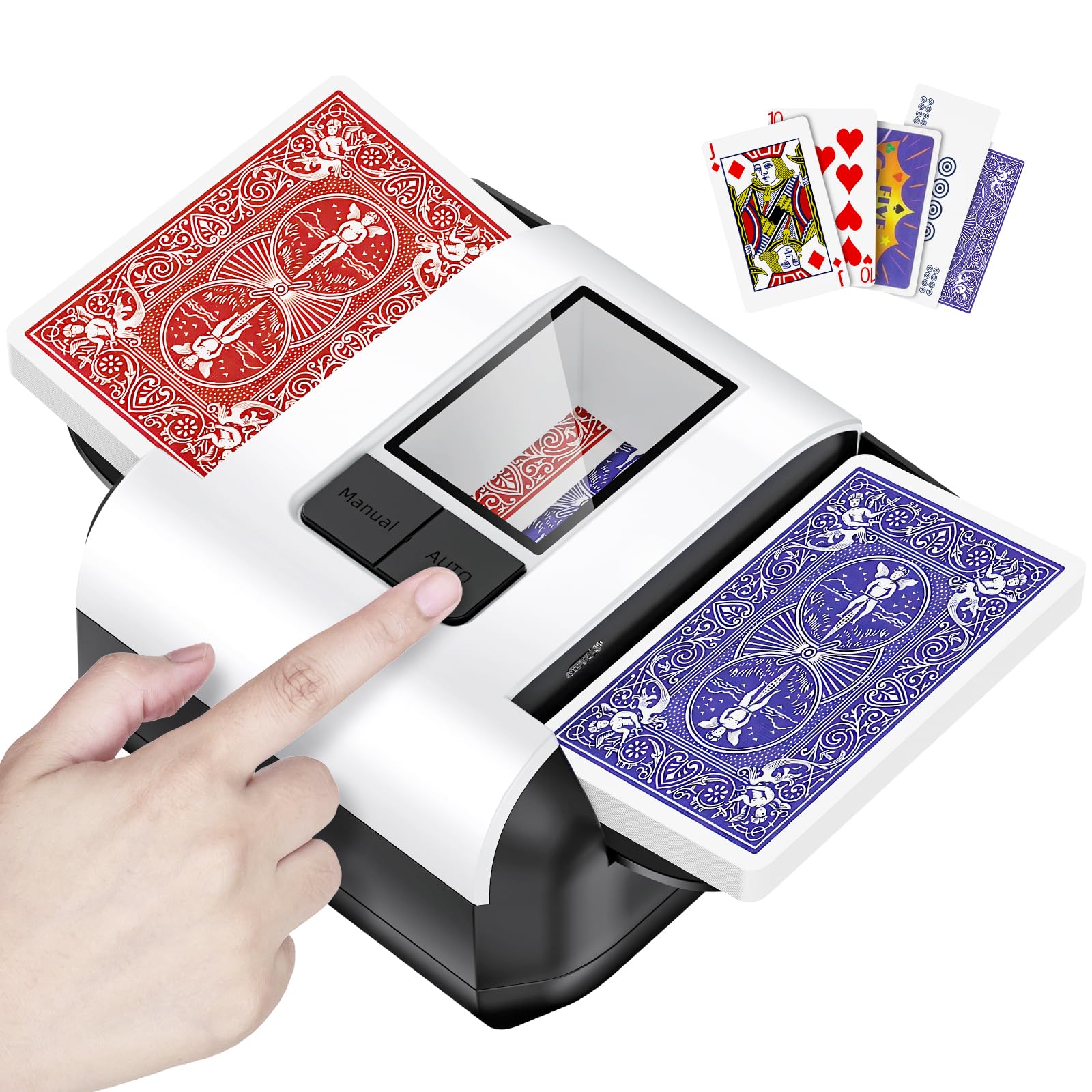
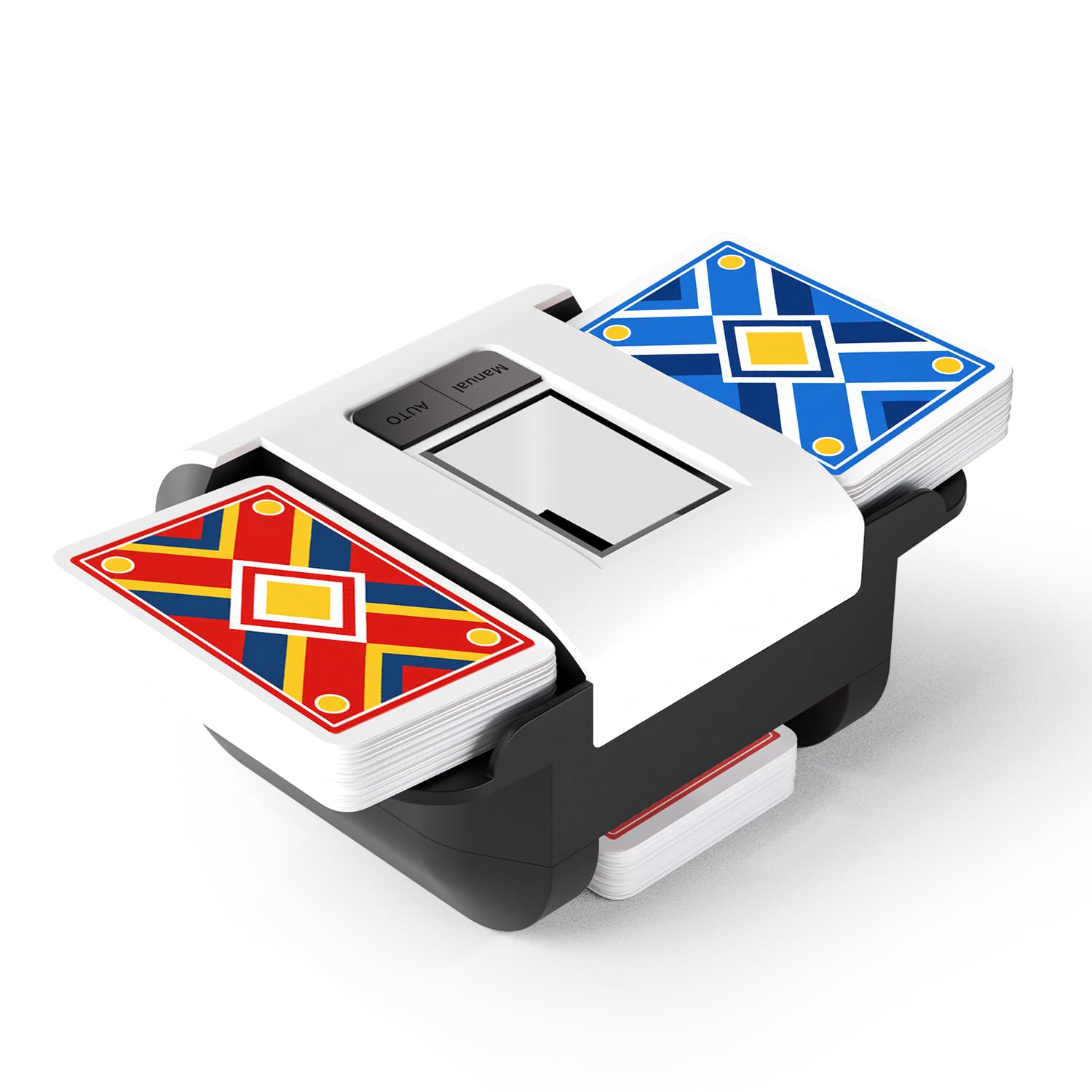
Two buttons do more for the ADZERD than the spec sheet suggests. Auto is the one we reached for during a fast-moving hand: press once, and the machine takes the deck and stops on its own. Manual is the better choice when a deck is thick, worn, or slightly oversized, because holding the button gives us a chance to stop the feed before a card catches. That flexibility is why it is our default for mixed game nights, where one group wants poker and another wants UNO or canasta.

The rest of the package is built for a table people share. Its 1-2 deck capacity covers the games most of us actually play, and the 1200mAh battery means we are not hunting for AA batteries before guests arrive. ADZERD lists the noise at 65dB, and in use it stays at the level of background table conversation rather than a motor that makes everyone lean in. The 6.6 x 4.7 x 3.1-inch body fits beside a score pad without becoming another piece of furniture.

We did not expect the compact size to matter as much as it did. It is small enough to leave out between hands, which is exactly what you want from a machine that is supposed to remove a chore rather than create one. The 1-2 deck capacity covers the games most of us actually play, and the body wipes clean after a snack-heavy game night.

If you want one shuffler that handles the widest spread of ordinary card nights with the least fuss, start here. The USB-C charging and hold-to-stop control are the details that keep it from feeling like a one-trick gadget.

Pros

  • Two useful modes for different decks
  • Quiet enough for table conversation
  • USB-C rechargeable with 1200mAh battery
  • Compact body fits beside a score pad

Cons

  • Will not shuffle while charging
  • Two decks maximum
Our verdict

Buy the ADZERD if you want one quiet, rechargeable shuffler for ordinary family games and the occasional poker night.
Check Latest Price
2

Best for Quiet Game Nights

BIFTU Automatic Shuffler

91 /100
Lab Score Outstanding

Key details

Power
Rechargeable battery
Weight
14.4 oz
Deck Capacity
1-2 decks
Shuffle Modes
Auto and semi-auto
View on Amazon

Quiet is the first thing we noticed about the BIFTU. At a table where people are talking, dealing, and arguing over the score, a shuffler that stays under the conversation is easy to forget. That matters more than a flashy spec: the machine should fade into the background between hands, not make everyone raise their voice.

BIFTU keeps the controls simple with one fully automatic button and a hold-to-shuffle manual mode. The rechargeable battery is a genuine convenience, and a single charge carried us through several double-deck sessions without a cable on the table. The 1-2 deck capacity is right for canasta, Phase 10, and most family games, and the compact body has a small enough footprint to sit beside the dealer.

Where this one earns its place is the balance of quiet operation and speed. It shuffled a double deck quickly enough that we were not waiting through a long mechanical cycle, and the sound stayed low. That combination is harder to find than a raw speed claim, and it is why the BIFTU suits a table that plays hand after hand.

That makes the BIFTU a strong pick for a regular card group that values a calm table over the absolute fastest shuffle. It is an easy machine to live with, and the rechargeable battery keeps the routine simple.

Pros

  • Quiet enough to fade into conversation
  • Rechargeable battery avoids AA packs
  • Fast double-deck shuffling

Cons

  • Can catch cards loaded off-center
Our verdict

Choose the BIFTU if quiet operation matters more than raw speed and your games stay within one or two decks.

Check Latest Price
3

Best for Small Tables

KPAW M2 Card Shuffler

91 /100
Lab Score Outstanding

Key details

Warranty
1-year manufacturer
Deck Capacity
1-2 decks
Shuffle Modes
Manual and auto
Card Retrieval
Bottom tray
View on Amazon

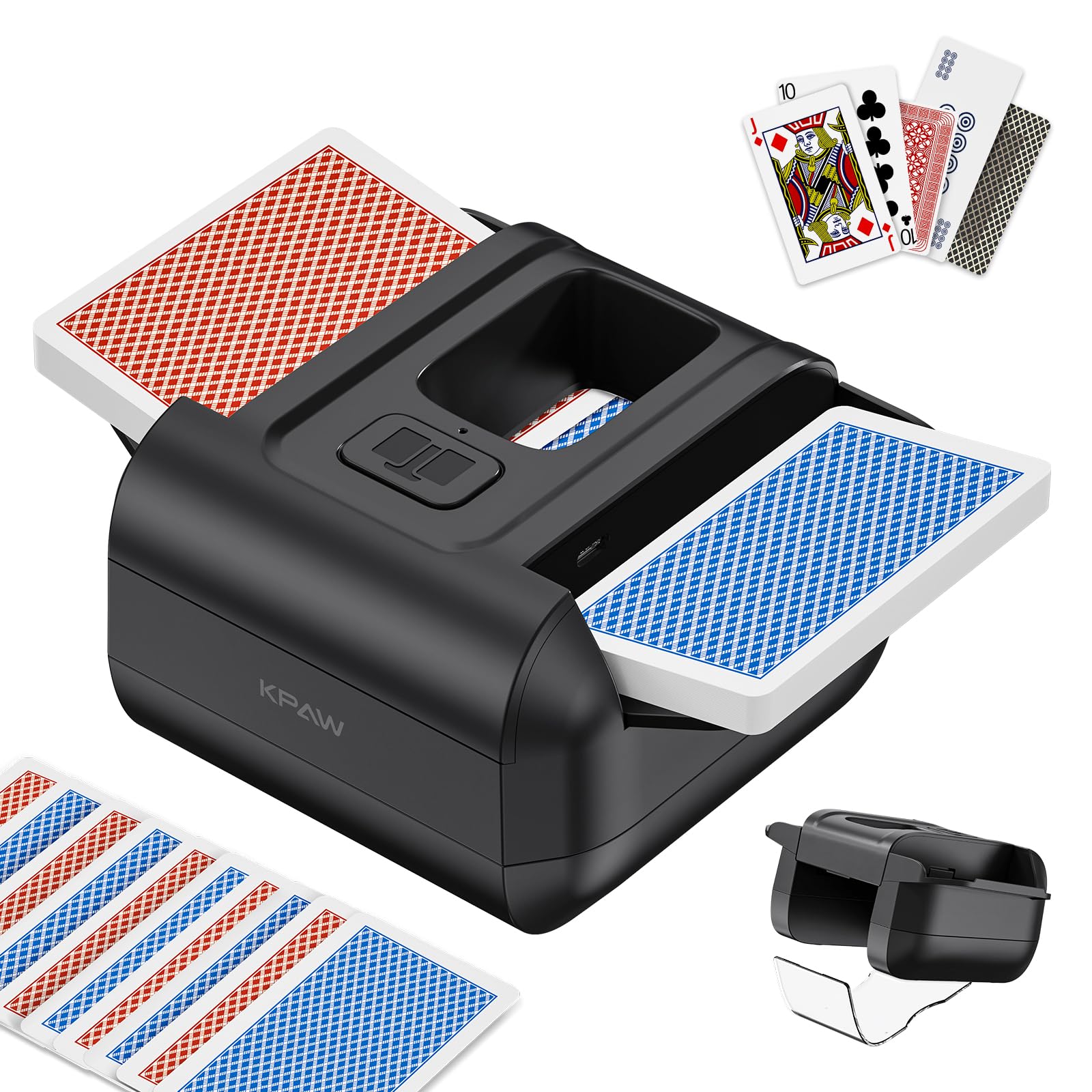
The bottom card tray is the detail that makes the KPAW M2 feel thought through. Instead of lifting the whole machine off a pile of cards, you slide out a tray and take the deck with you. On a crowded table, that is one less awkward move between hands, and it is the reason this one stays near the top of our small-table picks.

The M2 is a compact 1-2 deck machine with auto and manual modes, and the black finish disappears into a table that already has enough plastic clutter. The rechargeable battery keeps it free of a power cord, and the one-year manufacturer warranty is a useful cushion on a moving-parts product. This is the one we keep by a small table, where the tray and the compact body earn their space.

The M2 is not the fastest machine here, but speed is not why we reach for it. It is the tidy one: the deck stays contained, the controls are obvious, and the whole thing can be moved with one hand. For a four-person table or a kitchen island, that is the right trade.

Pros

  • Bottom tray keeps the deck contained
  • Small footprint for tight tables
  • One-year manufacturer warranty

Cons

  • Tray needs clearance on a crowded table
Our verdict

The KPAW M2 is the tidy choice for a small table, with a bottom tray and a compact body that make it easy to live with.

Check Latest Price
4

Best for Travel

XPAW X1 Card Shuffler

89 /100
Lab Score Excellent

Key details

Power
USB-C rechargeable
Card Fit
Retractable wings
Deck Capacity
1-2 decks
Shuffle Control
One-press auto
View on Amazon

The XPAW X1 is the one we pack when the game moves to a friend's house. Its body is compact, the USB-C battery means no AA pack, and the one-press AUTO control is simple enough to hand across the table. The retractable wings push or pull to fit standard poker and bridge cards, so it covers most of the decks we bring along.

For anyone with arthritic hands, the single-button operation is a genuine relief compared with a hand riffle. The machine is quiet enough to use in a living room, and the 1-2 deck capacity is standard for the category. We also appreciated that the controls are limited: no app, no pairing, no extra setup between hands.

The X1 is not the fastest machine here. It is the one we tuck into an RV drawer or a weekend bag for two-player games. The charge-first routine is easy to learn, and after that the machine stays out of the way.

If your card games travel with you, the XPAW's small body and USB-C charging make it the easiest of these to bring along. Just treat the charging cable as part of the game-night checklist, not something to plug in mid-hand.

Pros

  • Compact enough for a travel bag
  • One-press auto control
  • Easy on arthritic hands

Cons

  • Cannot run while charging
Our verdict

Pack the XPAW X1 if your card games travel and you want a small, quiet, one-press shuffler for older hands.

Check Latest Price
5

Best for Fast Games

ShuffleBox S1 Shuffler

88 /100
Lab Score Excellent

Key details

Power
2000mAh rechargeable
Claimed Speed
2 seconds
Deck Capacity
1-2 decks
Shuffle Modes
Auto and manual
View on Amazon

Two seconds is the number ShuffleBox puts on the S1, and speed is clearly the point. The one-press AUTO button starts the feed and the sensor stops it when the deck is through, so there is no second button to hold or timer to watch. In a game where the dealer changes every hand, that rhythm is the difference between a shuffle and a pause.

We think the S1 is at its best with a clean double deck. The 2000mAh battery kept it running through a long session without a cable, and the two-second cycle made it easy to keep the table moving. The 75dB noise figure is not the quietest in this group; it is a mechanical whirr you notice, though it did not stop conversation. The retractable wings help with standard cards, and the auto-stop means you can set the deck in place and let it work.

For a regular poker or canasta table that feeds it the same standard cards every time, the speed is worth the attention. The S1 is the speed pick, not the relaxed one.

Pros

  • Two-second auto-stop shuffle
  • 2000mAh rechargeable battery
  • Auto and manual modes

Cons

  • Jams with thick or uneven decks
Our verdict

The ShuffleBox S1 is for a regular double-deck table that wants the next hand dealt quickly and does not mind careful loading.

Check Latest Price
6

Long Warranty

OUFUYU Card Shuffler

89 /100
Lab Score Excellent

Key details

Power
2000mAh rechargeable
Warranty
2-year limited
Deck Capacity
1-2 decks
Shuffle Modes
Auto stop and manual
View on Amazon

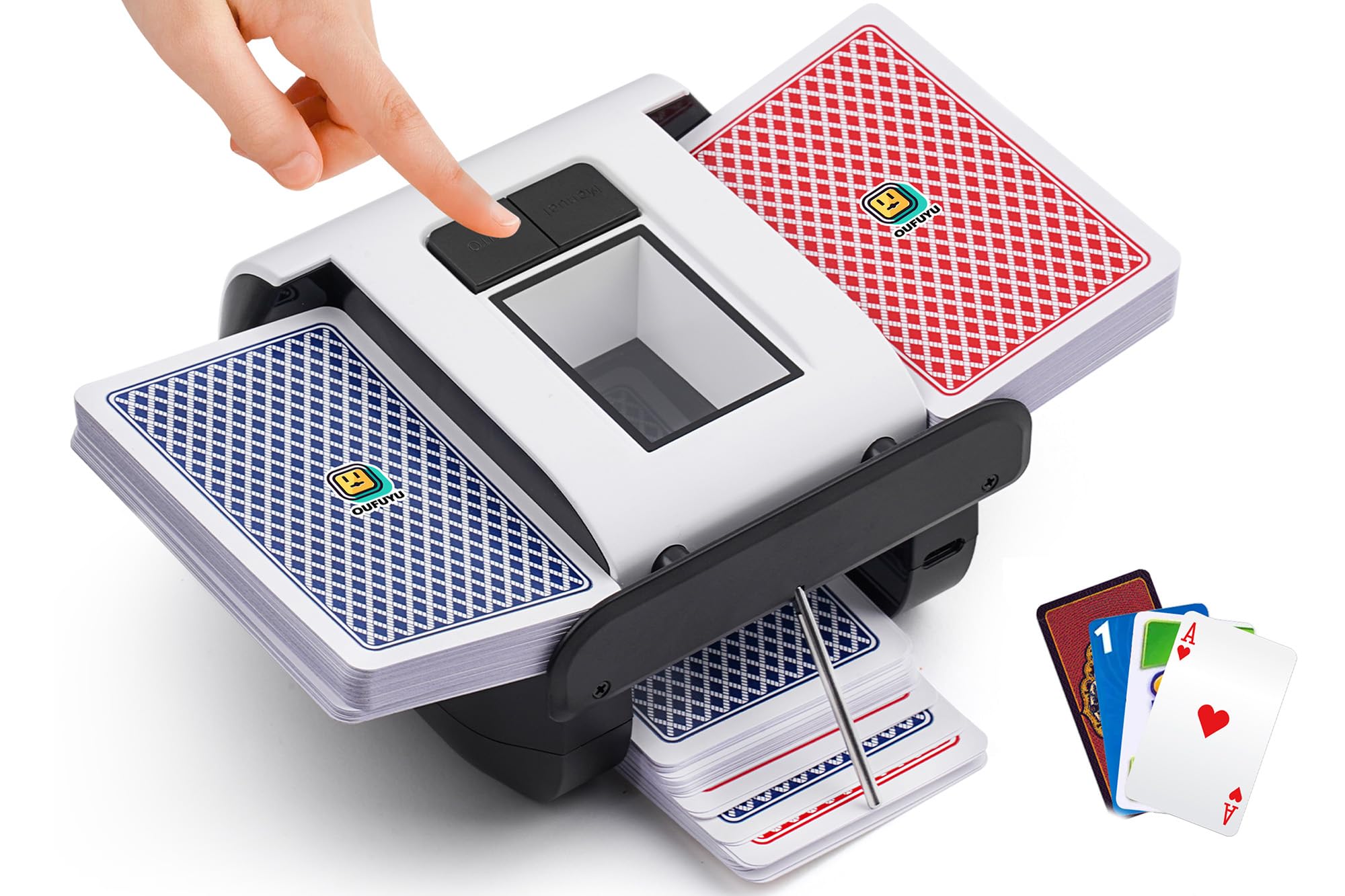
A two-year limited warranty is unusual enough in this category that it changes the way we think about the OUFUYU. Moving parts and plastic feed rollers are the weak points of any shuffler, so a longer coverage window is not a throwaway line. It tells you the maker expects the machine to survive more than a few game nights.

The rest of the package is familiar but well judged: 1-2 deck capacity, auto-stop and manual modes, a 2000mAh rechargeable battery, and a claimed two-second shuffle. The retractable wings handle standard card sizes, and the low-noise motor is tuned for a table where people are talking. We appreciated the manual option for thicker decks, where a slower feed is easier to control.

The body is plain plastic and the controls follow the same pattern as the rest of this group. That is fine: the OUFUYU is not trying to be a showpiece. The two-year coverage is the reason to choose it over a close rival, and it makes the machine easier to recommend for a household that will use it often.

For a household that plays often and wants a longer safety net, this is the quiet alternative. It is not the first name in the category, but the coverage is a real advantage.

Pros

  • Two-year limited warranty
  • Auto-stop and manual modes
  • 2000mAh rechargeable battery

Cons

  • Two-deck capacity only
Our verdict

Consider the OUFUYU if a two-year limited warranty matters more to you than the last word in speed or polish.

Check Latest Price
7

Compact Spare

Towome M1 Card Shuffler

91 /100
Lab Score Outstanding

Key details

Power
USB-C, 2000mAh
Footprint
6.49 x 4.92 x 3.15 in
Deck Capacity
1-2 decks
Shuffle Modes
Auto and manual
View on Amazon

The Towome M1 is small enough to disappear into a drawer, which is the first thing we noticed. At roughly 6.5 by 4.9 by 3.2 inches, it takes up less shelf space than a hardback book, and the USB-C rechargeable battery means there is no bottle of AA batteries to store beside it. For a game collection that already fills a closet, that is a real advantage.

The M1 handles one or two decks and offers both automatic and manual modes. Its side wing opens to about 3.82 inches, which is enough for standard poker and bridge cards. The 2000mAh battery and low-power motor are aimed at long sessions, and the three-second shuffle is quick enough for a family table. We liked the white finish for a bright game room, though it will show scuffs more than a dark machine.

The M1 feels like a straightforward plastic appliance rather than a premium object. That is not a problem for its role: the value is in the compact size and the charging convenience. We also like that the controls are limited to the two modes; there is no app, no pairing, no extra setup between hands.

For a small apartment, a travel bag, or a secondary table, the M1 makes sense. It is the one we tuck into a drawer for occasional games, not the one for a weekly poker night.

Pros

  • Compact 6.49 x 4.92 x 3.15-inch body
  • USB-C rechargeable, 2000mAh
  • Auto and manual modes

Cons

  • Two-deck capacity only
Our verdict

The Towome M1 is a sensible compact spare for occasional games, especially if you want USB-C charging in a small drawer.

Check Latest Price

How We Tested Automatic Card Shufflers

We started by pulling together every automatic shuffler we could find from established game and hobby brands — roughly 30 models — then filtered for deck capacity (a standard 52-card deck plus jokers), supported card sizes, and whether each machine ran on AA batteries, a USB-rechargeable pack, or a wall plug. Anything with novelty-grade construction or no meaningful review history came off the list. That left 10 machines, which we bought ourselves and put into rotation.

Testing ran for six months, mostly at the kitchen table: weekly poker nights, family rummy, and a long stretch of Uno with kids who are not gentle with cards. Each machine also ran a 100-shuffle count with three decks — a stiff new one, a broken-in one, and a cheap plastic-coated set — while we tallied jams, miscounts, and cards that came out creased or flew onto the floor.

We noted whether a machine needed two hands or a brace against the table to stay put, how loud it was with four people talking over it, and whether the trays felt solid or flexed under a full deck. For the rechargeable models, we timed the charge, counted shuffles per charge, and checked whether the machine would run while plugged in. Then we watched what six months did to the motors and the card feed, and whether spending more actually bought smoother handling or just a nicer-looking box.

How to Choose an Automatic Card Shuffler

Start with deck count and card size

A one- or two-deck machine covers most home games, from poker to canasta and UNO. Multi-deck models exist, but the feed slots and tray have to be sized for the larger stack; a machine advertised for six decks can still be fussy if the cards are thick or worn. Measure the cards you use most and check the slot or wing width. Standard poker and bridge cards are the safe target. Oversized tarot, jumbo, or thick plastic cards need a machine that explicitly fits them, not a standard model pushed past its limit.

We prefer a machine rated for the decks you actually play over one that claims a bigger number and feeds poorly. If your group regularly mixes in a second deck, check that the tray and opening can take the full stack without a fight.

Treat jam-free feeding as the main performance test

Jamming is the failure that turns a convenience into a chore. Look for a design that feeds both halves evenly, with a tray or a wide opening that lets you seat the deck flat. Retractable wings help with card-size changes, but they do not fix a deck that is bent or overloaded. A manual or hold-to-shuffle mode is useful when you want to stop the feed before a card catches.

Our advice is to keep the load within the stated deck count, square the cards before every pass, and avoid mixing worn cards with new ones. A machine that clears easily is worth more than one that promises a faster cycle and makes you dig a card out of the rollers.

Decide how quiet and how fast you need it

Speed claims are easy to market and easy to overvalue. A two- or three-second cycle feels quick, but the bigger difference at the table is whether the machine stops on its own and lets you deal without fiddling. Noise is the spec we watch more closely: a motor that sits under conversation is easier to live with than one that makes guests shout. A dB figure gives you a starting point, but hard tables reflect sound.

If quiet matters, put the machine on a mat and favor the models we flag for low noise. If speed matters, accept that the fastest machines can be less forgiving with thick or uneven decks.

Choose a power source and a footprint that fit the room

USB-C rechargeable batteries have largely replaced AA packs in the better home shufflers, and we prefer them for the simple reason that you are not buying batteries before every holiday. Check whether the unit can run while charging; some cannot, which means a top-up belongs on the pre-game checklist.

Footprint matters as much as capacity: a compact machine can live in a drawer, while a larger one needs table space beside the dealer. Measure the shelf or drawer where it will rest, not just the table.

Pay for support, not just the motor

Card shufflers are plastic machines with motors, rollers, and moving trays. That makes the warranty and the return window part of the product, not paperwork. A one- or two-year warranty is meaningful on a device that may run through hundreds of cycles. We also look for a tray or opening that is easy to clear without tools.

The cheapest models are not a bargain if a jam or a dead motor ends the game night. Spend for a design you can live with, then keep the receipt.

Frequently Asked Questions

Final Verdict

Start with the ADZERD if you want one machine for family games, poker, and the occasional double-deck session. Its two modes, quiet motor, and USB-C battery make it the easiest default here, and the compact body does not demand a dedicated table.

Choose the BIFTU if a hushed table matters most, the KPAW M2 if you want a bottom tray on a tight surface, or the XPAW X1 if the shuffler travels. The ShuffleBox S1 is the speed pick for a regular double-deck game; the OUFUYU is the longer-warranty alternative, and the Towome M1 is best as a compact spare.