Best Bingo Cards of 2026

A good bingo night dies in the details. I've watched it happen in a church hall and at my own kitchen table: the dauber soaks straight through a flimsy card, the numbers smear, and then four people shout bingo at once because the pack was printed with only a handful of layouts and half the room is holding the same sheet. The right set fixes all of that quietly — cards thick enough to survive a daubing, layouts shuffled so the room doesn't collide, print big enough for the grandparents at the end of the table to read without leaning in.

Over the past four months my team and I played through 14 bingo card sets — family nights, a school fundraiser, a backyard birthday where the cards got rained on and dried out fine. The lesson that surprised me most is that card count is a terrible proxy for value: a jumbo box of 100 means nothing if they're all variations on the same dozen grids, and thin paper shows its true cost around round three. What follows is what actually held up, from big-print sets for older crowds to compact packs worth keeping in the car for rainy afternoons.

1

Best Overall

MR Chips Jam-Proof Shutter Cards, 25 Pack

93 /100
Lab Score Outstanding

Key details

Marking
Sliding shutter windows
Card Size
7.5 x 6.6 inches
Card Count
25
Construction
Five-ply cardboard, plastic windows
View on Amazon

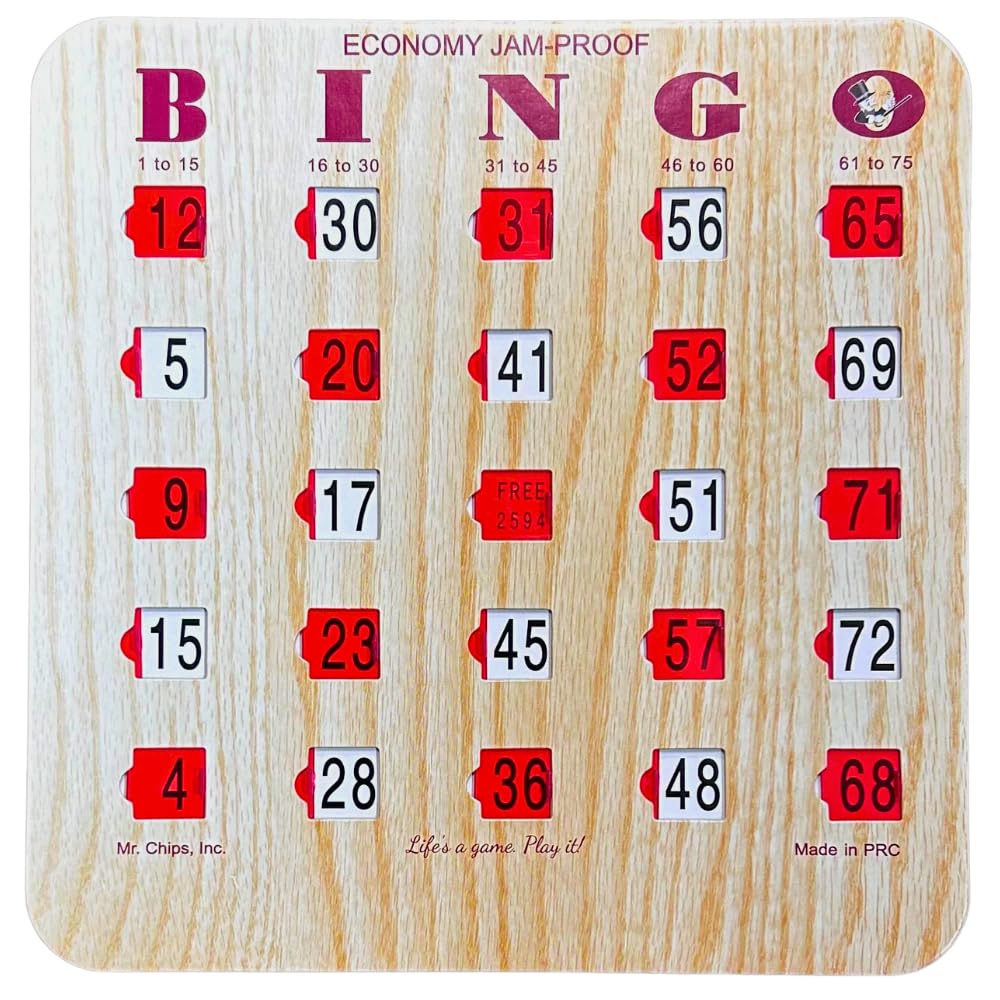
Twenty-five cards sounds like more than a family needs until the cousins arrive and the neighbors knock. That's the case for this MR Chips pack: enough cards for a full room, every one of them different, so a single call never produces two winners.

The windows do the work. Each number has its own plastic tab that stays exactly where you push it, so a bumped table doesn't reopen a marked square, and there is nothing to sweep off the floor afterward — no chips, no daubers, no ink. At 7.5 by 6.6 inches with a five-ply body, a card sits flat in one hand and doesn't flex when you press a tab.

What settles it for us is the balance of sturdiness and cost per card. This is the most solid slider action in this group and the least you'll pay per card among the reusable sets, which is why it's the one we recommend first. Six people around a kitchen table don't need 25 cards, though — a ten-card set does the same job for less.

The no-duplicate promise runs per box, not per household, so order once for the crowd you actually host rather than two packs you'll end up sorting at the door. That's the only planning this purchase asks of you.

Pros

  • Lowest cost per card among the reusable sets
  • Tabs hold their place when the table is bumped
  • No chips or daubers to buy or chase
  • Sturdy enough for kids and senior players

Cons

  • Bulkier to store than a pad of paper
Our verdict

For a group that plays more than a few times a year, this is our pick: 25 sturdy cards whose windows stay put, at the least you'll pay per card among the reusable sets here.

Check Latest Price
2

Best for Family Game Night

GSE Stitched Shutter Cards, 10 Pack

94 /100
Lab Score Outstanding

Key details

Marking
Sliding windows, one-motion reset
Card Size
7 x 7 inches
Card Count
10
Construction
Five-ply with stitched edges
View on Amazon

The reset is the first thing you notice. Run a thumb down the edge of a GSE card and every open window slides shut in one motion, which matters on the fifth game of the night when everyone else is still picking tabs closed one at a time.

We think the stitched border is what makes this the set to hand a family: five-ply board with thread around the edge holds together where glued shutter cards start peeling apart. Ten cards at seven inches square with half-inch numerals covers two tables of five and reads from across a kitchen. A few windows arrive stiff; work them back and forth once before the first game and they settle in.

Ten is also the ceiling. A classroom or a hall will need two sets, and a second set starts repeating cards. For a household that plays monthly, though, this is the set that earns its shelf space: nothing to buy, nothing to lose, nothing to throw out when the last call is made.

Pros

  • One motion clears every window for the next round
  • Stitched five-ply construction resists peeling
  • Half-inch numerals read across a table
  • No repeats within a set

Cons

  • Ten cards leaves a hall short
Our verdict

Ten stitched cards and a one-swipe reset make this the set we hand a family, as long as your game night tops out around ten players.

Check Latest Price
3

Best Paper Cards

GSE Reusable Bingo Sheets, 100 Pack

92 /100
Lab Score Outstanding

Key details

Colors
Five colors, 20 each
Card Size
5.25 x 4.75 inches
Card Count
100
Card Uniqueness
No repeats within a set
View on Amazon

Half an inch doesn't sound like much until you've watched someone squint at a four-inch card. These measure 5.25 by 4.75 inches, the largest paper cards in this group, with big black numerals, and they are the paper cards we recommend first for a mixed-age table.

The stock is thicker than newsprint, so a dauber leaves a clean mark instead of a wet blot, and the 100 cards arrive in five colors, 20 of each, which is how you split a room into tables without counting heads. Every card in a set is different. The trade is that fixed color split, so you can't order the whole hundred in one shade, and if you want them back next month, mark them with chips rather than ink.

Pros

  • Largest paper cards here at 5.25 x 4.75 inches
  • Thick stock resists dauber bleed
  • No repeats within a set

Cons

  • Fixed five-color split, 20 cards each
Our verdict

The paper cards we reach for first: bigger and thicker than the four-inch sheets here, with large numerals and no repeats in the pack.

Check Latest Price
4

Best for One-Off Parties

American Games 1-On Blue Bingo Paper, 500 Sheets

94 /100
Lab Score Outstanding

Key details

Color
Blue
Format
Loose single-card sheets
Sheet Size
4 x 4 inches
Sheet Count
500
View on Amazon

Five hundred cards makes sense for exactly one kind of night: the fundraiser, the school fair, the hall that needs a card in every hand and won't see them again. This pack does that job in blue, for the smallest outlay of the bulk packs here.

We keep it in the budget slot because it is honest about what it is — a plain four-inch sheet with a standard grid that takes a dauber and goes in the bin. The paper is thin, so a heavy hand pushes ink through to the table, and four-inch squares are small for older eyes. At a single event neither matters much, since the alternative is passing around scrap paper: hand out light dabbers and nobody brings it up.

Pros

  • Smallest outlay of the bulk packs here
  • 500 sheets cover a whole room
  • Standard grid works with any caller

Cons

  • Thin paper lets dauber ink bleed through
  • Four-inch squares are small
Our verdict

For a one-off fundraiser or school fair, this is the pack we buy: 500 disposable cards for the smallest outlay of any bulk pack in this group.

Check Latest Price
5

Best for Long Sessions

SEETOOOGAMES Bingo Books, 1,000 Sheets

93 /100
Lab Score Outstanding

Key details

Colors
10 colors
Format
100 books of 10 sheets
Sheet Size
4 x 4 inches
Sheet Count
1,000
View on Amazon

The unit here isn't the card, it's the booklet. SEETOO packs 1,000 sheets as 100 glued books of ten, so a player gets a ten-game strip and never has to hunt for a fresh card between rounds.

The sheets are four inches square with bold numerals, collated through ten colors, and the whole box weighs 1.7 pounds, light enough to carry in with the coolers. Glued books also mean one object per player instead of a loose fan that slides off the table when someone reaches for their coffee.

Repeats turn up in some batches, and a repeated card means two winners on one call. Fan each book before you deal and set the matches aside; that habit handles most of it, and it takes two minutes before the first game.

Per game, nothing here is cheaper. A thousand sheets across ten-round books lands at the lowest cost per game of any paper pack in this group, which is why it's what we point a hall, a reunion or a long holiday party toward.

Pros

  • 1,000 sheets across 100 ten-game books
  • Ten colors sort a room into tables
  • Light enough to carry in one hand

Cons

  • Repeats appear across some booklets
  • Glued books give each player ten sheets at once
Our verdict

We point halls and long holiday parties here: 1,000 sheets in ten-game books, at the lowest cost per game of any paper pack in this group.

Check Latest Price
6

Fundraisers and Halls

American Games Bingo Books, 200 Count

92 /100
Lab Score Outstanding

Key details

Paper
Newsprint
Colors
Blue, orange, green, yellow, pink
Format
200 books of 5 sheets
Sheet Count
1,000
View on Amazon

This is a fundraiser's pack, not a family's. Two hundred books of five sheets, collated blue, orange, green, yellow and pink, mean you can sell bundles at the door and hand each player five games' worth of cards in one motion — exactly the shape a hall wants.

The paper is newsprint, the standard for hall cards: a dauber takes to it beautifully, and a sheet is done after one game. Every book runs the same color order, so sorting a box into five piles takes one pass instead of a shuffle. Nothing here is fancy and nothing needs to be, which is why we'd put it behind a cash box without a second thought.

Pros

  • 200 books, five games per player
  • Pre-collated in five colors for handing out
  • Made in the USA by a long-running bingo supplier

Cons

  • Newsprint means one game per sheet with a dauber
Our verdict

A fundraiser workhorse: 200 five-sheet books in five colors, collated and ready to sell at the door, and that's why it made our list.

Check Latest Price
7

First-Time Hosts

Yuanhe Bingo Cards and Chips Set

92 /100
Lab Score Outstanding

Key details

Chips
1,000 clear chips
Card Size
4.7 x 5.2 inches
Card Count
100
Card Colors
Five mixed colors
View on Amazon

A thousand chips is the detail that changes how this set gets used. The cards are standard sheets in five colors, but the clear three-quarter-inch chips sit on top of a number without hiding it, so the same card plays again next week.

The chips are thicker than the flat counters that come with cheap sets, and because they're clear you can still read every number underneath. A hundred cards in five colors covers a classroom, and nothing needs a dauber, which is the point for anyone hosting kids or a lunchroom game.

It is the only set here that arrives ready to play without a second order for markers, and that convenience is what we keep coming back to. What it doesn't include is a caller, so pair it with the cage or the app you already use.

Pros

  • 1,000 clear chips included
  • Transparent chips keep numbers visible
  • Cards stay reusable when marked with chips

Cons

  • Cards bend more than thicker paper stock
  • Chips add something else to store
Our verdict

For a first bingo night or a classroom where daubers are banned, this is the set we hand over: 100 cards and 1,000 clear chips, ready to play.

Check Latest Price

How We Played Our Way Through 14 Bingo Card Sets

We started by pulling together every set we could find that was still in print and sold in multi-player packs, then narrowed the shortlist by reading the fine print: how many unique card layouts a set actually contained, card dimensions and print size, paper weight, and whether chips or daubers came in the box. Anything that advertised 100 cards without saying the layouts were unique got flagged before it ever reached the table.

Testing happened where bingo is actually played. We ran weekly Friday games at a dining table with a 7-year-old, an 11-year-old, and two grandparents reading through bifocals, then put the same sets through a 60-player fundraiser where we dealt every card in each pack face-up and counted how many grids repeated. A classroom party and a rainy Sunday with 20 people rotating through seats covered the louder, faster end of things.

Along the way we tracked actions rather than specs. We dragged a dauber across a single square to see whether ink bled into the row below, and noted which cards curled at the corners after a night of handling. We shuffled each deck 20 times and checked the edges for fraying, measured cards against a standard ruler, and counted how many rounds passed before someone legitimately called bingo in a full table. Cards that turned up twice in the same set, or that were too small for older players to scan without picking them up, came off the list — as did sets where the paper went soft after one damp afternoon.

How to Choose Bingo Cards

Paper or sliding windows

Paper cards are bought by the hundred and marked with a dauber. They are the cheapest way to put a card in front of a crowd and the right call when the game happens once. Sliding-window cards cost more upfront and last for years: no ink, no chips, nothing to sweep off the floor afterward.

Our rule of thumb is games, not players. If you play more than three times a year, buy shutters and stop thinking about it. If you are outfitting a fundraiser or a school fair where the cards leave in people's pockets, buy paper and buy plenty.

Match the pack to your crowd

Count the seats you can actually fill before you order. A ten-card set covers a family night; 25 cards covers the hall's back row; a bulk paper pack covers everyone who walks in. Buying two smaller sets instead of one large one is where trouble starts, because the no-duplicate promise usually applies per pack.

That is the trap worth knowing: bulk paper packs can carry the same card twice, and a repeated card produces two winners on a single call. Fan a new pack before you deal and set the matches aside. Every shutter set here promises no repeats within a set, so the sorting problem is a paper problem first.

Judge the marking surface

With paper, thickness is the whole story. Newsprint takes a dauber beautifully and lets ink straight through to the table; thicker card stock holds a crisp mark and survives a lighter hand. If you want to reuse paper at all, mark it with chips rather than ink.

With shutters, the window is the part that fails. Check that the tabs sit flush, that they stay where you push them when the table gets bumped, and whether the border is stitched or glued. Stitched edges are the ones that hold up to repeat play; glued ones are where peeling starts.

Get the size and print right

Four inches square is the standard paper size, and it is small: legible, but close work. Five-inch paper and seven-inch shutter cards are noticeably easier for kids and for players in their 70s, and the difference shows up in the second game, not the first.

If your table is mixed-age or anyone plays without glasses, spend the extra inch. A half-inch of card and a bolder numeral do more for a game night than any other upgrade at this price.

What a game actually costs

Paper is cheap per card and spent after one daubered game, which is exactly why it suits an event. A reusable shutter card costs several times more than a paper sheet and then plays every week for years, so the break-even usually arrives within a season of regular play.

Our advice is to buy for the second game night, not the first. If you host monthly, the pricier shutter set is the cheaper purchase by spring. If you host once, paper is not a compromise; it is the correct answer.

Frequently Asked Questions

Final Verdict

Start with the MR Chips 25-pack. It has the most solid window action in this group, no card repeats within a box, and enough cards for everything from a family table to a church hall. It is the biggest outlay here, which is worth it if bingo is a habit rather than a one-off.

Two situations change the answer. Playing with six people a few times a month? The GSE ten-card set costs less and resets in one swipe. Outfitting a single fundraiser where the cards walk out the door? Buy paper, and buy the 500-sheet pack.