Best Collectible Display Cases of 2026

A display case is supposed to make a collection look better, not turn it into a dusting chore. I’ve spent years rearranging a shelf of die-cast cars and mineral specimens, and I’ve learned that the wrong case shows every fingerprint, wobbles when you open it, and makes you dread adding anything new. The right one protects what’s inside, lets you see it, and doesn’t become its own project to assemble—we assembled and lived with 12 cases for seven months, and differences were obvious.

The cases that won us over got the small things right: adjustable shelves that fit odd-shaped pieces, clear instructions, and glass or acrylic that stayed clear after months of handling. Appearance matters, but so does durability—a case that rattles when you open it or sags under a heavy statue isn’t a display case, it’s a shelf with anxiety. Built-in lighting can make a collection look museum-worthy if it’s even and doesn’t wash out colors; the best picks below are the ones we’d buy again, whether you’re showing one grail piece or rotating a cabinet.

1

Best Overall

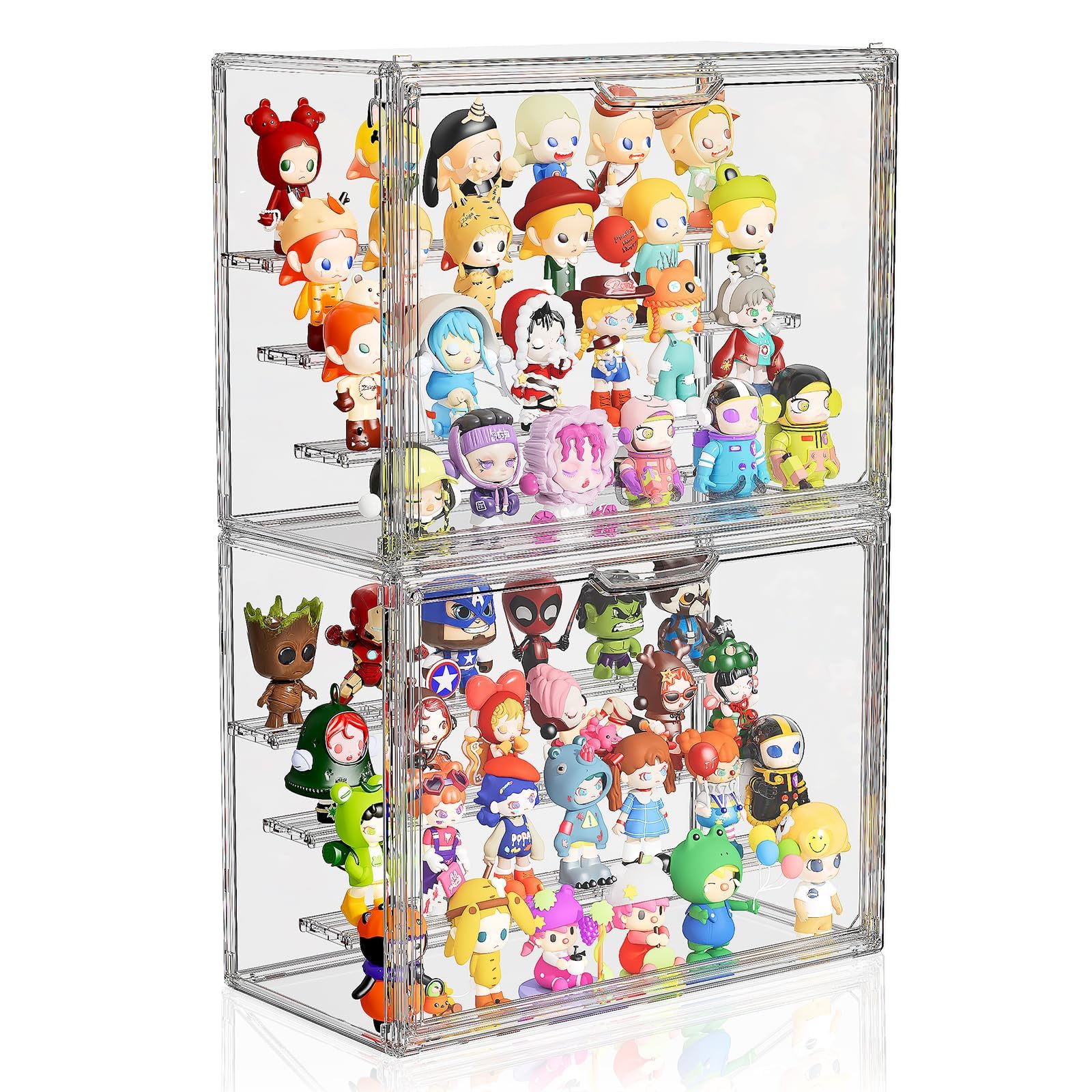
LXLXXL 3-Layer Display Case, 2-Pack

92 /100
Lab Score Outstanding

Key details

Door
Magnetic door
Assembly
Tool-free
Levels Per Case
3, with 2 removable dividers
Dimensions (each)
14.2"L x 8.7"W x 10.6"H
View on Amazon

Two cases, three levels in each, and no tools: that combination is why this pair sits at the top of our list. Stacked, they give six enclosed display levels on a single shelf; split up, they cover a dresser and a bookcase without looking like a mismatched set. The panels click together in minutes, and neither case needed a second pair of hands.

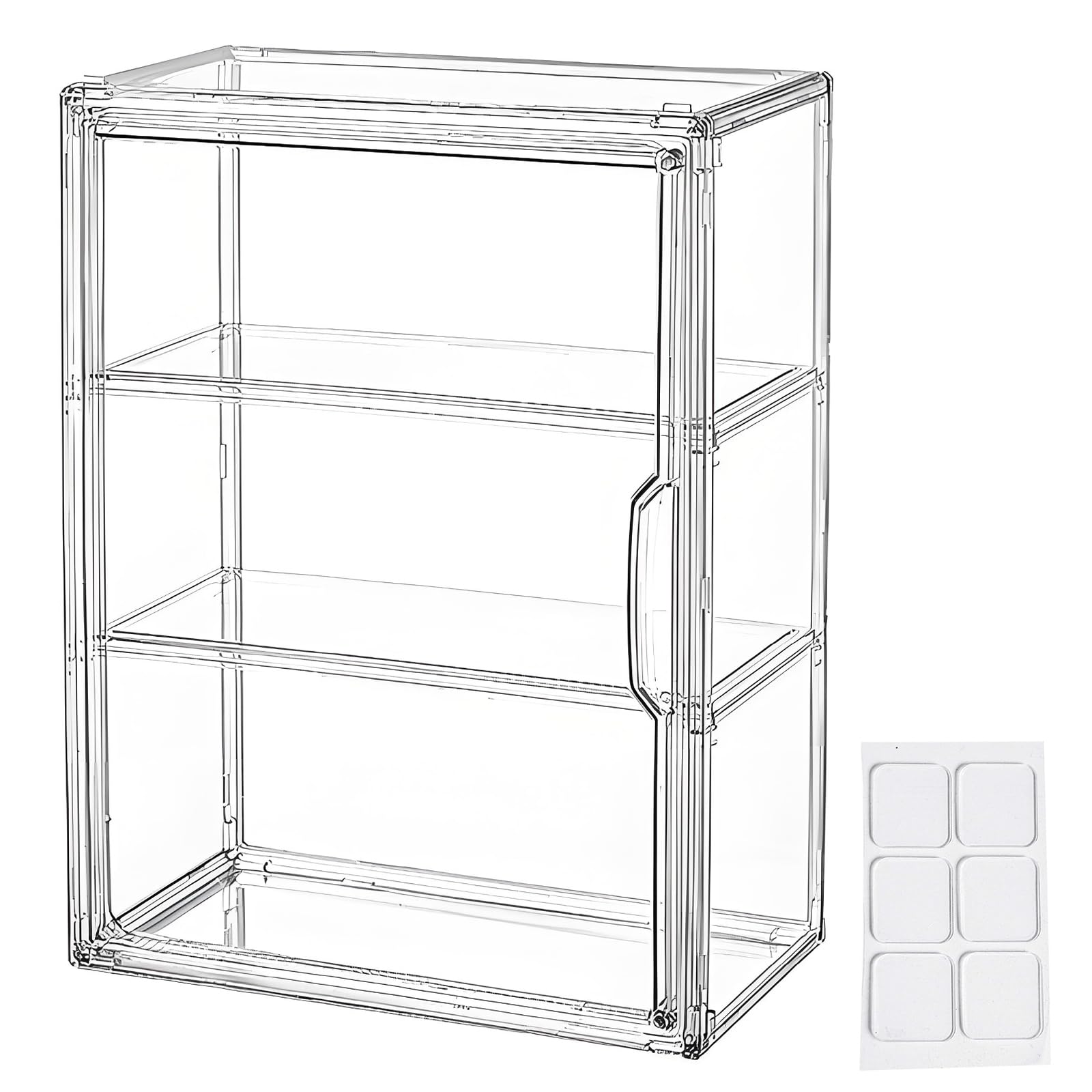
What we noticed first is how much the removable partitions change the job. Leave both brackets in and you have three shallow tiers for figures, minis, or blind-box sets; pull them out and one 10.6-inch cavity takes a taller piece. The magnetic door is the detail we kept coming back to, because it opens with one hand and closes flush — the sort of thing you appreciate when you rearrange a shelf every other week. The acrylic is clear enough that you stop seeing the front panel.

At 10.6 inches tall, this is a case for figures, models, and small statues rather than the quarter-scale piece you bought at a convention. For anything up to about 10 inches, it is the pair we hand people first.

The stack is what keeps it in the recommendation. The cases interlock rather than balance, so adding a third and a fourth next year gives you height instead of a new piece of furniture, and the two you already own stop looking like a temporary fix.

Pros

  • Two cases give six enclosed levels
  • Magnetic doors open one-handed and close flush
  • Removable dividers take taller pieces
  • Tool-free assembly in minutes

Cons

  • Door magnet can arrive weak or missing
Our verdict

Our pick for most collections: two cases, six enclosed levels, magnetic doors you can open one-handed, and panels that click together without tools.

Check Latest Price
2

Best for a Whole Collection

BROTTAR 65-Inch Corner Cabinet

92 /100
Lab Score Outstanding

Key details

Shelves
4 glass tiers
Lighting
3-color LED, motion sensor
Dimensions
33.5"W x 65"H x 23.6"D
Load Limit
160 lb
View on Amazon

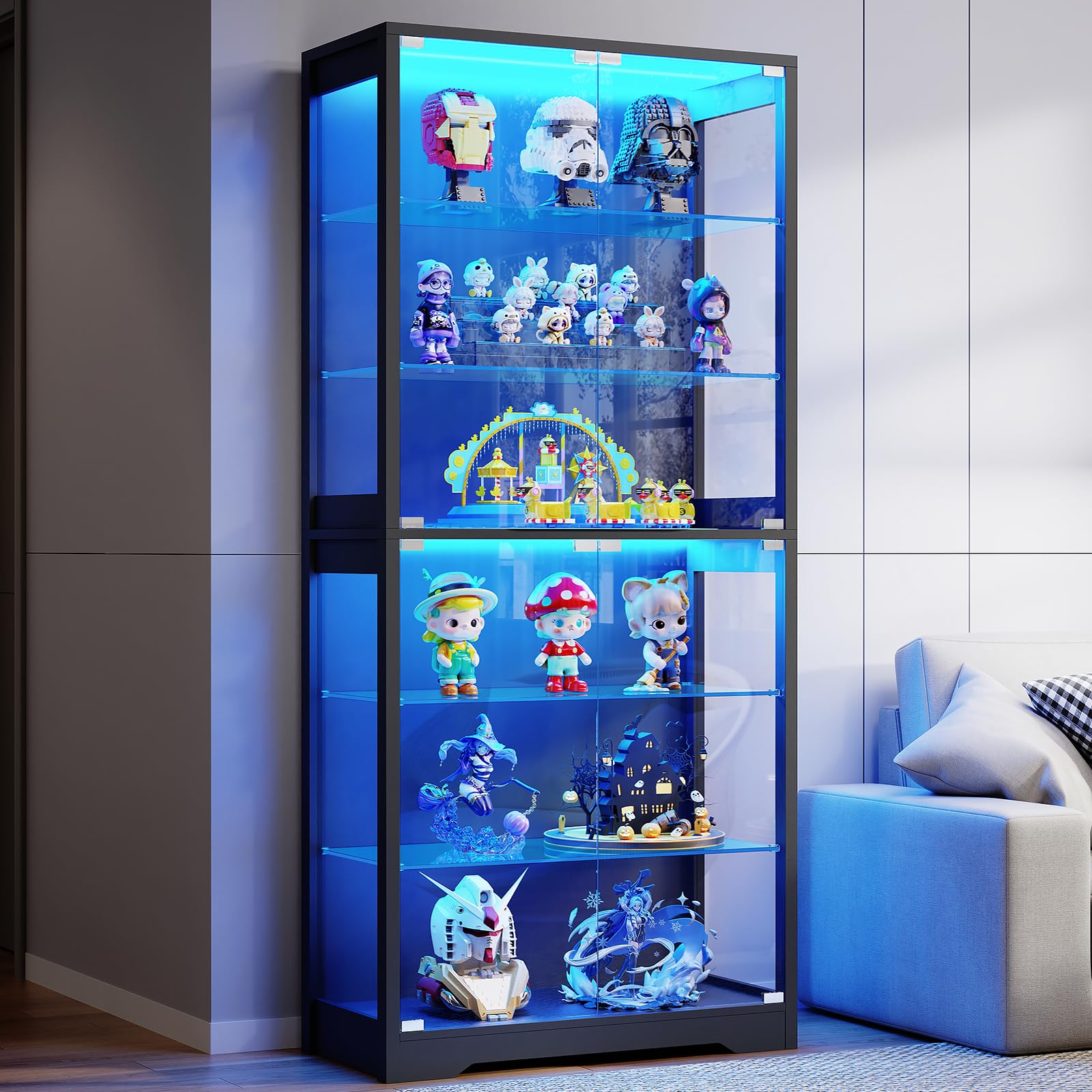
Corners are the one place in a room where a display cabinet costs nothing in floor space, and this one is built square to sit in a right angle: 33.5 inches across, 65 inches tall, and 23.6 inches deep. That depth is the number that matters most. It takes a helmet, a quarter-scale statue, a stack of boxed figures, or a couple of handbags on the same shelf — more than the slim towers manage with 14-inch footprints. Four glass panes and pop-up doors mean almost nothing interrupts the view.

What earns it a place here is the way the lighting behaves. Three colors, adjustable brightness, and a motion sensor that switches the LEDs on as you walk past and off when you leave; in a room where the cabinet is furniture first and storage second, that is the difference between a lit display and a permanent glow you have to remember to turn off. The frame is FSC-certified wood, the stated load limit is 160 pounds, and the glass sides keep the contents visible from across the room.

The footprint is the trade-off. A body this deep wants a real corner, not a nook beside a door, and it stays where you put it — this is furniture, not something you shift to dust behind. That is the deal it offers: one permanent corner in exchange for the shelf space the rest of the collection gets back.

Pros

  • Deep 23.6-inch shelves take helmets and large statues
  • Three-color LED with motion sensor
  • Four glass panes keep the view nearly unobstructed
  • Fits a 90-degree corner without stealing floor space

Cons

  • Assembly can run several hours
Our verdict

If the collection has outgrown shelf-top boxes, this is the cabinet we point to: four deep glass tiers, three lighting colors, and a corner footprint that costs no floor space.

Check Latest Price
3

Best Tall Tower

BROTTAR 71-Inch Tall Cabinet

87 /100
Lab Score Excellent

Key details

Door
Pop-up glass, handle-free
Shelves
6 glass tiers, 2.5" adjustment
Lighting
3-color LED, motion sensor
Dimensions
31.5"W x 71"H x 13.8"D
View on Amazon

Depth decides this cabinet before anything else does. At 13.8 inches front to back it takes rows of figures, boxed sets, books, and tall pieces, but a wide diorama or a long vehicle model simply does not fit on the shelf. What you get in exchange is 71 inches of height and six glass tiers on a 31.5-inch-wide strip of wall — a column of collection in a slot a corner cabinet could never use.

Each shelf moves in 2.5-inch steps, so a row of small figures can sit low with a taller piece given a full gap above it, and the single pop-up glass door covers the whole front for rearranging. The handle-free door and the high-gloss black finish make it read as a shop fixture rather than a bookcase with glass in it, and the three-color LED with motion sensor comes as standard.

This is the pick when the collection runs along a wall rather than into a corner — a hallway, the end of a long room, a strip of bedroom wall nobody uses. The anti-tip device is not optional: a 71-inch cabinet that is not screwed to the wall shifts when the door is pulled. Anchor it properly and it earns every inch of the height.

Pros

  • Six glass tiers on a 13.8-inch-deep footprint
  • Shelves adjust in 2.5-inch steps
  • Three-color LED with motion sensor
  • Handle-free door reads as furniture

Cons

  • Tall frame feels less rigid than the corner cabinet
Our verdict

We reach for this one when the collection runs along a wall: six lit glass tiers on a footprint barely over a foot deep.

Check Latest Price
4

Best for Bulky Pieces

LXLXXL 5-Pack XL Display Case

92 /100
Lab Score Outstanding

Key details

Lid
Magnetic
Stacking
Interlocking slots
Pack Size
5 cases
Dimensions (each)
14.2"L x 8.7"W x 10.6"H
View on Amazon

No shelves, no dividers, no internal steps — that is the whole idea here. Each box is 14.2 by 8.7 by 10.6 inches of empty clear space with a magnetic lid, which is what you want for a boxed figure, a tall statue, a diorama, or a handbag you would rather not dust. The boxes also sit on their side and link through slots on the top and the sides, so five of them become a grid rather than a leaning tower.

We keep these for the pieces that will not fit the tiered cases, and the five-pack makes more sense than it sounds, because a collection rarely has only one awkward item. What you give up is stiffness: the walls flex more than the thicker cases on this list, so nothing heavy goes on the top box, and the lid relies on its magnet rather than a hinge. For light collectibles behind clear plastic, neither has been a problem.

Pros

  • Shelf-free cavity takes tall, bulky pieces
  • Five boxes interlock into a grid
  • Magnetic lid keeps dust off
  • Fast one-person assembly

Cons

  • Sold only in fives, even if you need one
Our verdict

We keep these for the awkward pieces: a shelf-free 10.6-inch cavity with a magnetic lid, five at a time, and slots that let you build a wall of them.

Check Latest Price
5

Best Wall-Mounted for Small Figures

DisplayGifts Minifigure Display Case

90 /100
Lab Score Outstanding

Key details

Door
Lockable, 98% UV-filtering acrylic
Assembly
None required
Capacity
About 80 minifigures
Shelf Height
2.25"
View on Amazon

Shelf height is the whole argument for this case: 2.25 inches per row, sized for minifigures rather than adapted to them, with a felt back and small foot supports that hold the figures upright. It arrives in one piece — no flat-pack, no tools — and hangs on the wall with the hardware in the box, holding about 80 figures. That, plus a door that locks, is why it stays on our list for anyone whose collection is small, numerous, and within reach of children.

For LEGO minifigures in particular it solves something the acrylic boxes do not: 80 figures at eye level instead of six per shelf at waist height, with rows deep enough for a figure holding a weapon or wearing a cape. The black frame and felt interior do the figures a favor too — a white minifigure against a white wall is a smudge, and against black felt it is a portrait.

Mounting is the part to get right. The case hangs on wall hardware, and hollow-wall fixings holding a loaded cabinet is how collections end up on the floor; put it into studs or a proper anchor and it stays put. Figures with a wide stance can also topple on the narrow shelves if the case gets knocked, so close the door gently and let the latch do its job.

Pros

  • About 80 minifigures on 2.25-inch rows
  • Lockable, UV-filtering acrylic door
  • Arrives in one piece, nothing to assemble
  • Felt back and figure foot supports

Cons

  • Snug 2.25-inch rows will not take tall or wide figures
Our verdict

We like this one for minifigures specifically: about 80 figures behind a lockable, UV-filtering door, hung at eye level, with nothing to assemble.

Check Latest Price
6

One Large Piece

Cliselda 10x10x16 Acrylic Case

89 /100
Lab Score Excellent

Key details

Base
Thickened black acrylic
Assembly
Required, fittings included
Dimensions
10"L x 10"W x 16"H
Protection
Dustproof, reduces UV
View on Amazon

Ten by ten by sixteen is a specific shape, and it is the one a lot of large pieces actually need: a quarter-scale figure, a ship model, a big build, a mineral specimen. The black base is what sells the look. Instead of another clear box floating on a shelf, the piece sits on a dark plinth and the acrylic reads closer to glass — a display decision the other acrylics here do not offer.

Assembly is straightforward but not foolproof. You get panels, fittings, gloves, and a cleaning cloth; the panels arrive under a protective film that has to come off, and the measurements are honest, so measure the piece rather than the box and allow for the edges. Ours went together square, and the film peeled away clean with no marks left behind.

The lid is where it stops short of the stackable cases: it rests on the base rather than latching, so lift the whole thing from the bottom when you move it. As a single-piece display, though, this is the best-looking case of its size on the list — the black base does more for a model than extra height does.

Pros

  • Black base makes one piece read as a plinth
  • 10 x 10 x 16 fits large models
  • Internal measurements are accurate
  • Gloves and cleaning cloth included

Cons

  • Thin panels can crack during assembly
Our verdict

We use this one for the single showpiece: a 10-inch cube, 16 inches tall, with a black base that makes whatever is inside look catalogued rather than stored.

Check Latest Price
7

Small, Stepped Rows

MSHOMELY Stepped Display Case, 2-Pack

89 /100
Lab Score Excellent

Key details

Door
Magnetic
Shelves
6 stair-step pieces, 2 cases
Material
PET
Dimensions (each)
14.2"L x 7.08"W x 10.83"H
View on Amazon

The stair-step shelves are the reason to notice this one. Six stepped shelf pieces across the two cases lift the back row higher than the front, so small figures stop disappearing behind each other — a display riser built into the case, without a separate riser to buy and dust. If you arrange by set or by series, that is the difference between seeing your collection and seeing the front row of it.

Each case is 14.2 by 7.08 by 10.83 inches, which makes it the narrowest front-to-back of the acrylics here. Seven inches of depth suits rows of small figures and flat items. The magnetic front closes on its own, assembly is tool-free, and the boxes stack without wobbling once they are loaded.

The steps also give flat items something to sit in: the grooves hold carded figures and small boxes upright instead of letting them slide. That is a detail you do not get on smooth shelves, and it matters when half the collection is still in packaging.

Where this pair earns its place is the small stuff: four-inch-and-under figures, blind-box sets, Mini Brands, Nanoblocks — anything that benefits from being lifted a step. If your collection is mostly one scale and mostly small, it shows more of it per case than the flat-shelved boxes do, and that is the whole argument.

Pros

  • Stepped shelves raise the back row into view
  • Six shelf pieces across two cases
  • Tool-free assembly with a magnetic front
  • Stacks without wobbling when loaded

Cons

  • Stepped shelves crowd out taller figures
Our verdict

The stepped shelves sold us: the back row sits higher, so nothing hides behind anything, and small figures finally read as a collection.

Check Latest Price
8

First Collections

BOHOIDEE 3-Tier Display Case

85 /100
Lab Score Excellent

Key details

Door
Magnetic, touch-open
Dividers
2 removable boards
Stacking
Interlocking
Dimensions
10.63"L x 5.51"W x 14.17"H
View on Amazon

This is the least expensive case we recommend, and the plastic says so. It is light — about two pounds empty — narrower than the others at 5.5 inches deep, and the panels have some give to them. None of that matters much when the job is keeping dust off a row of small figures on a desk, which is exactly what it does.

The layout is genuinely useful: 14.17 inches tall with two removable divider boards, so you can run three compartments, two, or one tall space. The magnetic door opens with a touch and closes on the magnet, and the units interlock when you stack them. For Cinnamoroll, Nanoblocks, mini blind-box figures, and a collection that grows a few pieces at a time, that is enough structure.

Ignore the wall-mount option. The adhesive fixings are the weak link — a loaded case that lets go takes the collection with it — and there is no good reason to hang a two-pound box when it sits happily on a shelf.

Buy it for a first collection, a gift, or a corner of a room that does not justify a cabinet. When the collection outgrows it, the LXLXXL pair or the stepped MSHOMELY set is the step up, and the little one can move on to holding the overflow.

Pros

  • Least expensive sealed case here
  • Two removable dividers make three compartments
  • Magnetic door opens with a touch
  • Interlocks with matching units when stacked

Cons

  • Acrylic scratches more readily than the thicker cases
Our verdict

This is the one we hand to first-time collectors: a narrow three-compartment case with a touch-open magnetic door, best kept on a desk rather than a wall.

Check Latest Price

How We Tested Collectible Display Cases

We started by scanning the market for cases that could hold everything from a single die-cast car to a shelf of mineral specimens, then narrowed the shortlist by size, price, and whether replacement parts or adjustable shelves were available. We ended up with 12 cases and spent seven months with them in living rooms, home offices, and one very crowded craft corner—assembling, loading, dusting, and opening them the way a collector actually would.

Assembly came first: we timed each build solo, followed the provided instructions page by page, and noted where the diagrams skipped a step or a panel needed two people. Once built, we loaded each case with a mix of heavy statues, small figures, and oddly shaped specimens to see whether shelves fit and whether the unit stayed sturdy when we opened and closed it daily. We checked glass and acrylic for scratches after repeated cleaning, watched whether doors sagged, and gave each case a gentle shake to see if it wobbled on its feet.

For display quality, we looked at how much glare the glass threw under a living-room lamp, whether built-in LEDs lit the back corners or just the front row, and if the light washed out paint or made dust more obvious. We judged appearance in daylight and at night, checking for uneven seams, cloudy acrylic, and hardware that looked cheap up close. On wall-mounted units, we tested the supplied adhesive strips and mounting pads on painted drywall, then checked whether they held after a week of opening and closing. We also compared what each case offered for the money—shelf count, hardware, finish—because a case that fights you every time you swap a piece isn’t a good value. After seven months, the ones still in our homes are the ones that stayed square, opened smoothly, and made the collection—not the case—the thing you notice.

How to Choose a Collectible Display Case

Measure the piece, then measure the inside

Every case is sold by its outside dimensions; your collectible meets the inside. A 10-inch cube with a thickened black base loses floor space to that base, a 10.6-inch-tall box loses a little height to its lid, and a 2.25-inch shelf row is a ceiling rather than a suggestion. Measure the tallest and widest piece you own with its stand or its box, then add an inch of clearance before you look at anything else.

Then think about the next piece, because collections grow toward the tallest thing in them. That is why removable dividers matter more than shelf count: pulling a bracket out of the LXLXXL pair turns three shallow tiers into one deeper cavity, while a fixed-shelf case stops fitting the week you buy something bigger.

Sealed, lockable, or just covered

An enclosed case keeps dust off; a sealed one keeps dust and fingers off. Magnetic doors and lids are the common closure here, and they are the reason these cases get opened at all — a door you can flick with one hand gets used, and a door with clips gets avoided. If there are children, pets, or clumsy housemates around, pay for a lock; the DisplayGifts cabinet is the only pick here with one.

UV is the other half of protection. Acrylic and glass both slow fading, and some doors are rated for UV; none of them stops a south-facing window. If the case sits in direct sun for part of the day, move it — a UV-filtering door buys time, not immunity.

Where it will live decides the shape

Tabletop, wall, or floor: pick the spot before the product. Shelf-top boxes suit a bookcase or a dresser and stack into a tower as the collection grows. A wall cabinet buys the space above a desk but needs studs or proper anchors — the adhesive strips sold with some acrylic cases are not a mounting system. A floor cabinet wants 65 to 71 inches of wall, a second pair of hands, and the supplied anti-tip device screwed into the wall.

The trap is the word compact. A case sold as compact can still be 14 inches wide and 11 inches tall, which is fine on a dresser and too big for a rented room's only shelf. Measure the gap to the ceiling above the shelf, and remember that a lid needs room to lift and a door needs room to swing.

Lighting either lasts or it doesn't

Lighting is the feature that sells a glass cabinet and the part most likely to fail. The LEDs in these cabinets run as strips or pucks behind a diffuser, and when they go, they tend to go as a unit. Choose a cabinet that stands on its own with the lights switched off; the two BROTTAR cabinets here add three colors and a motion sensor, but the display has to work without them.

Then plan for the weight. Glass shelves want a load spread across them rather than balanced on one foot, and the heaviest piece belongs on the bottom tier, where a fall is shortest.

Frequently Asked Questions

Final Verdict

For most collections the money belongs with the LXLXXL two-pack: two cases, six sealed levels, doors that open with one hand, and a stack that grows as the collection does. It is the least fussy way to get a shelf of figures properly enclosed.

The exception is scale. When the pieces are too tall for a 10.6-inch cavity, or when the collection has become the room's furniture, the BROTTAR corner cabinet does that job with four deep lit glass tiers — provided you have a corner going spare and an evening to build it.