Best Deck Boxes of 2026

A deck box has one job: keep your cushions dry and your patio from looking like a yard sale. That sounds simple until you've watched a cheap lid sag under a week of rain or spent a Saturday afternoon squinting at wordless assembly diagrams. I've done both. What you actually want is a box that shrugs off weather, swallows more than the listed capacity suggests, stays sturdy when someone plops down on the lid, and doesn't cost more than it's worth.

Over eight months, I lived with a dozen deck boxes on my deck and patio, and my team assembled and loaded each one alongside me. We paid close attention to assembly, quality, size, storage capacity, and sturdiness — the things you notice only after the box is full and the first storm hits. Some boxes felt solid empty but flexed once loaded; others sealed tightly but were a misery to put together. The picks below are the ones that earned their spot.

1

Best Overall

Keter Westwood 150 Gal

91 /100
Lab Score Outstanding

Key details

Capacity
150 gallons
Lid Mechanism
Hydraulic piston
Exterior Dimensions
61"L x 28.3"W x 25.2"H
Seating Weight Limit
660 lb
View on Amazon

The lid lifts itself. A hydraulic piston takes it up and holds it there, which sounds like a small thing until you're stacking four cushions into a box that's 61 inches long and reaching the far end one-handed. That was the difference we noticed first, and it's why this is our top pick: the largest capacity in this group is also the easiest to load.

At 150 gallons it takes a full set of patio cushions with room left for pool floats, and the 660-pound seating rating makes it a real bench rather than a perch — two adults, not one. The wood-plank resin reads as furniture from across the deck, and it's rated waterproof, which is the claim that matters for cushions going back out the next morning.

The trade is space. At 61 inches long and 28.3 inches deep it is a piece of furniture, so measure the wall before you order and accept that it will own that corner. Direct sun is the other thing to plan around: the resin is UV-resistant, but a lid that never gets a break from afternoon sun is where warping shows up first, so a spot against the house suits it better than the middle of an open deck.

Assembly is click-together panels and a short set of directions, done in an afternoon without tools. What keeps it at the top isn't any single figure: the box that gets opened twice a day is the one that earns its footprint, and this is the one we kept coming back to.

Pros

  • Holds a full cushion set with room to spare
  • Gas-strut lid stays open while you load
  • Doubles as a 660-pound bench
  • Waterproof-rated resin with a wood-plank finish

Cons

  • Two-year warranty is the shortest here
Our verdict

Our default for a deck with room for a 61-inch bench: 150 gallons swallows a full cushion set, and the gas-strut lid leaves both hands free to load.
Check Latest Price
2

Best Value

East Oak 120 Gal

93 /100
Lab Score Outstanding

Key details

Capacity
120 gallons
Lock Type
Dual-lock
Exterior Dimensions
53.2"L x 22.7"W x 25.5"H
Seating Weight Limit
880 lb
View on Amazon

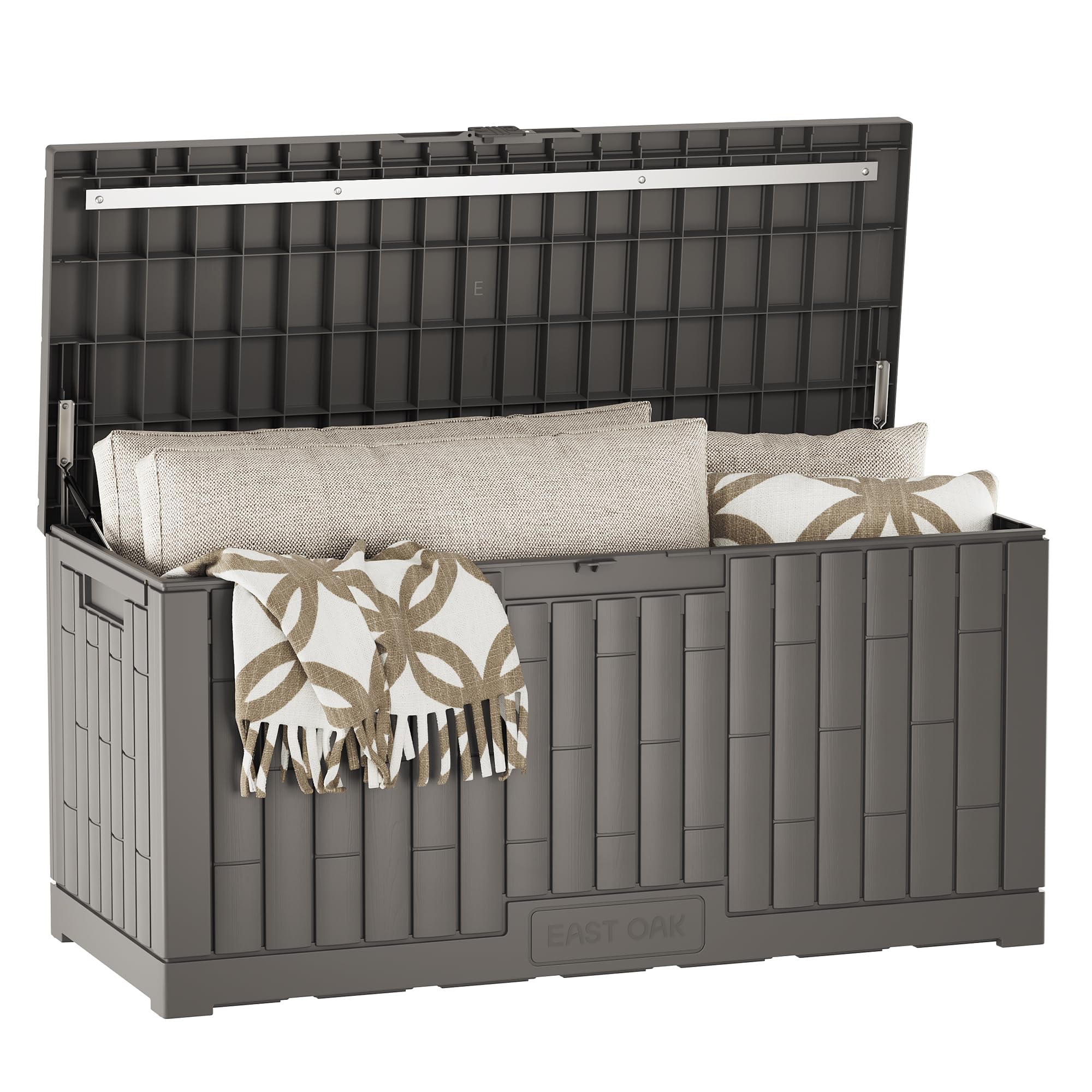
Thirty gallons less than our top pick, about eight inches shorter, and a good deal cheaper — that's the trade the East Oak 120-gallon box offers, and on a normal-size patio we think it's the smarter one. The steel tubing running through the panels is what makes it work: it's how a 33-pound resin box carries an 880-pound rating without thickening the walls.

A four-cushion set plus floats still fits, and the flat top doubles as a side table next to the grill. We paid close attention to the lock, since a box this size tends to end up holding things you don't want borrowed: there are two locking points, and the hardware is rust-proof rather than painted.

Assembly is snap-together and takes minutes, which matters if the box arrives before the patio does. The 880-pound rating is not just headroom on paper, either — at 33 pounds the box is light enough for one person to slide into position, then strong enough for two people to sit on. In this group, nothing balances capacity, strength, and a lockable lid better for the money.

Pros

  • Steel-tubed panels rated to 880 pounds
  • 120 gallons for less than the top pick
  • Dual-lock lid takes a padlock

Cons

  • Lid doesn't always pull down tight at the corners
Our verdict

We think it's the smartest buy for a normal-size patio — 120 gallons, steel-reinforced to 880 pounds, for a lot less than the biggest box here.

Check Latest Price
3

Best Heavy-Duty

Lifetime 60012 130 Gal

91 /100
Lab Score Outstanding

Key details

Capacity
130 gallons
Warranty
10-year limited
Exterior Dimensions
60"L x 24"W x 27.2"H
Seating Weight Limit
900 lb
View on Amazon

Ten years. That's the warranty on the Lifetime 60012, and it's the longest in a group where two years is the norm. Pair it with a 900-pound seating rating and powder-coated steel hinges, and you get the one box here built like outdoor furniture rather than a plastic tote.

Long lounger cushions go in flat rather than folded, because the interior runs 60 inches by 24, and the flat lid turns into a serving table at a cookout. The spring hinge is the detail we appreciated most: it closes under control instead of dropping, which matters when the person closing it is eight years old or holding a plate.

What it asks in return is effort. Assembly is the one job in this group that involves real fasteners rather than snapping panels into place, so have a screwdriver and a second pair of hands ready. Lifetime also rates the box water-resistant rather than waterproof, which is why a bead of silicone along the inside seams is worth twenty minutes before the first storm. Do that, and the warranty has less to prove.

Pros

  • 10-year limited warranty, longest here
  • 900-pound seating rating
  • Spring hinge closes gently instead of dropping

Cons

  • 52 pounds empty; needs two people to place
Our verdict

We reach for it when the box doubles as seating: a 900-pound rating, steel hinges, and a 10-year warranty beat everything else here on the long haul.

Check Latest Price
4

Best for Small Spaces

Greesum 31 Gal

0 /100
Lab Score Fair

Key details

Capacity
31 gallons
Lock Type
Padlock
Exterior Dimensions
22.04"L x 16.34"W x 20.87"H
Seating Weight Limit
220 lb
View on Amazon

On a balcony, the question isn't how much a box holds — it's whether you can walk past it. The Greesum is 22 inches by 16.3 inches on the ground and stands 20.87 inches tall, which puts the lid at side-table height beside a pair of chairs. That's the whole trick: it stores like a deck box and works like furniture.

Inside, 31 gallons takes a season of pool toys, a bag of potting soil, grill tools, or the cushions off two chairs. The small-stuff details are what we didn't expect at this size: a hydraulic bracket so the lid doesn't slam, holes for a padlock, and the tools in the carton for assembly.

Weight is the catch. Just under 11 pounds empty means a gust can slide it across a smooth deck or lift the lid, so it belongs against a railing or a wall rather than the open middle of a roof deck. Put it where it's sheltered, and it earns its keep as the easiest box here to move when the furniture gets rearranged.

Pros

  • Balcony footprint, 22 by 16 inches
  • Lid sits at side-table height
  • Padlock holes and a hydraulic bracket

Cons

  • Rated for one adult, not two
Our verdict

For a balcony or a poolside corner, we take the small one: 31 gallons, a 220-pound seat, and a lid you can lock.

Check Latest Price
5

Covered Porches

Keter Kentwood 92 Gal

89 /100
Lab Score Excellent

Key details

Capacity
92 gallons
Recommended Use
Garage or covered patio
Exterior Dimensions
21.2"L x 50.39"W x 23.23"H
Seating Weight Limit
441 lb
View on Amazon

Keter recommends the Kentwood for garage and covered patio use, which deserves more attention than the usual fine print on a deck box — especially since the same listing calls it waterproof. Treat the covered spot as the honest description: rain from above is one thing, wind-driven rain working at a lid seam is another.

The size is the part that surprised us. A full set of seat cushions plus the throw pillows disappears into a 50-inch footprint that still leaves room for a grill, and the wood-look brown resin matches the other Keter finishes here for less money than the big boxes. It snaps together without tools, which makes it the quickest of the full-size boxes to set up.

Where it lands in this group is the mid-size slot, and that's a real one: 441 pounds of seating takes two adults at a barbecue, and at under 24 pounds it's light enough to drag out of the way when the deck gets swept. If your porch has a roof over it, this is a lot of storage for the footprint; if it doesn't, the boxes above are the safer spend.

Pros

  • 92 gallons in a 50-inch footprint
  • 441-pound rating seats two adults
  • Snaps together without tools

Cons

  • Lid doesn't always pull down snug
  • Hinges are the weak point
Our verdict

We keep it for covered porches and garages: 92 gallons of wood-look resin that snaps together without tools.

Check Latest Price

How We Tested the Best Deck Boxes

To build our shortlist, we started with the deck boxes sold by major retailers and filtered out anything with vague capacity claims, flimsy-looking hinges, or a price that didn't match the material. That left us with 12 models, which we assembled and used for eight months on our own decks and patios. We timed each assembly solo, noted whether the panels lined up without forcing, and paid attention to whether the instructions assumed two people or a full toolbox.

Once built, each box went into rotation for cushions, pool toys, grill tools, and bags of potting soil. We measured interior dimensions against the exterior footprint to see how much storage we actually got, then filled each box to the point where the lid would still close. During rainstorms, we checked whether water pooled on the lid, seeped through the seams, or found its way inside; after windy days, we noted which lids had popped open. We also sat on every lid that claimed to be a bench and dragged the empty boxes across a wood deck to see if the corners held up.

After eight months, we looked for fading, cracks, rusted screws, and hinges that had gone loose. We compared what each box cost against how well it survived that stretch, because value isn't the same as a low price. The boxes that scored best were the ones we stopped thinking about — they assembled without drama, swallowed more than expected, and kept the contents dry.

How to Choose a Deck Box

Measure the Cushions Before the Capacity

Gallons tell you volume; interior length and depth tell you whether a lounger cushion goes in flat or has to be folded and stacked, and that difference decides how much you really fit. The size classes here are also length classes: 150 gallons runs 61 inches long, 130 gallons runs 60, 92 gallons about 50, and the small boxes about 22.

Stack your cushions, measure the pile, then take a tape measure to the deck. A box that holds everything but blocks the door to the kitchen is the wrong box.

Buy for the Worst Weather That Spot Sees

Waterproof is a rating, not a promise about blowing rain. What keeps cushions dry is a lid that seats plus a box sitting square on level ground, and no resin box here is sealed like a cooler. Keter recommends its Kentwood for garage or covered-patio use, which is an honest description of how most of these handle weather best.

If your deck has a roof over it, spend your money on gallons rather than seals. If the box stands in the open, put it on a slab or pavers, keep it out of the corner where two rooflines dump water, and check the lid after the first storm.

Check the Seating Rating, Not the Look

The seating ratings here run from 220 to 900 pounds, and the spread is structural rather than cosmetic. A 220-pound rating means one adult perched with a drink; 441 pounds means two people at a barbecue; 660 and up is a bench you sit on without thinking about it.

Height matters as much as strength. A box around 20 inches tall is a side table beside a chair; 25 to 27 inches is seat height. Decide which of those you want before you fall for a finish.

Weigh Lid Hardware and Locks

On a long box, a gas strut or a controlled spring hinge earns its cost: you'll be loading with both hands and reaching to the far end, and a plain hinged lid either drops on your wrist or lifts in a gust. The Lifetime's spring hinge closes gently; the Westwood's piston holds the lid up while you stack.

Locks are the small decision. Most boxes here have a fitting that takes a padlock, which keeps children, neighbors, and casual hands out of pool chemicals and tools. It will not stop someone determined, because the fitting is resin.

Budget for Assembly and for Years, Not Months

Snap-together resin panels take minutes and no tools; the Lifetime uses fasteners and wants a screwdriver and a second pair of hands. That extra hour buys 10 years of warranty against two on the Keter boxes, which tells you what each maker expects from its own product.

If the box will live in one spot for a decade, buy the longer commitment. If it moves with the furniture or travels to a rental, the light snap-together boxes are the practical choice.

Frequently Asked Questions

Final Verdict

Of the boxes we kept, the Keter Westwood is the one we point most people to: 150 gallons, a lid that stays up on its own, and a bench rating that makes it furniture rather than storage. If your patio is average rather than enormous, the East Oak gives you 120 gallons and steel reinforcement for a good deal less.

Start with your cushion stack and the wall you're willing to give up, and the choice usually makes itself.