Best Dice Boxes for D&D and Tabletop Dice of 2026

Game night has a rhythm: the campaign recap, the snack break, then the moment everyone reaches for the dice. A good dice box keeps that moment smooth, with dice where you left them, a lid that opens without scattering d4s across the table, and enough room for the set you actually use. A bad one turns storage into a small ritual of frustration, with lids that pop open in a bag and felt that pills after a month. The right box fixes all of that and doubles as a stable rolling surface.

I've been rolling dice for years, and my table has strong opinions about what a box should feel like. Over the past seven months, we tested 12 dice boxes, from slim wooden cases to magnetic leather-style folders, judging quality by hinges and lining, appearance by how each sat on a coffee table, and size and capacity by what actually fit inside. Value came down to whether the extras felt useful rather than filler, and gift appeal to whether I'd hand one to a friend without a caveat. One thing I learned: closed height matters as much as footprint, since a lid that presses on your tallest d20 turns storage into a squeeze.

1

Best Overall

SIQUK Dice Case

95 /100
Lab Score Outstanding

Key details

Shell
Hard EVA with 900D Oxford cloth
Dimensions
11.02 x 5.98 x 2.2 in
Rolling Tray
Removable slotted tray
Dice Capacity
Up to 8 sets
View on Amazon

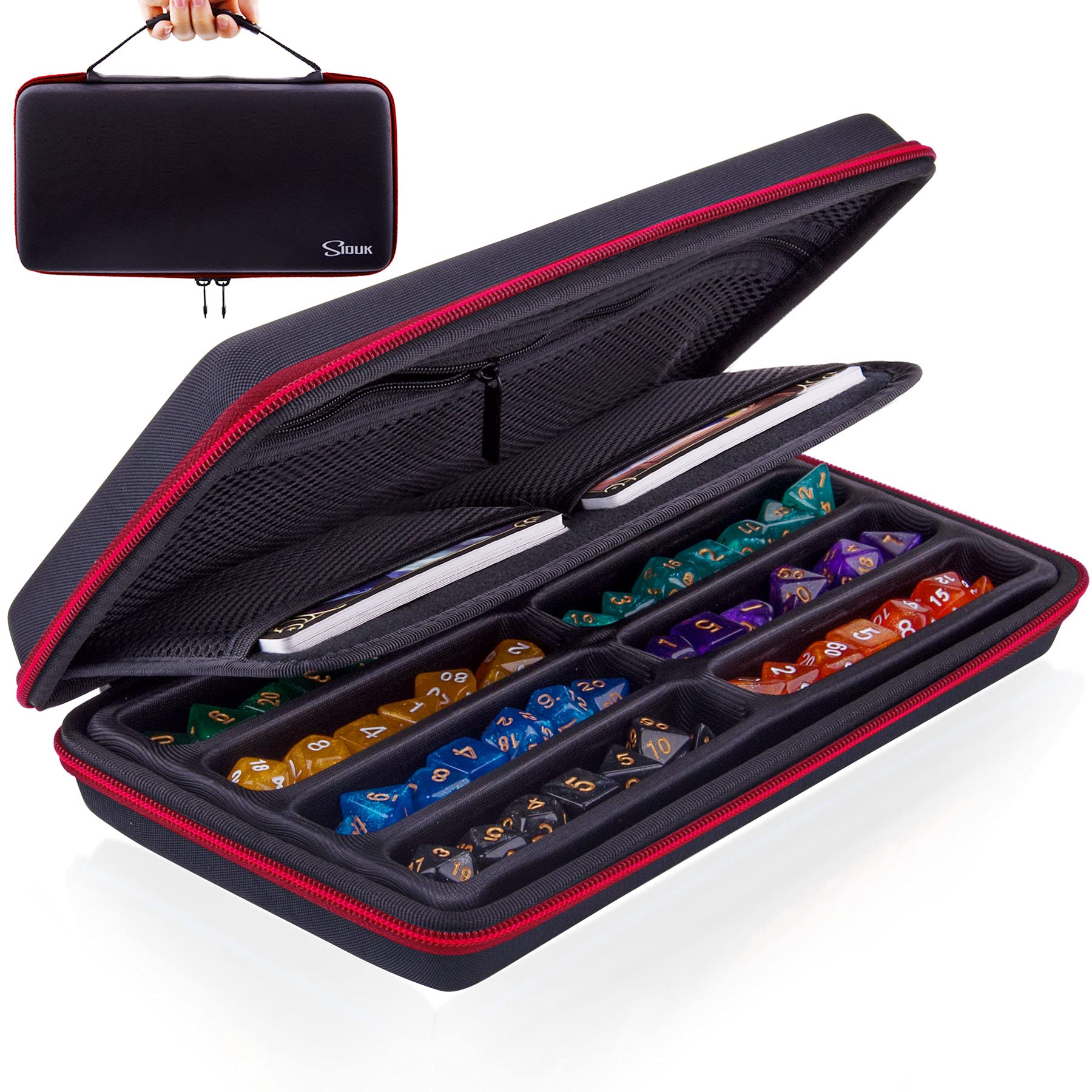
The tray inside this case lifts out, and that's the whole reason it's our top pick. Load eight sets into the molded slots, zip it shut, and the dice travel flat and quiet; unzip it at the table, lift the tray out, and the compartment underneath becomes a rolling well with two inches of wall around it. That depth is doing real work — a shallow tray lets a d20 hop out on the first bounce, and there's no recovering from that once it's on a game store floor.

The lid is where the storage gets smarter than the plain exterior suggests: a large mesh pocket takes a folded character sheet, and two small pockets hold a pencil, a mini, or the stray d6 that never made it back into a set. The slots grip standard seven-die sets firmly enough that nothing rattles on the walk over. That grip has a limit, though — chunky hand-made d20s and metal dice sit proud of the slot and the lid presses on them instead of closing flush.

At 11 by 6 by 2.2 inches it slides into a tote beside a couple of hardbacks, and the web handle lets you carry it on one finger with the books under the other arm. The 900D Oxford shell has held up to bag duty without anything we'd notice. It's the case we grab when we don't want to think about dice at all, which is the highest compliment a storage box can get.

Pros

  • Removable tray doubles as a rolling well
  • Holds eight standard sets in molded slots
  • Mesh pockets for a sheet and small gear
  • Hard EVA shell with a smooth zipper

Cons

  • Snug slots pinch oversized and metal dice
Our verdict

We recommend this one to most people: eight standard sets ride in slots that keep them quiet, and the tray lifts out to become a rolling well.

Check Latest Price
2

Best Case and Tray in One

CASEMATIX Dice Tray Case

95 /100
Lab Score Outstanding

Key details

Closure
4 magnetic snaps
Dimensions
10 x 10 x 2 in
Rolling Area
6.5 in arena in the base
Dice Capacity
Up to 115 dice, six sets
View on Amazon

Ten inches square and two inches deep, this is built like a small briefcase: a hard PU leather shell, a soft non-scratch lining, and an embossed dragon across the top if you want your dice box to look like something a wizard would carry. The lid comes off entirely and works as a second rolling tray, which is the trick that makes it more than a leather box.

Where it earns its place is at a full table. With the base and the lid both working as arenas, the far end of the table isn't reaching over your character sheet to roll, and two players can throw at once. We like that more than we expected to; it turns one purchase into seating for two.

The listing promises up to 115 dice, which works out to six standard sets; packed with big d20s and metal, plan on five. Small dice can wedge into the channel that runs around the rim — a d4 is the usual victim, and a fingernail is the usual fix. Closed up it's a flat package that slides behind a car seat, which is not something the taller chests here can claim.

Pros

  • Lid lifts off as a second rolling tray
  • Holds up to six standard sets
  • Non-scratch interior protects painted dice
  • Embossed leather finish looks the part

Cons

  • Four magnets need a deliberate pull
  • Ten-inch square takes real bag space
Our verdict

If you want the box and the rolling surface to be one object, this is the one we point to: leather outside, a six-and-a-half-inch arena inside, and a lid that adds a second.

Check Latest Price
3

Best for Large Collections

SIQUK Big Capacity Case

92 /100
Lab Score Outstanding

Key details

Carry
Built-in handle
Trays
Two removable slotted trays
Pockets
Two large mesh pockets
View on Amazon

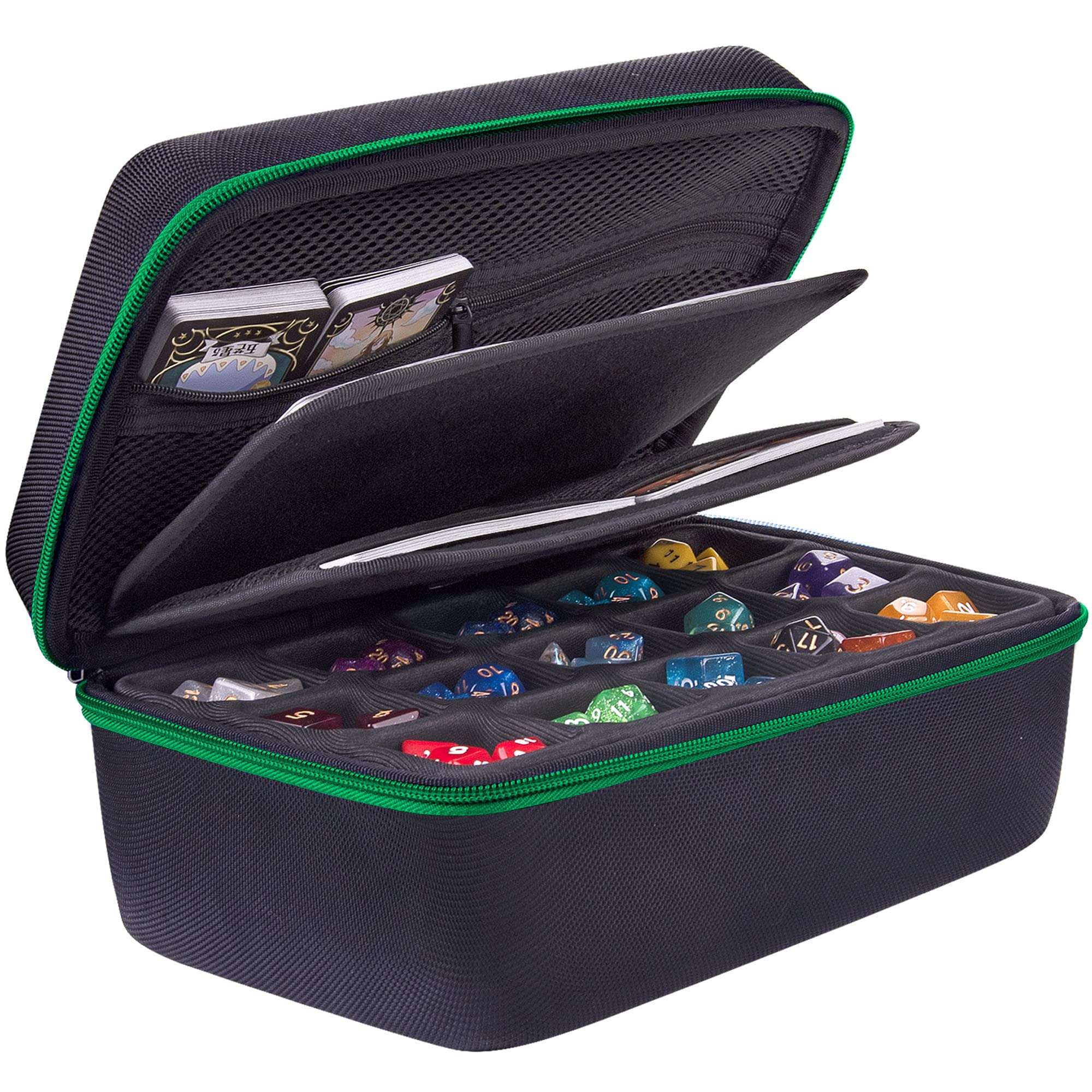
This is the case for the DM whose dice bag has turned into a duffel. Two slotted trays stack inside it, and each lifts out on its own — pull one to your side of the screen for the session's monsters and leave the other packed with your good set. That sounds like a small thing until you've spent a turn digging through six sets for a d12.

The capacity holds up in the direction that matters: standard seven-die sets drop one per cell, and the oversized dice that come in bundle boxes and collector sets fit too, which is more than the compact molded cases can promise. Two large mesh pockets in the lid take the paperwork — a sheet, an initiative tracker, a pencil — and the handle is easy to grab one-handed when the thing is full.

We keep this one for collectors and for campaigns where the DM brings everything. The trade is size: it's a bag item, not something that slips into a coat pocket, and a full one has some heft. New cases can smell of fabric and adhesive for a day or two, so unzip it and let it air before you load it.

Pros

  • Two trays come out independently
  • Fits oversized collector and bundle dice
  • Mesh pockets take sheets and pens
  • Shell and zips hold up to travel

Cons

  • Snug slots grip chunky dice
Our verdict

Buy this when eight sets is a rounding error: two removable slotted trays, mesh pockets for the paperwork, and room for the oversized dice the compact cases turn away.

Check Latest Price
4

Best Display Case

Forged Dice Display Case

91 /100
Lab Score Outstanding

Key details

Lid
Clear plastic display lid
Trays
Three removable divided trays
Dimensions
13.75 x 9.5 x 4.5 in
Dice Capacity
Up to 24 sets
View on Amazon

Everything the SIQUK does for a game night, this case does for a shelf. It measures 13.75 by 9.5 by 4.5 inches, with aluminum edges, a clear plastic lid, and a black textured interior — closer to a display board than a carrying case, and built to be looked at with the lid down.

Three divided trays hold up to 24 polyhedral sets between them, and the trays are the point: lift one out, pass it down the table, set it back. Take all three out and the base becomes a rolling surface with a wall around it, which is the one job a display case usually can't do. The velvet lining matters more than it sounds — we expected decoration, and it turns out to keep resin and metal dice from knocking together.

It's the priciest case in this group and the only one that treats a collection as something to look at, and a clear lid, velvet trays, and a rolling base are three things no other case here does at once. It's the sort of object that ends up living open on a shelf, getting rearranged.

Pros

  • Clear lid shows the collection off
  • Three removable velvet-lined trays
  • Holds up to 24 polyhedral sets
  • Base doubles as a rolling surface

Cons

  • Heavy and wide for a game bag
  • Slots sized for standard acrylic dice
Our verdict

A collection you want to look at rather than lug around belongs in this case: a clear lid, three velvet-lined trays, and a base that rolls once the trays come out.

Check Latest Price
5

Backpack Carry

ALKOO Dice Storage Case

93 /100
Lab Score Outstanding

Key details

Insert
Removable foam tray
Weight
3.2 oz
Dimensions
6.29 x 1.18 x 7.87 in
Dice Capacity
Up to 5 sets
View on Amazon

At 1.18 inches thick and 3.2 ounces, this case disappears into a backpack in a way none of the bigger boxes here manage. That's the trade: five sets instead of eight, flat foam instead of deep molded wells, and no room for a character sheet. If the case is something you carry to a session and back rather than a collection you keep, it's the right trade.

The foam tray holds five sets flat, which makes it easy to see at a glance that the d8 is still on the kitchen table. It lifts out entirely, handy for spreading dice out mid-game and less handy when the case is opened at an angle — set it down flat before you unzip and the insert stays where it belongs.

The outside does what a small case needs to: the zipper runs smoothly, the shell holds its shape, and we were pleasantly surprised by the exterior, which looks sharper than the bare foam inside suggests. New ones carry a factory smell for a day or so, so unzip it and let it air before it goes in a bag with your books.

Pros

  • Barely over an inch thick
  • Weighs about three ounces
  • Foam tray lifts out for spreading dice

Cons

  • Loose insert slides when opened off-level
  • Flat cutouts let odd dice rattle
Our verdict

Backpack space decides this one: five sets, barely three ounces, and a foam tray that shows every die at a glance.

Check Latest Price
6

Gift and Display

Forged Dice Mimic Chest

93 /100
Lab Score Outstanding

Key details

Closure
Clasp with working hinges
Material
Hand-painted polyresin
Dimensions
5.5 x 3.5 x 3.75 in
Dice Capacity
Up to 35 dice or 5 sets
View on Amazon

Set this on the table and the game stops for a second. The chest is cast in polyresin and hand-painted, and when the lid comes up you're looking into a mouth full of teeth rather than a tray of dice. It's the one case here that does something at the table before anyone rolls.

We think that's the fairest way to judge it: a display piece that holds dice, not a travel case that happens to be decorative. The hinges and clasp are working hardware set into resin, and the teeth along the rim can snap and the hinge screws work loose once the chest gets knocked around or shoved into a bag. That doesn't make it a bad buy; it makes it the box that lives on a shelf or rides in something padded.

Inside is a single open cavity, 5.5 by 3.5 by 3.75 inches, rated for five sets or 35 dice. Packed tight that's about right; if you like to rummage, three sets and a handful of loose dice is the realistic load. The clasp holds the lid shut, and the heft is what makes it feel like a prop rather than a box.

Pros

  • Hand-painted mimic detail stops the table
  • Working hinges and a closing clasp
  • Rated for five sets or 35 dice
  • Heavy resin feels like a prop

Cons

  • Teeth and hinge screws are the wear points
  • One open cavity with no dividers
Our verdict

We think it earns its place as the gift pick rather than the daily driver: a hand-painted mimic that stops the table, with hinges that want gentle handling.

Check Latest Price

How We Tested the Best Dice Boxes

We built the shortlist from player recommendations, game-store shelves, and maker specs, then narrowed it by internal dimensions, closure type, material, lining, and claimed capacity. Anything with vague measurements or a lid that relied on friction alone came off the list.

The remaining 12 boxes spent seven months in regular use. They sat on coffee tables during weekly campaigns, rode in backpacks to a convention weekend, got passed around during one-shot sessions, and lived on shelves between games. We filled each with a standard seven-dice set, then added metal d20s, mini d6s, and a few oversized dice until the lid would no longer close flush. We counted what fit without pressure and noted whether the compartments held dice snugly or let them rattle.

Closure was the first thing to fail on cheaper boxes, so we opened and closed each one 100 times, then held it upside down and shook it for 30 seconds to see whether the lid stayed put. We checked whether magnetic snaps self-aligned or needed two hands, whether locking mechanisms stayed tight after repeated use, and whether hinges and screws loosened. We also looked at durability over the seven months: finish scratches, lining wear, felt peeling, and corners that softened. For appearance and gift appeal, we set each box on a table and asked two non-players which one they'd pick up; for value, we compared what each did against what it cost.

How to Choose a Dice Box

Match Capacity to What You Actually Carry

Compare cases in sets, not dice. A standard polyhedral set is seven dice, so a case rated for eight sets holds 56, and the big SIQUK's stacked trays are aimed at someone who owns several hundred. Most players carry one or two sets to a session, and a case twice that size is dead weight in a bag.

DMs and collectors are the exception. If you run the game, two removable trays are worth more than a hundred extra slots, because you can pull one down the table and leave the other packed.

Decide Whether You Want a Rolling Surface Built In

Rolling on the table works right up until a d20 leaves the table, and a case whose base becomes a shallow arena solves that in the object you were already carrying. Check the rim height rather than the footprint: the SIQUK's compartment is two inches deep and keeps dice in, while a display case's base is shallower and better for showing dice than for stopping a bounce.

If two people roll at once, the CASEMATIX's lid gives you a second surface. That matters at a crowded table and not much anywhere else.

Check Slot Size Against Your Own Dice

This is where most dice boxes disappoint, and it is invisible in a listing photo. Molded slots are cut for standard acrylic seven-die sets; metal dice, hand-poured resin d20s, and the oversized dice that come in bundle boxes sit proud of the slot, so the lid presses on them or won't close flush.

Before you buy, measure your largest d20 across the faces. If it runs much over an inch, look for a case with a removable slotted tray and an open compartment — the insert comes out and the space underneath takes the odd shapes. Flat foam, like the ALKOO's, is more forgiving than deep molded wells, though it holds less firmly.

Weigh Protection Against Display

Two families of box do different jobs. Hard EVA and PU leather cases with zips or magnets are built to be knocked around in a bag; resin chests and clear-lidded display cases are built to be looked at. Both store dice, but only one survives a drop on a driveway.

On a decorative chest the hardware is the wear point: hinges screwed into resin, thin cast teeth, a latch that takes the whole lid's weight when it's lifted by one corner. If the box lives on a shelf, that's a fair trade. If it rides in a backpack, buy slots and a zipper instead.

Frequently Asked Questions

Final Verdict

For most players the SIQUK case is the answer: eight sets in slots that keep them quiet, a pocket for the character sheet, and a tray that lifts out so the case becomes your rolling well. Beyond slot size, we have no caveat worth mentioning.

Two situations change the recommendation. If your collection has outgrown a single tray, or includes the oversized dice from bundle boxes, step up to the big SIQUK. And if the box is going to live on a shelf and be looked at rather than carried, the Forged Dice display case does that better than anything else here.