Best Dungeon Master Screens of 2026

A dungeon master screen does two jobs at once: it hides your maps and notes from players, and it puts the rules you need at eye level. A flimsy one wobbles every time someone bumps the table; a beautiful one with cramped panels can slow a session more than it helps. We've spent six months with 12 screens, and the right ones stay put, look like part of the table, and keep the chaos behind them organized.

What surprised me is how much the small stuff matters: whether the panels fold flat for transport, how tightly the sleeves grip a handout, and whether the player-facing art pulls players in or looks like a craft project. Value isn't just the sticker price—it's how many sessions a screen survives before a hinge loosens or a corner frays. Customizability matters too; some screens are blank canvases, while others lock you into one layout. The picks below are the ones my group kept reaching for across different tables and budgets.

1

Best Overall

CZYY Faux Leather DM Screen

95 /100
Lab Score Outstanding

Key details

Folded Size
9" x 12" x 0.5"
Standing Size
12" tall x 36" long
Cover Material
Faux leather
Insert Pockets
Four, A4 size
View on Amazon

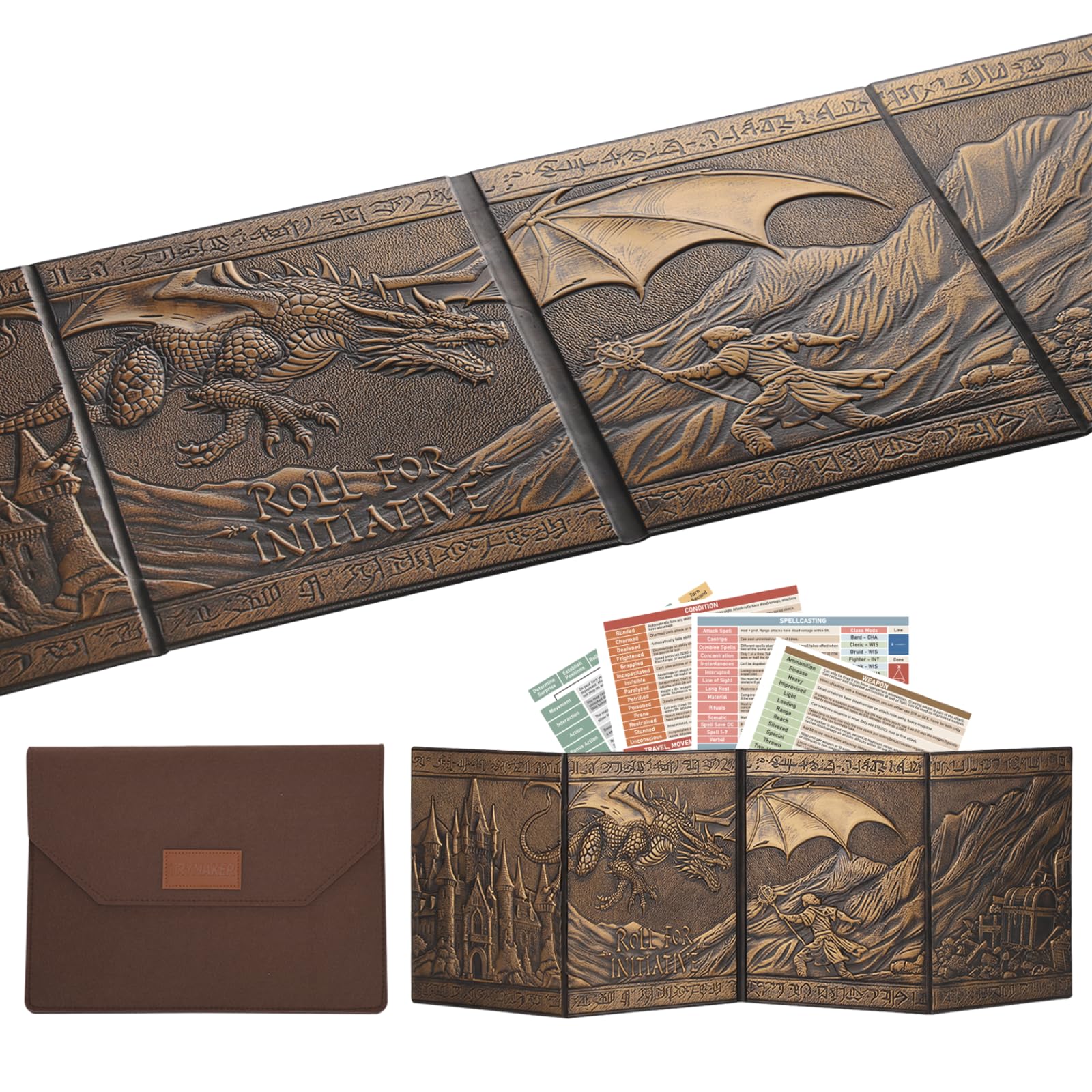
The side your players see is a raised leather scene — a dragon, a mimic, a stretch of dungeon masonry — and it's the only screen in this group that people remarked on before anyone sat down. What sold us is underneath that: the four panels hold their angle without a book propped behind them, they don't creep across the table when someone leans on the map, and the plastic behind each sleeve is stiff enough that a page doesn't sag into the fold. We've used screens that collapse into a heap the moment you let go. This isn't one of them.

Inside, four sleeves take A4 sheets, and the laminated reference inserts that come with it are genuinely readable — the sort of thing you glance at mid-turn instead of opening a book. Here's the catch: A4 is a shade narrower than a U.S. letter sheet, so a page printed at home needs a trim down one long edge before it slides in cleanly. Thirty seconds with a paper cutter, and it's the only fuss this screen asks of you. The felt case is the detail we kept coming back to, because it keeps the embossing from getting scratched in a bag.

It stands 12 inches tall and 36 wide, folds to roughly the size of a hardback, and weighs about two pounds. That's the trade: the leather and the stiffening are what make it feel permanent, and they're also what you carry to game night. Four pockets is also the least reference space of the big customizable screens here — the Stratagem and the CASEMATIX both give you eight.

Pros

  • Panels stand unaided and stay put
  • Laminated reference inserts are easy to read
  • Felt carry case included
  • Full 12-inch height hides a stack of notes

Cons

  • Four pockets where rivals offer eight
  • About two pounds to carry
Our verdict

The one we reach for: stiff faux-leather panels, four full-size sleeves, a felt case, and enough height to hide a stack of notes. Buy it if you want a screen that looks like furniture.

Check Latest Price
2

Best Value

Stratagem The Master's Tome

93 /100
Lab Score Outstanding

Key details

Pockets
Eight, letter paper
Material
Waterproof vinyl
Standing Size
11.5" tall, over 3 ft wide
Folded Thickness
1/2"
View on Amazon

Eight pockets cut for letter paper is the detail that makes this screen easy to live with. Print your notes at full size, slide them in, no trimming and no A4 compromise — and you get pockets on both sides, so the player-facing panels can carry art or a handout. It runs more than three feet wide and 11.5 inches tall, which is more coverage than our top pick for less money, and the vinyl takes dry-erase marker. We wrote initiative order straight onto a panel and wiped it clean at the end of the night.

The folding is where it gives ground. The vinyl is thin, and the seams at the hinges are what decide how long it lasts. A rough fold or a bag full of hardbacks is what does the damage — ours has been fine because it gets folded flat and kept on a shelf rather than crushed in a rucksack. Buy it for a home table and it's a lot of screen for the money. Treat it as a screen that lives in a bag and you're inviting the split seam.

Two more things worth knowing. The pockets are snug, which holds a page securely but slows a mid-session swap, and the included reference pages cover 5e and Pathfinder as examples rather than as a complete answer for either. Wipe the vinyl down at the end of each session, as the maker advises, and it stays clean instead of building up a grey haze of old marker.

Pros

  • Eight letter-size pockets, no trimming
  • Dry-erase vinyl on both sides
  • Over three feet wide when open
  • Lowest price of the screens here

Cons

  • Snug pockets slow down page swaps
Our verdict

If you print fresh notes every session, this is the screen to buy: eight letter-size pockets, dry-erase vinyl, and a fold-flat build at the lowest price in this group.

Check Latest Price
3

Best for Big Tables

CASEMATIX 8-Panel Deluxe GM Screen

91 /100
Lab Score Outstanding

Key details

Weight
4.84 lb
Pockets
Eight wet-erase, US Letter
Folded Size
11.75" x 10.75" x 1.75"
Standing Size
47" x 11.75"
View on Amazon

Forty-seven inches across and 11.75 tall, this is the widest wall of reference in this group, and we understood the appeal the moment it was open: eight letter-size wet-erase pockets across the main panels, plus two interior wings that swing out to give you four more surfaces facing you. If your group has a permanent table and a DM who wants every table and condition in view at once, there is nothing else here that covers this much ground.

It weighs 4.84 pounds, and that weight is also why it sits still when players lean over the map. Folded, it measures about 11.75 by 10.75 by 1.75 inches — thick enough that it wants its own slot in a bag rather than being wedged between books. At 12 inches tall and that wide, your players also can't see over it to the battle map unless the table is deep, so measure before you commit.

The embossed dragon cover is the best-looking of the leather-look screens here, and it doesn't feel cheap in the hand. Where it asks for patience is setup: eight pockets and four wing surfaces take real time to fill the first time, and you want to do that at home rather than while five people watch you shuffle paper.

Pros

  • Widest reference surface in this group
  • Wet-erase pockets sized for letter paper
  • Swinging wings add four more surfaces
  • Sits still on the table

Cons

  • Nearly five pounds to carry
  • Needs a deep table to see past
Our verdict

For a dedicated game room with a deep table, nothing here matches its surface area. We recommend it to groups who leave the screen up between sessions.

Check Latest Price
4

Best for Wilderness Campaigns

D&D Wilderness Kit Screen

95 /100
Lab Score Outstanding

Key details

Player Handout
Laminated Actions in Combat sheet
Punch-out Cards
14 condition, 9 initiative, 4 weather and exhaustion
Dry-erase Extras
100-hex map and journey tracker
Reference Tables
Weather, foraging, navigation, food and water, ship speeds
View on Amazon

The screen is only part of what you're buying. The box also carries a laminated Actions in Combat sheet for players who are still learning, a dry-erase 100-hex map and a separate journey tracker for marking progress, and a punch-out card set — 14 conditions, nine initiative trackers, four covering exhaustion and extreme weather — and it all packs back into the folder.

The screen's own tables are niche in the best way: weather, foraging, navigation, food and water, ship speeds. If your campaign is a trek — Chult, Saltmarsh, Icewind Dale, the Underdark — those are the numbers you'd otherwise page through three books to find, and having them on the inside of the screen saved us real time in a travel-heavy session. If your game lives in a city, most of that interior sits unused.

It's a printed screen, so there's nowhere to slide your own notes except behind it, and the tables you get are the ones Wizards chose. The build is solid — it stands like the hard cover of a book, and the art runs across all four panels without a seam in the picture. Nothing else here bundles as much usable paper for the same kind of money.

Pros

  • Wilderness tables you'd otherwise page for
  • Dry-erase hex map and journey tracker
  • Condition and initiative cards included
  • Art runs unbroken across four panels

Cons

  • Fixed wilderness tables, no swappable inserts
Our verdict

Buy it if your campaign is outdoors: the tables cover travel, weather, and foraging, and the hex map and condition cards earn their space in the folder.

Check Latest Price
5

Best Compact

D&D 2024 Dungeon Master's Screen

93 /100
Lab Score Outstanding

Key details

Format
Four-panel cardstock screen
Weight
14.1 oz
Interior
Revised 2024 reference tables
Rules Edition
Fifth edition, 2024
View on Amazon

There's no sleeve on this screen. It's four cardstock panels with Wizards' tables printed on the inside, and what you see is what you get. That's a real limitation if you write your own encounters — and it's also why it's the fastest screen here to set up and the lightest to carry, at just over 14 ounces.

The interior is the 2024 revision, rebuilt after a decade of DM feedback, and it's organized around the questions the current rules actually make you answer. Our group runs the new edition, and having the skill list and the revised tables in front of you rather than on a separate sheet is the reason this one stayed on the table after the novelty of the leather screens wore off.

The player-facing art is the least adventurous in this group — posed characters rather than a sweeping scene — and the cardstock is lighter than the leather-wrapped screens, so it wants a folder or a sleeve in the bag. Neither bothers us much given what it costs. For someone learning the current edition, it's the least intimidating screen to put up.

Pros

  • Revised 2024 tables built for current play
  • Skill list and core tables at eye level
  • Sets up and folds away in seconds
  • Just over 14 ounces

Cons

  • Printed tables only, nothing to swap in
  • Lightest cardstock build here
Our verdict

The pick for a new DM running the 2024 rules who wants current tables and nothing to assemble. Compact, quick to set up, and the simplest thing here to carry.

Check Latest Price
6

Gift Giving

Trymaker Faux Leather DM Screen

91 /100
Lab Score Outstanding

Key details

Included
Rule sheets, felt sleeve, gift box
Standing Size
37.56" x 12.2"
Cover Material
Faux leather
Pocket Material
Thickened PVC
View on Amazon

Creased sleeves are the quiet annoyance of customizable screens: you read a rule through a wrinkle and lose the line. This one's answer is thickened PVC in the pockets, and in the hand it reads flatter and clearer than the vinyl sleeves on the cheaper picks here. It's the sort of detail that doesn't show up in a photo and decides whether you enjoy using the thing.

The rest is presentation. An embossed battle scene in an antique bronze finish that looks more expensive than it is, a fold that slips into a backpack like a book, rule reference sheets, a felt sleeve, and a gift box. It's the one here that arrives ready to hand to someone as a present rather than needing a bag and a ribbon.

We've had less time with this screen than with the top two, and nothing about it has worried us — the panels stand, the pockets read cleanly, the finish hasn't marked. It measures 37.56 inches wide by 12.2 tall, so it covers a normal table while still letting players see past it. Pick it when the look matters as much as the pockets.

Pros

  • Thickened PVC sleeves read without creases
  • Embossed bronze finish looks pricey
  • Felt sleeve and gift box included
  • Folds to book size for a backpack

Cons

  • Close to three pounds in the bag
Our verdict

A gift-grade screen with the clearest sleeves in this group. Choose it when the look matters and you want your printed pages to read cleanly.

Check Latest Price
7

First Screens

Haxtec 4-Panel DM Screen

89 /100
Lab Score Excellent

Key details

Panels
Four
Inserts
Four 5.5e rules sheets
Material
Paper
Standing Height
11.5"
View on Amazon

Paper, not leather — and the maker argues that as an environmental choice rather than an apology. What it buys you is weight and price: this is the lightest full-size screen in the group and one of the cheapest four-panel fold-outs here. It stands 11.5 inches tall, which is tall enough to hide a DM screen's worth of notes and dice.

Four 5.5e reference sheets come already in the pockets, and those fit. Your own letter-size printouts mostly won't, because the sleeves are cut narrow — the supplied inserts are narrower than standard letter paper and the pockets are made to that size. Trim before you print, or plan on folding the edge under and hoping nobody notices.

The plastic is the weak point. The sleeves are tight enough that forcing a page can pull the plastic away from its backing, so slide slowly and don't overstuff. The panels themselves are stiff and the artwork is genuinely good — one of the better fantasy scenes in this group, which is not what you expect at this end of the price range.

As a first screen, a spare for a second group, or a gift for someone who just started DMing, it does the job: it hides your notes, it stands up, and it puts 5.5e tables in front of you without a book lying open. Buy it knowing you'll trim pages and treat the sleeves gently, and it will last a new DM long enough to know what they want next.

Pros

  • Lightest full-size screen here
  • 5.5e reference sheets included
  • Stiff panels and strong artwork
  • Low cost for a four-panel screen

Cons

  • Sleeves cut narrow for standard paper
  • Plastic can peel if a page is forced
Our verdict

A sensible first screen or spare: light, paper-built, and shipped with 5.5e reference sheets. Expect to trim your own printouts before they slide in.

Check Latest Price
8

Chult Campaigns

Tomb of Annihilation DM Screen

93 /100
Lab Score Outstanding

Key details

Weight
12.8 oz
Campaign
Tomb of Annihilation
Material
Cardboard
Dimensions
8.5" x 11" x 0.5"
View on Amazon

If you're running Tomb of Annihilation, this is the screen that matches the book: random encounters in Omu and the jungle, treasure and cache drops, weather tables for Chult, and a player-facing vista that sets the tone before anyone rolls a die.

It's cardboard, it weighs 12.8 ounces, and it measures 8.5 by 11 by half an inch — the smallest folded footprint of anything here, which matters when the screen shares a bag with three sourcebooks. The art on the outside is lovely, and the inside is dense in exactly the way you want when the party wanders off your prepared map.

Outside that campaign it's a plain, short screen covered in tables you'll never read, with no way to add your own. That's the deal. It's the least expensive way to get the Chult tables in front of you, and it's worth nothing to a table playing anything else.

Pros

  • Chult encounters, treasure, and weather at a glance
  • Smallest folded footprint here
  • Player-facing art sets the scene
  • Light enough to carry with the books

Cons

  • Only useful for one campaign
Our verdict

Only worth it if you're running Tomb of Annihilation — then the Chult tables save you constant page flipping, and nothing else here does that.

Check Latest Price

How We Tested 12 Dungeon Master Screens

We built the shortlist by scanning current screens, filtering out ones with thin hinges, unclear panel layouts, or sleeves that only fit oversized paper, and looking for a mix of materials, formats, and price points. Then we tested 12 screens over six months in the places they actually get used: a weekly home campaign, a cramped coffee table one-shot, and a convention table where setup had to happen fast. We set each one up solo, folded and unfolded it at least once per session, and noted whether it stayed upright when someone leaned on the table.

During play, we watched whether the screen helped us run combat faster or just blocked the map, and whether the inside panels were legible under dim lamp light. We slid standard handouts and printed stat blocks into every sleeve, then tilted each screen to see whether the paper gripped or slid out. We also checked the player-facing print for glare, blur, and wear, and tried adding notes with clips and tape to judge how much each screen could be customized without looking messy.

After each session, we checked hinges, corners, and sleeve seams for loosening or fraying, then compared that wear against what each screen cost. The screens that scored best were not always the prettiest; they were the ones that set up quickly, survived being hauled in a tote, and still looked good enough to leave on the table between sessions.

How to Choose a Dungeon Master Screen

Sleeves or printed tables

A screen with sleeves — the CZYY, the Stratagem, the CASEMATIX — is a frame you fill. Print your own notes, swap systems between campaigns, and write on the vinyl with a dry-erase marker. A printed screen such as the 2024 D&D screen or the Wilderness Kit hands you the tables the publisher chose and asks nothing of you in return.

The trap with printed screens is edition drift. A screen built around one printing of the rules keeps the old numbers when the next book lands, and there's nothing to slide out. If you run homebrew, more than one system, or a rules set that isn't D&D, buy sleeves. If you run one edition at a fixed table and want zero prep, printed is genuinely faster.

Match the sleeve to your paper

Pocket size is the detail shoppers skim and then regret. U.S. letter is 8.5 by 11 inches; A4 is 8.27 by 11.69. A letter sheet is wider than an A4 sleeve and slightly shorter, which is why people end up trimming pages or living with a curled edge. The sheets that ship with a screen are usually cut to the pocket rather than to your printer, so they fit where yours don't.

Check which standard the pockets are cut for before you order. The Stratagem and the CASEMATIX are built around letter paper; the CZYY and most imported leather-look screens take A4. If you print at home, set your printer to the pocket size rather than fighting it afterward.

Size it to your table

Width runs from around 22 inches to 47, and height clusters between 11.5 and 12. Taller hides a stack of notes and a dice tray; shorter lets your players see the map without leaning. Width cuts both ways — the CASEMATIX's 47 inches is the most reference space here and also a wall the group has to look around.

Measure your table depth before you buy the widest screen you can find. You need room for the screen, the battle map, and everyone's character sheets, and a screen that forces players to stand up is a screen that gets folded away.

Folds, seams, and carrying it

Screens fail at the hinge, not in the middle of a panel. Thin vinyl folds smallest and is the most vulnerable to a split seam; leather-wrapped and stiffened panels stand up better and weigh more, from a bit over a pound up to nearly five.

Fold along the seams instead of grabbing a panel corner, keep it flat or in the case if one comes with it, and don't bury it under sourcebooks. A screen that lives in a bag wants a sleeve; a screen that lives on a shelf can be as heavy as you like.

Frequently Asked Questions

Final Verdict

The CZYY is the screen we recommend to most tables. The panels stand on their own, the sleeves are readable at a glance, the felt case means the embossing survives the trip, and it looks like a piece of furniture rather than a printout.

One requirement changes the answer. If your notes are printed on U.S. letter and you don't want to trim every page, the Stratagem's eight letter-size pockets and dry-erase vinyl cover more table for less. And if the screen never leaves a dedicated game room, the CASEMATIX's extra panels buy you the most working space of anything here.