Best Miniature Painting Sets of 2026

A miniature paint set shouldn't be judged by bottle count. The good ones thin cleanly, cover a shoulder pad in two coats, and stay suspended instead of separating into a watery puddle. I learned that after a cheap set looked generous in the box, then turned a batch of goblins into a chalky mess. What separates a set built for miniatures from a general craft kit is consistency: the same drop behaves predictably on plastic, metal, and primer, whether you are blocking in base colors or layering a highlight. That consistency is what saves the evening.

Over six months, my team and I painted 14 sets across a batch of 28mm fantasy figures, board game minis, and terrain. We compared color selection and value, but spent more time on coverage and performance, then kept handling the finished figures to see which finishes stayed flat and which chipped. We also tracked curing time, because a paint that feels dry but stays tacky is a trap. The picks below are the sets that made painting feel easier, not just fuller.

1

Best Overall

Vallejo Basic Colors USA Set

95 /100
Lab Score Outstanding

Key details

Cleanup
Water or Vallejo medium
Dispenser
Precision eyedropper
Paint Type
Water-based acrylic
Bottle Count
16 × 18 ml
View on Amazon

The dropper bottle is what decided this one for us. Vallejo's 18 ml bottles let you shake, unscrew, and drop exactly what you need onto a palette, then cap the rest without a brush ever going near the supply. Sixteen bottles in the Basic Colors USA range sounds modest next to a wall of a hundred colors, but the palette leans on the fundamentals that do most of the work on a figure, and we found ourselves mixing to shift a shade rather than mixing to fill a gap.

Coverage is where it earns the recommendation. On a primed plastic figure the paint sits down flat, holds an edge, and the light colors build to a solid coat in fewer passes than we expected from a set at this level. It's a paint that doesn't punish someone still learning: thin it, load the brush properly, and it does what you intended.

Straight from the bottle it's thick, so plan on a drop of water or medium on the palette before it goes near the model. Thinned, it comes off the brush predictably and dries to a flat finish, and cleanup is water — which matters more than it sounds when you're painting three nights a week. Prime first, though. Acrylic on bare, glossy plastic can scrape off under a thumbnail, and that's a surface problem rather than a paint problem.

What's not in the box is a brush, a palette, or a guide, and sixteen bottles won't cover every scheme you dream up — the greens and oranges are yours to mix. Dosed by the drop, 18 ml goes further than the bottle count suggests, and the set grows with you: every color here has a match elsewhere in the wider range when one runs dry.

Pros

  • Drop-by-drop dosing, so very little paint is wasted
  • Strong, even coverage on primed plastic
  • Thins and cleans up with water
  • 16 × 18 ml bottles last through a project

Cons

  • Only 16 bottles, so secondary shades come from mixing
Our verdict

Our pick for most painters: consistent, water-thinnable acrylics in dropper bottles that cover cleanly and don't punish a beginner's technique.

Check Latest Price
2

Best All-In-One Starter Kit

Army Painter Fanatic Starter Set

96 /100
Lab Score Outstanding

Key details

Paint Mix
7 acrylic, 2 metallic, 1 wash, 1 primer
In The Box
Brush and miniature figure
Paint Count
11 × 18 ml
Color System
Flexible triads
View on Amazon

Eleven bottles, a brush, and a miniature: the Fanatic Starter Set is the only pick here that lets you sit down with nothing and finish a figure. The practice model is small and lightly detailed, which we think is exactly right — you can watch what thinning does to a surface without risking a character you care about. And the eleven bottles aren't filler: seven acrylics, two metallics, a wash, and a brush-on primer, which happens to be the order most beginners paint in anyway.

The color triads are the smartest thing in the box. Each paint belongs to a family built from the same root color, so a base, a shade, and a highlight sit next to each other in the tray — you're not guessing which green goes over which green. The included guide walks through thinning, priming, basing, shading, and highlighting, which is more instruction than most sets bother with.

Where it gives ground is the finish, which lands closer to satin than flat matte. A figure straight from the box looks a touch shinier than one sealed with matte varnish; next to a painted army you notice it, and across a table you stop caring. For the first dozen figures, the sequence in the box matters far more than the last few percent of sheen.

Pros

  • Brush and practice miniature included
  • Wash, primer and two metallics in the box
  • Triad system makes shading a base color obvious
  • Beginner guide covers thinning through highlighting

Cons

  • Eleven bottles is a smaller palette than the 16-bottle sets
  • Satin finish reads shinier than matte
Our verdict

The set we hand a brand-new painter: paint, wash, primer, brush, and a practice figure, so the first session ends with something finished.

Check Latest Price
3

Best for Batch Painting

Army Painter Speedpaint 2.0 Set

90 /100
Lab Score Outstanding

Key details

Coverage
One coat
Paint Mix
9 Speedpaint, 1 metallic
In The Box
Basecoat brush
Paint Count
10 × 18 ml
View on Amazon

This set does one job, and it does it well: a generous coat over a light primer, and the paint runs into the recesses while the raised surfaces stay bright, so a figure comes out base-coated and shaded in a single pass. Where it stops is detail. Faces, lenses, and freehand still want an ordinary acrylic, and nobody should open ten bottles of Speedpaint expecting to paint a character from start to finish.

The method has rules. Start from a white or light grey primer, shake the bottle properly, load the brush generously, and resist going back over an area while it's still wet — that's what turns a clean one-coat finish into streaks. The ten bottles give you nine colors and a metallic plus a basecoat brush, and the paint dries fast enough that you can work around a model instead of waiting on it.

For a batch of thirty skeletons or a board game's worth of identical heroes, we reach for this before anything else; the progress is quick enough to keep a project alive. Keep two or three ordinary acrylics within arm's reach for eyes, metal trim, and anything you want to glaze, and the finished figures hold up beside models that took three times as long.

Pros

  • One generous coat covers base and shade
  • Nine colors plus a metallic and a basecoat brush
  • Dries fast enough to keep painting

Cons

  • Needs a white or light primer, sold separately
  • Little control for layering and fine detail
Our verdict

The fastest route to a painted army: one coat over light primer gives you base and shadow, provided you keep detail paints nearby.

Check Latest Price
4

Best for Historical Figures

Vallejo Wargame Special Set

92 /100
Lab Score Outstanding

Key details

Finish
Matte
Dispenser
Precision eyedropper
Paint Type
Water-based acrylic
Bottle Count
16 × 18 ml
View on Amazon

Sixteen bottles of uniform. Where the Basic Colors set hands you a general spectrum, this range is chosen for figures in cloth — light and dark flesh tones, blue grey, mahogany brown, and the greens and yellows that do most of a military line. If you paint historical or military miniatures, it's the palette that stops you rebuilding a khaki out of four bottles every time you sit down.

Same bottle, same habits: 18 ml droppers, water-based, thinning predictably, drying to a flat finish. On vehicles and larger models it goes on smoothly enough to leave no brush marks, and a few drops of thinner take it through an airbrush without drama. Bottle to bottle it stays consistent — we've used sets where the yellow and the brown behave like different products, and this isn't one of them.

Between this and the general Basic Colors set, the difference is where the greens and browns are aimed. A historical project gets more usable color per bottle from this box; a fantasy army in purples and oranges will need bottles it doesn't contain. Buy it once your project has a period, not before.

Pros

  • Palette built around uniforms, flesh, and equipment
  • Smooth coverage with no brush marks on vehicles
  • Thins for an airbrush without drama
  • Same dependable dropper bottle as the rest of the range

Cons

  • Military-leaning palette leaves gaps for fantasy and sci-fi
  • Most expensive of the paint sets here
Our verdict

The pick for historical and military painters: sixteen dropper bottles of uniform colors that cover cleanly, mix predictably, and airbrush without fuss.

Check Latest Price
5

Already Own Paint

Nicpro Miniature Painting Kit

92 /100
Lab Score Outstanding

Key details

Size
9.65 x 3.94 x 7.48 inches
Brushes
12 detail and 4 drybrush
Consumables
100 palette papers, 4 sponges
Kit Contents
Wet and dry palette, brush rest, storage bag
View on Amazon

A wet palette is the least glamorous purchase in this hobby and the one that changes the most. Nicpro's kit is the desk rather than the color: a lidded wet palette with a dry palette over the top, twelve detail brushes, four drybrushes, four sponges, a hundred sheets of palette paper, a brush rest, and a bag to carry it in. If you already own paints and you're still mixing on a saucer, this is the upgrade that changes your results fastest.

What the wet palette buys you is time. A mixed color stays workable for a session instead of a few minutes, so you can come back to a shoulder an hour later and find the paint still moving, and the lid means you can close it overnight rather than washing up after every sitting. The paper and sponges are enough to run it for a long while, and sixteen brushes cover everything from a size 0 liner to a drybrush — more shapes than most painters will ever use, which is useful while you work out the few you do.

Pros

  • Wet palette keeps mixed paint workable for hours
  • Lid lets you close up mid-project
  • Twelve detail brushes plus four drybrushes
  • 100 papers and 4 sponges keep it running

Cons

  • No paint included
Our verdict

The kit for painters who already have color: a lidded wet palette, sixteen brushes, and enough paper to keep both working.

Check Latest Price
6

Plastic Scale Models

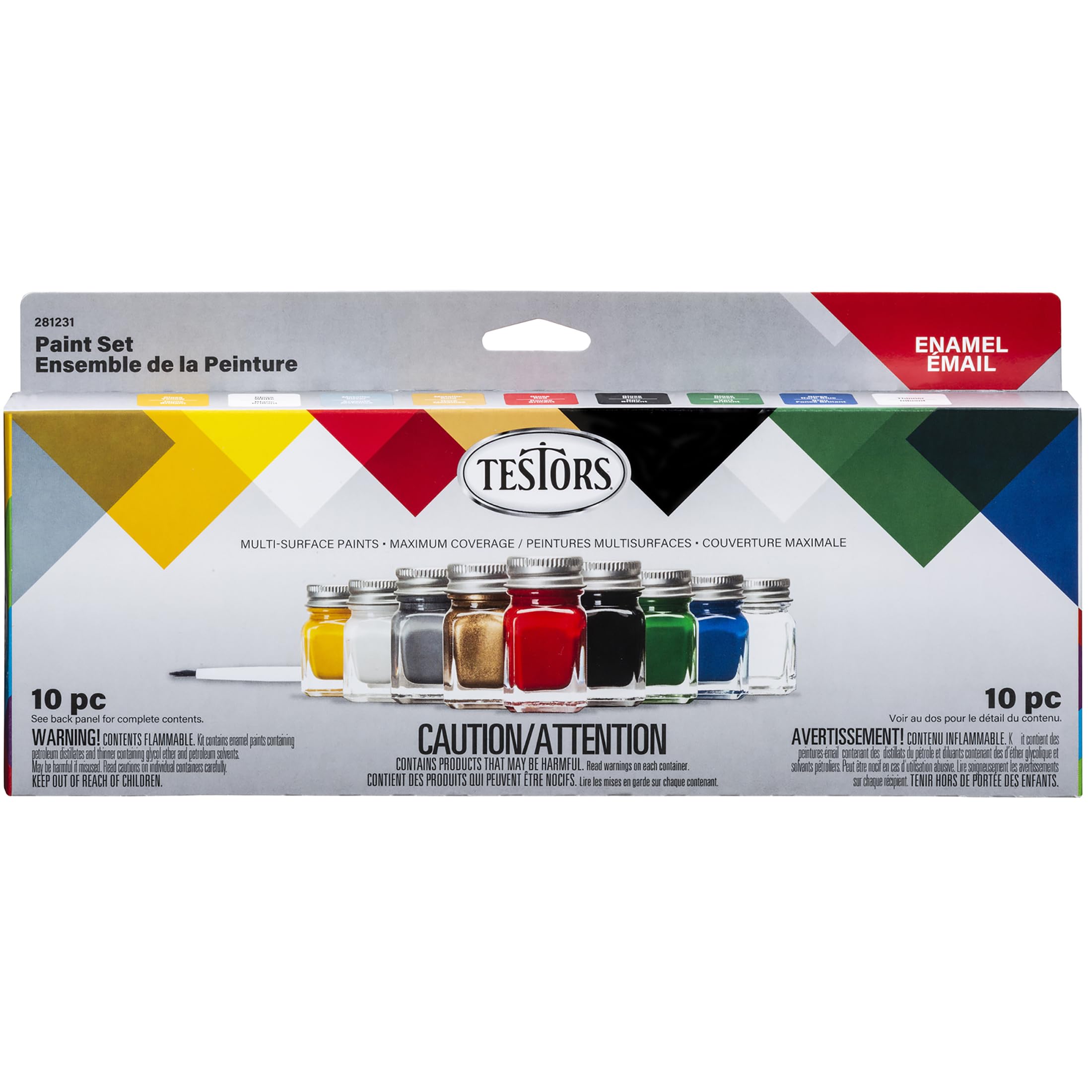
Testors Enamel Paint Set

91 /100
Lab Score Outstanding

Key details

Age Range
13 and up
In The Box
Thinner, brush and tray
Paint Type
Enamel
Paint Count
8 color bottles
View on Amazon

Eight bottles, a brush, a plastic tray, and a bottle of thinner: this is the classic hobby enamel set, and it has been in model boxes for decades. Enamel behaves nothing like the acrylics above. It flows out thin, dries hard and touch-fast, and it holds a tough film on smooth plastic, which is why it built its reputation on car bodies and aircraft fuselages.

The colors are strong, the bottles thin down easily once the thinner is out, and a first car kit or die-cast will look better than it deserves to. What we noticed is how much of the process happens away from the model: decanting, thinning, cleaning brushes in solvent, and keeping the whole operation clear of anything you don't want a gloss film on.

For miniature figures, water-based acrylic is the easier tool — layering without solvent, water cleanup, and no smell in a small room. Enamel earns its keep on smooth, hard surfaces where a durable film matters, and as a low-cost way to find out whether you enjoy the medium before spending more on it.

Pros

  • Dries hard and fast to the touch
  • Thinner, brush, and tray included
  • Vibrant colors that cover model surfaces well

Cons

  • Cleanup needs solvent thinner, not water
  • Only eight colors to work from
Our verdict

The budget route into enamel: eight hard-drying colors, thinner, brush, and tray for model cars and aircraft rather than fine figure work.

Check Latest Price

How We Tested the Best Miniature Paint Sets

We started by pulling together sets sold for miniature hobbyists rather than general acrylics, then narrowed the shortlist by checking paint quality—pigment load, bottle and dropper behavior, and whether colors separated in the pot—along with whether the range was actually useful for armor, skin, cloth, and terrain. We filtered out kits that padded the box with duplicate shades or tiny pots, and we noted what came with each set, since a miniature painting set should feel usable on day one rather than like a pile of paint you have to supplement. That left 14 sets, which we used over six months.

Each set went through the same bench test on primed plastic and metal figures: a 28mm fantasy fighter, a board game miniature, and a piece of scatter terrain. We thinned every paint on a wet palette, blocked in a shoulder pad, and counted how many coats it took to hide the primer, then painted faces, straps, lenses, and edge highlights to see whether the paint held a fine point or flooded detail. We also mixed the same skin tone and a few two-color blends across sets, because color selection is not just a count—it is whether the range lets you shade and highlight without inventing every intermediate step.

Finished figures were handled daily, stored loose in a foam tray, and checked for edge wear after each week; that is where durability separated the sets, with some colors rubbing through on a sharp elbow while others stayed put. For curing time, we noted tackiness at one hour, overnight, and after 72 hours, then again after a week, since a paint that feels dry to the touch can still gum up in a case. Value came down to how much of each set we reached for, not how many bottles were in the box—a smaller range of useful, opaque colors beat a sprawling one with weak coverage.

How to Choose a Miniature Painting Set

Dropper Bottles and Pots

Several sets here dose from a dropper tip, and that one detail shapes how you work. A dropper lets you put three drops on a palette, mix a shade, and leave the rest of the bottle clean. A pot invites you to dip a loaded brush back into the supply, which is how a nice red turns muddy by the third session.

Pots load a brush faster, so they suit small touch-up jobs and quick repairs. For desk painting with a wet palette, favor droppers — you'll waste less, mix more accurately, and keep the bottle usable to the last centimeter.

Count the Colors, Then Count What's Missing

A 16-bottle palette sounds like more paint than an 11-bottle starter set, but the bottle count is the least useful number on the box. A general palette gives you fundamentals to mix from; a starter set spends some of its bottles on things you can't mix — a wash, a metallic, a brush-on primer.

Check for a metallic and a wash before you compare totals. The Vallejo sets here are palettes you build from; the Army Painter starter is a sequence you follow.

Acrylic for Figures, Enamel for Models

Water-based acrylic is the default for miniature figures, and it isn't close. It thins with water, cleans up with water, layers without solvent, and dries flat enough to photograph. Enamel needs thinner for every step, dries harder and glossier, and rewards a smooth surface like a car body rather than a cloak full of folds.

If your shelf is tabletop figures, buy acrylic. If you're building a scale car or aircraft, enamel still makes a case for itself.

One-Coat Paints Are a Different Tool

Speed and contrast paints are heavily pigmented and thin enough to run into recesses on their own, which is why a single coat reads as a base and a shade at once. They come with conditions: a white or light primer underneath, a generous load, and no going back over an area while it's still wet.

They're superb for a batch and poor for a face. Treat a speed paint set as half a toolkit and keep ordinary acrylics beside it.

The Extras Decide Whether You Start

A first box with no brush, no model, and no instruction is a shopping trip, not a hobby. A starter set that includes a practice miniature and a guide gets you to a finished figure faster than a bigger palette will. A wet palette and one decent size 1 brush improve everything you paint afterward.

Buy the tools once and the paint as you need it.

Frequently Asked Questions

Final Verdict

For most people, the Vallejo Basic Colors USA set is the one to buy. Sixteen dropper bottles of water-thinnable acrylic that cover in a pass or two, clean up at the sink, and don't punish a technique you're still learning — that combination beats a bigger palette you have to fight.

Two situations change the answer. If you own no brush, no primer, and no model, the Army Painter Fanatic Starter Set puts an entire first session in one box. And if the project is thirty skeletons rather than one hero, Speedpaint 2.0 gets you to a finished table far sooner, as long as you keep a couple of ordinary acrylics for the detail.