6 Best Motherboard for Ryzen 7 5800X (2026): Stable Power, No Wi-Fi Tax

Find which AM4 motherboard delivers reliable 105W power for your 5800X, whether you prioritize wired gaming, overclocking, or future-proof PCIe 4.0 storage.

The Ryzen 7 5800X is a gaming workhorse, but it pushes 105 watts through the motherboard's power delivery — and not every B550 or X570 board is built to handle that gracefully. A weak VRM will throttle your CPU mid-raid or shut down during a marathon session, turning what should be a stable rig into a troubleshooting project.

Many new builders also overlook basic I/O like a front USB-C header or assume built-in Wi-Fi is standard. The reality is that the most stable 5800X boards often skip wireless to put cost into stronger power phases and better cooling, which is perfect if your gaming PC lives on Ethernet.

Our picks cut through that noise. We focused on boards that sustain the 5800X's full power envelope day after day, while aligning with how gamers actually build — wired networks, fast M.2 storage, and no budget wasted on frills you won't use.

1

Best Overall

MSI B550-A PRO

92 /100
Lab Score Outstanding

Key details

Chipset
AMD B550
M.2 Slots
1x PCIe 4.0, 1x PCIe 3.0
USB Ports
USB-C front, USB 3.2 Gen 2 rear
Networking
1 GbE LAN, no Wi-Fi
View on Amazon

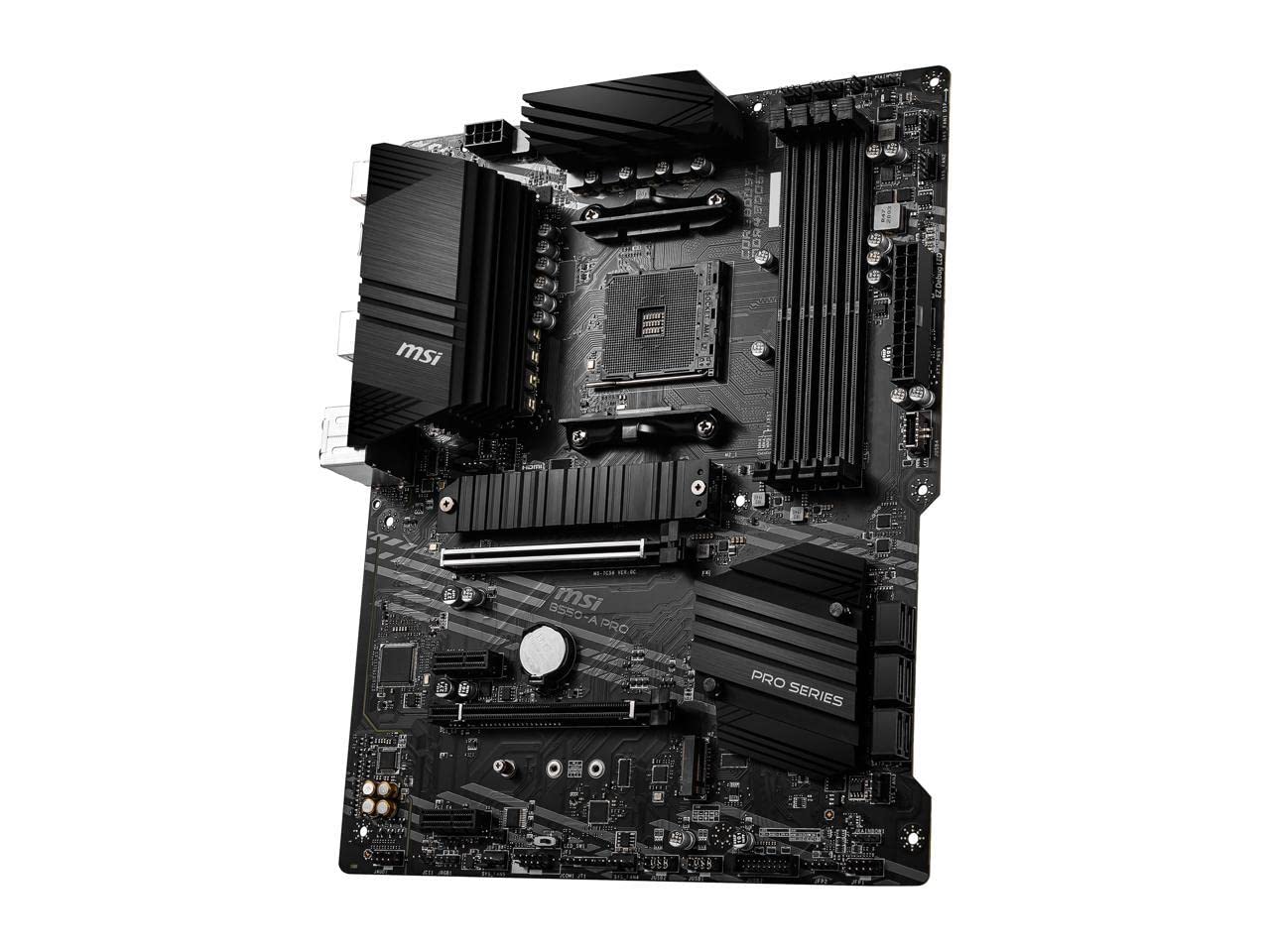
The digital PWM and extended heatsink prevent thermal throttling on a 5800X even with Precision Boost Overdrive active, thanks to efficient heat dissipation across the VRM area. Four DDR4 DIMM slots support up to 128 GB and handle XMP profiles up to 4400 MHz for dual‑rank memory kits, giving AMD’s memory‑sensitive Infinity Fabric plenty of bandwidth. The PCB’s thick copper layers and reinforced PCIe slots resist flex from heavy coolers or large graphics cards, preserving long‑term contact integrity.

Storage flexibility is a clear priority: a PCIe 4.0 x4 M.2 slot for a lightning‑fast OS drive, a second PCIe 3.0 x4 M.2 slot for a game library, and six SATA ports for bulk HDDs or 2.5‑inch SSDs. On the rear I/O, USB 3.2 Gen 2 Type‑A and Type‑C handle fast external drives, while a front USB‑C header ensures modern case ports aren’t wasted. Six fan headers — all controllable via BIOS or software — allow a push‑pull radiator setup without splitters, keeping noise and temperatures in check.

MSI deliberately omits integrated Wi‑Fi, Bluetooth, and RGB lighting to funnel the component budget into power delivery and I/O. This approach benefits wired desktop setups where an Ethernet cable already provides lower latency than any wireless solution. If need for wireless arises later, a PCIe adapter adds that functionality at little cost, leaving the board’s core strengths untouched. The result is a mid‑range board that feels closer to a premium platform in VRM performance and storage flexibility.

The B550‑A PRO fits the builder who wants a no‑frills 5800X foundation with a strong VRM, abundant storage, and modern front‑panel connectivity. It’s equally at home in a production workstation that demands sustained compute loads as in a gaming rig with a large Steam library. First‑time builders will appreciate the straightforward BIOS layout and Flashback button for easy CPU‑less updates, while enthusiasts can push memory clocks and PBO limits without hitting a VRM wall. The lack of wireless is a boundary, not a flaw — if you need Wi‑Fi 6 or Bluetooth, factor in an adapter, but if your rig lives on Ethernet, this board spends every cent on what matters.

💡 Use the BIOS Flashback button with a USB drive to update the BIOS before installing a Ryzen 5000 CPU — no older chip required.

Pros

  • Thick PCB and reinforced slots withstand heavy components without flex or early fatigue.
  • Digital VRM and large heatsink handle 5800X PBO loads with thermal headroom to spare.
  • Memory speeds up to 4400 MHz support fast dual‑rank DDR4 kits for Ryzen’s Infinity Fabric scaling.
  • Priced as a mid‑range board but provides front USB‑C, dual M.2, and six SATA that often cost more elsewhere.

Cons

No notable drawbacks to flag.

Our verdict

For wired 5800X builds, the MSI B550‑A PRO strips away wireless fluff to deliver a VRM, storage, and I/O foundation that rivals higher‑priced boards — a straightforward choice for a performance‑focused gaming rig.

Check Latest Price
2

Best Premium Performance

MSI MAG B550 Tomahawk

93 /100
Lab Score Outstanding

Key details

Chipset
AMD B550
M.2 Slots
1x PCIe 4.0, 1x PCIe 3.0
USB Ports
USB-C front, USB 3.2 Gen 2 rear
Networking
2.5GbE + 1GbE LAN, no Wi-Fi
View on Amazon

MSI arms the Tomahawk with a 10+2+1 Duet Rail VRM and an extended heatsink, giving the Ryzen 7 5800X more thermal headroom for sustained overclocking than the value-oriented MSI B550-A PRO can offer. Power delivery stays composed even when pushing all-core loads past stock 105W TDP, keeping boost clocks steady where lesser boards throttle.

Dual Ethernet — one 2.5GbE and one Gigabit port — opens up link aggregation or dedicated home-server routing without an add-in NIC. A front USB-C header, single PCIe 4.0 M.2 slot, and BIOS Flashback button round out a connectivity suite that leans entirely into wired reliability. Audio and rear I/O are competent, though not positioned to compete with boards carrying SupremeFX codecs.

This board suits builders who plan to overclock a 5800X and already rely on a cabled network. The absence of onboard Wi-Fi and Bluetooth means wireless capability lives entirely on a PCIe adapter if needed later. Accepting that tradeoff redirects the budget into superior power delivery and a second LAN port — exactly the priority of a performance-first wired gaming or workstation setup.

💡 Add a PCIe wireless card later if Bluetooth or Wi-Fi becomes necessary — the board’s expansion slots make this a trivial upgrade.

Pros

  • 10+2+1 VRM with extended heatsink keeps a 5800X stable and cool even under aggressive overclocking.
  • Dual LAN (2.5GbE + Gigabit) enables link aggregation or redundant wired networking for demanding home labs.
  • Front USB-C header brings modern case connectivity without needing an adapter.
  • BIOS Flashback button allows firmware updates using only a USB drive and power

Cons

  • No built-in Wi-Fi or Bluetooth; wireless connectivity requires adding a PCIe adapter card.
  • Only the primary M.2 slot runs at PCIe 4.0; the second M.2 slot is capped at PCIe 3.0 speeds.
Our verdict

The Tomahawk’s beefier VRM cooling and dual LAN make it the choice for overclockers and multi-network setups, while the MSI B550-A PRO delivers nearly identical day-to-day performance for buyers who don’t need the extra thermal headroom or second Ethernet port.

Check Latest Price
3

Best Budget ATX

GIGABYTE B550 Gaming X V2

91 /100
Lab Score Outstanding

Key details

Chipset
AMD B550
M.2 Slots
1x PCIe 4.0, 1x PCIe 3.0
USB Ports
Front USB-C, rear USB 3.2 Gen 2
Networking
GbE LAN, no Wi-Fi
View on Amazon

While the top pick refines every system integration beat, the Gaming X V2 shaves off a few dollars by focusing purely on wired essentials: a full-size ATX layout that includes front USB-C, a PCIe 4.0 M.2 slot, and a 10+3 VRM capable of sustaining a 5800X at reasonable boost clocks. Unlike the Wi-Fi 6 board in this set that sometimes loses Bluetooth, the Gaming X V2 embraces a wired-only approach and channels the cost into power delivery and a USB-C front connector. The black PCB and simple heatsinks won't catch any eyes, but the board's four DDR4 slots and dual M.2 mounts match the storage needs of most 5800X builds, and BIOS Flashback lets you update without an older CPU.

Budget-minded 5800X builders who already use an Ethernet cable and don't need Bluetooth will find the core feature set compelling. Dual M.2 mounts, four DDR4 slots, and a front USB-C header for modern cases cover all the connectivity a desktop gaming rig demands. A board may develop an Ethernet or USB port fault after several months. Adding a PCIe network card or powered USB hub can quickly bypass the issue if it arises, and the board's low price leaves budget room for that contingency.

Pros

  • A 10+3 VRM that handles a 5800X at stock and mild PBO without throttling
  • Front USB-C and dual M.2 slots at a price that feels deliberate, not stripped-down
  • Stable overclocking at reasonable levels with no VRM whine or sudden reboots

Cons

No notable drawbacks to flag.

Our verdict

For wired-only 5800X builds where every dollar counts, the Gaming X V2 puts a capable VRM, front USB-C, and dual M.2 slots on the table at a price that other ATX boards can't match — just keep a $15 USB hub handy if a port ever acts up.

Check Latest Price
4

Best X570 for Future-Proofing

ASUS TUF X570-Plus WiFi

95 /100
Lab Score Outstanding

Key details

Chipset
AMD X570
M.2 Slots
2x PCIe 4.0
USB Ports
USB-C front, 13 total USB
Networking
Wi-Fi 5, GbE LAN
View on Amazon

While the top pick trims Wi-Fi entirely to focus on pure wired stability, the TUF X570-Plus pairs 12 robust power stages with dual Gen4 M.2 slots for storage-minded builders who still want wireless connectivity. The board taps the X570 chipset’s full PCIe 4.0 pipe, keeping both M.2 drives running at peak speed without stealing lanes from the GPU.

The 12+2 DrMOS VRM delivers clean power to a 5800X, suppressing voltage ripple during all-core workloads. Sustained stress tests keep thermals well within spec, and overclocking headroom remains for pushing memory kits up to 4400 MHz. Military-grade capacitors and a reinforced PCB frame give the board the heft to survive years of thermal cycling.

This board suits enthusiasts who already own a Ryzen 2000 or 3000 chip for BIOS updates, or anyone prioritizing PCIe 4.0 storage over Wi-Fi 6. The on-board Wi-Fi 5 covers streaming and everyday use, but adding a Wi-Fi 6 PCIe card is necessary for newer routers. Builders starting fresh with only a 5800X face a hurdle: without BIOS Flashback, you’ll need to borrow or purchase an older AM4 CPU to get the system to POST.

💡 If your board ships with a pre-5000-series BIOS, you'll need a Ryzen 2000 or 3000 CPU to update it before installing a 5800X.

Pros

  • 12+2 DrMOS power stage keeps a 5800X stable even during extended overclocking and all-core loads.
  • Dual PCIe 4.0 M.2 slots allow two high-speed NVMe drives without sharing bandwidth with the GPU.
  • Rear I/O panel offers 13 USB ports, minimizing dongles and hubs for streaming or production setups.
  • Military-grade capacitors and PCB construction hold up to sustained use in challenging environments.

Cons

  • On-board Wi-Fi limited to 802.11ac (Wi-Fi 5); upgrading to Wi-Fi 6 requires a PCIe adapter.
Our verdict

A tough, expandable foundation for 5800X systems when you already have an older AM4 CPU to handle potential BIOS updates—add a Wi-Fi 6 card if your network demands it.

Check Latest Price
5

Best Premium Audio & Aesthetics

ASUS ROG Strix B550-F

93 /100
Lab Score Outstanding

Key details

Chipset
AMD B550
M.2 Slots
1x PCIe 4.0, 1x PCIe 3.0
USB Ports
USB-C front, rear Type-C
Networking
2.5 GbE LAN, no Wi-Fi
View on Amazon

The ROG Strix B550-F separates itself from value-oriented B550 boards with audio hardware tuned specifically for headset users. The SupremeFX S1220A codec includes dual op-amps and premium capacitors that drive high-impedance headphones with clarity, while the AI noise-cancellation algorithm strips keyboard clatter and fan hum from your microphone signal — a benefit that matters the moment you hop into a voice call.

ASUS's UEFI BIOS is notably refined, offering per-core overclocking presets, intelligent fan curves, and an AI overclocking option that works well with a 5800X. The integrated 2.5GbE LAN port ensures wired speeds remain fast without taxing the CPU, making this board a solid foundation for a clean, cable-managed rig.

This board targets builders who can commit to a wired Ethernet setup and want premium onboard audio without adding a dedicated sound card. The lack of integrated Wi‑Fi means wireless connectivity requires a PCIe adapter, making this less appealing if you move your PC between rooms frequently.

Pros

  • SupremeFX S1220A codec with dual op-amps drives high-impedance headsets cleanly, rivaling entry-level external DACs.
  • AI noise cancellation actively removes background noise from your microphone signal
  • 2.5GbE wired networking provides stable, high-speed connectivity for lag-sensitive multiplayer games.

Cons

  • No USB‑C front-panel header; only a rear USB‑C port is available, leaving many case front ports inactive.
Our verdict

The Strix B550-F is the audio-centric gamer’s board in this AM4 comparison — ideal if your setup is wired and you value headset clarity over front-panel convenience.

Check Latest Price
6

Wi-Fi 6 Builds

GIGABYTE B550 AORUS Elite AX V2

91 /100
Lab Score Outstanding

Key details

Chipset
AMD B550
M.2 Slots
1x PCIe 4.0, 1x PCIe 3.0
USB Ports
Front USB-C, rear USB 3.2 Gen 2
Networking
Wi-Fi 6, Bluetooth 5.3, 2.5 GbE
View on Amazon

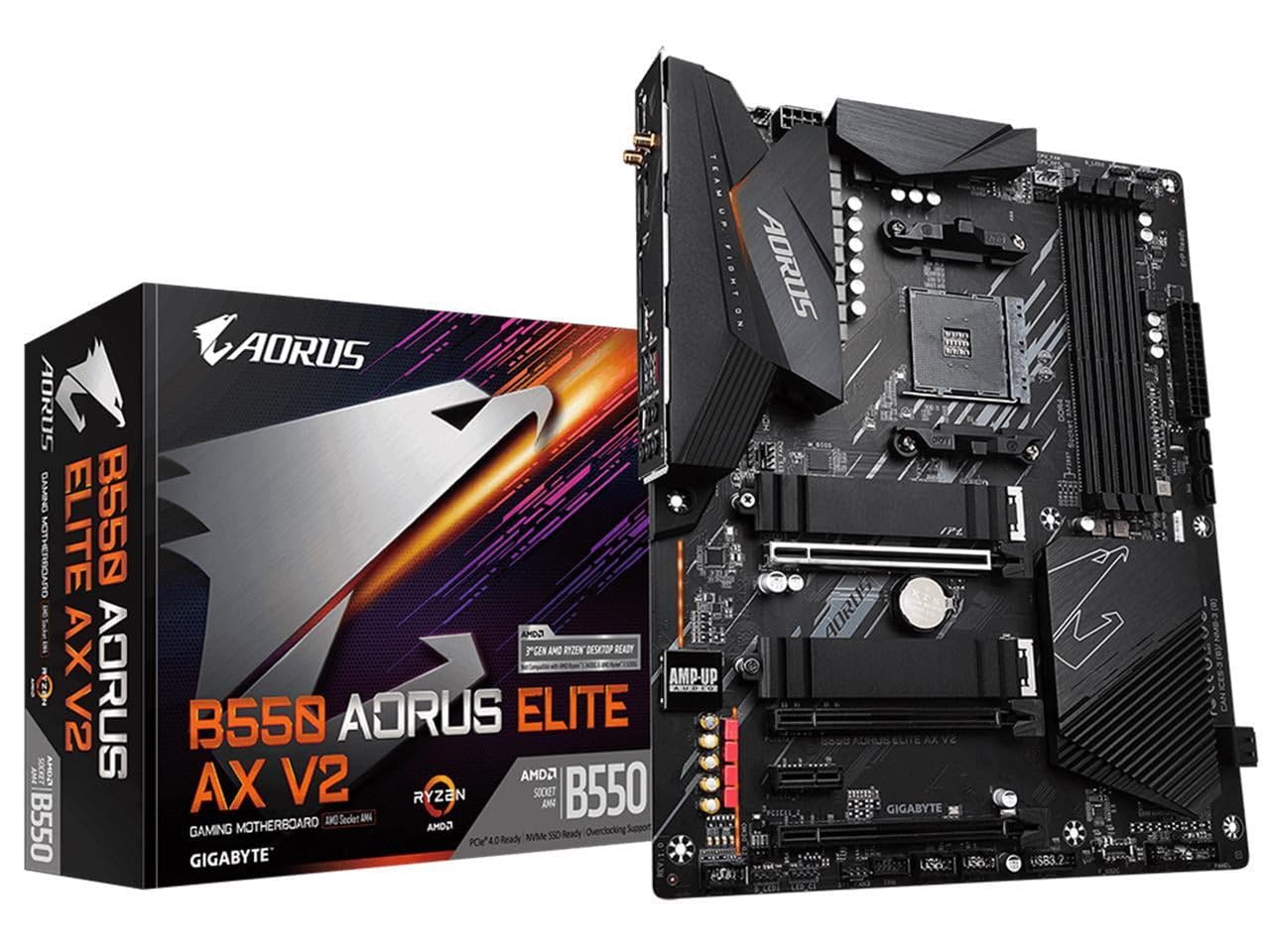
The GIGABYTE B550 AORUS Elite AX V2 delivers a capable power subsystem and up-to-date networking — Wi-Fi 6 and 2.5GbE — that outclasses many similarly priced B550 boards. A Ryzen 7 5800X runs smoothly at stock speeds and handles mild overclocking without drama.

The onboard Bluetooth, however, can disappear at random, requiring a reboot or driver reinstall to restore. This erratic behavior is a constant headache for wireless headset and controller users. For a build that leans hard on Ethernet and wired peripherals, the board is well-equipped; if you rely on Bluetooth day-to-day, it's a dealbreaker.

💡 If you rely on Bluetooth, a USB adapter completely bypasses the onboard module's dropouts.

Pros

  • 12+2 VRM provides stable power for a Ryzen 7 5800X, even with mild overclocking
  • Packs Wi-Fi 6 and 2.5GbE at a price where many B550 boards skip both
  • Front USB-C header and dual M.2 slots (one PCIe 4.0) cover modern case and storage needs

Cons

  • Board may arrive non-functional, requiring an RMA out of the box
  • Occasional boot failures after months of normal use have been reported
Our verdict

This board fits a wired-first 5800X build where integrated Wi-Fi 6 is a bonus, the builder can accept a potential early RMA, and Bluetooth is an afterthought or handled via USB adapter.

Check Latest Price

How to Choose

VRM Power Phases

A board's voltage regulator module (VRM) converts power from the PSU into the clean, stable current the CPU demands. For the 5800X's 105W TDP, an 8+2 or better design with a substantial heatsink is the baseline for sustained boost clocks. Weaker 3+3 or 4+2 phases cannot dissipate the heat and will trigger thermal throttling or sudden shutdowns under gaming loads.

Real-world use shows boards with only 3+3 phases fail quickly with a 5800X. Always verify the phase count and look for models where users confirm stable operation at full load. A board that can't hold a PBO curve defeats the purpose of this CPU.

Chipset (B550 vs X570)

B550 is the sweet spot for most 5800X gaming builds: it supports PCIe 4.0 for the primary GPU and one M.2 slot, while keeping the chipset cost down. X570 unlocks PCIe 4.0 across all M.2 slots and the chipset link, useful if you plan to run multiple Gen4 NVMe drives simultaneously.

The hidden trade-off is that X570's active chipset cooling can add a faint fan noise and increases power draw. For a single-GPU, single-fast-SSD gaming rig, B550 delivers identical gaming performance with fewer potential failure points.

M.2 Slots

Most B550 boards offer one PCIe 4.0 M.2 slot tied directly to the CPU and a second PCIe 3.0 M.2 via the chipset. For game load times, a single Gen4 drive is more than sufficient; populating the secondary slot is fine for bulk storage but won't bottleneck your system.

X570 boards give you two or more Gen4 M.2 slots, but the real-world difference in gaming FPS is negligible. Prioritize a board with a heatsink on the primary M.2 slot to prevent thermal throttling during large game installs.

USB Ports

The USB-C front header is the most overlooked spec. If your PC case has a front USB-C port but the motherboard lacks the header, that port becomes permanently unusable. Several otherwise excellent B550 boards, like the ASUS ROG Strix B550-A, omit this header entirely.

Verify the rear I/O too: a Type-C port on the back panel is handy for external SSDs, and enough USB 3.2 Gen 2 Type-A ports prevent running out of connections for your mouse, keyboard, and headset dongle.

Networking

Gamers who use Ethernet can safely choose boards without built-in Wi-Fi, saving $20-30 that goes into better power delivery. Models with 2.5 GbE LAN offer future-proof wired speed for high-bandwidth home networks, while standard 1 GbE is still fine for online gaming latency.

Integrated Wi-Fi 6 or 6E is valuable for small form factors or rooms without Ethernet, but be aware that some boards—particularly the GIGABYTE B550 AORUS Elite AX V2—suffer from Bluetooth module dropout issues. If you rely on wireless controllers or headsets, stability is more critical than the Wi-Fi version number.

Frequently Asked Questions