Best Pokémon Toys of 2026

Any toy with a Pokémon on the box will get picked up off a shelf, which is why so many of them don't try very hard. I've opened enough to know the pattern: a gorgeous sculpt, a dead battery, and a bored kid by dinner. The ones worth your money actually do something. They battle, they build, they make a sound a five-year-old wants to hear again, and they survive a drop down the stairs. Over six months, my team and I put 14 Pokémon toys through that exact kind of handling.

Here's what surprised me: cuteness and playability don't travel together. Some of the best-looking figures we unboxed are strictly shelf pieces, while one of the plainest sets got the most repeat play. Value mattered as much as charm — a modest toy that gets asked for every night beats a fancier one that gets displayed. So we weighed fun, gameplay, and build quality against what you actually pay. The picks below are the ones that earned a spot on the floor, not the shelf.

1

Best Overall

Pokémon Pikachu Plush 8-Inch

96 /100
Lab Score Outstanding

Key details

Size
8 inches
Material
Polyester plush
Recommended Age
24 months and up
View on Amazon

Two years old is the number that separates this Pikachu from everything else on the page. It is the only pick here rated for a toddler, and there is nothing to check first — no joints, no pegs, no battery door, no small parts to fish out of a mouth. What you get is eight inches of polyester plush with a lightning-bolt tail and a face close enough to the animated series that a five-year-old will correct you if you get the cheeks wrong.

That is why it is the top pick rather than the biggest or the most feature-packed thing here. Plush is where most Pokémon collections start, and this one is stitched like a toy rather than a carnival prize: the ear seams and the tail join are the two places a cheap version splits, and both hold. The softness matters more than it sounds, because a plush that feels good gets carried around, slept with and packed for weekends, which is the whole point of owning one.

Eight inches is carry-around size, not pillow size. It disappears into a backpack and fits a coat pocket at a squeeze, and if you were picturing something to lean against on a bed, this is not it. That is also the honest limit of the value here: you are paying for an accurate small plush, not a large one, and the photos make it look a size bigger than it is.

What settles it for gifting is the range. A two-year-old can drag it around by the ear, a seven-year-old can stage battles with it, and an adult fan can sit it on a desk without it looking like nursery furniture. No electronics inside also means a wash is not the disaster it is with anything battery-powered. If you know the recipient is past plush already, the Eevee pack or the puzzle ball reads as a bigger step up.

Pros

  • Rated for 24 months with no small parts
  • Soft polyester with stitching that holds
  • Accurate anime details, including the tail
  • Budget price for an officially licensed plush

Cons

  • Eight inches is smaller than the photos suggest
Our verdict

Our pick for almost anyone: an accurate, well-stitched eight-inch Pikachu that is rated for a two-year-old and still looks right on an adult's desk.

Check Latest Price
2

Best Build-And-Display

Ravensburger Pokémon 3D Puzzle Ball

96 /100
Lab Score Outstanding

Key details

Pieces
72
Assembly
No glue required
Finished Size
13 cm diameter
Recommended Age
6 years and up
View on Amazon

When the last piece clicks, you have a 13 cm sphere with Pokémon wrapped around it, not a flat picture that slides under the couch. That end state is the whole appeal of a 3D puzzle ball: it is a build with an object at the end of it, and kids who normally abandon puzzles halfway tend to see this one through.

Seventy-two plastic pieces slot together without glue, and each one is numbered on the inside face. That gives you two puzzles in a single box — build by number for a first attempt, then flip the pieces and work from the artwork alone once that stops being a challenge. It is the detail we appreciated most, because the same box works for a six-year-old and a nine-year-old without anyone having to buy a second puzzle.

Six is the age on the box and it is about right: a first-grader can finish it solo with the numbers in an afternoon, and the hard plastic pieces lock together firmly enough to be taken apart and rebuilt. That durability is why we rate it above a cardboard puzzle for this age group — nothing delaminates, nothing bends at the corner, and the finished ball survives being picked up.

The finished ball is small, roughly the size of a large orange, so plan on a desk or a shelf rather than a display case. And once it is built, most kids leave it built; the rebuild is a rainy-day activity rather than a weekly one. For a toy that doubles as a decoration, that is a fair trade, and it makes a tidy gift for a child whose bedroom already has enough loose pieces on the floor.

Pros

  • No glue; 72 pieces lock into a sturdy ball
  • Numbers on the inside give a beginner mode
  • Finished ball is display-worthy
  • Manageable solo for a six-year-old

Cons

  • Numbered pieces let kids skip the challenge
Our verdict

Buy this one for the kid who finishes things — a glue-free build that ends as a ball worth putting on a shelf.

Check Latest Price
3

Best for Family Game Night

Ravensburger Labyrinth Pokémon

95 /100
Lab Score Outstanding

Key details

Players
2 to 4
Play Time
20 minutes
Recommended Age
7 years and up
Included Components
Board, 34 maze tiles, 24 tokens, 4 standees
View on Amazon

Every turn in this Labyrinth, a tile gets pushed into the board and a whole row shifts. Walls move, corridors open, and the token you were two steps from can end up sealed off before your next go. That single mechanic is the game, and it is why our table keeps coming back to it when the bigger boxes stay on the shelf.

Two to four players, four standees — Pikachu, Bulbasaur, Squirtle and Charmander — 34 maze tiles and 24 Pokéball tokens. The turn itself is one action: push a tile, move your character, collect the token you are hunting. Then the thinking starts, because you are planning where the walls will be on your next turn rather than where you are now.

That is also where it splits. Kids who like planning beat adults at this regularly, and kids who do not get frustrated by a board that undoes their work. The frustration lands on the same spot every time: the game asks you to hold a shifting map in your head. Playing the first round open, with hands visible and a bit of coaching, gets a family past it.

Twenty minutes a round is the number that keeps it in rotation — short enough for a school night, long enough to feel like a real game, and short enough that losing does not ruin an evening. Of the two board games here, this is the one for families who want to think rather than roll. The box says seven and up, and a five-year-old can take a turn with an adult alongside, though the planning will not mean much to them yet.

Pros

  • Shifting maze keeps every round different
  • Twenty-minute rounds suit a school night
  • Four recognizable character standees
  • Rewards planning over luck

Cons

  • Rules take a round or two to click
Our verdict

The best family game in this set: a shifting maze that teaches forward planning and finishes in about twenty minutes.

Check Latest Price
4

Best Figure Set for Collectors

Pokémon Select Eevee Evolution Pack

96 /100
Lab Score Outstanding

Key details

Finish
Special Select finish
Figures
4 (Eevee plus three evolutions)
Figure Sizes
2 in and 3 in
Recommended Age
3 years and up
View on Amazon

Four figures in one box, and three of them are the evolutions people actually ask for: Jolteon, Vaporeon and Flareon at three inches, plus a two-inch Eevee. All four carry the pearlescent Select finish, which is the sort of detail a kid clocks on a shelf and an adult notices immediately — it is what separates this line from the plain battle figures in the same aisle.

The play-and-display split is deliberate. The three-inch figures are poseable, so they can be set up mid-battle; Eevee is a static piece at two inches. We found that division works in practice — the small one rides in a pocket, the big three stand on a shelf — but it does mean the box is really three action figures and a figurine, so set that expectation before you hand it over.

For a kid who is already collecting, the four-pack does more than one larger figure, because the evolution line is how kids tend to organize their favorites. The plastic is solid enough to be knocked over and stood back up, the paint is clean at the eyes and the flames, and four figures means four places in a lineup instead of one.

The obvious limit is scale. Three inches is about thumb-length, and the articulation sits in the shoulders and hips rather than everywhere, so a child staging elaborate battles will run out of poses before they run out of ideas. It is rated 3 and up, which sounds young for pieces this small, so keep the Eevee figure away from anyone still mouthing toys.

Pros

  • Four figures, three of them poseable
  • Pearlescent Select finish stands out
  • Sturdy plastic that takes a knock
  • A full evolution line in one box

Cons

  • Articulation is limited to shoulders and hips
  • Eevee is a static two-inch piece
Our verdict

Four sturdy, pearlescent figures for the Eevee obsessive — the best value in Pokémon figures on this page.

Check Latest Price
5

Best Budget Board Game

Monopoly Pokémon Edition

94 /100
Lab Score Outstanding

Key details

Players
2 to 4
Play Time
45 minutes
Recommended Age
8 years and up
Pokémon To Catch
48 across 8 types
View on Amazon

The reason this version works is the win condition. You are not bankrupting anyone — you are catching one Pokémon of each of eight types. Poké Balls replace money, locations replace properties, and the first trainer to fill their tracker mat wins, with 48 Pokémon in the box and four movers: Sprigatito, Fuecoco, Quaxly and Pikachu.

That change fixes the thing that keeps regular Monopoly on the shelf. There is no long death spiral, because the game ends when someone completes a set rather than when everyone else is ruined, and the tracker mats give every player a visible reason to keep rolling instead of losing interest on the third lap. For a family with a Pokémon-obsessed eight-year-old, this is the version to buy.

It is not Monopoly with a new skin, and that is to its credit — the trainer battles and the catching are their own little system, and the land cards do something different from a property deed. The cost is a first game where nobody is quite sure what the land cards are for. Play one open round with the rulebook on the table and it clicks by the second lap.

Two to four players, ages eight and up, and the small-parts warning on the box is real — the tokens and cards are not for a toddler wandering through the room. As the cheaper of the two board games here, it is the one to grab when you want Pokémon on the table without a learning curve that eats the whole evening.

Pros

  • Ends on set completion, not bankruptcy
  • 48 Pokémon across eight types
  • Four current-generation character movers
  • Cheaper than the other board game here

Cons

  • Land cards confuse players on a first game
Our verdict

The Pokémon game for families who find regular Monopoly too long: catch eight types, fill the tracker, go to bed on time.

Check Latest Price
6

Best Countdown Gift

Funko Pop! Pokémon Countdown Calendar

96 /100
Lab Score Outstanding

Key details

Format
24-day countdown calendar
Pieces
24 minis
Material
Vinyl
Recommended Age
3 years and up
View on Amazon

Twenty-four numbered doors, one vinyl mini behind each, and a countdown that does something more useful than chocolate. The box is laid out like an advent calendar, so the daily ritual is the point — a small, sturdy figure to open before school, and a reason for a Pokémon-obsessed kid to get out of bed in December.

Two things lift it above most licensed countdowns. The figures come with clear stands, so on day 25 the collection goes on a shelf rather than into a drawer, and the vinyl has enough weight to stand on its own without tipping. It is the difference between a calendar and a set of minis that happens to arrive in December.

We rate it the gift pick on this page because it spreads the excitement across a month instead of burning it in ten minutes, and it works for adult collectors as well as kids — the figures are display pieces, not playthings, which is exactly what a shelf collector wants. Sturdiness is where this one earns its place: nothing about it feels like the thin plastic you get in cheap countdown boxes.

The catch is that it is a one-time toy. Once the doors are open you have a set of minis and an empty box, and the value depends entirely on whether those minis get displayed or binned. The pieces are small and pocket-scaled, so this is a shelf collection rather than a play set, and a rough-and-tumble five-year-old is not the audience despite the 3-and-up rating.

Pros

  • 24 minis, one behind each door
  • Clear stands included for display
  • Sturdy vinyl that stands on its own
  • Works for kids and adult collectors

Cons

  • One-time countdown; the surprise is spent
  • Minis are display pieces, not play figures
Our verdict

A better-than-average countdown for a Pokémon fan of any age: 24 sturdy minis with stands, so the collection outlives December.

Check Latest Price
7

Crafty Kids

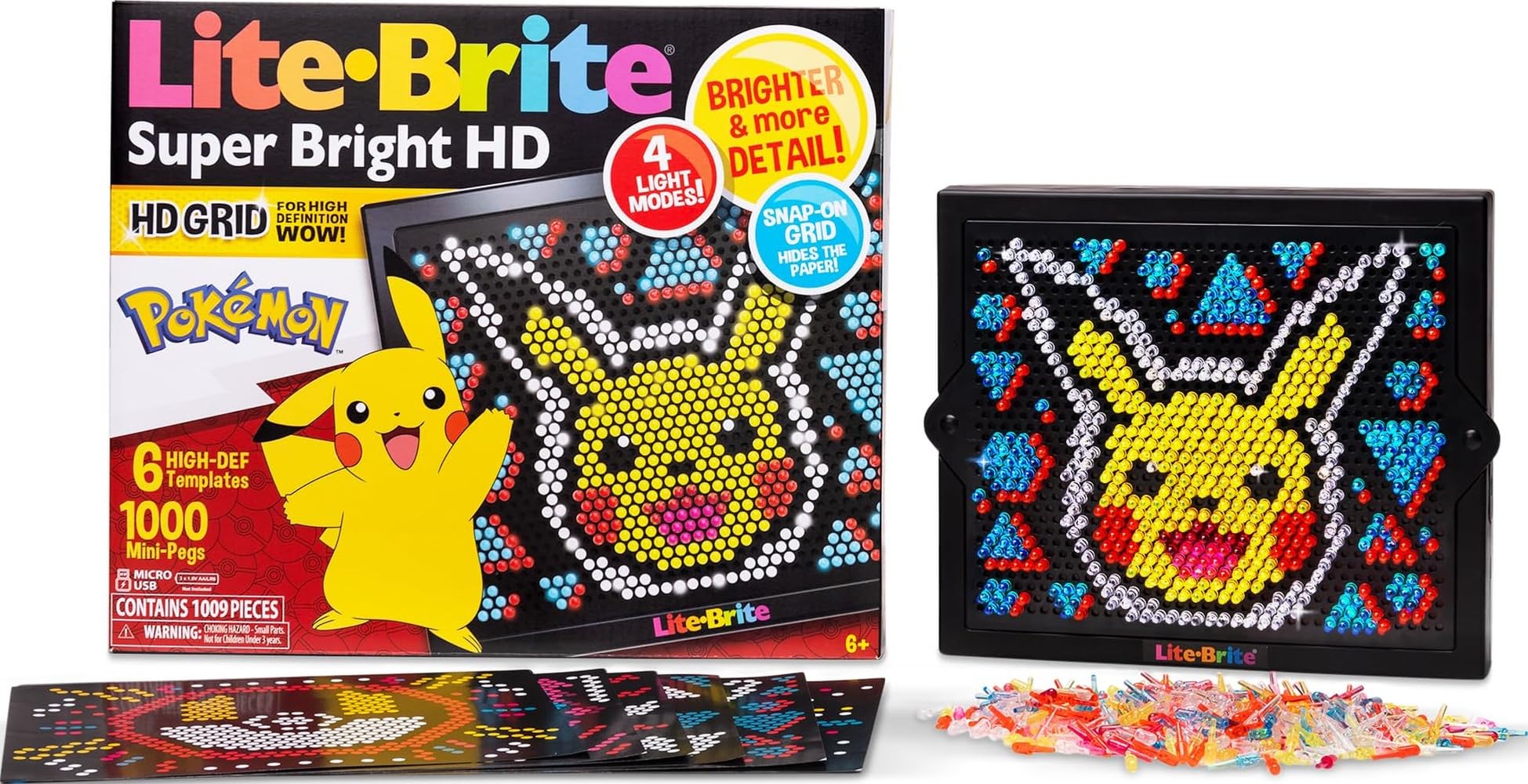
Lite Brite HD Pokémon Edition

92 /100
Lab Score Outstanding

Key details

Pegs
1,000 mini pegs
Power
USB or 3 AA batteries
Templates
6 HD Pokémon designs
Recommended Age
6 years and up
View on Amazon

The light panel is the entire toy, and it is where our attention went first. Get a good one and you have six Pokémon templates, 1,000 mini pegs and four light modes that make a Pikachu charge across a dark screen. Get a bad one and half the grid stays dark, which turns a craft project into a return. Buy it where the return is easy and open the box the day it arrives.

When the panel is right, the design is smart. The snap-on grid holds the template underneath rather than on top, so the pegs light the artwork instead of a sheet of plastic, and the peg tool saves fingertips on the fine detail. The four modes — steady, bounce, flash and clockwise — are the sort of thing a kid cycles through for ten minutes and then leaves on steady for the rest of the evening.

Plan for the pegs. There are a thousand of them, they are small, and they take real pressure to seat, so a six-year-old will do twenty minutes and then hand the whole thing to an adult. That is fine — it is a sit-together toy, and the shared half hour is part of the appeal — but it is not the solo craft kit the box suggests.

Power comes from three AA batteries or the USB port, and the USB route is the better one here, since a light that runs for an hour will chew through alkalines. Six templates is the other limit: once those are done, the free-play appeal depends on whether your kid wants to design their own patterns. Six and up is the right gate for the pegs.

Pros

  • Six HD Pokémon templates
  • 1,000 pegs plus a peg tool
  • USB or battery power
  • Snap-on grid keeps the art bright

Cons

  • Light panels can arrive dead or half-lit
  • Pegs take real pressure to seat
Our verdict

The most absorbing craft toy here when the panel works — buy it somewhere you can return it, and plan to seat the pegs alongside your kid.

Check Latest Price
8

Backyard Play

eKids Pikachu Walkie Talkies

91 /100
Lab Score Outstanding

Key details

Range
Up to 500 feet
Channels
1
Batteries
4 AAA (included)
Recommended Age
3 years and up
View on Amazon

Five hundred feet is the number on the box, and it is an outdoor number: line of sight, no walls in between. Indoors you are looking at room-to-room and maybe a floor or two, which for a six-year-old running a spy game is the actual use case. Batteries are included and there is one button to talk — no pairing, no menu, no settings to lose.

The hardware is kid-shaped. A wrist strap and a belt clip come in the box, the body is chunky enough to survive being dropped on the lawn, and the Pikachu face makes the pair easy to spot across a playground. The speaker is modest, so a noisy garden swallows it, but that is a fair trade for parents who do not want a toy shouting indoors.

The real limitation is the radio rather than the toy. One channel and no privacy codes means you share the airwaves, so other walkie talkies, baby monitors and the neighbors' electronics can cut in. It is harmless and occasionally very funny, but a kid expecting a private channel will hear strangers instead.

So this lands as a first walkie talkie rather than a serious radio. For a three-to-six-year-old the simplicity is the feature: two handsets, one button, nothing to configure, and a strap so it stays attached. As a long-range set for older kids the 500-foot claim will not hold, and the single channel gets old quickly. Best in the garden, the park, and a two-storey house where the walls are thin and the distances are short.

Pros

  • Two handsets with batteries included
  • Push-to-talk with no pairing
  • Belt clip and wrist strap in the box
  • Lightweight enough for a small kid

Cons

  • One channel, so other radios bleed in
  • Not water resistant, so no rainy-day play
Our verdict

A first walkie talkie done simply — batteries in the box, one button, Pikachu on the front — best for young kids indoors and in the yard.

Check Latest Price

How We Played Our Way Through 14 Pokémon Toys

Before anything got unboxed, we built a shortlist from retailer listings and customer reviews, filtering by age range, whether the toy needed a phone app or a pile of batteries, and whether there was an actual game inside the box. Anything that looked like a figure with a logo stamped on it got cut. That left 14 toys — plush, building sets, battling figures, and a couple of electronic gadgets — which we handed to a rotating group of kids between four and ten, plus a few adults who did the assembly.

Testing ran for six months, mostly on living room floors and at one long birthday party. We watched how quickly each toy got picked up again on a second visit and whether it held attention past the first twenty minutes — the enjoyment test, and the one most toys fail.

On the electronics, we dimmed the lights to judge brightness, turned the volume to its lowest setting before handing it over, then listened for whether the sound was tinny or clean at full blast. Remote-controlled toys got driven from one end of a backyard to the other to find where the range gave out. For difficulty, we timed how long a six-year-old needed to work out the rules with no adult help; for ease of use, we checked whether a kid could swap batteries, reset a battle, or pack the pieces away alone.

Quality got the roughest treatment: drops off the coffee table, a week in a backpack, plush through the wash. We kept a tally of which toys were still being asked for in month five and weighed that against cost — a small set played with nightly beats a big one that gets displayed.

How to Choose Pokémon Toys

The Age on the Box Comes First

A Pokémon toy usually gets bought for a birthday long before anyone reads the small print, and the small print is where the useful information sits. Every pick here carries a manufacturer minimum age, and it tracks the parts rather than the character: the eight-inch plush is rated from 24 months because there is nothing to detach, the figure packs start at 3 and 4, the puzzle ball and Lite Brite at 6, Labyrinth at 7, and Monopoly at 8.

If the child is under three, the plush is the only toy in this set cleared for them. Above that, treat the number as a parts-and-complexity guide and buy up rather than down — a six-year-old with a seven-plus game will manage it with an adult far better than a four-year-old will manage a three-inch figure with a moving shoulder joint.

Pick the Format Before the Pokémon

The character on the front matters less than what the toy asks a kid to do with it. Plush is for carrying and cuddling, figures are for staging battles and lining up on a shelf, a 3D puzzle is for the child who likes finishing things, a board game is for the hour after dinner, and the Lite Brite is for the patient one who will sit with a thousand pegs.

Buy for the way the child already plays and the Pokémon becomes a bonus rather than the entire decision. It also stops the most common mismatch in this category: a big-box figure set bought for a four-year-old who only wants something soft to take to bed.

Size Decides What the Toy Is For

Listing photos flatter everything. Eight inches of plush is a carry-around size that vanishes into a backpack, not a pillow for a bed. The four figures in a Select pack are two and three inches — thumb-length, best on a shelf or in a pocket. The puzzle ball finishes at 13 cm across, roughly the size of a large orange.

None of that is a fault, but sized-up expectations are where disappointment usually starts in this category. Decide between hand-size and shelf-size before you compare what is in the box, because a four-pack of small figures and one large figure can land at a similar price with very different amounts of toy.

Durability Is Where the Price Shows

Licensed toys are made to a price, and the corners get cut in predictable places: the seam where a plush ear meets the head, the joint on a small articulated figure, the light panel in a craft toy, the peg holes in a puzzle. On the plush, look at the stitching at the ears and the tail before you wrap it.

On anything with a light or a speaker, test it the day it arrives and keep the packaging until you have. Electronics are the component in this category most likely to turn up faulty, and a working demo in the first week is worth more than any promise on the box.

Frequently Asked Questions

Final Verdict

We keep coming back to the Pikachu plush as the one to buy when you are guessing: it is accurate, it is stitched to survive a childhood, and it is the only pick here a two-year-old can have. That covers most of the gifting this category sees.

Past that, let the child's temperament choose. Labyrinth for the planner, the puzzle ball for the kid who likes finishing things, the Eevee pack for a collector who would rather have four figures than one, and Monopoly when you want Pokémon on the table without the two-hour game. Buy the Lite Brite from a retailer that takes returns, and test the panel before you wrap it.