Best Pool Cue Sets of 2026

Most of us have done it: picked a cue off the wall, lined up a shot, and watched the ball drift just enough to miss. The house cue is usually warped, the tip flattened to a nub, and the weight is a coin flip. A good pool cue set fixes all of that: straight shafts, consistent weight, a tip that holds chalk, and a grip that won't slip in sweaty hands. In a basement rec room or a weekly league, that consistency turns a lucky shot into a repeatable one.

In seven months, we've shot with 12 cue sets in a basement rec room, two local pool halls, and on league night. We rolled every shaft on a flat table, weighed each cue, and chalked up hundreds of shots. One thing I've learned: a set is only as strong as its worst shaft. A single warped stick can throw off your whole game, no matter how nice the case looks. The picks below stayed straight, felt balanced in hand, and held up after months of play.

1

Best Overall

LOTKEY 4-Cue Set

91 /100
Lab Score Outstanding

Key details

Length
58 in
Weights
18 to 21 oz
Cue Count
4
Shaft Material
Solid Canadian maple
View on Amazon

Four cues that each weigh something different is the point of a set like this, and LOTKEY is the one that makes the difference visible: the blue cue is 18 ounces, yellow 19, red 20, green 21, one color per weight. Hand a guest the green cue and nobody has to squint at a sticker or guess. We think that small piece of design is worth more than it sounds, because the quickest way to sour a casual game is to hand someone a cue that is too heavy for them, and the colors make the choice obvious.

Under the paint it is selected 6A Canadian maple with 13 mm leather tips and a textured leather wrap on the handle, and the set carries a six-month manufacturer warranty, which is longer than most here. Straightness is good rather than perfect, and that is true of nearly everything in this category. What surprised us is how finished they look; sets at this price usually give themselves away at the ferrule or the wrap, and these do not.

The honest caveat is longevity. This set has not been on tables as long as the house standards, so nobody can tell you how it looks after five years of Friday nights, and the six-month warranty is doing some of the reassurance work. It also ships as four cues and nothing else, so if you are setting up a table from scratch, put chalk, a rack and a tip tool on the same order.

Pros

  • Four color-coded weights, 18 to 21 oz
  • Solid Canadian maple with 13 mm leather tips
  • Six-month manufacturer warranty
  • Lowest price of the sets we recommend

Cons

  • Cues only, with no chalk or rack
Our verdict

We think this is the set most home tables should have: four color-coded weights, solid maple and the best finish we saw at this price.
Check Latest Price
2

Best Upgrade

ASKA L3 5-Cue Set

91 /100
Lab Score Outstanding

Key details

Handle
Wrapless
Weights
18 to 21 oz
Cue Count
5
Shaft Material
Canadian hard rock maple
View on Amazon

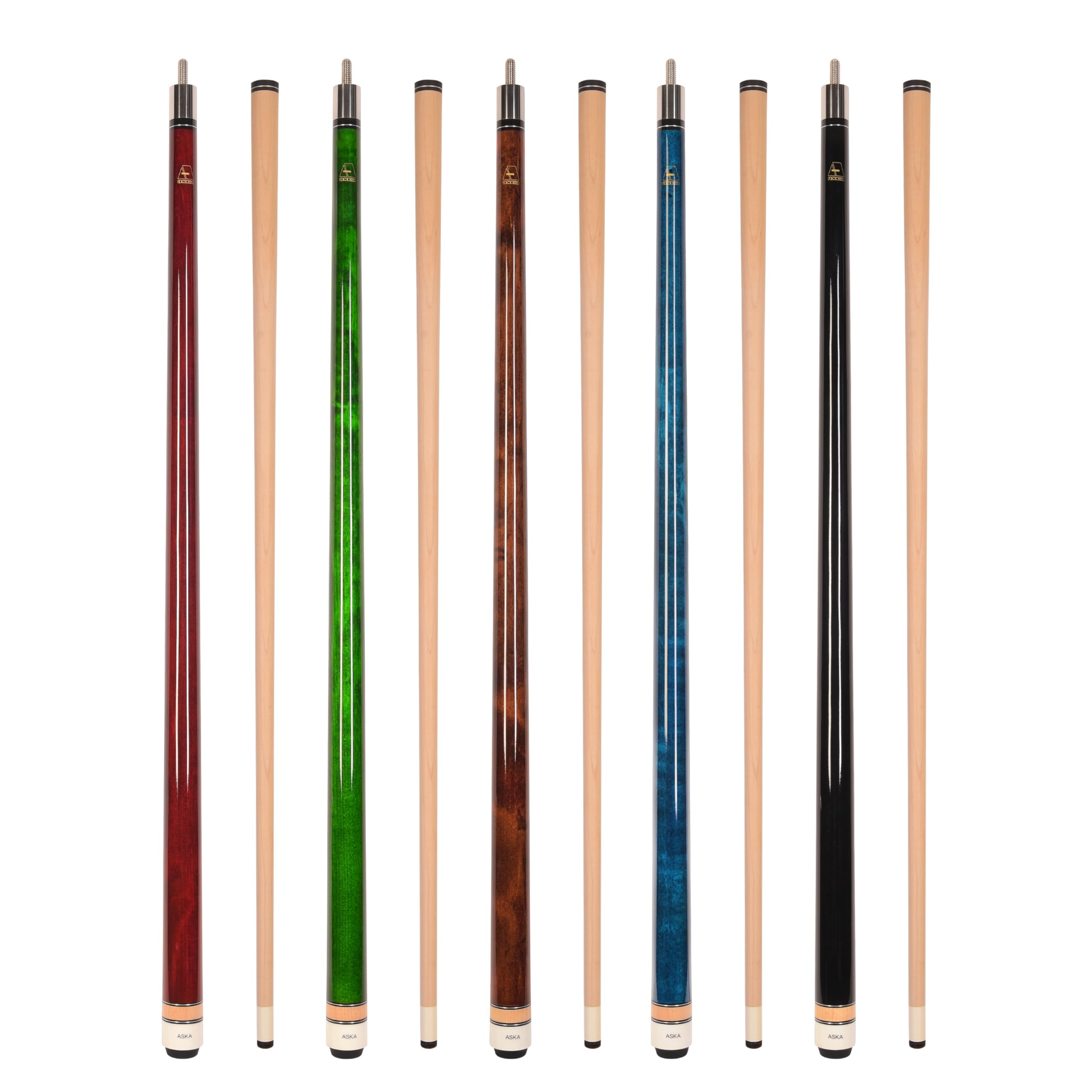
This is the most expensive set we recommend, and the money goes to one place: straightness. A cue that rolls out of true is the failure that ruins a house set, and of everything here this is the one whose shafts most reliably arrive true. That single quality is worth more at a home table than any cosmetic detail on the butt.

Five cues, and the weight map is smarter than it looks: red at 18 ounces, green and brown at 19, blue at 20, black at 21. Two cues at 19 ounces matters more than the count suggests, because 19 is the weight most casual players reach for first, and a foursome does not end up negotiating over the one cue everybody likes. We also like the wrapless handle for a shared set: nothing to unravel, nothing to keep tacky, and a damp cloth takes chalk dust off in one pass.

The bones are right: 29-inch Canadian hard rock maple shafts, 13 mm hard leather tips on ABS ferrules, and a 5/16x18 stainless joint, which is common enough that replacement shafts will still exist in a decade. What we do not like is the paperwork. The return window runs 30 days, which is tight on a set this expensive, so open the box and roll all five cues the day it lands.

Pros

  • Best straightness record in this group
  • Two of five cues weigh the popular 19 oz
  • Wrapless handle wipes clean and cannot unravel
  • Common 5/16x18 joint keeps shafts replaceable

Cons

  • Premium price for a five-cue set
  • 30-day return window only
Our verdict

Spend the extra if you want the best-finished house set here and the one whose shafts most reliably arrive straight.

Check Latest Price
3

Best Fiberglass Set

GSE Fiberglass Cue Set

91 /100
Lab Score Outstanding

Key details

Tip
12.7 mm leather
Weights
18 to 21 oz
Cue Count
4
Shaft Material
Fiberglass composite
View on Amazon

If your table lives in a garage, a basement or a covered porch, wood is a gamble. Maple moves with moisture, and a shaft that rolled true in March can wobble by August. GSE builds this set from fiberglass composite with a matte finish, which is the construction that cares least about the weather, and it is the reason we point at this set for a damp room rather than at one of the maple sets.

The details are thought through for that setting. The handle is a Veltex microfiber grip that stays put in a hot room, the joint is a 3/8-10 stainless steel pin with a black collar, and the tip is 12.7 mm, a hair narrower than the 13 mm on everything else here, glued to a one-inch fiber ferrule. Composite plays firmer and more uniform than wood; if you love the grain and give of maple, this is not the set that converts you.

The four weights run 18 to 21 ounces, so it still works as a house set rather than a single stick, and the matte black finish hides the scuffs a busy table hands out. The 30-day warranty is the main soft spot, short enough that you should roll every shaft the day it arrives. The tip is the part most likely to need attention first, and a replacement is a quick job at any shop that services cues.

Pros

  • Composite shafts built to resist warping
  • Four weights, 18 to 21 oz
  • Microfiber grip that stays put in heat
  • 12.7 mm leather tip on a fiber ferrule

Cons

  • Tips can need replacing early
  • 30-day manufacturer warranty
Our verdict

For a garage, basement or covered porch where humidity is a fact of life, this composite set is the one we point to.

Check Latest Price
4

Best Matched Set

ProSniper 4-Cue Set

89 /100
Lab Score Excellent

Key details

Length
58 in
Weight
19 oz
Includes
4 chalks
Cue Count
4
View on Amazon

All four cues in this set weigh 19 ounces. That is unusual, since most sets here spread 18 to 21 ounces across four or five sticks, and it decides who the set is for. If you want a rack where every cue feels the same, this is it. If you want something heavy for breaking and something lighter for a smaller player, this set cannot do either.

The rest is well judged. Canadian maple shafts, 13 mm tips, and four different wrap designs so each cue is identifiable across a room, which is a small thing until four people set their cues down at once and then reach for the wrong one. It is also the only set here that ships with chalk, four cubes in the box, so the cues are playable the day they arrive instead of after a run to the store. We liked that more than we expected to.

The single weight is the real limit. Nineteen ounces is a good all-round number, and it suits a matched set where nobody has to think about which cue they picked up, but it is not a break cue and it is heavy for a child or a small guest. If your group is mostly adults who play the same way, the uniformity is the reason to buy. Just check that everyone at your table agrees before you commit.

Pros

  • Four matching 19 oz cues
  • Four chalk cubes in the box
  • Canadian maple shafts with 13 mm tips
  • A different wrap design on each cue

Cons

  • One weight only, with no heavy break cue
  • Tips can separate within a few weeks
Our verdict

Buy it for a rack of four cues that feel identical in the hand; skip it if you want a heavy break cue in the mix.

Check Latest Price
5

Bar Play

Empire USA One-Piece Set

88 /100
Lab Score Excellent

Key details

Length
57 in
Weights
18 to 21 oz
Cue Count
6
Construction
One-piece hardwood
View on Amazon

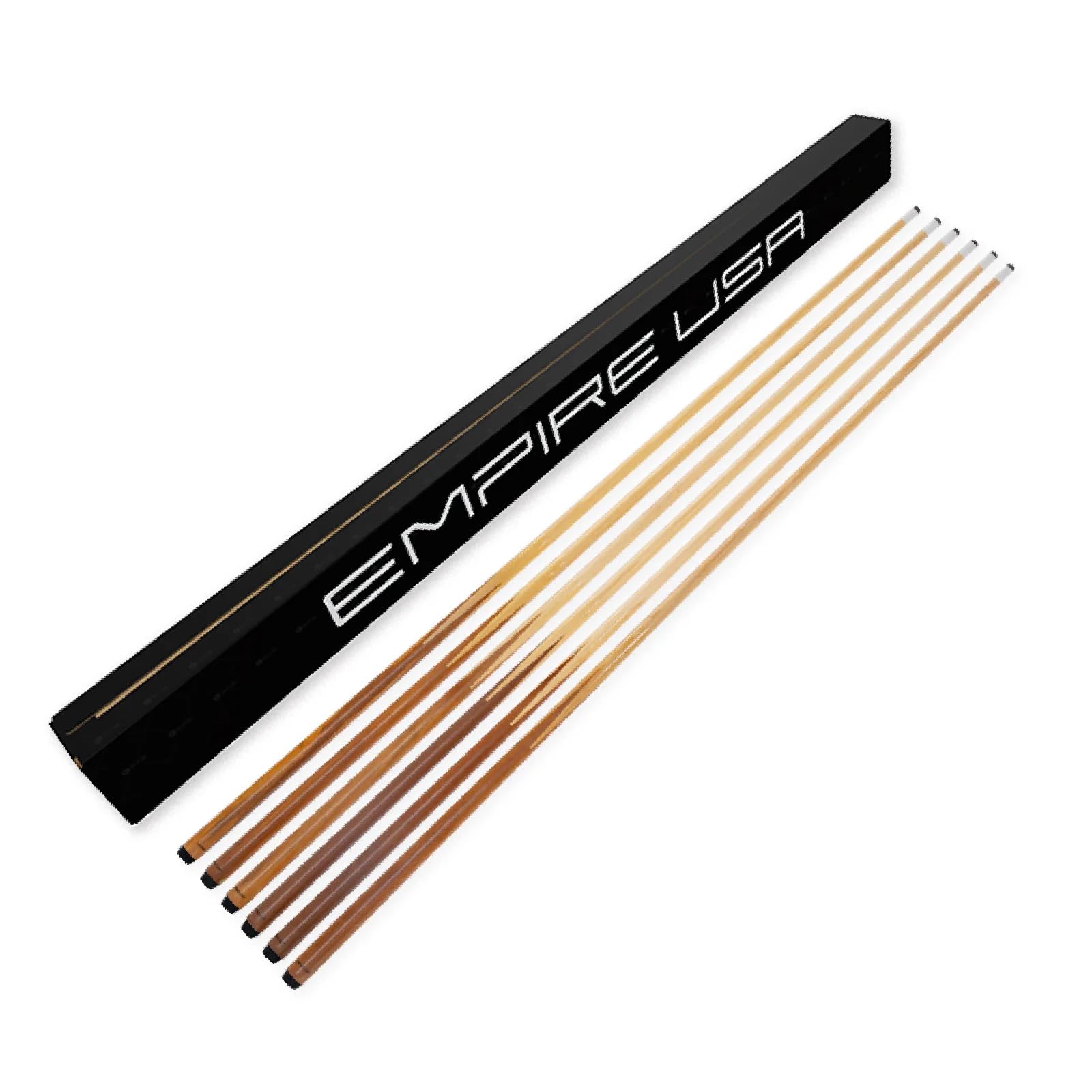
Six cues, one piece each, 57 inches long. There is no joint, so there is nothing to leave half-tightened after a guest racks the balls, no shaft that goes missing, and no collar to work loose over a thousand games. For a set that lives where things get dropped, a bar, a club room or a basement with a dartboard beside the table, that is the most useful thing a cue can offer.

The weight spread is deliberate too: one 18-ounce cue, two at 19, two at 20 and one at 21, enough for a full table with a spare in reserve. They are solid hardwood with 13 mm leather tips, and there are rubber covers over the bumper screws, a small detail but the kind that keeps a busy set looking decent after a year. The two-year manufacturer warranty is the longest of anything here.

Where we land: at 57 inches they run an inch shorter than the standard sets here, which you notice reaching across a long table, and one-piece cues need somewhere to live, a wall rack or a corner that is not in the way. Neither is a dealbreaker in a bar. For a room where the cues are shared, dropped and never quite put away, this set does more with its money than anything else here.

Pros

  • Six one-piece cues with no joints to loosen
  • Weights spread across 18, 19, 20 and 21 oz
  • Two-year manufacturer warranty
  • Rubber covers over the bumper screws

Cons

  • One-piece sticks are awkward to store and carry
  • No joint, so no shaft swaps later
Our verdict

If your cues live where people drop them, six one-piece sticks and a two-year warranty make this the safest money here.

Check Latest Price

How We Tested Pool Cue Sets

We started by pulling together every cue set we could find between budget and mid-range prices, then filtering by shaft material, tip hardness, weight range, and whether the set included a case. That left us with 12 sets, which we tested over seven months in a basement rec room, two local pool halls, and a weekly league night.

Straightness was the first gate. We rolled each shaft across a flat table and watched for wobble at the joint and tip — any cue that didn't roll true was set aside. We weighed every cue on a digital scale and noted the balance point, then hit hundreds of shots: draw, follow, and side spin. We paid attention to how the tip held its shape and chalk, whether it mushroomed after a few weeks, and whether the finish chipped when the cues rattled around in a case.

Grip and ergonomics got judged by feel. We asked players with different hand sizes to shoot a rack and describe whether the wrap felt tacky or slick, especially once chalk dust and sweat built up. We also checked stability at the joint — no rattle, no looseness after repeated assembly. Value came last: we compared what each set cost against how it played and how it looked after months of use, from the inlays to the butt cap. The sets that made the list earned it.

How to Choose a Pool Cue Set

Check Straightness Yourself, on Day One

The most useful thing you can do is roll every cue yourself. Lay each one on the cloth with the tip just off the rail, roll it slowly, and watch the shaft where it meets the butt; a wobble there is the one that ruins a shot. Sight down the shaft as well, because your eye catches a bend your hand cannot feel.

Do it the day the box lands, while the return window is still open. Store the set flat in a rack or standing upright rather than leaning in a corner, where damp and gravity both work on a shaft over a season.

Match the Weight Spread to Your Players

Eighteen to 21 ounces covers almost every adult player. Heavier cues hit harder and suit a break or a big stroke; lighter ones give more control and tire smaller hands less. A set with four different weights does the most work at a family table, because everyone eventually settles on one they like.

If your group all plays the same way, a uniform 19-ounce set is simpler, and the ProSniper set here is built on exactly that logic. We put more weight on the spread when guests are regulars, so buy for the people who actually pick up a cue at your house.

One Piece or Two, and Where the Set Lives

A two-piece cue packs down, stores short and lets you replace a shaft without retiring the butt. The trade-off is a joint that needs keeping tight and clean, and the joint is where a wobble usually shows up first. A one-piece cue has nothing to work loose, which is why bars tend to use them, but it wants 57 or 58 inches of rack and will not go in a bag.

If the table is permanent and guests are hard on equipment, go one piece. If cues travel to a hall or a friend's house, go two.

Maple, Fiberglass and What You Grip

Maple is the traditional shaft and gives the feedback most players expect, but it moves with humidity, which is what makes a damp basement hard on a wood set. Fiberglass composite resists moisture and needs almost no upkeep, at the cost of a firmer, less lively feel on the ball.

The handle matters as much as the shaft. Leather wraps are tacky and wear in well, nylon wraps are cheaper and can unravel, and a wrapless butt wipes clean and never needs rewrapping. If the table sits in a garage, prioritise composite and wrapless.

What's Actually in the Box

Most sets here are cues and nothing else: no chalk, no wall rack, no case, no tip tool. Chalk and a rack are day-one purchases, and a case only matters if the cues leave the house. A tip tool is worth owning because tips wear, and a handful of spare tips costs far less than retiring a cue.

Frequently Asked Questions

Final Verdict

The LOTKEY set is what we tell most people to buy. Four color-coded weights, solid Canadian maple, six months of cover and the lowest price of anything we recommend make it the easiest decision on this page.

If you want the best-finished house set and the budget stretches, the ASKA L3 is the upgrade, with five cues and the cleanest straightness record in this group. And if the table lives somewhere damp, buy the fiberglass GSE and stop worrying about the seasons.