Best Tabletop Game Mats of 2026

Game night is going fine until someone leans across the table and sends a stack of cards skating into a dice tray. A tabletop game mat is the simplest fix: a grippy surface that holds cards, tokens, and miniatures in place, protects the table underneath, and gives everyone a clear play area. It also makes cleanup easier when a snack bowl tips over. But not every mat rolls out flat, stays put, or wipes clean, and the wrong size can leave half your cards hanging off the edge.

I've hosted a weekly game night for years, and we've spent the past four months putting 15 mats through everything from solo campaign sessions to a crowded tournament table. The best ones did the boring things well: they stayed flat, kept components where we put them, and looked good enough to leave out. The differences came down to material quality, printed map clarity, and whether the surface actually erased clean after a dry-erase marker test. The mats that made the cut are below.

1

Best Overall

TidyBoss DND Expansion Pack

96 /100
Lab Score Outstanding

Key details

Grid
1-inch squares
Included
3 mats, 2 markers, eraser, 4 clips
Mat Size
24 x 36 inches
Material
Laminated art paper
View on Amazon

Six terrains out of three mats is the arithmetic that earns this set its place: lava, desert, forest, swamp, cave, and ocean, each printed across 24 by 36 inches over a high-contrast one-inch grid. That is a campaign's worth of encounter settings you never have to draw, and the grid stays readable from the far end of the table, which is the first thing we check on any printed mat.

The four straightening clips are the detail that makes it work. Laminated mats arrive rolled and want to stay that way; clip the roll open and it settles flat in a few minutes instead of spending the first hour under a stack of rulebooks. The dry-erase side behaves as well — the included markers wipe off with the eraser, and a damp paper towel deals with anything that sat through a week.

For midrange money you get the complete kit: three double-sided mats, two markers, an eraser, and the clips, so a new group needs nothing else on day one. We keep coming back to it for pickup games because the terrain does the describing for you — drop miniatures onto the lava sheet and everyone at the table knows what they are looking at.

All three mats roll into a single bundle, which is what makes it practical to carry to somebody else's table. And because each sheet is printed on both faces, there is no dead weight in the bag: when one terrain gets familiar, its reverse is a change of scenery.

Pros

  • Six printed terrains from three mats
  • Clips hold the rolled mats flat
  • Dry-erase surface wipes clean
  • Markers, eraser, and clips included

Cons

  • Laminated paper can crease in storage
  • 24 x 36 inches needs a full dining table
Our verdict

Six printed terrains, dry-erase markers, and clips that flatten the roll make this our default pick for RPG groups who would rather play than draw.

Check Latest Price
2

Best for Board Games

Allplay Board Game Playmat

91 /100
Lab Score Outstanding

Key details

Backing
No-slip
Mat Size
3 x 5 feet
Material
Neoprene
Thickness
5mm
View on Amazon

There is no grid on this mat, and that is exactly why it belongs here. Three feet by five feet of 5mm neoprene covers a table with a soft matte surface: cards slide instead of catching on wood grain, and the thickness is enough that you can lift a card off it without bending a corner.

The stitching is what we appreciated most. It is inset, sitting lower than the playing surface, so a card that slides to the edge does not catch on a raised hem and flip — which is precisely where a carefully stacked deck goes flying on cheaper mats. Five millimeters is also a good deal more than the 3mm sheets most mats use, and that is what makes this feel like a game table rather than a cloth.

It is water resistant and wipes clean, and the no-slip backing keeps it anchored through an evening of reaching and shuffling. Between sessions it rolls up and stands in a closet, which is the practical way to store something this size.

Be clear about what it is for. This is a board-and-card-game surface; if your group plays D&D with miniatures and measured movement, you need a printed grid, and the TidyBoss or the Chessex will serve you far better.

Pros

  • Thick 5mm neoprene play surface
  • Inset stitching does not catch cards
  • No-slip backing holds it in place
  • Water resistant and easy to wipe

Cons

  • About 8.4 pounds, so it stays home
  • Carrying case is a tight squeeze to repack
Our verdict

We point board-game hosts here: 5mm of no-slip neoprene turns any table into a game table, and the inset stitching keeps cards from catching at the edge.

Check Latest Price
3

Best Budget

EverGame Foldable Battle Mat

92 /100
Lab Score Outstanding

Key details

Grid
1-inch squares and hexes
Storage
Folds into storage box
Included
7 dice, 4 markers, eraser, spray
Mat Size
23 x 27 inches
View on Amazon

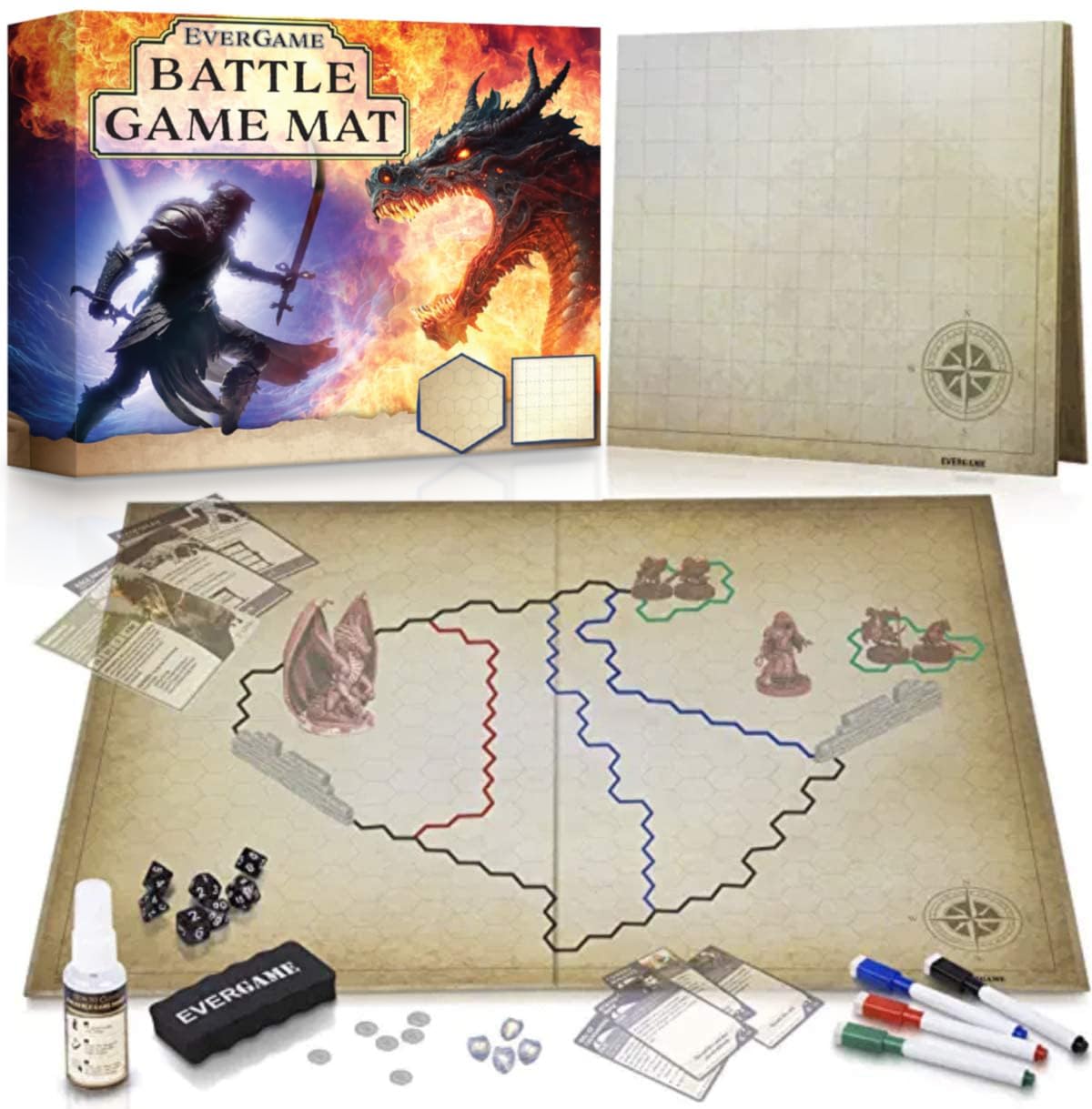
It arrives folded rather than rolled, and that changes the first five minutes of a session: no curling corners to weight down, no clips to hunt through a dice bag. Unfold it on the table and the board sits flat while everyone else is still unpacking miniatures.

The board is double-sided — one-inch squares on one face, one-inch hexes on the other — printed in an aged-scroll style that reads as parchment rather than graph paper. It comes with four markers with eraser caps, a separate eraser, a spray bottle, a seven-piece dice set, and a storage box, which is a complete first kit rather than a mat with a pen thrown in.

Where it earns its place is as the set we hand a new group. It is the least expensive route into a proper printed grid here, everything a first session needs is in the box, and the hex face suits games that measure diagonals — something square grids handle clumsily.

The fold is the thing to watch. Our board came out stiff enough to skip the clips entirely, and it lives in its box between sessions, so it has kept its shape; a board that gets folded back on itself inside a bag will start to show it at the creases.

Pros

  • Folds flat and stores in its box
  • Square and hex grids on one board
  • Dice, markers, eraser, and spray included
  • Least expensive way into a printed grid

Cons

  • Smaller 23 x 27 play area
  • Laminated top can separate with heavy use
Our verdict

The budget pick we keep recommending: it folds flat, prints squares on one side and hexes on the other, and includes dice and markers for a first campaign.

Check Latest Price
4

Best for Card Games

Biouai 2-Pack TCG Playmats

92 /100
Lab Score Outstanding

Key details

Edges
Stitched
Included
2 mats and tube
Mat Size
24 x 14 inches
Material
Rubber
View on Amazon

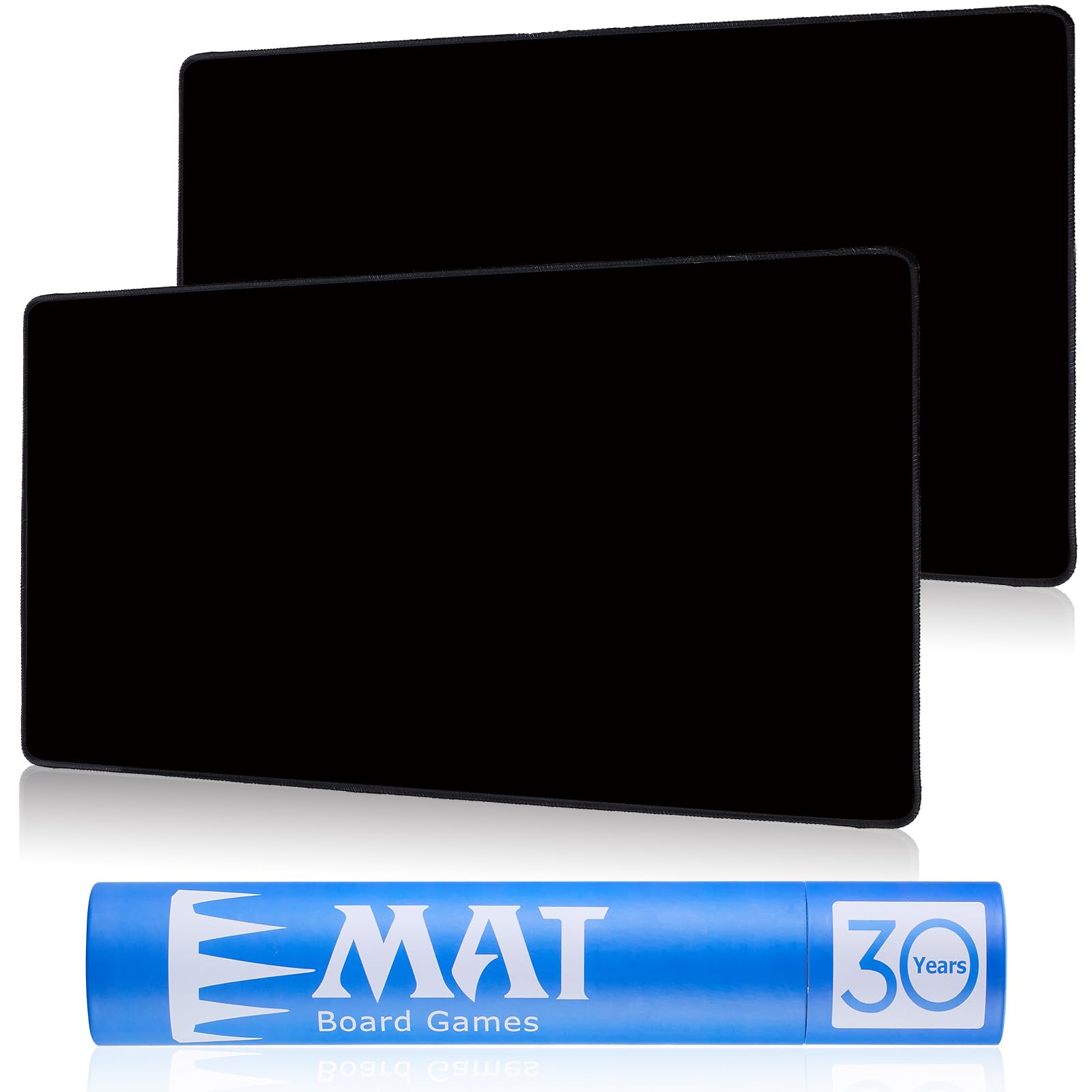
Two people, one card game, one table at the shop — that is the situation these mats are cut for, and they solve it neatly: two 24-by-14-inch rubber mats and a tube, so both players get a clean surface out of the same purchase instead of one of you playing on bare table.

The stitching matters more than it sounds. It sits flush with the surface rather than proud of it, so sleeves glide over the edge instead of catching, and stitched edges are the first thing to fray on a cheap playmat. Rubber wipes down with a damp cloth, which handles the spilled-drink scenario that a paper battle mat does not survive.

What we like about the size is that it is honest: a 24-by-14 mat holds a deck, a graveyard, a row of lands, and tokens — the full layout for Magic or Yu-Gi-Oh — and nothing beyond that. The tube keeps both rolled for a commute, and the pair costs about what you might expect to spend on one mat elsewhere in this guide.

Pros

  • Two mats in one purchase
  • Stitched edges lie flush with the surface
  • Rubber wipes clean with a damp cloth
  • Tube keeps both mats rolled

Cons

  • Card-game layout only, no battle-map space
  • Cardboard tube rather than a hard case
Our verdict

Buy these for card night: two stitched rubber mats and a tube, sized for a full TCG layout and sold as a pair rather than a single.

Check Latest Price
5

Best Large Grid

Chessex Megamat

90 /100
Lab Score Outstanding

Key details

Ink
Wet-erase only
Grid
1-inch squares and hexes
Mat Size
34.5 x 48 inches
Material
Expanded vinyl
View on Amazon

Buy the markers before the mat. The Megamat is expanded vinyl and takes wet-erase ink only; dry-erase markers can sink into it and stay there, and no amount of wiping brings the surface back.

With the right pens, this is the large-format mat we point big-encounter DMs toward. At 34.5 by 48 inches it covers most of a dining table, the vinyl does not wrinkle the way laminated mats do, and a square face on one side and a hex face on the other covers nearly every system on the shelf. Wet erase also earns its keep mid-session: a sleeve dragged across the map will not smear the dungeon the way dry erase does.

The cost is maintenance. Erasing means a damp paper towel or a mild detergent solution rather than a swipe of the eraser, so redrawing mid-fight is a two-minute pause instead of a five-second one, and ink left sitting for days takes real work to lift.

Pros

  • Big 34.5 x 48 playing area
  • Squares one side, hexes the other
  • Vinyl resists the wrinkling of laminated mats
  • Wet-erase ink will not smear under a sleeve

Cons

  • Wet-erase markers only, and no pens included
Our verdict

For big encounters this is the one: a 34.5-by-48 vinyl surface that resists wrinkling, provided you buy wet-erase markers and keep a damp cloth handy.

Check Latest Price
6

Best Modular

GSM Brands Battle Board 4-Pack

89 /100
Lab Score Excellent

Key details

Grid
1-inch squares
Pieces
4 boards
Backing
Non-skid
Board Size
17 x 13 inches each
View on Amazon

A single rectangle is the wrong shape for a lot of encounters. Four boards of 17 by 13 inches can run in a line for a corridor, form an L for a corner fight, or sit two-by-two as a 34-by-26 room — the shape you build is the shape of the fight.

Rigid boards do something rolled mats cannot: they lie flat immediately, with nothing to uncurl and nothing to clip. The front is a dry-erase parchment print that takes dry-erase markers and wipes clean, and the reverse is a non-skid material that grips the table.

The real use is prep and fog of war. Draw two rooms on separate boards before the session, keep the second face down, and reveal it when the party opens the door; the same trick stacks for multi-story buildings, where several boards beat one big map. The join is the compromise — a miniature straddling two boards sits slightly proud — so build rooms with a wall running along the seam and it stops mattering.

For a table that changes shape every week, this is the most flexible surface in the group, and the one we set out when we do not yet know how big the fight will get.

Pros

  • Build any map shape from four boards
  • Rigid boards lie flat immediately
  • Dry-erase surface wipes clean
  • Packs flat for storage and travel

Cons

  • Squares only, no hex face
Our verdict

We keep these for encounters that are not rectangles: four rigid boards that lie flat, wipe clean, and reshape the map to fit the fight.

Check Latest Price
7

Warhammer 40K

Lighter Creative 44 x 60 Battle Mat

88 /100
Lab Score Excellent

Key details

Included
Canvas carrying bag
Markings
Pre-printed deployment zones
Mat Size
44 x 60 inches
Material
Synthetic leather, 1.2mm
View on Amazon

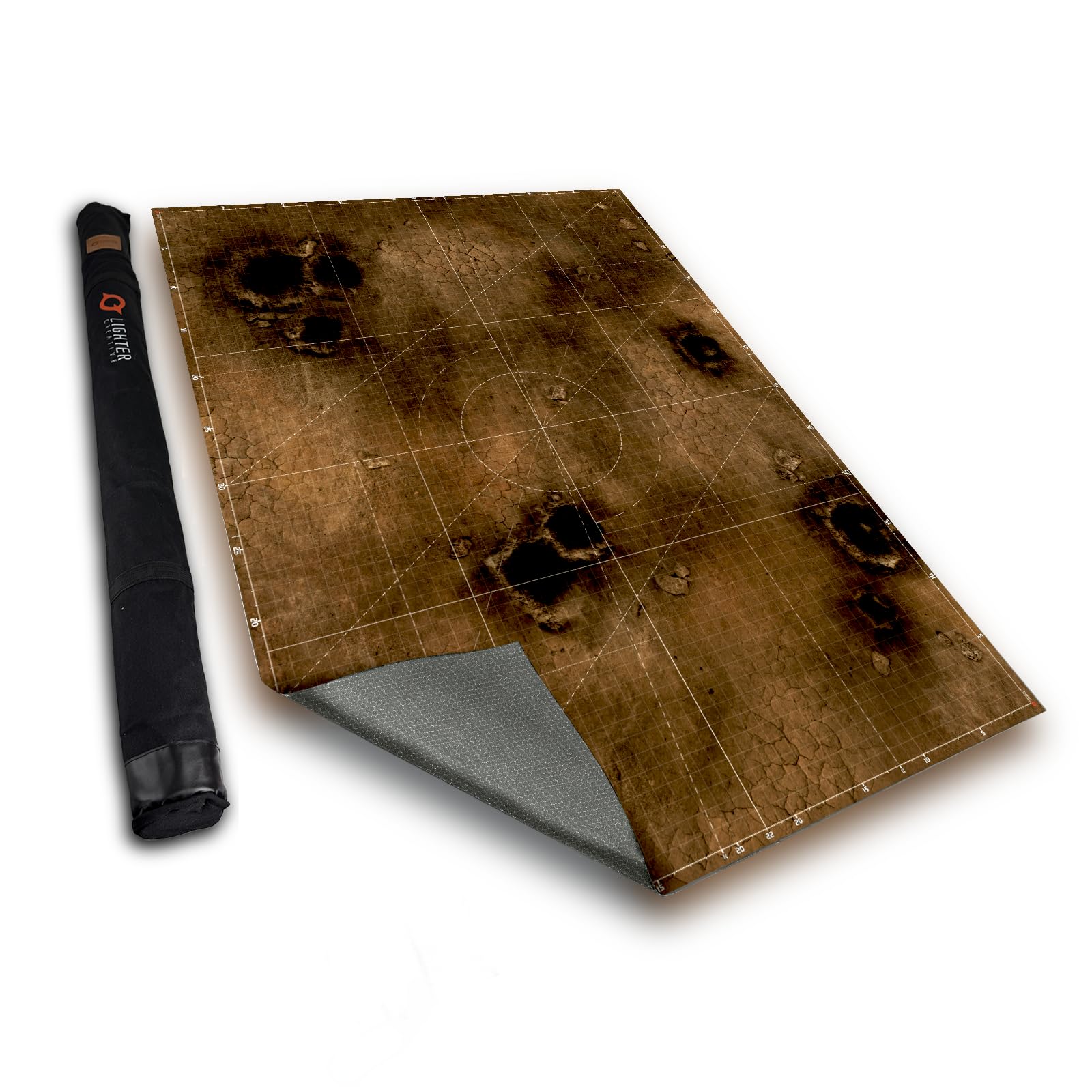
The markings are the product. Deployment zones, objective positions, territory lines, and a one-inch grid are printed onto a 44-by-60-inch surface sized for Warhammer 40K, which turns setup from a tape-measure exercise into unfolding a mat.

The material is 1.2mm synthetic leather: water resistant, wrinkle resistant, and wipeable, with a canvas bag for transport. It is a nicer surface than laminated paper, too — models sit on it without sinking, and a knocked-over drink is a wipe rather than a redraw.

For a 40K player, this is the pick. It removes the measuring that eats the first twenty minutes of a game, and the printed lines are legible without crowding the board. It is equally a single-purpose mat at premium money: if you also run D&D or board games, those markings are clutter, and a plain grid or a plain neoprene surface does more for you.

It ships folded, so unfold it the night before a game rather than ten minutes before. The creases relax with time on the table, and the edges settle once the material has warmed up.

Pros

  • Pre-printed deployment zones and objectives
  • 1-inch grid for measurement
  • Water-resistant synthetic leather
  • Canvas carrying bag included

Cons

  • Printed for WH40K 11th edition only
  • 44 x 60 inches needs a dedicated table
Our verdict

If you play Warhammer 40K on a dedicated table, these pre-printed zones and grid cut setup to minutes; for anything else the markings get in the way.

Check Latest Price

How We Tested Tabletop Game Mats

We built the shortlist by comparing materials, true dimensions, grid styles, and care instructions across neoprene, cloth, and vinyl options, then filtered out mats whose listed size or surface didn't match how we actually play. That left 15 mats, which we used for four months during weekly game nights, solo campaign sessions, and a weekend tournament at a local game store. We rolled each one out on kitchen tables, a folding table, and a friend's dining room table, leaving it in place for the whole session.

To see whether a mat stayed put, we nudged the table, reached across it for tokens, and watched whether cards or meeples drifted. We measured every mat against its listed size, then set up a standard card-and-board layout to judge whether the play area felt cramped or generous. Creasing got its own check: we rolled and unrolled each mat before every session and noted whether corners curled or the surface settled flat. For portability, we carried each one to a friend's house in its bag or strap and paid attention to bulk and awkwardness.

Gameplay observations were plain: how easily cards slid and picked up, whether dice bounced true, and whether miniatures stood without tipping. For map quality, we compared printed grids and artwork under a lamp, looking for blurry lines, uneven color, and contrast that made terrain hard to read. Erasability got a separate pass — we wrote on compatible mats with dry-erase markers, let the ink sit for an hour, then wiped with a dry cloth and a damp one. Value came down to whether the material, edges, and surface still looked good after four months, not just on day one.

How to Choose a Tabletop Game Mat

Decide on a grid before anything else

If your games measure movement in inches, you want a printed 1-inch grid; there is no workaround for counting squares by eye at the end of a long session. If you play board games and card games, a grid is visual noise under your components and a plain surface is the better buy — the Allplay mat has no grid at all, and that is its whole design argument.

Hexes are worth seeking out if your group plays games that measure diagonals, since a square grid handles those clumsily. A double-sided mat with squares on one face and hexes on the other covers both habits without buying twice.

Match the size to your table, then subtract

24 by 36 inches is the hobby standard for a battle mat and takes up most of a six-foot dining table. Before you order, subtract the mat from the table: a 36-inch-wide table with a 24-inch mat leaves about six inches on each side for character sheets, dice trays, and drinks, which is enough. Put a 34-inch mat on that table and the edges are for nothing but elbows.

Smaller tables want the 23-by-27 or modular route, while a 3-by-5 neoprene mat or a 44-by-60 wargame surface is a dedicated-table purchase, not something you bring out on a coffee table.

Lying flat is the quality test that matters

A mat that will not lie down is a mat you fight all evening. Rolled laminated mats curl at the corners and need clips or a stack of rulebooks; folded boards land flat immediately but remember their creases; thick neoprene relaxes out of the roll within minutes; rigid boards cannot curl at all.

Storage decides how well any of them survives. A laminated mat that lives folded in a bag will crease, and a vinyl mat left rolled tight in a hot car takes a set. If you have no shelf to store a mat flat, buy a folding board or a modular set instead of a roll.

Match the pen to the surface

Laminated mats take dry-erase markers, which wipe off with a felt eraser and suit groups that redraw constantly. Vinyl mats take wet-erase markers only, and dry erase on vinyl can sink in and stay there permanently — it is the fastest way to ruin a good mat. Neoprene takes no ink at all.

Think about your table's rhythm. Wet erase does not smear under a sleeve dragged across the map, which matters in a scrum, but erasing means a damp cloth rather than a swipe. Dry erase is friendlier mid-session and rewards you for wiping the mat down the same night.

Frequently Asked Questions

Final Verdict

Our default is the TidyBoss set. Six printed terrains, markers, an eraser, and clips that flatten the roll give an RPG group the most usable surface for midrange money, and the dry-erase face takes whatever the session throws at it.

If your table is for board games and card games rather than miniatures, buy the Allplay mat instead — 5mm of no-slip neoprene is simply a better surface to sit at, and the premium buys you the feel of a game table. On a small table or in a bag that travels weekly, the EverGame folds flat and costs the least.