Best Arcade Cabinets of 2026

A home arcade cabinet is part furniture, part time machine—but the fantasy of owning one often collides with a 200-pound delivery box and a six-page instruction booklet. The real question isn't whether you want one; it's whether the games feel right, the build holds up, and the thing fits in your space. We've spent the past eight months assembling, playing, and living with six cabinets to answer that. The best ones bring the neon-lit arcade experience home without turning your living room into a repair project.

What separates a great cabinet from a frustrating one is rarely the game count—it's whether the joystick responds the way your muscle memory expects, whether the game list leans on genuine classics or filler, and whether assembly takes an evening or a weekend. Compact models can be surprisingly satisfying, and the cost usually tracks the quality of the controls and the wood. Below, our picks are organized by the kind of player you are, so you can find the one that fits your space and your nostalgia.

1

Best Overall

Ms. Pac-Man Class of '81 Deluxe

91 /100
Lab Score Outstanding

Key details

Height
61 inches
Screen
17 inches
Weight
81 lb
Games Included
12
View on Amazon

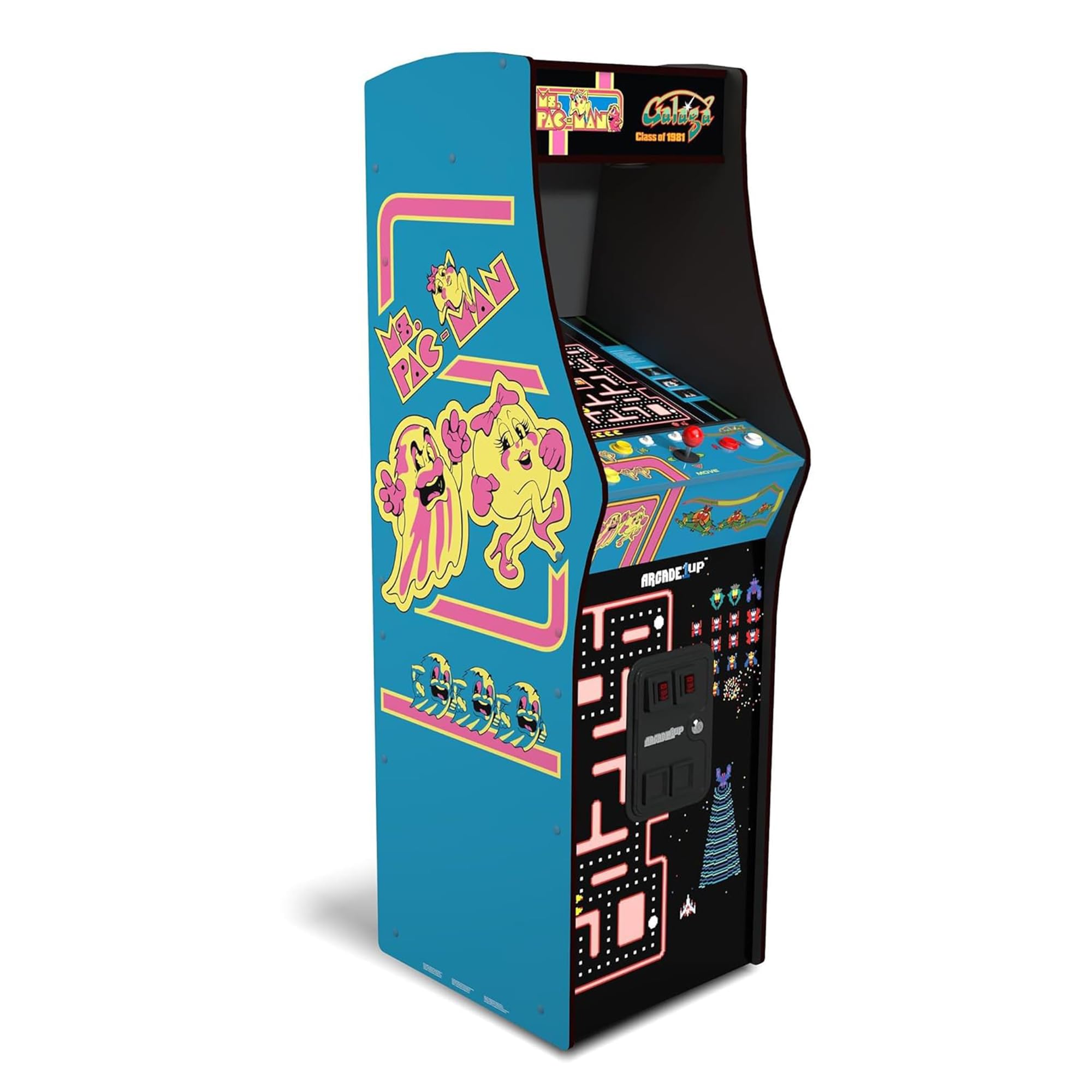
Sixty-one inches tall, 18.82 inches wide, 22.44 inches deep, and 81 pounds: the Class of '81 is a full-size cabinet in the way that matters. You stand at it, it holds a wall the way a bookcase does, and the 17-inch BOE screen is the same panel Arcade1Up uses across its Deluxe line, bright and correctly proportioned for maze games and vertical shooters. The light-up marquee and molded coin door do most of the room-setting work before anyone presses start.

We point most buyers here first, and it's the game list rather than the hardware that earns it. Twelve titles pulled from 1981 is the era people actually recognize when they walk in, and the real-feel joystick, responsive buttons, and dual speakers make them sound and feel like the machine in the back of a pizza place. The Wi-Fi leaderboards are the pleasant surprise: you post scores against other players and it asks nothing monthly for the privilege.

Plan on an afternoon. These cabinets arrive as panels, cam locks, and a long manual, and the instructions are the weak link, with black-and-white diagrams that reward patience and a second pair of hands. Build it where it will live. It's 81 pounds once assembled, and wrestling that up a finished staircase twice is nobody's idea of a good Saturday.

One note before you compare counts: the cabinets in this family share large parts of their libraries, so a 12-game machine and a 14-game machine can differ by only a couple of titles. Pick the marquee you want to stand in front of, not the bigger number.

Pros

  • Plays and sounds like the original
  • 17-inch screen sized for standing play
  • Light-up marquee and faux coin door
  • Wi-Fi leaderboards with no subscription

Cons

  • 90-day manufacturer warranty is short
Our verdict

The one we tell most people to buy: a full-size cabinet with 12 games from the era everyone recognizes, and the least expensive way into a real upright.

Check Latest Price
2

Best No-Assembly Option

Evercade Alpha Street Fighter

86 /100
Lab Score Excellent

Key details

Screen
8 inches
Weight
13.2 lb
Assembly
Pre-assembled
Built-in Games
6
View on Amazon

Flat-pack is the default in this category: panels, a bag of cam locks, and a manual that assumes you enjoy this sort of thing. The Evercade Alpha shows up built. Unbox it, plug in the USB-C cable, and you're playing, and we think that convenience is worth real money to anyone who has spent an evening squinting at a diagram.

What you're playing is six Street Fighter games, from Street Fighter II Champion Edition through the Alpha series, with Super Puzzle Fighter II Turbo for when the competition needs a breather. The stick and buttons are competition-grade rather than toy-grade, the 8-inch IPS panel is crisp at 720p, and the light-up marquee takes swappable inserts, with three in the box.

The cartridge slot is the part that changes the math. Evercade's library runs past 500 cartridges, so the six built-in games are a starting point rather than the whole story, and built-in Wi-Fi handles updates without a cable. It's also the lightest cabinet here at 13.2 pounds, which means it moves between rooms without a plan.

Where it gives ground is scale. An 8-inch screen on a 13-pound bartop is a desk machine, the kind you pull close rather than stand back from, and it wants a counter or a shelf underneath it. Set beside a 61-inch upright it's a different class of object, and for a lot of apartments that's exactly the point.

Pros

  • Arrives fully assembled; plug in and play
  • Cartridge slot opens 500-plus Evercade titles
  • Competition-grade stick and buttons
  • Three swappable light-up marquees

Cons

  • Built-in library is Street Fighter only
  • Two-player needs USB controllers, sold separately
Our verdict

Buy this if you want arcade controls without an afternoon of assembly: it plays the moment you unbox it, and the cartridge slot keeps it from going stale.

Check Latest Price
3

Best Cocktail Table

Top US Video Arcades Cocktail Table

91 /100
Lab Score Outstanding

Key details

Screen
22 inches
Players
2
Warranty
5 years
Dimensions
34 x 26 x 30 inches
View on Amazon

Thirty inches high, 34 inches long, and 26 deep, with a tempered glass top and two stools tucked underneath: this is a cocktail table in the old arcade sense, where you sit facing your opponent with the screen between you under glass. It wants floor in the middle of a room, not a stretch of wall, and that single fact will decide the purchase for most people.

The 22-inch screen is the largest here by a wide margin, and the construction is the heaviest-duty of the group, 3/4-inch structural plywood rather than the particle board thinner cabinets use. It also arrives plug-and-play with hundreds of classic 80s titles and no adult games on the list, which makes it the easy one to leave running in a family room. The parts warranty runs five years, the longest coverage in this guide by a distance.

The format is what won us over. Standing at an upright is a solo pleasure even with a friend watching; sitting across a cocktail table turns a high score into a conversation, and nobody has to drag a chair over. Our reservation is the game list itself, because several hundred titles is a menu to scroll rather than a dozen you know by heart, and the first evening goes to hunting instead of playing.

The two stools are the tell. Nobody bundles seating with a cabinet they expect you to play alone.

Pros

  • 22-inch screen visible from both stools
  • Five-year parts warranty, longest here
  • Structural plywood rather than particle board
  • Arrives ready to play, two stools included

Cons

  • Needs open floor instead of a wall
  • The priciest cabinet here by a wide margin
Our verdict

Buy this when the cabinet is meant to furnish a room: a 22-inch screen under tempered glass, two stools, a plywood build, and five years of parts coverage.

Check Latest Price
4

Best for Small Spaces

Arcade1Up Pac-Man Countercade

87 /100
Lab Score Excellent

Key details

Power
4 AA batteries or micro-USB
Screen
7 inches
Weight
6.3 lb
Games Included
3
View on Amazon

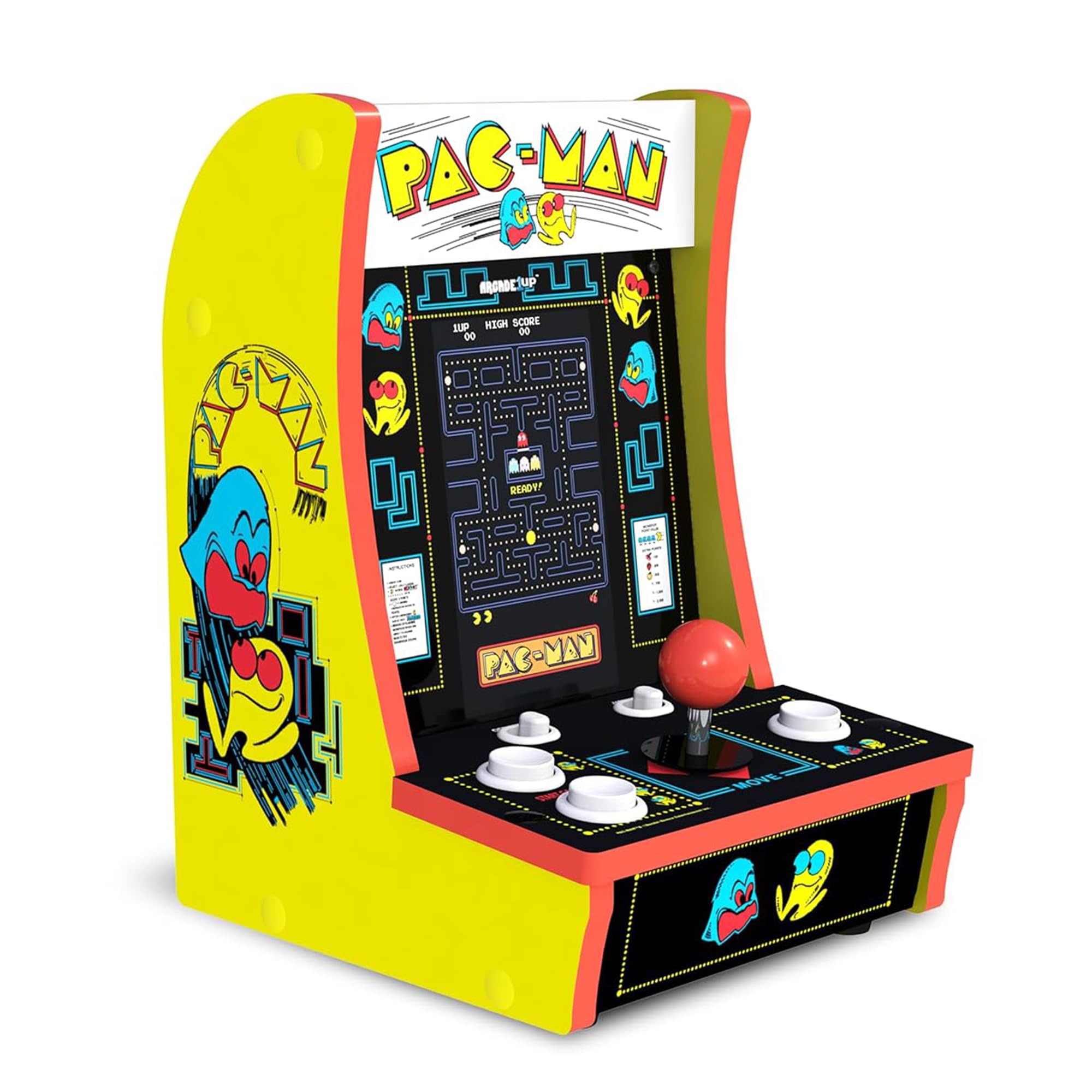
There's a handle on the top and a battery bay underneath. The Countercade stands 13.11 inches tall, measures 9.4 by 8.7 inches at the base, weighs 6.3 pounds, and runs on four AA batteries or a micro-USB cable, which makes it the only cabinet here that can move from the den to the patio without a hand truck.

We kept reaching for it for exactly that reason. Three games, Pac-Man, Super Pac-Man, and Pac-Mania, on a real joystick and buttons is a better use of a spare shelf than another console, and the light-up marquee and dual speakers are what stop it feeling like a toy. There's no assembly at all; it plays straight out of the box, which nothing else in this guide at this size manages.

Be ready for the scale. Once the styrofoam is out it reads smaller than the box suggested, and the 7-inch screen rewards sitting close, sharp on a desk and a squint from across the room. It's a rotation piece rather than the cabinet you build a room around, and it's happiest when you treat it that way.

Pros

  • Runs on AA batteries or micro-USB
  • 6.3 pounds with a built-in carry handle
  • No assembly; playable out of the box
  • Real joystick and buttons with light-up marquee

Cons

  • Three games, one player at a time
Our verdict

The one to buy when the space is a shelf rather than a wall: three Pac-Man games on a real joystick, and it runs on AA batteries.

Check Latest Price

How We Tested Arcade Cabinets for the Home

We started by scanning the market for cabinets that ship fully assembled or require minimal setup, filtering out models with vague game lists or no stated monitor specs. We also ruled out anything too wide for a standard doorway or too tall for a basement ceiling. That left us with six cabinets—a mix of compact countertop units and full-size uprights—which we tested over eight months.

Each cabinet lived in a real home: a living room corner, a finished basement, and a garage game room. We assembled every one ourselves, timing the process and noting where the instructions sent us back a page. During game nights, we played at least ten rounds across a mix of fighting, shooting, and platforming titles, watching for joystick dead zones, button mush, and screen lag. We also nudged each cabinet mid-game to see if it wobbled, ran a hand along the edges for rough laminate, and measured the footprint against a couch and a doorway to judge how compact it really felt.

We counted how many titles we actually recognized and wanted to play, not just the total number listed. To gauge value, we compared the control deck and monitor quality against what the cabinet costs—and noted which ones felt like a dedicated console with a cabinet around it versus a toy. Finally, we invited friends who hadn't touched a joystick in years and watched which games pulled them in for "one more round." The cabinets that scored best kept us playing after the novelty wore off.

How to Choose an Arcade Cabinet

Start with the game list, not the count

Manufacturers pad counts by bundling overlapping libraries, so a 12-game cabinet and a 14-game cabinet from the same family can share most of their titles. Write down five games you play this month, then check the actual list against them. A cabinet with hundreds of titles looks generous and behaves like a menu: the first evening goes to scrolling instead of playing.

The Ms. Pac-Man Class of '81 is the cleanest version of the other approach, a tight set pulled from one year, every title recognizable. For most households that beats a sprawling list every time.

Measure the footprint and the route to the room

A full-size upright runs roughly 61 inches tall, 19 wide, and 22 deep, so treat it like a narrow bookcase and leave a few feet of clear floor in front for the player. Cocktail tables sit around 30 inches high but want open floor in the middle of a room rather than a wall.

Here's the trap: compact in a listing usually means it fits a car trunk, not that it fits an alcove. Tape the footprint on the floor, measure the stair turn, and count doorways before you order.

Decide whether assembly is part of the deal

Flat-pack cabinets arrive as panels, cam locks, and a manual, and assembly is the part people underestimate: allow an afternoon, a second person, and decent light, and build it in the room where it will live. Keep the packaging until every game loads, because a return gets far harder once the box is gone.

If you know you won't build it, pay for the alternative. The Evercade Alpha is the only bartop in this guide that arrives finished, and the cocktail table plugs in with no tools at all.

Match the screen and the controls to the games

Screen size tracks format: 17 inches on a full-size upright, 22 on the cocktail table, 7 to 8 on bartop and countertop units. Stand or sit where you'll really play before deciding the smallest is fine, because a 7-inch panel is a lean-in experience.

Controls matter more than the panel. A joystick and buttons cover maze games, shooters, and fighters; a trackball is what makes golf and bowling feel right; a wheel and pedals decide racing. Buy for the control you'll use most, since it can't be added later.

Work out what a second player costs

Two-player support isn't automatic. Some cabinets have a single control panel, others expect you to plug in USB controllers you supply, and the cocktail table is built for two people facing each other across the glass. Count the controllers you need before checkout.

Also check the online side: leaderboards are a nice way to keep playing, and the full-size Arcade1Up cabinets include theirs without a subscription.

Frequently Asked Questions

Final Verdict

The Ms. Pac-Man Class of '81 Deluxe is the cabinet we recommend to most people: 12 games from the year the arcade peaked, a 17-inch screen, and a footprint that behaves like furniture rather than a monument. Build it once, in the room where it stays, and it will hold that wall for years.

If the build itself is the dealbreaker, the Evercade Alpha plays the moment it comes out of the box. If the cabinet is meant to furnish a room rather than fill a corner, the cocktail table earns its price.