Best Mini Arcade Machines of 2026

Arcade games are built on a simple promise: put in a coin, get a thrill. Miniature cabinets sell that promise for the living room, but good ones and bad ones look nearly identical in photos. The difference shows up the moment you play — a mushy joystick, a screen too small to follow the action, or a cabinet that walks across the table when you get excited. Ten of these have lived in my house for the past six months, and my kids and I have put them through far more rounds than a tabletop toy deserves. What separates the keepers is playability: real controls, a game list worth revisiting, and a machine that looks like it belongs in a room rather than a closet.

Size catches people out more than anything else — a cabinet a couple of inches wider than planned can swallow a desk, and one that's too small becomes a novelty nobody touches after a week. Appearance earned equal weight in our scoring, since half the appeal is a scaled-down cabinet that looks right on a shelf. What follows are the ten that stayed fun after the novelty wore off and justified what they cost.

1

Best Overall

Arcade1Up Pac-Man Countercade

87 /100
Lab Score Excellent

Key details

Power
4 AA batteries or micro-USB
Screen
7 inches
Dimensions
9.4 x 8.7 x 13.11 inches
Built-in Games
3
View on Amazon

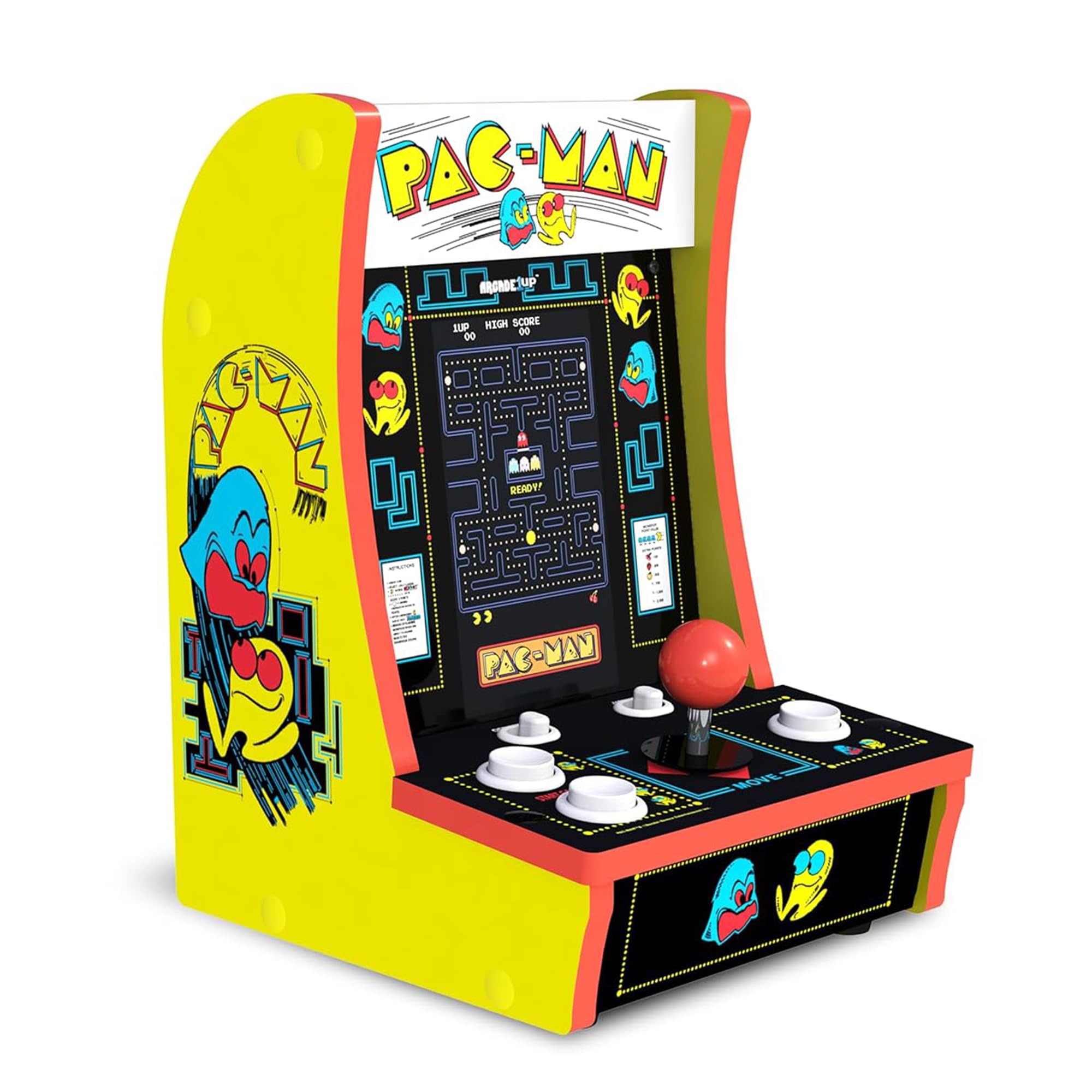
At 9.4 by 8.7 by 13.11 inches and 6.3 pounds, this is the only machine in the group that wants a real square of counter rather than a corner of a desk, and we think that trade is the right one. The 7-inch screen is big enough that you stop squinting and start playing, the joystick and buttons are sized for adult hands, and the lit marquee and dual speakers finish an impression the palm-size units cannot touch. This reads as a small arcade cabinet rather than a toy shaped like one.

Three games come installed — Pac-Man, Super Pac-Man and Pac-Mania — and the AC adapter and micro-USB cable are both in the box, so there is nothing to buy before the first game. It runs from that adapter or from four AA batteries, and there is a handle built into the top for carrying it to a friend's kitchen. The battery option is the detail we appreciate most, because it lets the machine live on a bookshelf or a patio table with no outlet in sight.

One expectation to reset: 13 inches tall is countertop scale, and it photographs bigger than it sits. The joystick is real-feel rather than arcade-grade, so it rewards a light touch instead of the boardwalk slam, and if you want Street Fighter or a two-hundred-game menu, this is not that machine. As a single object that handles screen, sound, controls and presence at once, nothing else here is close.

Pros

  • 7-inch screen is easy to read at a glance
  • Full-size, real-feel joystick and buttons
  • Runs on AA batteries or the included adapter

Cons

  • Only three games, all Pac-Man
  • Joystick is real-feel, not arcade-grade
Our verdict

Our default pick: it's the only machine here that plays like a cabinet, with a 7-inch screen and grown-up controls, and it suits anyone who wants one good machine rather than a menu.
Check Latest Price
2

Best Value

Thumbs Up 240-in-1 Mini Arcade

88 /100
Lab Score Excellent

Key details

Screen
2.5 inches
Dimensions
3.46 x 3.54 x 5.91 inches
Battery Life
5 hours
Built-in Games
240
View on Amazon

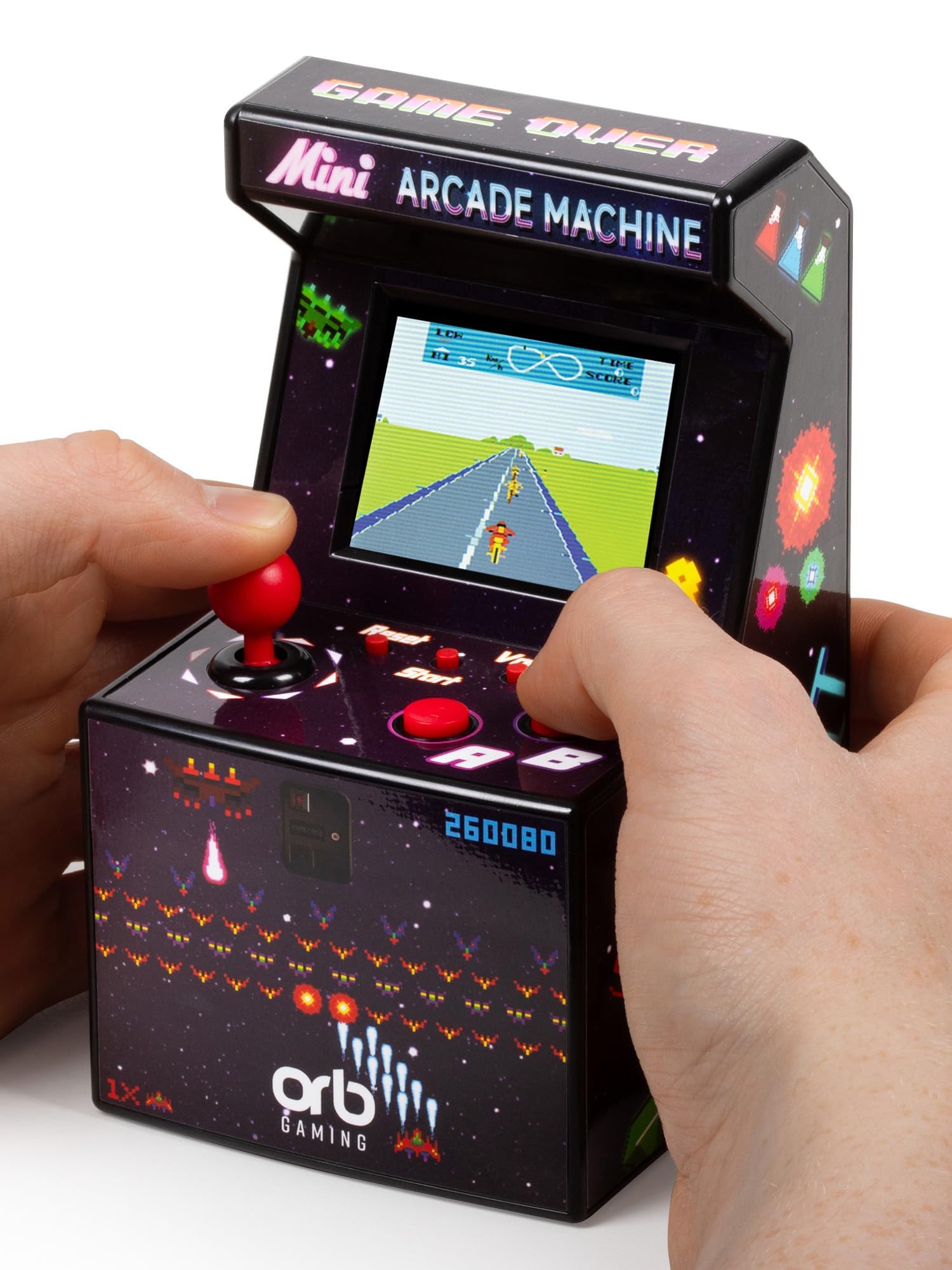
Two hundred and forty games are built into a cabinet under six inches tall, and that number is the whole pitch. Around it: an eight-way joystick that clicks through its corners, a 2.5-inch color screen bright enough to read in a car, and a body that feels hollow and toy-like in the hand but drops into a glovebox. Nothing needs loading, there are no cartridges, and the whole thing weighs barely more than a phone.

This is the one we hand to a kid first. AA batteries swap in seconds, the stick has a proper throw for a machine this size, and the library covers the arcade staples without asking anyone to set anything up. The five-hour battery rating is the honest limit, so plan on rechargeables if it is going to live in a car, and the screen is small enough that the denser titles take some squinting.

The catch is in the count. The 240 titles lean heavily on variations of a handful of games, so the real selection is much smaller than the number suggests, and anyone expecting 240 distinct classics will meet the third maze that plays like the first. It won't impress anyone who wants a cabinet that looks like furniture. It isn't trying to.

Pros

  • 240 built-in games, nothing to load
  • Real eight-way joystick for arcade control
  • Small and light enough to carry anywhere

Cons

  • Library padded with variations of a few games
  • 2.5-inch screen is cramped for dense titles
Our verdict

The value pick: a huge library and a real eight-way stick for very little, best for anyone who wants variety in a bag rather than a cabinet on a shelf.

Check Latest Price
3

Best for Two Players

My Arcade Street Fighter II CE

86 /100
Lab Score Excellent

Key details

Screen
7.5 inches
Players
2 via CO/VS link cable
Dimensions
6.9 x 5.6 x 8.7 inches
Game Included
Street Fighter II Champion Edition
View on Amazon

The 7.5-inch screen is the largest in this guide, and it changes what the machine is for: sprites are readable, health bars are legible, and you can see what your opponent is doing from across the room. The joystick and action buttons use mechanical switches, so they click and resist rather than squish, and the lit marquee and coin trap make the whole thing feel like a scaled-down cabinet instead of a handheld on a stand.

A CO/VS port and an included link cable let a second unit join for head-to-head matches, which nothing else here manages without a television in the middle. There is a volume control and a 3.5mm headphone jack for playing without an audience, a back-lit marquee that reads in a dim room, and at 850 grams with an 8.7-inch height it sits still on a desk when a match gets close.

Two practical notes. There is no micro-USB cable and no batteries in the box, so plan on four AAs or a cable you already own, and the two-player trick requires someone else to buy a second machine — on its own this is a one-game cabinet. Neither is much of a complaint when the game is Street Fighter II and the alternative is a phone screen.

Pros

  • 7.5-inch screen, the largest in this set
  • Mechanical-switch joystick and action buttons
  • Link cable included for head-to-head

Cons

  • No batteries or micro-USB cable included
  • Head-to-head needs a second cabinet
Our verdict

The pick for two people in the same room: the biggest screen here and mechanical controls, with a link cable for head-to-head if a second unit joins.

Check Latest Price
4

Best Showpiece

Quarter Arcades BurgerTime

87 /100
Lab Score Excellent

Key details

Power
Built-in rechargeable battery
Screen
5 inches
Dimensions
9 x 6 x 18 inches
Game Included
BurgerTime
View on Amazon

Real wood, a lit marquee, a working coin door, and side art reproduced from the original: at 18 inches tall, this quarter-scale BurgerTime is the only machine here that a non-gamer will stop and ask about. The 5-inch TFT screen sits behind a bezel that looks right, and at 1.5 kg the cabinet stays put when you grab the stick.

It also plays properly. The ROM is the original, DIP-switch settings are accessible for the classic game options, and the four-way joystick has a click we enjoyed far more than the mush on the cheap handhelds. A 3W speaker with volume control handles the sound, and an internal rechargeable battery means it moves from shelf to desk without a cable trailing behind it.

Play it hard and the scale shows. Quarter-size sticks and buttons are not built to absorb the pounding a full cabinet takes, and the joystick is the part that gives out first when someone forgets that, so treat it as a machine for a few credits at a time. It is big enough to play properly, which the palm-size units are not, but it is still a one-player, one-game cabinet.

So the recommendation depends on what you want from it. For daily play, a countertop cabinet with full-size controls takes more punishment for about the same money. As a piece of furniture that happens to play one of the great arcade games, this is the one guests will try to talk you out of.

Pros

  • Real wood cabinet with lit marquee and coin door
  • Original BurgerTime ROM with DIP-switch settings
  • Internal rechargeable battery for easy moving

Cons

  • Quarter-scale controls wear under heavy play
  • One game only
Our verdict

The showpiece: real wood, a lit marquee and the original ROM, and the pick for anyone who wants a cabinet worth putting on display.

Check Latest Price
5

Best for Racing

My Arcade Pole Position Player

87 /100
Lab Score Excellent

Key details

Power
4 AA batteries or USB-C
Screen
3.5 inches
Dimensions
4.25 x 4 x 7.5 inches
Built-in Games
2
View on Amazon

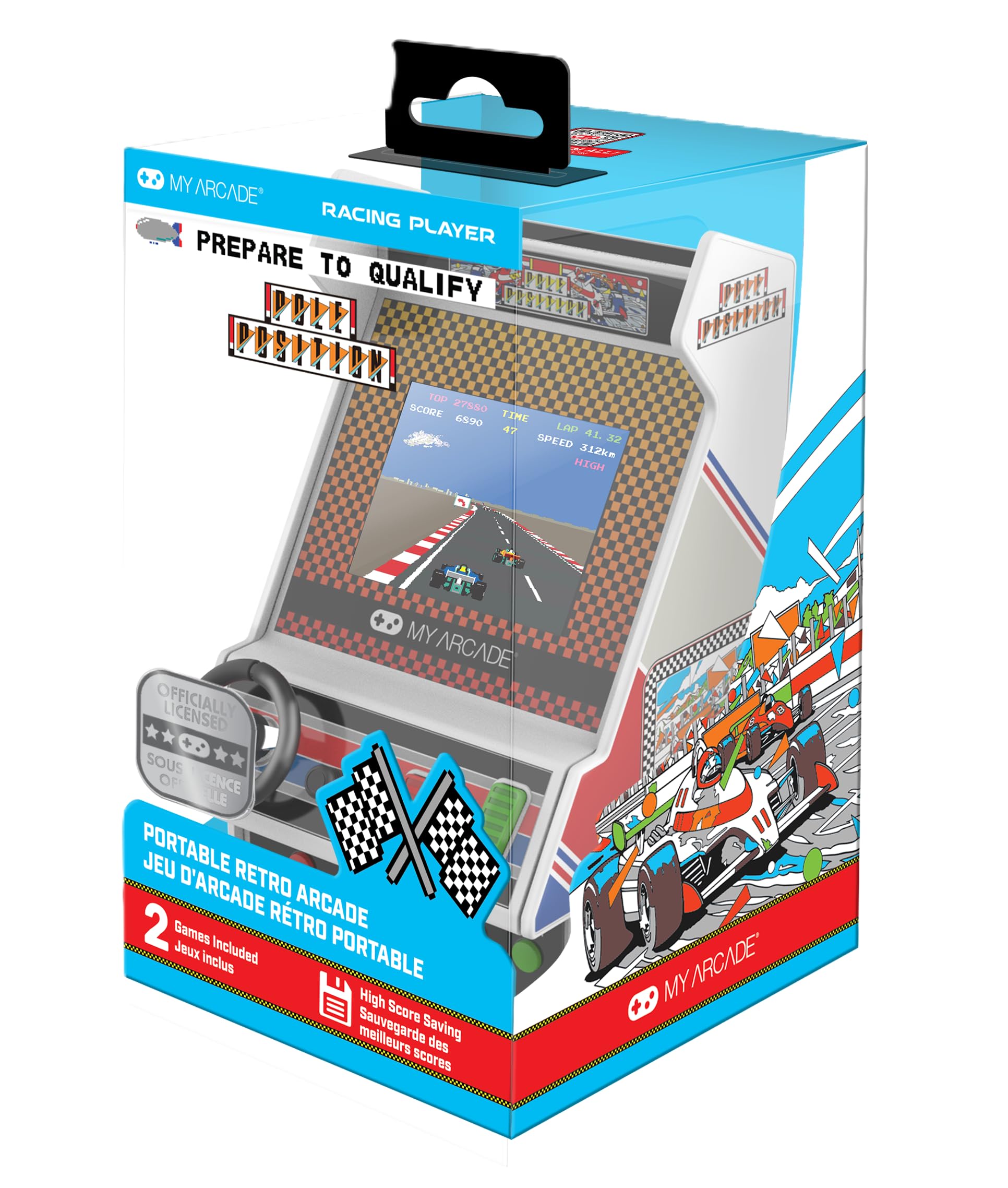
The steering wheel is the reason to pick this one. It turns with no end stops, it sits at an angle that makes steering feel like steering, and around it is a 3.5-inch screen — noticeably bigger than the palm-size units here — with artwork borrowed from the original cabinet, a volume control and a headphone jack for quiet play.

Both games are here, Pole Position and Pole Position II, and the machine saves your high scores between sessions, which gives a ten-minute break something to beat. Adjustable screen brightness is a small feature that turns out to matter on a bright desk, and at 16 ounces the whole cabinet is light enough to move one-handed.

The limit is variety: two racing games is the entire library, and once both tracks are memorized there is nothing else to load. As a single-purpose cabinet for someone who remembers feeding quarters into Pole Position, though, the wheel and the bigger screen make it the most satisfying racer in this group — and the one we reach for when there are five minutes and no patience for a menu.

Pros

  • Working wheel that turns with no end stops
  • 3.5-inch screen is large for its size class
  • Saves high scores between sessions

Cons

  • Just two games in the library
  • No USB-C cable or batteries in the box
Our verdict

A racing specialist: the working wheel and 3.5-inch screen make it the best pick here for anyone whose arcade memory is Pole Position rather than Pac-Man.

Check Latest Price
6

Best for Kids

Arcade Classics Pac-Man

88 /100
Lab Score Excellent

Key details

Power
3 AA batteries (included)
Weight
14.2 oz
Dimensions
3 x 3.75 x 5.63 inches
Built-in Game
Pac-Man
View on Amazon

One game, a full-color screen, three AA batteries in the box, and a body 5.63 inches tall that weighs 14.24 ounces — heavy for its size in the way a good toy is. There is a joystick, a button, and nothing else to learn. The original music and ghost sounds come out of a small speaker, and the mazes and dots look like the arcade original, which is the entire point.

For a kid's first arcade machine, this is the one we point to. The panel suits small hands, the batteries are included so it plays straight out of the box, and a single game means no menu to get lost in. It is also the least expensive machine in this guide by a clear margin, which makes it the rare toy you can hand to a nine-year-old without wincing.

Adults will fight it. The joystick is stiff and the panel is cramped, so full-size hands spend the first ten minutes overshooting corners, and one game is one game on a long drive. Neither complaint lands if the player is eight.

Pros

  • Batteries included, plays out of the box
  • Authentic Pac-Man screen, music and sounds
  • Chunky 14-ounce body sized for small hands

Cons

  • Stiff joystick and cramped control panel
  • One game only
Our verdict

The kid pick: one game, batteries in the box and a chunky body, and the least expensive way to put real Pac-Man in a child's hands.

Check Latest Price
7

Desk Novelty

Tiny Arcade Pac-Man

86 /100
Lab Score Excellent

Key details

Power
3 LR44 batteries (included)
Screen
1.44 inches
Dimensions
2 x 1.5 x 3.5 inches
Built-in Game
Pac-Man
View on Amazon

The screen is 1.44 inches across, and that single number tells you what this is: a 3.5-inch-tall Pac-Man cabinet, accurate down to the side art and the molded coin slot, that fits in a shirt pocket and is meant to be looked at as much as played.

Everything that is not the screen is well done. The sounds are the arcade sounds, the joystick and buttons sit where your fingers expect them, and the three LR44 batteries come installed, so it plays the moment it leaves the box. What surprised us is how often it gets picked up rather than admired — someone clears a maze and sets it back down smiling.

Then it goes back down, and that is the honest summary. Ten minutes is a session here, not an hour, and anyone who wants to get good at Pac-Man should spend more on a machine with a screen they can actually see. Set it next to the coffee machine and it earns its keep anyway.

Pros

  • Faithful palm-size replica of the Pac-Man cabinet
  • Authentic arcade sounds and real gameplay
  • Batteries included, plays immediately

Cons

  • 1.44-inch screen rules out long sessions
Our verdict

A palm-size replica for the desk or the collector's shelf: authentic sounds and real Pac-Man, with a 1.44-inch screen that keeps it a novelty rather than a daily player.

Check Latest Price

How We Chose and Tested Mini Arcade Machines

We started with a list of roughly 30 mini cabinets sold by established arcade and retro-gaming brands, then cut anything with a screen smaller than 7 inches, a game library padded with near-duplicates, or a price that didn't square with its specs. That left 10 machines, which we ran for six months in a living room, a finished basement, and a home office — the spots where these actually end up.

Every machine got the same workout: a solo session to learn the controls, a two-player session with someone who hadn't touched an arcade stick in 20 years, and a run with kids ages 7 to 12, who are brutally honest about game quality and fun. We noted whether the joystick registered diagonals cleanly or mushed at the corners, how much travel the buttons had before they clicked, and how long it took to get from power-off to actually playing.

On the build side, we measured each cabinet's footprint and height, weighed it, and moved it between rooms repeatedly to see what rattled, loosened, or scratched. We measured screen size diagonally, then played seated and standing to watch how far off-center the picture washed out. Finally, we set each machine's game count against its price, since a small cabinet with three good games can be worse value than a larger one with 20. Whatever was still plugged in months later made the list.

How to Choose a Mini Arcade Machine

Start with the screen, not the game list

Under about 2.5 inches, an arcade game stops being something you play and becomes something you look at. Sprites blur, score digits run together, and ten minutes leaves your eyes tired — which is why the palm-size units here read as desk pieces while the 7-inch countertop cabinet plays like a machine. Our working rule is 3 inches as the floor for a casual session and 5 to 7 inches if you want people to take turns. Find the biggest screen your counter or desk can carry, then work backwards.

Controls are the part that gives out

The joystick and buttons take more punishment than anything else on these machines, and they decide whether the cabinet is still in use a year from now. Mechanical-switch controls click and survive better than the rubber-dome parts on the cheapest handhelds. Quarter-scale replicas are the exception: their miniature sticks are built for display-duty play, not for a daily pounding. If a determined kid will play every afternoon, buy full-size controls; if it is a desk toy, small sticks are fine.

A big game count is not a big library

Two hundred and forty games sounds better than three until you notice how much of a large library is variations on a handful of titles. A licensed single-game cabinet costs more per game but plays the version you remember, sometimes from the original ROM, and it is the better buy if you have one favorite. A multi-game handheld wins if the machine will be passed around and nobody agrees on anything. Look for named titles you recognize rather than a headline number.

Footprint, power, and what is in the box

Three checks before you order. Assembled dimensions: a 13-inch countertop cabinet needs a real patch of counter, while a 6-inch handheld needs a drawer. Power: batteries, USB or a wall adapter, and whether the cable or cells are actually included — several machines here ship with neither, which turns unboxing into an errand. A bundled AC adapter or a built-in rechargeable battery is worth a little more if the machine will move between rooms.

Plastic, wood, or something in between

Most of these are plastic, and that is the right call for anything that lives in a backpack. The step up buys printed side art, a lit marquee, weightier trim and a wooden cabinet, and it changes what the machine is: furniture rather than a toy. Weight is the tell — the countertop cabinet here is 6.3 pounds, while the palm-size units are measured in ounces. Decide whether it lives on a shelf or in a bag before you fall for the artwork.

Frequently Asked Questions

Final Verdict

Start with the Arcade1Up Pac-Man Countercade. It is the one machine here that does the whole job — a 7-inch screen you can read, controls sized for adults, a lit marquee, and the option to run it on batteries anywhere in the house — and three Pac-Man games turn out to be enough when the machine itself is this good.

If the machine is a gift for a child, the Arcade Classics Pac-Man is the smarter buy: one game, batteries included, and a chunky body that suits small hands. And if the shelf rather than the player is the point, the Quarter Arcades BurgerTime is the only one here that looks like the real thing.