Best Board Games of 2026

There's a board game in your closet you played exactly once. Someone talked it up, you got everybody to the table, and forty minutes later half the room was checking their phone. A good game fixes that: it's taught in five minutes, it gives every person at the table a real decision to make, and it makes the next game night happen without anyone having to lobby for it. The problem is that box art, award stickers, and a wall of five-star reviews tell you almost nothing about which boxes those are.

Over the past six months, my team and I have played through 18 games with kids, roommates, couples, and friends who will freely admit they'd rather be watching TV. What separates a keeper from a dust collector isn't complexity. It's whether the rules click while you're learning them, whether the pieces hold up after a winter of shuffling, and whether the decisions stay interesting on the fourth play — most games show you everything they have on the first. The ones that survived all of that earned their shelf space, and they're the ones below.

1

Best Overall

Azul

96 /100
Lab Score Outstanding

Key details

Tiles
100 resin
Players
2-4
Play Time
30-45 minutes
Recommended Age
8+
View on Amazon

A table of glossy mosaic tiles is a strong opening move, but the pull of Azul is the choice behind every pick: take the colors you need from a factory display and you may hand a neighbor the exact tiles they wanted. The rules are plain, the scoring is visible, and the tension stays friendly.

We recommend it as the default for mixed-age strategy nights. At 2-4 players, it fits a family table without feeling like a children's game; the three-step turn is easy to teach, while the race for rows, columns, and bonuses keeps experienced players thinking. In our play, the first round moved slowly enough to learn and quickly enough to want another.

The 100 resin tiles are the reason it gets pulled out; they feel good to handle and make the finished board look like something worth photographing. Four player boards and nine factory displays also mean it wants a proper table, not a tray. The linen bag makes cleanup easy, which matters after a long night.

It is not a party game, and we do not treat it as one. It is the box we choose when the same people want a game that rewards attention and still lets the table talk.

Pros

  • Easy to teach in one round
  • Deep tile-drafting choices
  • Stunning table presence
  • Works well from two to four

Cons

  • Age 8+ leaves younger siblings out
Our verdict

Azul is our top pick for families and friends who want a beautiful, easy-to-teach strategy game that still gives everyone real choices.

Check Latest Price
2

Best Strategy

Splendor

98 /100
Lab Score Outstanding

Key details

Players
2-4
Play Time
30 minutes
Recommended Age
10+
Development Cards
90
View on Amazon

If Azul is the game that gets the table talking, Splendor is the one that quietly keeps everyone leaning in. We choose it as the strategy pick for a table that likes building something from nothing and does not need a board full of scenery to enjoy it.

The turn is refreshingly small: take tokens, buy a development card, or reserve a card for later. That simplicity hides an engine that snowballs, and we found the pleasure is in timing a cheap card now so a noble patron becomes reachable later. Games run about 30 minutes, which is short enough for a weeknight and long enough for the choices to matter.

The components do their job: 90 development cards and 10 noble tiles, with gem tokens that feel solid rather than toy-like. We appreciate that setup is quick and the table stays readable even when several players are buying cards. The theme is light, so do not expect role-play or table talk; the appeal is the clean economic puzzle.

It is not a loud group game, and that is the point: Splendor rewards the player who watches the table, counts what is scarce, and strikes when the engine is ready.

Pros

  • Quick three-action turns
  • Satisfying engine building
  • Plays in about 30 minutes
  • Solid cards and tokens

Cons

  • Caps at four players
Our verdict

We choose Splendor when the group wants a tight engine-building puzzle; it is the sharpest strategy game here for two to four players.

Check Latest Price
3

Best Travel and Word Game

Bananagrams

98 /100
Lab Score Outstanding

Key details

Tiles
144
Players
2-8
Play Time
15 minutes
Recommended Age
7+
View on Amazon

The banana-shaped pouch looks like a novelty until you realize it is the whole point: Bananagrams is the rare word game that can go in a tote bag and be on the table before the coasters are out. The 144 tiles are loose, but the format is self-contained and the rules take about a minute.

There are no turns, which is the design choice that makes it work. Everyone builds a personal crossword at the same time, taking new tiles as they use them; a round can finish in 15 minutes, and nobody spends the evening waiting. With 2-8 players and a 7+ age floor, it suits families and adult groups who want a word race rather than a slow crossword.

We keep it for travel and quick filler games rather than a main event. The pouch is sturdy and compact, and it disappears back into a bag when the round ends. What we appreciate most is how easily it adapts to the group: younger players can build shorter words while adults race ahead, and the game stays lively. The lack of a board is the trade-off, since the play still needs enough table room to spread out several grids.

Pros

  • No-turn word race
  • Packs into a banana pouch
  • Works for 2-8 players
  • Builds spelling and vocabulary

Cons

  • Requires basic spelling; not for pre-readers
Our verdict

We pack Bananagrams for travel and fast word play: it suits families and adult groups who want a game with no waiting for turns.

Check Latest Price
4

Best Tile Game for Mixed Ages

Rummikub

96 /100
Lab Score Outstanding

Key details

Format
Numbered tiles and four racks
Players
2-4
Play Style
Rummy-style runs and groups
Recommended Age
8+
View on Amazon

Four racks of numbered tiles look modest on the table, but Rummikub is the game we bring out when we want a mixed-age group to settle into something brainy without a long teach.

The rules borrow from rummy: build runs and groups, then rearrange the table to make room for your next play. That last part is what keeps it from feeling like solitaire; every turn asks you to read the shared board and find a small opening. With 2-4 players and an 8+ age floor, it works for families and adults, and the first round teaches most of what you need.

The tiles are the right size to handle and read, and the four racks keep everyone's hand tidy. We noticed the tiles have enough weight to stay put when the table is rearranged, which matters because the whole game is one long chain of small moves. It is at its best with three or four, where the shared table stays busy and the waiting stays short. Two players get a quieter, more surgical game.

We think Rummikub earns its keep precisely because the board is never finished; a play that looks blocked can open up after one clever rearrangement, and that is the moment the table leans in.

Pros

  • Rummy rules are easy to grasp
  • Brainy without being heavy
  • Good for mixed ages
  • Tiles are easy to handle

Cons

  • Racks feel plasticky next to the tiles
Our verdict

We trust Rummikub when grandparents and teenagers share a table and you want a tile game that rewards planning more than speed.

Check Latest Price
5

Best Party Game

Jenga

96 /100
Lab Score Outstanding

Key details

Blocks
54 wood
Players
1-100
Storage
Tube with handle
Recommended Age
6+
View on Amazon

The best thing about Jenga is the noise it removes: the table goes quiet, everyone leans in, and the next block is the only thing that matters. That shared tension is why we recommend it as the party dexterity game for almost any group.

The rules need no reading and barely any teaching: pull a 54-block tower apart, stack each block on top, and try not to be the one who brings it down. With 1 or more players and a 6+ age floor, it works for a family with young children, a table of adults, or a solo stacker who wants a quiet challenge.

We were surprised by how much the tube-shaped storage matters; the blocks and stacking sleeve go back in without a puzzle, and the handle makes it easy to carry outside. The blocks are wood, so they have a little weight and a satisfying clack, and the tower looks better on a coffee table than a plastic alternative. We also like that the game gets harder as the tower grows, which keeps experienced players interested without adding rules.

Pros

  • No learning curve
  • Works for one or many
  • Sturdy wood blocks
  • Tube storage with handle

Cons

  • Needs a steady, level table
Our verdict

Jenga is our party pick when a crowd needs a shared spectacle rather than a rulebook; its physical tension works for almost any age.

Check Latest Price
6

Best for Preschoolers

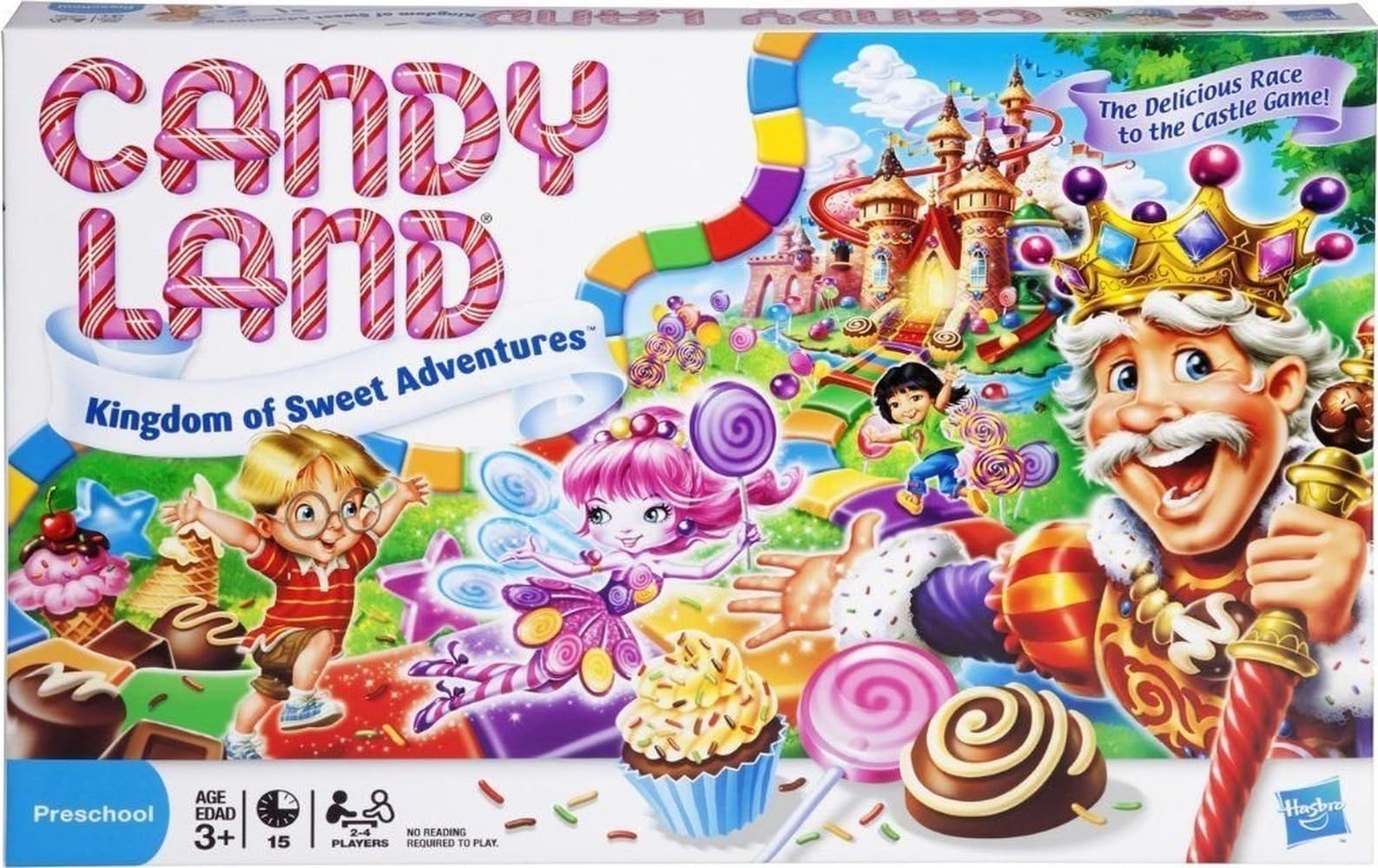
Candy Land

96 /100
Lab Score Outstanding

Key details

Players
2-4
Reading
Not required
Play Time
15 minutes
Recommended Age
3+
View on Amazon

The no-reading rule is what makes Candy Land worth keeping on the shelf: a 3-year-old can take a turn without an adult translating the cards. It is a race to the castle, not a strategy test, and that is exactly the point.

We recommend it as a first board game, not as the centerpiece of a grown-up game night. With 2-4 players and a 15-minute play time, it teaches taking turns, colors, and losing without a meltdown; the colored cards and gingerbread pawns are simple enough for small hands.

The luck can feel brutal to an adult who lands on the wrong card, but it also gives a preschooler a real chance against an older sibling. The board is basic cardboard and the cards are stiff, so this is a game you buy for the experience, not the components. The gingerbread pawns are chunky enough for small hands, and the whole game resets in a minute.

Pros

  • No reading required
  • Teaches turns and colors
  • Quick 15-minute rounds
  • Simple pieces for small hands

Cons

  • Very little strategy for older players
Our verdict

We hand Candy Land to a preschooler as a first board game: no reading, quick turns, and a real chance to win against an adult.

Check Latest Price
7

Adult Party Groups

Secret Hitler

98 /100
Lab Score Outstanding

Key details

Format
Hidden-role social deduction
Players
5-10
Components
Wooden pieces, secret envelopes
Recommended Age
17+
View on Amazon

The five-player minimum is the first thing to know about Secret Hitler: this is not a game you can pull out for a couple, and the 17+ label is not decorative. It is a social deduction game built for a crowd, with hidden roles, accusation, and a table that gets loud fast.

With 5-10 players, each round divides the table into liberals, fascists, and a secret Hitler; the wooden pieces and foil-stamped boards give the bluffing a surprisingly physical presence. We found the quick rounds make it easy to reset and play again, which is why it earns a place at adult game nights. It is the one game here that turns a room of eight into a single nervous conversation.

We recommend Secret Hitler for groups who already enjoy bluffing games and have enough people to fill the roles. The rules take a practice round to click, and the theme is deliberately provocative, so it is not a casual family pick. What we appreciate most is the ceremony of the secret envelopes and the way every reveal gives the table something new to argue about.

Pros

  • Built for 5-10 players
  • Fast social-deduction rounds
  • Wooden pieces and foil boards
  • High replay value

Cons

  • Premium price for a party game
Our verdict

We save Secret Hitler for adult game nights with at least five players who enjoy bluffing, accusation, and a little chaos.

Check Latest Price

What Six Months and 18 Games Taught Us

Every game here started on a longer list of about 60 titles, pulled from award shortlists, hobby forums, and the games our friends genuinely keep on their shelves rather than the ones they display. We filtered by what's printed on the box: player count (anything that only worked with exactly four got cut), recommended age, and listed play time, since a 90-minute runtime is a hard sell on a weeknight. Price mattered too — nothing made the cut that cost more than a nice dinner out. That left 18 games.

Each one got played at least four times. The first play was always a weeknight with adults who had never seen it: I timed the rules explanation from opening the box to the first turn, and counted how many times anyone reached back for the rulebook mid-game. The second was a Sunday afternoon with kids between 7 and 12 at the table, where I watched whether the youngest could take a turn without an adult walking them through it, and whether the grown-ups were still engaged by round three. The third was the harder test — seven people, a holiday gathering, dessert on the table, half the room distracted — to see whether a game could hold a crowd that wasn't fully paying attention.

Component quality got checked as we went: how cards looked after a few dozen shuffles, whether cardboard tokens started to delaminate, whether the insert still held everything after the tenth repack, and how long cleanup took when everyone was tired and ready for bed. We also tracked whether the fourth play felt different from the first, or whether the group just repeated the strategy that worked. Games that only had one play in them were the first to go.

How to Choose a Board Game for Your Group

Match the player count to the room

The number on the box is a range, not a promise. Azul and Splendor cap at four, Jenga works for one or many, and Secret Hitler needs five before it works at all. We look at the usual crowd, not the biggest possible party, because a game that needs six players will sit on the shelf if four is your normal table. If your group changes size often, keep one flexible filler like Bananagrams alongside a bigger-night game.

Treat the age label as a reading and patience label

Age floors tell you more than whether a game is 'for kids.' Candy Land's 3+ rating means no reading and one-step turns; Bananagrams at 7+ assumes basic spelling; Splendor at 10+ expects players to plan several turns ahead; Secret Hitler's 17+ label is an adult-content warning. Choose for the youngest player who will actually join, not the average age of the room, and save the grown-up games for after bedtime.

Decide how much luck you want

Luck keeps a mixed-age table close; strategy gives regular players a reason to come back. Candy Land and Jenga are almost pure chance or physical nerve, which is why a child can beat an adult. Azul and Splendor add planning without removing the swing of the draw. Rummikub sits between, with simple rummy rules and enough rearrangement to reward a sharp eye. If your group argues over luck, pick a game where every turn gives you a real decision.

Budget the teach, the table, and the reset

A 15-minute game can still take 15 minutes to teach. Bananagrams opens fast; Splendor and Azul need a practice round; Secret Hitler needs a group willing to learn roles together. We also count table space: Azul's four boards and nine factory displays want room, while Jenga wants a steady surface. And check the reset: a game that takes longer to pack than to play will stay in the box.

Frequently Asked Questions

Final Verdict

Azul is the board game we put in front of a mixed group first. It teaches in a round, looks inviting on the table, and gives both casual and experienced players a real decision on every turn. If your group prefers a quieter numbers engine, choose Splendor; if the box needs to travel, choose Bananagrams. The exception is a preschooler at the table, where Candy Land is the honest starting point.