Best Trivia Board Games of 2026

Trivia night has a way of separating the scholars from the guessers—and the wrong game can make that gap feel like a chasm. The best trivia board games don’t just reward the person who memorized the atlas; they keep everyone at the table leaning in, arguing over answers, and actually learning something. That means a mix of question difficulties, a range of topics, and rules simple enough that you can explain them while handing out coasters.

Over the past three months, my team and I have played 14 different trivia games—with family, with friends, and with a few reluctant teenagers—and the ones that stood out shared a few things. They were easy to teach, the questions felt fair rather than gotcha-style, and the components survived being passed around a crowded table. A trivia game is only as good as its question variety; play it twice and you start to notice the repeats. The picks below are the ones we kept reaching for even after the testing was “officially” over.

1

Best Overall

Trivial Pursuit Family Edition

95 /100
Lab Score Outstanding

Key details

Ages
8 and up
Players
2 or more
Questions
1,200
Card Decks
100 adult, 100 kids
View on Amazon

Two stacks of cards do the work in this edition: 100 blue cards written for adults and 100 yellow ones written for kids, and on your turn you answer from the deck that matches you. It is a small structural choice with a large effect at the table — a 9-year-old and a grandparent can sit at the same board, answer different questions, and both come out with a real shot at a wedge.

That balance is why this is the trivia game we recommend first for most households. There are 1,200 questions across six categories, and the box carries six movers, 36 wedges, two cardholders and the die, so a family of five can start playing without hunting through a drawer for spare tokens.

The other change we appreciate is the wedge rule. In this edition you can earn a wedge on any colored space, not only the six marked wedge spaces, which shortens a game noticeably — useful on a school night. It also packs into a box about 10.5 by 8 inches, so it lives on a shelf rather than on the closet floor.

The one thing to know before you buy is calibration. The yellow deck assumes more than a 6-year-old knows, and adults who play a lot of trivia will find the blue deck gentle. Teams solve both problems at once: pair a younger kid with an adult and the questions land about right for everyone at the table.

Pros

  • Adult and kid decks let mixed ages compete
  • 1,200 questions across six categories
  • Wedges on any colored space shorten a game

Cons

  • Repeats appear after a lot of play
Our verdict

Our pick for most households: separate adult and kid decks mean a mixed-age table plays one game, and 1,200 questions keep it going.
Check Latest Price
2

Best for History Buffs

Chronology

96 /100
Lab Score Outstanding

Key details

Ages
14 and up
Events
800
Players
2 to 8
Timeline Span
2,000 years through 2024
View on Amazon

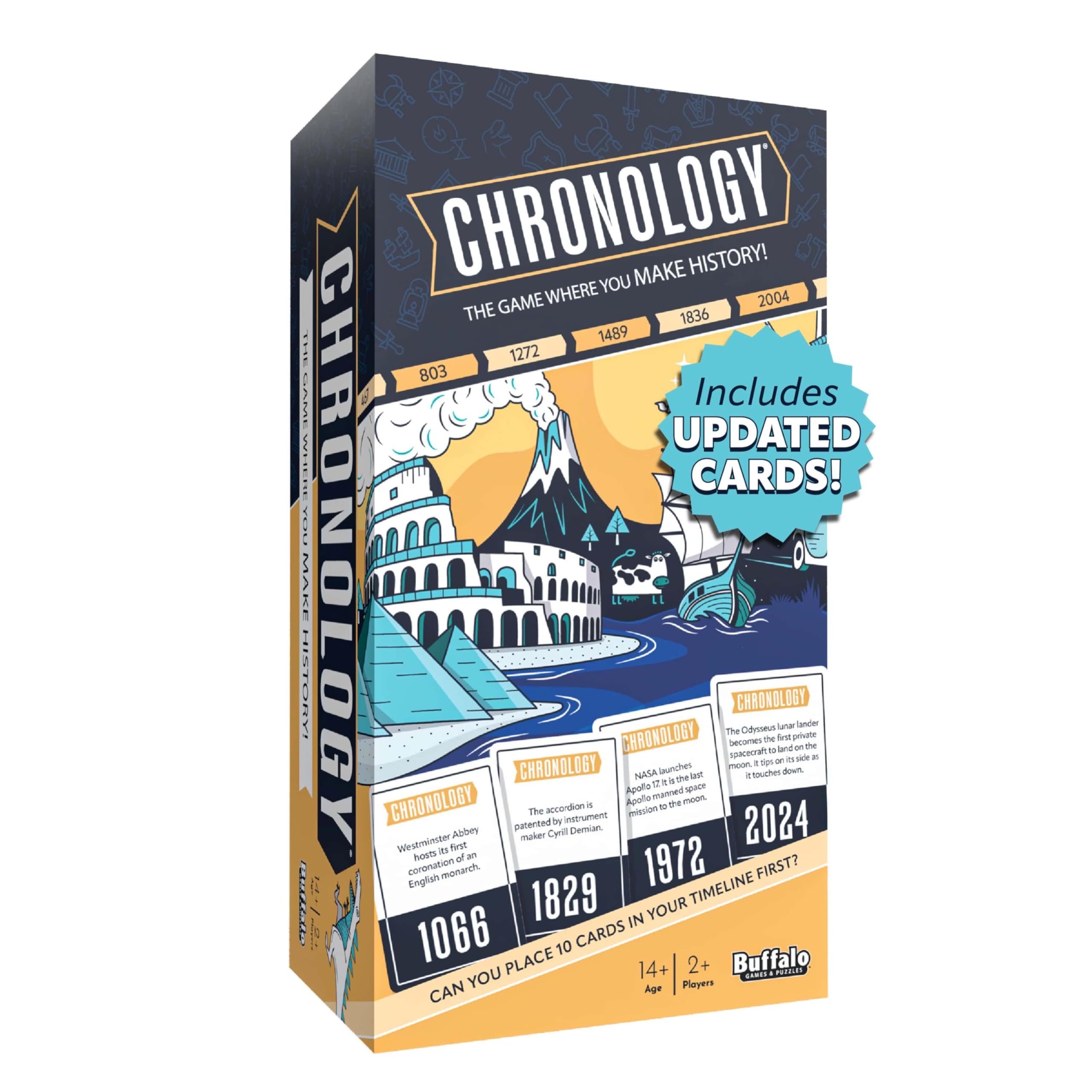
There is no question to answer in Chronology. A card names a historical event, and you slide it into your timeline wherever you think it belongs — before or after the cards already in front of you. Get it right and the card stays, which makes your timeline longer and your next placement harder.

We like it for the table that groans when a quiz starts. Nobody has to produce a date or a name; a rough sense of whether the airplane came before the telephone is enough to keep playing, and the cards themselves become the scoreboard. With 800 events spanning 2,000 years up to 2024, it holds up for people who think they know history well, too.

Setup takes about a minute — deal a starting card to each player and put the deck in the middle. The rules fit on a card, it seats 2 to 8, and rounds run short enough that this is the one we reach for when there is half an hour before dinner rather than a whole evening.

What keeps it from being a pure knowledge test is the draw. A run of easy cards can carry a player who knows less history than the person beside them, and the timeline you have built shapes how hard your own next card is. That is the trade for a game a history-averse group will actually finish.

Pros

  • No dates to memorize
  • 800 events spanning 2,000 years to 2024
  • Explains in a minute and plays quickly

Cons

  • Ages 14+ keeps younger children out
Our verdict

Buy it if your group likes history but hates being quizzed — placing events on a timeline rewards a good hunch, not a memorized date.

Check Latest Price
3

Best Music Trivia

Hitster

95 /100
Lab Score Outstanding

Key details

App
Free Hitster app required
Ages
16 and up
Players
2 to 10
Music Cards
300+ hits
View on Amazon

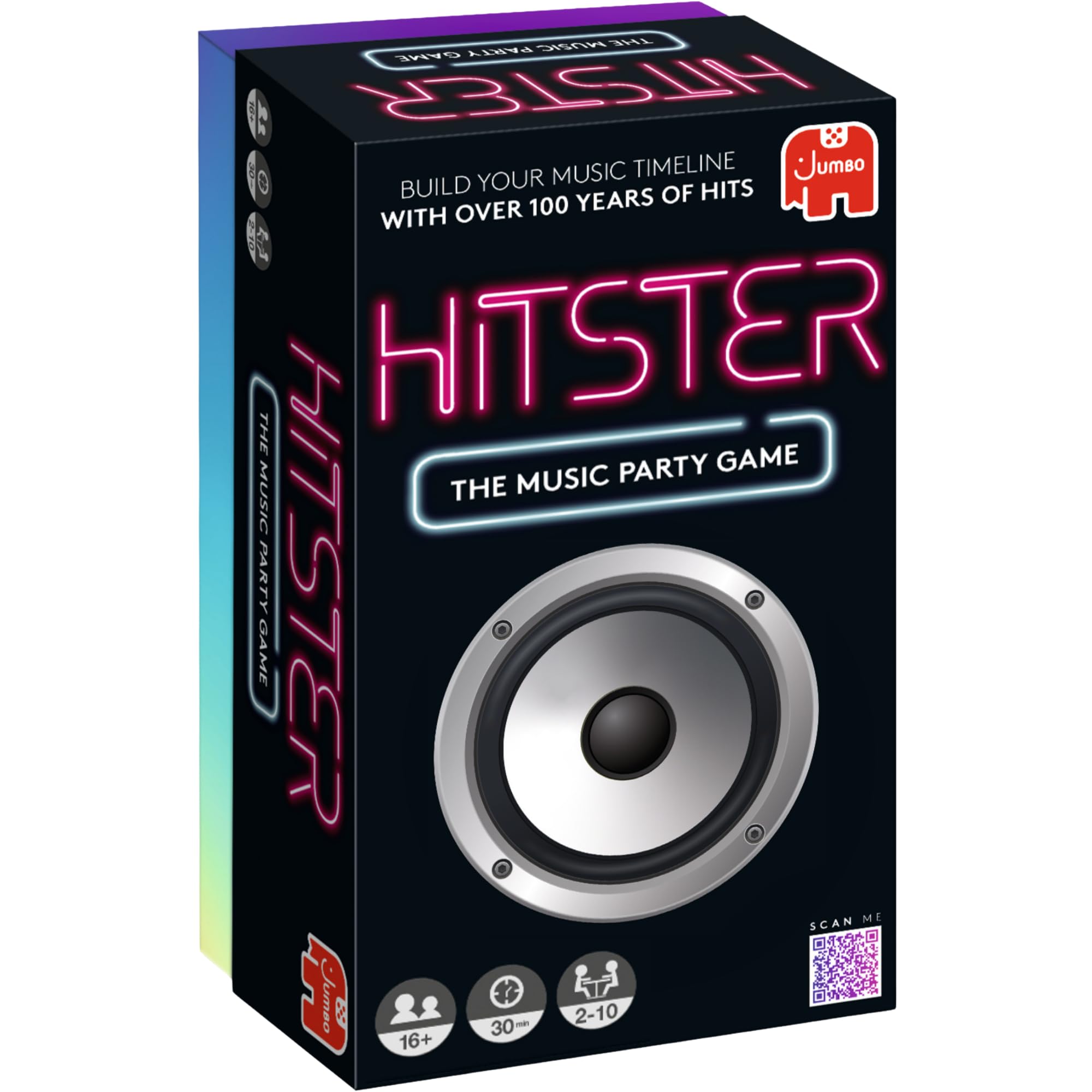
Where our top pick hands you a card with a question on it, Hitster plays you a song. You scan the QR code on a card, the free app starts the track, and you work out which decade it belongs to and where it slots into the timeline in front of you. That swap, listening instead of reading, is why it is the music pick here and the easiest game in this set to put in front of three generations at once.

The deck holds more than 300 hits running from the 1960s to the present, so everyone at the table has an era they remember. It seats 2 to 10, which covers a party and a quiet pair, and the box lists competitive, cooperative and solo modes rather than assuming you will invent your own.

Setup is close to nothing: cards, 37 chips, instructions. We liked that the chips give the game something to do with its hands during the guessing, and that a song nobody knows is still placeable by feel — the production, the drums, the sound of the year. You do not have to be a music expert to stay in.

The catch is dependence. No app, no game: a dead phone, a missing download or a room too loud to hear a chorus turns this into a stack of cards. We treat a charged phone and a speaker as part of the kit, the way you would check for batteries. The box says 16+, though the game plays younger when the music is shared across the table.

Pros

  • 300-plus hits from the 1960s to today
  • Seats 2 to 10 and sets up in seconds
  • Competitive, cooperative and solo modes

Cons

  • Needs a phone, the app and audible playback
Our verdict

The music quiz we recommend when the table spans generations; just budget for a charged phone and the app.

Check Latest Price
4

Best Fast-Paced Party Trivia

Smart Ass

93 /100
Lab Score Outstanding

Key details

Ages
12 and up
Players
2 to 6
Question Cards
411
View on Amazon

Half the table shouted an answer before the question was finished, and in Smart Ass nobody tells them off — if you know it, you say it, even when it is not your turn. The categories are the broad ones (who, what, where am I), and the cards are written to be yelled rather than considered.

There is a real board under all that noise: six movers and stands, a jumbo category die, a jumbo movement die, and 411 question cards. Movement comes from answering, so turns resolve fast and nobody spends the round waiting for the dice to come back around.

That pace is why it is our pick for adult and older-teen gatherings. It is the least expensive game in this guide, which matters when you are buying for a group you do not know well, and it seats 2 to 6 without needing half the dining table. The humor comes from the questions and the shouting rather than from a gimmick, and that is the part that holds up on a fifth play.

Pros

  • Anyone can answer at any time, so no waiting
  • 411 cards and two dice keep rounds moving
  • Least expensive game in this guide

Cons

  • Questions run older than the 12+ label
Our verdict

The fastest, loudest game here, and the cheapest way to fill a table of adults and teens.

Check Latest Price
5

Best for Big Groups

Mount Cleverest

93 /100
Lab Score Outstanding

Key details

Ages
6 and up
Format
True-or-false cards
Players
2 to 12
Betting Discs
30
View on Amazon

Thirty discs come in the box, and they are the whole game: someone reads a true-or-false statement, everyone secretly bets a disc on the answer, and wrong bets lose their disc. Nobody sits a question out, which is the point.

Because each card is a coin flip between two answers, a 7-year-old has close to the same odds as the person who reads the newspaper cover to cover. That is a design choice we are happy to defend at a family table — the game stays close, and the arguments about the answers are half the entertainment.

The stated range is 2 to 12 players, and the box is small, about 5.75 by 6.5 inches, so it travels in a tote bag. We have used it as an after-dinner game where the table is not fully committed: people drift in, bet a disc, drift out. That is exactly the setting where a turn-based board game falls apart.

For a crowd that is not made of trivia people, this is the one we hand over first: no categories to learn, no turn order to police, and a 50/50 escape hatch for anyone who freezes. The trade is depth — it is a warm-up rather than the main event, and a table of quiz veterans will want something with more bite before the night is over.

Pros

  • Everyone bets on every question, so nobody sits out
  • 50/50 odds let young kids compete with adults
  • Seats 2 to 12 in a box that fits a tote

Cons

  • Statements get familiar after several sessions
Our verdict

A big, low-commitment table is where this one lives — a coin flip keeps every age in the game.

Check Latest Price
6

Best for Disney Families

Magical World of Disney Trivia

95 /100
Lab Score Outstanding

Key details

Ages
6 and up
Board
3D sculpted locations
Players
Up to 6
Kids Cards
Picture-based questions
View on Amazon

If there is a Disney adult in the house and a six-year-old who has seen every movie twice, this is the trivia game that gets used. The kids cards pair questions with pictures of Disney characters, which is the reason the 6+ label holds up when a younger sibling wants in.

The production is the nicest in this set: 3D sculpted locations on the board, character movers (Mickey, Minnie, Stitch, Nemo, Simba, EVE, Tiana, Elsa), and Pixar sketch art on the cards. We found the board is the part that sells it — it looks like something, and a kid responds to that before responding to a rulebook.

It seats up to six, and the questions range from park history and vintage shorts like Steamboat Willie to Pixar and the films themselves. The deep cuts are genuinely hard: adults who consider themselves Disney-literate will get beaten by a 10-year-old with a Frozen obsession and then stumped by an old question about the parks.

In a Disney household, this earns shelf space a general-knowledge game does not, and the questions go deep enough that the adults do not run away with it. At a table that is indifferent to the movies, every third question is a shrug. That is a narrower audience than most games here, and it is the right one.

Pros

  • Picture-based kids cards include younger players
  • Sculpted board and character movers look the part
  • Covers parks, films and Pixar, not just the movies

Cons

  • Assumes real Disney knowledge from every player
Our verdict

The pick for Disney households with young kids: picture cards let a six-year-old play, and the deep cuts keep the adults honest.

Check Latest Price
7

Best for Serious Trivia

Trivial Pursuit Master Edition

92 /100
Lab Score Outstanding

Key details

Ages
16 and up
Timer
Electronic timer included
Players
2 to 6
Questions
2,950
View on Amazon

This is the edition that settles arguments about whether a trivia game is too easy. The questions are hard — sometimes frustratingly so — and the 16+ on the box is there for a reason. It is our pick for a table of adults who watch quiz shows for fun and want to be genuinely beaten.

There are 2,950 questions across six familiar categories: geography, entertainment, history, art and literature, science and nature, sports and leisure. Two rule sets come in the box — the classic wedge hunt, or the faster version where any correct answer earns a wedge — and the electronic timer is meant to keep either one moving.

We ended up running the fast rule and the timer together, because a hard deck plus a long silence is how trivia nights die. The timer takes two AAA batteries, so check the drawer before game night rather than after everyone arrives.

Kids are out — the content assumes an adult's frame of reference, and the Family Edition covers that table. What you get instead is range: some cards are easy enough for a loud, confident guess, others draw blank stares from everyone, and the mix is what makes a win feel earned. Our table kept arguing about the answers after the box was closed, which is the most we ask of a trivia game.

Pros

  • 2,950 questions, the largest supply here
  • Timer keeps hard rounds from stalling
  • Classic or fast wedge rules, your choice

Cons

  • Same questions resurface across sessions
Our verdict

For adults who want a real test: 2,950 questions, a timer, and no mercy for the casual player.

Check Latest Price
8

Church Study Groups

So You Think You Know the Bible

95 /100
Lab Score Outstanding

Key details

Ages
10 and up
Cards
300
Players
2 or more
Questions
500+
View on Amazon

Every answer in this deck comes with a scripture reference, so when someone disputes a call, the group can look it up instead of settling it by seniority. For a Bible study or youth group, that one feature is what separates this from a quiz that happens to be religious.

Inside are 300 cards holding more than 500 questions, sorted into categories with action cards mixed in to break up straight quizzing. The box says 2 or more players; in our experience teams work better than solo turns, because the material starts discussions and eight people taking turns alone stalls them.

Where it earns its place in this guide is the church-group shelf rather than the general game shelf. The 10+ rating is honest — younger kids will know the famous stories and struggle with the rest — and a table that does not share the material will spend the night watching rather than playing. For the audience it is built for, the citations make it the most usable game here.

Pros

  • Scripture reference on every answer
  • 300 cards with more than 500 questions
  • Built for teams and larger groups

Cons

  • Answer print is small and faint
Our verdict

A niche pick that does its niche well — scripture-cited questions make it the one to bring to a study group.

Check Latest Price

How We Tested the Best Trivia Board Games

We started by researching the most-recommended trivia games on the market, then filtered the list by player count, age range, and price. We looked for games that claimed to work for both family game night and adult gatherings, and we paid attention to whether the rules could be explained in under five minutes—a key test for ease of use. From there, we narrowed it down to 14 games and brought them to the table.

Over three months, we played each game at least three times with groups ranging from four to eight people, including kids as young as 9 and adults who take their trivia seriously. We rotated the games through Friday night family dinners, a monthly couples’ game night, and a few low-key Sunday afternoons. During each session, we timed how long setup and rules explanation took, then noted whether anyone had to grab the manual mid-game.

We tracked how often questions repeated across plays, whether the difficulty felt balanced for mixed ages, and if anyone actually learned something new—our informal measure of educational value. We also watched for the fun factor: did people groan at a hard question or check their phones? We shuffled cards, passed boxes around, and dropped a few tokens to see how the components held up, and we read every question aloud to catch awkward phrasing or answer keys that were hard to follow. Games that caused arguments over rules, or that left the youngest player guessing every round, didn’t make the cut.

How to Choose a Trivia Game

Match the questions to the people at the table

The age on the box describes content, not difficulty, and the two drift apart. In the Trivial Pursuit Family Edition, the kids deck assumes more than a six-year-old knows while the adult deck runs gentle for anyone who quizzes regularly; teams are the fix. Our rule: if the table spans more than a decade, choose a game that splits questions by age or lets partial knowledge score, like Chronology's timeline placement or Mount Cleverest's coin-flip bets. A single-difficulty deck suits a single-difficulty group.

Count the question supply

A trivia game is a consumable. Groups that play twice a month will start recognizing cards within a year, and no amount of good component design fixes a deck you have memorized. Compare totals honestly: 2,950 questions in the Master Edition, 1,200 in the Family Edition, 800 timeline cards in Chronology, 411 in Smart Ass. If you play often, buy the larger supply and accept that a small deck is a phase rather than a fixture.

Decide between a quiz and a race

Turn-based trivia is calm and fair, and it is the wrong shape for eight people. When the table gets big, look for simultaneous formats: Smart Ass lets anyone shout an answer at any time, Mount Cleverest has everyone bet on the same question, and Hitster plays one song to the whole room. With four or fewer, a turn-based board rewards the person who actually knows things, which is the point of owning one.

Check what the game needs from the room

Some of these need more than a table. Hitster requires a phone running the free app plus sound everyone can hear, the Master Edition's timer takes two AAA batteries, and a board game wants roughly a square foot of flat surface. Read the box for what is not included before you wrap one as a gift, and keep spare batteries with the game rather than in a kitchen drawer.

Themed decks only work on the converted

A Disney, Bible or music deck is a great purchase for a table that shares the obsession and a flat one for a table that does not. Themed games are narrower by design: the questions cannot wander outside the subject, so a group that does not know the films or the songs spends the night guessing. If game night is a recurring event with changing guests, buy a general-knowledge deck first and let the themed one be the holiday game.

Frequently Asked Questions

Final Verdict

If your game night mixes ages and you want one box that actually gets played, the Trivial Pursuit Family Edition is the pick: separate decks, a faster wedge rule, and enough questions to last a winter. For a table that would rather reason than recall, Chronology is the better game of the two.

Adults only and competitive? The Master Edition will separate the contenders from everyone else at the table, while Smart Ass is the one to grab when the group is loud and the evening is short.