Best Collectible Card Games of 2026

The fear with any collectible card game is that you'll open a box and still not have a deck worth playing. That happens more often than it should, especially when a set is built around chase cards and the starter deck is an afterthought. A good one fixes that: it gives you a complete game in one purchase, a fair path to the cards you actually want, and cards that survive real shuffling. It also respects the second hobby hiding inside the first — the binder.

Over the past six months, my team and I have opened, shuffled, and played through 14 starter decks, booster bundles, and two-player sets. We taught the rules to friends who had never played a trading card game and watched where they got stuck. We sorted every rare, counted duplicates, and asked whether the set had enough variety to keep a deck from going stale. The games that rose to the top were the ones that stayed generous after the first box — and the ones I kept reaching for after testing was done.

1

Best Overall

MTG Final Fantasy Starter Kit

95 /100
Lab Score Outstanding

Key details

Format
Two 60-card ready decks
Players
2
Rares Per Deck
5 rares, 1 foil mythic
Beginner Support
Learn-to-play guide
View on Amazon

Two 60-card decks, a learn-to-play guide, and a foil mythic in each half of the box — this is the shortest route from buying a collectible card game to sitting down and playing one, and it is the least expensive of the three picks here. Nothing needs building first. You open it, hand a deck to whoever is across the table, and start reading cards out loud.

Cloud is on one side and Sephiroth on the other, and each deck carries five rares plus a Mythic Rare Legendary Creature in traditional foil, so the pair drops ten rares and two foil mythics into a collection before anyone wins a game. We were struck by how much the Final Fantasy art does the recruiting: if you have any history with the games, these are cards worth leafing through before the first hand is dealt.

Casual is the operating word. These are two-player decks tuned for kitchen-table games against each other or another starter deck, and a built Commander list will flatten them — which is fine, because the job here is learning turn structure and keyword abilities on an even footing. The guide walks through card types and the common keywords rather than handing over the full rules document.

Shelf space is the quiet advantage: at 7.6 by 6 inches and 10.4 ounces it sits beside the board games instead of vanishing into a drawer, and it is an easy shape to wrap. The 13+ label on the box is worth checking before you hand it to a younger player.

Pros

  • Two complete decks, so no building first
  • Ten rares and two foil mythics inside
  • Guide teaches card types and keywords
  • Smallest outlay of the three picks here

Cons

  • No solo play; it is built for two
Our verdict

The best first purchase here: two ready-to-play decks, a guide, and foil mythics, so two people can be playing within minutes of opening the box.

Check Latest Price
2

Best for Building a Collection

MTG Foundations Starter Collection

92 /100
Lab Score Outstanding

Key details

Format
Card pool, no ready-made deck
Also Included
Deck Builder's Guide, storage box, 2 life counters
Cards Included
387 cards plus 3 Play Boosters
Rare Or Better
75 cards
View on Amazon

There is no ready-made deck inside the Foundations Starter Collection, and that is deliberate. The box holds 387 cards — 75 of them rare or better, six in borderless treatment — plus three Play Boosters, a deck builder's guide, two click-wheel life counters, and a storage box. It is raw material rather than a game you can deal out the minute it arrives.

We think that makes it the right buy once you have played a few games and want to stop borrowing decks. The booklet is what turns a pile into decks: 387 cards is enough to build several 60-card lists with trade stock left over, but only if someone explains how to balance lands, creatures, and spells. That is the job the guide does, and it is the reason this beats buying four loose packs and hoping.

The supporting pieces earn their place too. Two click-wheel counters mean nobody hunts for a pen on game night, and the box gives the pile somewhere to live once it is sorted instead of migrating across a desk.

Six borderless cards are the ones most likely to end up in a binder rather than a deck, and the full-art lands make a first build look better than it plays. That is the charm of a box like this: it is the purchase that turns a player into a collector.

Pros

  • 387 cards, 75 at rare or better
  • Deck Builder's Guide included
  • Storage box and two life counters
  • Three Play Boosters to draft or open

Cons

  • An evening of sorting before the first build
Our verdict

Buy this when you want cards to build with rather than a deck to play tonight: 387 cards, 75 at rare or better, and a guide that tells you what to do with them.

Check Latest Price
3

Best Pokémon Booster Box

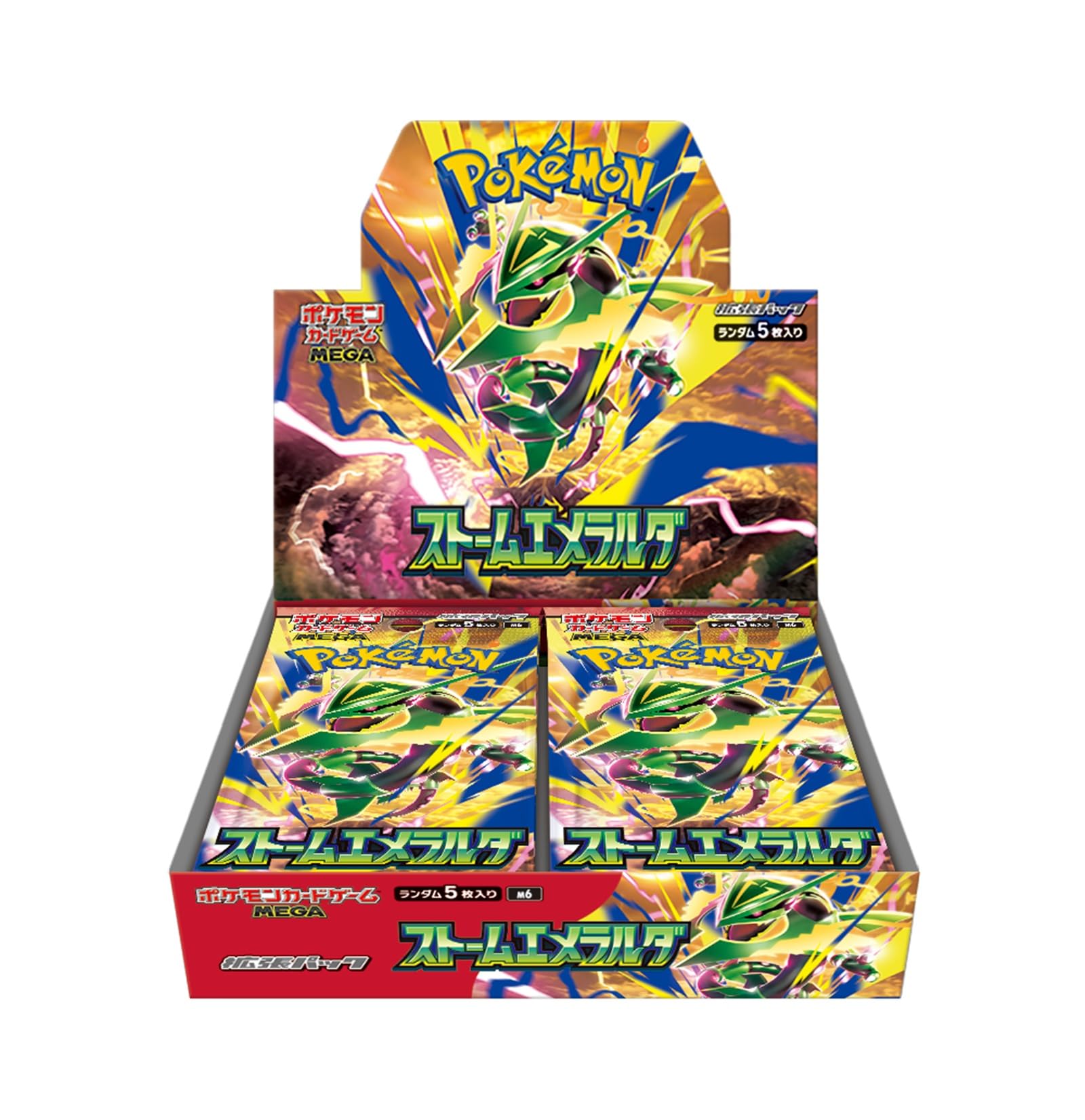
Pokémon Storm Emerald Booster Box

92 /100
Lab Score Outstanding

Key details

Packs
30
Format
Sealed booster box
Total Cards
150
Cards Per Pack
5
View on Amazon

Thirty packs sounds like a haul until you count: five cards to a pack means this box holds 150 cards, and that is the number worth comparing rather than the pack count. It is a collecting purchase rather than a deckbuilding one, and the arithmetic is the reason.

The seal is what makes it worth buying as a box. A closed thirty-pack box is the surest way to know nothing has been searched or swapped, and it turns a purchase into an evening: plenty of packs for four or five people to draft, with leftovers. If one particular card is the goal, buy that card; packs are for the pull, not the plan.

The opening is the entertainment here, and we were surprised by how little that bothered us. Thirty packs go a long way across a table, the mess is half the fun, and what is left over keeps for the next visit — which makes this the pick for a birthday or a draft night rather than for finishing a deck.

Set it beside either Magic pick and the difference is what happens first: those two want a table, a second player, and a bit of reading; this one just wants everyone to sit down and open.

Pros

  • Sealed box, so nothing has been searched
  • Five-card packs are quick to open and hand around
  • Enough packs to cover a table of four or five

Cons

  • Five-card packs cap the box at 150 cards
Our verdict

The pick for sealed packs rather than a deck to play: a 30-pack box that splits cleanly across a table and needs no rules reading first.

Check Latest Price

How We Tested the Best Collectible Card Games

We built a shortlist of 14 products — starter decks, booster bundles, and two-player boxes — chosen to cover the major play styles and price points, then filtered by what each box actually included. Before the first shuffle, we inventoried every component: deck lists, rulebooks, dice, tokens, counters, playmats, and any digital codes. We noted what a new player would still need to buy on day one, because a starter set that requires three extra purchases is not a starter set.

Testing ran for six months. We played at kitchen tables after dinner, at a local game store on weekend afternoons, and on a road trip with a small group of friends. Each game got at least five full matches, plus a teaching session with someone who had never played that title before.

We timed how long it took a beginner to take a legal first turn and whether the rulebook answered questions without a phone search. We shuffled each deck fifty times and checked for edge wear, bent corners, and foil curling. After each match, we noted whether the game ended in a tense finish or dragged past the point of fun. We sorted full sets to see how often duplicates appeared, whether the rare slots felt attainable, and whether the art and mechanics stayed varied across the box; we also tracked how many playable decks came out of a single purchase and whether the included extras — dice, counters, tokens — were useful or filler.

How to Choose a Collectible Card Game

Start With the Format

A box with two decks in it is the only kind you can play the evening it arrives; everything else assumes you will build something first. Card pools suit the tinkerer who wants to construct decks from a wide base of staples. Sealed packs are for the opening and the draft, not for finishing a decklist.

Decide which of those three evenings you are picturing — a first game, a deckbuilding project, or a table covered in wrappers — and the shortlist falls to one or two boxes. Buying packs to assemble one specific deck is the slowest and most expensive route to it.

Count Cards, Not Packs

Pack sizes vary, so a 30-pack box is not automatically the bigger purchase: multiply packs by cards per pack before you compare two boxes. A five-card pack opens fast and hands around easily; a larger pack gives you more per rip and more to sort afterward.

Then look at rarity. A box that puts 75 cards at rare or better is a different purchase from one that is mostly commons, even when the totals look close. Two numbers, thirty seconds, and you know which box is actually the better buy.

Check the Beginner Support and the Player Count

Teaching tools are the most underrated part of an entry box. A tutorial pair with a step-by-step booklet gets two people playing without a third person reciting the rules, and reference cards and playboards do the same job from a different angle.

Check the player count as well: a two-deck kit needs exactly one other person, while a card pool needs an opponent and a deck recipe before it does anything at all. If the box is a gift for someone who plays alone, that is the detail that decides the purchase.

Open It, Count It, Check the Printing

Sealed card product can arrive with a miscut stack, ink dark enough to obscure the text, or a component missing, and the return window is your only leverage. Open the box the day it lands, count the decks and packs against the contents list, and fan a few cards to check the cut and the print.

Do the same with the seals themselves. A box that has been opened and resealed goes straight back, whatever the cards inside look like.

Buy the Art You Want to Keep

Collectible card games are small art objects as well as game pieces, and the set you love is the one you will still be sorting a year from now. A licensed theme you already care about does more for a first purchase than a marginally stronger card list, and it is why a themed starter kit keeps its appeal after the rules are learned.

If the cards are headed for a binder rather than a deck, choose on the art.

Frequently Asked Questions

Final Verdict

Buy the Final Fantasy Starter Kit. It is the one box here that ends with two people playing rather than two people sorting, it is the smallest outlay of the three, and the rares and foil mythics inside mean a collection starts on the same evening the game does.

If the goal is cards to build with rather than a deck to play tonight, the Foundations Starter Collection is the better spend: 387 cards, 75 at rare or better, and a guide that tells you what to do with them. And for a Pokémon household, the Storm Emerald box is the sealed, shareable option — just know that 30 packs means 150 cards.