Best Board Games for Kids of 2026

A board game can look perfect on the shelf and then you read the rules aloud and watch your kid's face glaze over. The real test is whether everyone stays at the table past round one—and whether the game turns a restless afternoon into an hour of shared attention without tears or a missing pawn. Over the past six months, my team and I played 18 kids' board games at kitchen tables, on living room floors, and through a few very long playdates. The keepers were the ones that got requested again.

Kids are honest critics: too many rules and they drift, too little and they're bored by round three. We wanted games you can explain in two minutes but still think about afterward—where a 6-year-old can beat a grandparent without anyone letting them win. Classic titles got a fair shot, but a few were just nostalgia and thin cardboard. These picks survived sticky fingers, repeat play, and actual family game nights; the pricier ones had to prove they'd get pulled out more than once.

1

Best Overall

Connect 4 Classic Grid

96 /100
Lab Score Outstanding

Key details

Ages
6 and up
Discs
42 (21 red, 21 yellow)
Players
2
Board Size
10.51 x 10.51 inches
View on Amazon

One sentence of rules, two players, five minutes a round: that's the case for this one at the top of our list, and it's why it's the first game we put in front of a six-year-old. Four discs in a row wins, and everything interesting happens after a child has learned that — blocking a column, building a line upward, spotting the move that ends it. In our testing the shift from dropping discs at random to defending a line came faster than we expected, often inside a single sitting.

The current version earns its place on small details. The discs have ridges around the rim, so they stack flat and lift off carpet instead of sliding out of small fingers. The grid sits on two legs that come off, which makes it the easiest game here to move between the kitchen table and the floor, and the slider bar drops a whole column at once when someone wins — the sort of payoff that makes a five-year-old want another round.

The plastic is where it gives ground. The slider takes real force to release a full column and the legs carry the whole grid, so pull the bar straight and firmly rather than wrenching it sideways, and the mechanism holds. We also rate the two alternative modes in the guide, a free-for-all Frenzy version and a drop-or-eject variant, though classic play is the one we kept coming back to.

Pros

  • One rule, first round within minutes
  • Ridged discs stack and pick up easily
  • Slider bar clears a whole column at once
  • Smallest outlay here for the most replay

Cons

  • Two players only
Our verdict

Our default pick for a first real two-player game: one rule, five-minute rounds, and enough strategy that you'll be trying to win by the third round.
Check Latest Price
2

Best First Game

Candy Land

96 /100
Lab Score Outstanding

Key details

Ages
3 and up
Players
2 to 4
Board Size
15.75 x 10.63 inches
Playing Time
About 15 minutes
View on Amazon

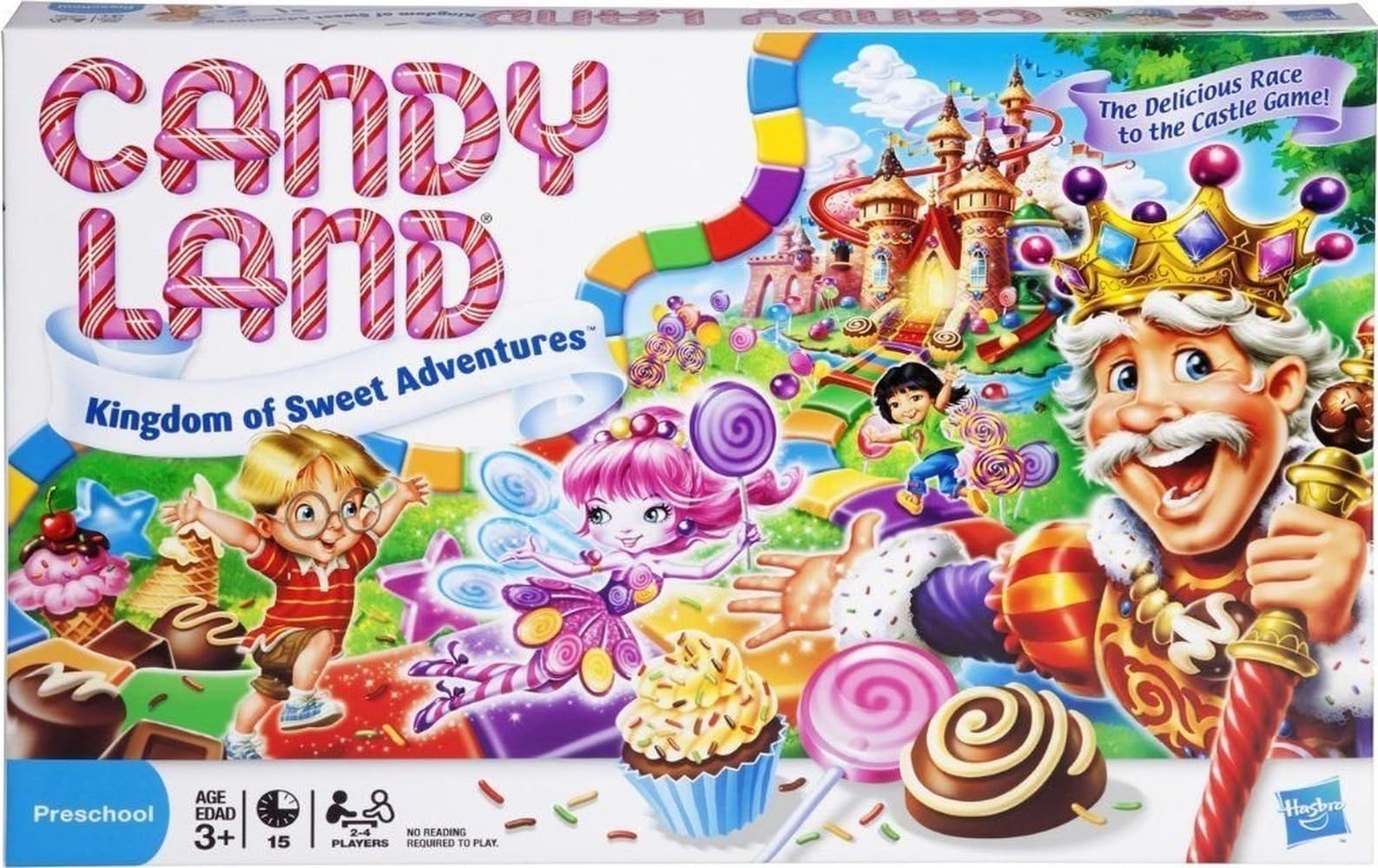
Nothing your child does in Candy Land changes who wins. The deck decides, the gingerbread pawns obey, and that is exactly why it works at three years old. A preschooler isn't learning strategy here; they're learning to draw a card, count the squares, sit through three other turns, and lose without the afternoon collapsing — the skills every other game on this page depends on.

The no-reading design is the part to look at, and it's why we keep one in the cupboard even after the kids have outgrown it. Each card shows its destination as a picture, so a child who can't decode a word finds the square and moves their own pawn unaided. Rounds run about 15 minutes, short enough for a tired three-year-old to finish one. One practical snag: the cards arrive stiff, so deal them face up for the first few games rather than asking small hands to shuffle. Expect it to be outgrown around five — this is the on-ramp, not the destination.

Pros

  • No reading
  • Teaches waiting, counting and losing
  • About 15 minutes a round

Cons

  • A late card can send a child back to the start
Our verdict

The first board game we hand to a three-year-old: no reading, four pawns, and a 15-minute round that teaches waiting more than it teaches winning.

Check Latest Price
3

Best for Mixed Ages

Zingo

96 /100
Lab Score Outstanding

Key details

Ages
4 to 10
Players
2 to 6
Cards And Tiles
6 double-sided cards, 72 tiles
View on Amazon

The zinger is why this one works. A child slides the dispenser forward, two tiles drop into the tray, and whoever has the matching picture on their card claims it — no die to roll, no pawn to count, no long wait between turns. That physical business does more for a four-year-old's attention than any rule we could explain, and it's the part we reached for first in every round we played.

Two levels in one box is the feature shoppers underrate. One side of each card is pictures, the other is words, and the 72 tiles are double-sided to match, so a four-year-old matching a cat to a cat and a seven-year-old reading "kitten" are playing the same round at different levels. Six cards put up to six at the table, which makes this the pick for siblings spaced a few years apart — nobody is waiting for the little one to catch up. Rounds are over in minutes, so a losing child gets another go straight away.

Seventy-two tiles in a plastic chute will occasionally jam, and a shake clears it; that's the cost of the mechanism that makes the game. The bigger ask is price — this is the most expensive game in this group, and the money goes into the dispenser and the double-sided components rather than a thicker box. In a house with a four- and a seven-year-old, it's still the one that gets set up without an adult suggesting it.

Pros

  • Two levels: pictures for pre-readers, words for early readers
  • Seats up to six at one table
  • Rounds finish in minutes
  • The tile dispenser is the hook

Cons

  • Most expensive game in this group
Our verdict

Buy this one when the ages at your table don't match: two reading levels in one box, six seats, and rounds short enough to keep a four-year-old in her chair.

Check Latest Price
4

Best for All Ages

Jenga

96 /100
Lab Score Outstanding

Key details

Ages
6 and up
Blocks
54 hardwood blocks
Players
1 or more
Storage
Tube with carry handle
View on Amazon

No board, no cards, no reading. Jenga is 54 blocks of hardwood and one rule — pull a block, stack it on top, don't bring the tower down — which is why a five-year-old and a twelve-year-old can play the same game without anyone adjusting the rules for the younger one.

The stacking sleeve is the detail shoppers skip and shouldn't. It squares the first layers in one go, so setup takes seconds and the tower starts true; build it by hand and you spend the opening minutes nudging blocks level while everyone waits. The tube with a handle matters too, because 54 loose blocks in a cardboard box is how games get lost, and this one packs away in something a child can carry to a friend's house.

What you accept is the rhythm. A round can end in under a minute and most of the evening goes on rebuilding, and on a hard floor the crash is loud enough to bring the whole house running — either the point or the reason you save it for the afternoon. It's also the only game here a single child can play alone, which counts on a rainy day. We keep coming back to it because nobody has to be taught.

Pros

  • 54 hardwood blocks, not plastic
  • Stacking sleeve squares the tower in seconds
  • Tube with a handle for storage
  • Plays solo, or with a whole room

Cons

  • Rounds end fast
Our verdict

The all-ages pick we never have to explain: 54 wooden blocks that give a five-year-old and a grandparent the same odds.

Check Latest Price
5

Best for Early Money Skills

Monopoly Junior

96 /100
Lab Score Outstanding

Key details

Ages
5 to 8
Players
4
Playing Time
About 30 minutes
View on Amazon

Junior is the version that ends. The box lists about 30 minutes, the properties are a zoo, a movie theater and a video game arcade, and the money is simple enough that a five-year-old can take a turn without a translator. That sounds like faint praise. It's the reason this comes out on a school night when the full Monopoly box stays on the shelf.

The sold signs are the smartest thing in it. Forty-eight of them mean a child physically plants ownership on the board and watches their color spread — property as something you can see rather than a rule you have to remember. The banknotes in this edition are all singles, so buying and making change is counting rather than converting denominations, which is the arithmetic a kindergartner can actually do. Watching a five-year-old work out that she can't afford a property and has to wait a turn is the whole educational case in one moment.

The four character tokens carry more weight than they look like they should — Little Scottie, Little Hazel, the toy car and the top hat give a small child someone to be, which is half of why the board holds their attention. An eight-year-old will soon want the real thing, and that's the boundary of what this one is for rather than a fault in it.

Pros

  • About 30 minutes, not three hours
  • 48 sold signs make ownership visible
  • Single banknotes keep the arithmetic simple
  • Ages 5 to 8 with kid-friendly properties

Cons

  • Thin board that can split along the fold
Our verdict

The version of Monopoly a five-year-old can finish, and the one we keep for the 5-to-8 window because counting and change are built into every turn.

Check Latest Price
6

Preschool Race Game

Trouble

95 /100
Lab Score Outstanding

Key details

Ages
5 and up
Players
2 to 4
Die Roller
Pop-O-Matic bubble
Playing Time
About 30 minutes
View on Amazon

The die is sealed under a plastic dome in the middle of the board and you pop it with the flat of your hand. That single design decision is why this survives a house with a five-year-old: no die rolling under the sofa, no argument about whether a cocked roll counts, no chasing a plastic cube while three children wait. Press the dome, read the number, move a peg.

The game underneath is a plain race — first to bring all four pegs home wins — and at 5 and up it slots between Candy Land's pure luck and Connect 4's actual thinking. The Power Up spaces in the instructions give it a second gear for a seven-year-old, and a round runs about half an hour. The dome occasionally gives a weak roll; a firm press with the palm rather than a fingertip is the fix.

Where it sits for us is the game you buy for a child who has outgrown a picture-card race but isn't ready to plan two moves ahead. It's also the easiest of these to take along, since there's no loose die to lose under a table. If you want one game that will still be played at nine years old, this isn't it — Connect 4 and Jenga have longer legs.

Pros

  • Sealed Pop-O-Matic die
  • Ages 5 and up, with a Power Up variant
  • Four pegs, a race anyone can follow

Cons

  • Thin board and light plastic
Our verdict

Our pick for a five-year-old who isn't planning two moves ahead yet: a sealed die, four pegs, and a half-hour race nobody has to explain twice.

Check Latest Price

How We Tested 18 Kids' Board Games Over Six Months

We started with a long list of 40-plus kids' board games and narrowed it by age range, price, availability, and one blunt question: could a family actually play this together without a referee? The final 18 covered classics, newer titles, and a few look-alikes. Over six months, we played each one at least five times with kids ages 4 to 10, plus at least twice with adults only to see whether we'd voluntarily open it after bedtime.

Testing happened at kitchen tables, on living room floors, during rainy Saturday afternoons, and through a few long playdates where the guest had never seen the rules. We timed setup and the first rules explanation, then watched for the signs that a game is circling the drain: glazed eyes, side conversations, a kid asking how many turns are left. I kept a running note of meltdown triggers—player elimination, runaway leaders, rules that reward reading speed over luck—and whether the box said 'ages 6 and up' while a 6-year-old actually needed help every turn. We also noted which games got requested again without a parent suggesting them.

Build quality got the sticky-finger treatment: we stacked boards, shuffled cards repeatedly, dropped boxes, and packed everything back into the insert after every session. After a few weeks, we checked for frayed card corners, splitting box seams, flimsy spinners, and pieces that had already gone missing. We compared price per play by tracking how often each game came back into rotation, because value isn't the sticker price—it's the game that survives a month of rematches without falling apart.

How to Choose a Board Game for Kids

Read the Age Band as a Reading Test

Ages 3 and up almost always means no reading at all: a picture card, a colored square, a pawn that moves itself. Ages 4 to 5 adds matching and simple counting, and 6 and up assumes a child can hold a rule or two in their head and lose without a scene. The trap is buying up a band for a bright child — a four-year-old with a 6+ game usually ends up with an adult moving their pieces, which isn't the same as playing. Match the box to the youngest child who will play unaided, not the oldest in the house.

Count the Seats at Your Table

Two-player games and family games fail in opposite ways. Connect 4 is exactly two players, so a third child waits with nothing to do. Monopoly Junior comes with four tokens, so in a two-child house an adult is in every round whether they wanted to be or not. If your kids are close in age, a head-to-head game is cheaper and gets more play. If they're three or four years apart, look for levels or a no-reading design, as in Zingo, so both can play the same round on their own terms.

Decide How Much Luck You Can Live With

Pure-luck games let the youngest player win outright, which is worth a lot in the years when losing is a crisis. They also cost you any interest in the outcome, and a 15-minute Candy Land round is about the limit. Skill games such as Connect 4 and Jenga hold an adult's attention, but a four-year-old loses nearly every time, and nobody enjoys that either. Our rule for a first cupboard: one luck-led game for the youngest child, one thinking game for the household, and little in between.

Inspect the Part That Moves

The mechanism is what breaks. A Connect 4 slider bar and its legs, a Zingo tile chute, a Trouble pop dome, the crease on a folding board — each is where a cheap component shows up first. Before you buy, work out whether the moving part is the game or an accessory: if the whole point is the popping or the sliding, pay for the version that does it well. Then play on a hard, flat surface, since carpet is where folded cardboard boards start to split.

Spend on Components, Not on Rules

Prices here range widely for what is, at bottom, the same evening's entertainment. The wood-block game and the tile-dispenser game cost more because hardwood and tooling cost more, not because their rules are better. The cheapest pick in this group is also the one we reach for most often. Buy the components you'll actually handle — blocks that survive being dropped, a dispenser a child can work, a board that lies flat — and don't pay extra for a bigger box.

Frequently Asked Questions

Final Verdict

Buy Connect 4 first. It's the cheapest game here, it's the one that gets played longest, and it's where a child's improvement shows up fastest — you can watch the shift from random discs to an actual plan. Add Candy Land if there's a three-year-old in the house; nothing else here asks so little of a pre-reader, and nothing else is outgrown so quickly.

If your kids are spread across four years, Zingo covers both of them in one box. If you want a game that works with a crowd and needs no explaining at all, that's Jenga.