Best Deck-Building Games of 2026

Deck-building is the rare game mechanic you can explain in a sentence: everyone starts with a weak hand of cards, spends them to buy better ones, and eventually the better ones come back around to buy better still. What that sentence leaves out is everything that separates a great box from a forgettable one — how quickly a deck starts to hum, whether one bad shuffle can bury you, and whether the table stays chatty or goes quiet and calculating. The right game makes the loop feel obvious by the second turn and still gives you something new to try on the tenth play.

My team and I have spent six months working through 14 deck-building games, and the spread was wider than I expected. Some taught themselves inside a single round; others needed a practice game before anyone at the table relaxed. The ones we kept were easy to learn and hard to win, with pacing that held up once everyone knew what they were doing. Those are the picks below.

1

Best Overall

Dominion 2nd Edition

98 /100
Lab Score Outstanding

Key details

Theme
Kingdom building
Players
2–4
Play Time
30 minutes
Recommended Age
14+
View on Amazon

Dominion is the game that taught many of us how to build a deck during play, and the 2nd Edition still makes the cleanest case for owning one. Everyone starts with the same small deck, buys action, treasure, and victory cards from a shared market, and watches the next hand change because of it. The box handles two to four players and lists 30 minutes, which is long enough for a real engine and short enough for a weeknight.

What keeps it at the top of this set is the way every purchase has a visible consequence two or three turns later. The market changes from game to game, and the base box has enough variety that we didn't feel pushed toward expansions to keep it interesting. The first couple of games can feel like you're buying money rather than executing a plan, but that click comes quickly for most groups.

The base box is self-contained in a way that matters: you can play it for months without buying another set, and the card combinations keep the market from settling into a routine. It is the one we reach for when the deck itself is the entertainment, not the theme or the table spectacle.

Pros

  • Complete base box needs no expansions
  • Every purchase changes later hands
  • Plays two to four in about 30 minutes
  • Market changes from game to game

Cons

  • Less thematic than licensed rivals
Our verdict

We recommend Dominion as the default deck-builder for a mixed group that wants a complete game in half an hour.

Check Latest Price
2

Best Budget Two-Player

Star Realms

95 /100
Lab Score Outstanding

Key details

Players
2
Box Size
2.8 x 1.8 x 3.8 in
Play Time
20 minutes
Recommended Age
12–15
View on Amazon

Star Realms is the deck-builder we carry when the plan is a quick duel, not a full game night. The box measures 2.8 by 1.8 by 3.8 inches, so it disappears into a bag, and the 20-minute frame makes it easy to play twice while the coffee is still hot. The focus is why it works: every card goes into the same head-to-head fight.

The shopping row is the whole game: you buy ships and bases, add them to your deck, and use the combat to chip away at your opponent. We found the factions give each purchase a clear job, so the deck doesn't turn into a pile of unrelated good cards. The direct attack keeps both players engaged, and the small ruleset means a new player can be competitive in the first session.

Pros

  • Fits in a pocket or bag
  • Plays in about 20 minutes
  • Easy first deck-builder
  • Direct combat keeps both players involved

Cons

  • Two-player only
  • Close games can swing on a lucky draw
Our verdict

We recommend Star Realms as the deck-builder to keep in a bag for fast two-player duels.

Check Latest Price
3

Best Solo and Co-Op

Star Realms Frontiers

94 /100
Lab Score Outstanding

Key details

Players
1–4
Box Size
6 x 4 x 2 in
Contents
152 cards and rulebook
Recommended Age
14+
View on Amazon

Star Realms Frontiers is the version to choose when one box needs to cover a solo session and a four-player table. It is a standalone game, not an expansion, with 152 cards and a rulebook, and it lists one to four players. The solo and co-op scenarios are the reason it exists alongside the original; the two-player duel is still there, but it is no longer the only way to play.

The new double ally ability rewards committing to one faction, which gives the buying decisions a sharper edge than the base game's generalist approach. We also appreciate that the box can be combined with Star Realms or Colony Wars, so it grows with a collection instead of replacing it. The scenarios add setup choices without turning the game into a campaign.

For us, the flexibility is the selling point: one box covers a quiet solo game and a group game, and the sci-fi combat is easy to explain. If you already own the base game, treat this as a companion as much as a standalone; the new modes are a reason to revisit the system, not a replacement for the leanest duel.

Pros

  • Covers solo, co-op, and one to four players
  • Standalone box with 152 cards
  • Double ally ability rewards faction focus
  • Combines with Star Realms and Colony Wars

Cons

  • More rules overhead than base Star Realms
Our verdict

We recommend Star Realms Frontiers when you want one compact box that covers solo play, co-op, and a four-player table.

Check Latest Price
4

Best Thematic Duel

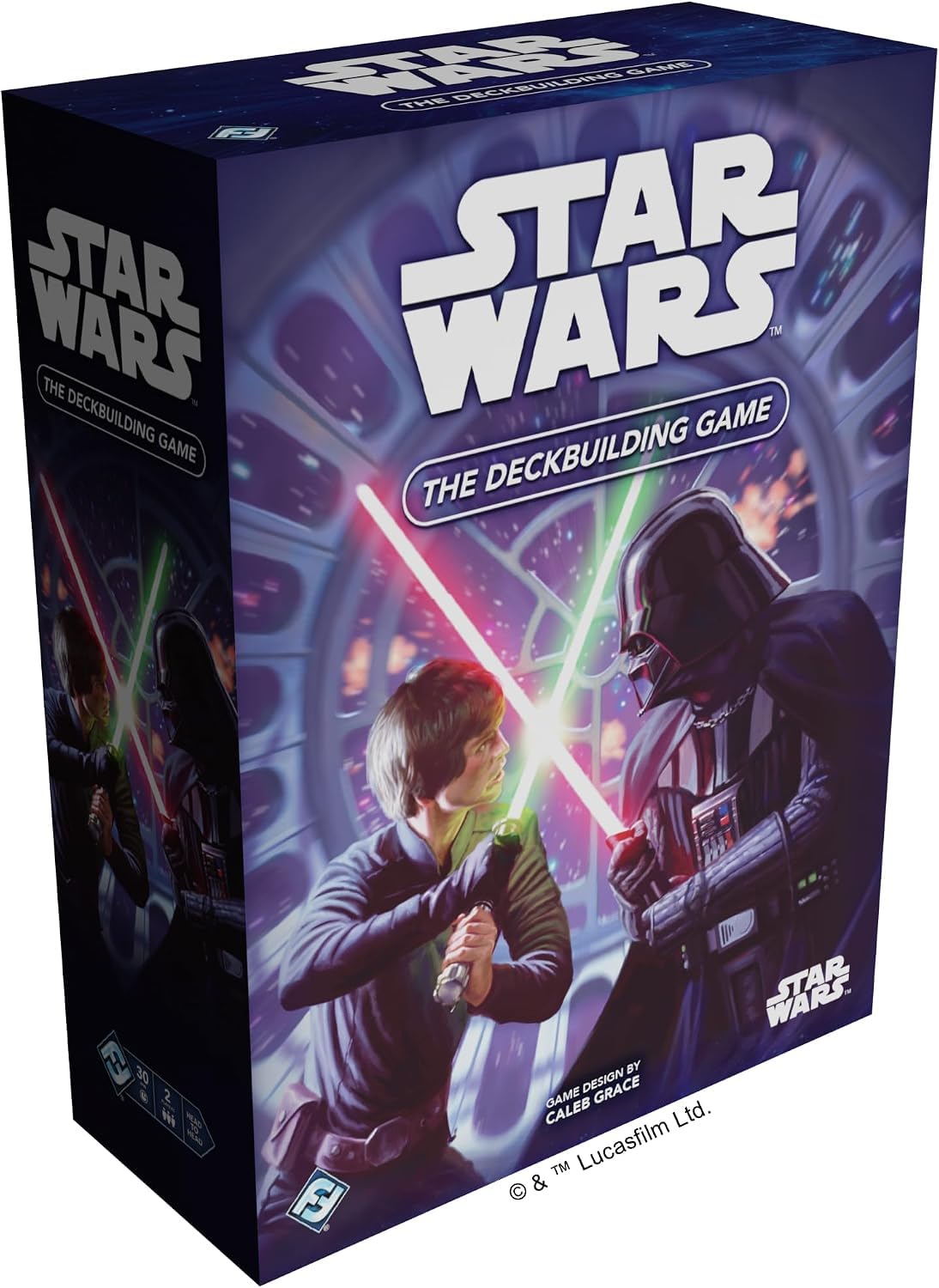
Star Wars: The Deckbuilding Game

94 /100
Lab Score Outstanding

Key details

Players
2
Factions
Rebels and Empire
Play Time
30 minutes
Recommended Age
12+
View on Amazon

The Rebel-versus-Empire split is the first thing that makes Star Wars: The Deckbuilding Game feel different from the other head-to-head picks here. One player takes the Empire, the other the Rebels, and each side gets its own playstyle and card pool. The box runs about 30 minutes and includes 142 cards, 70 counters, and a balance track.

We reach for this one when both players want the theme to carry the table, not just decorate it. The objective is to destroy three of your opponent's bases, so every purchase points toward a visible fight, and the faction abilities give each side a distinct rhythm. The art and the familiar characters do a lot of work, especially for a group that already knows the films.

The focus is narrow in a useful way: it sets up fast, plays in about half an hour, and gives two players a complete arc without a campaign. We wouldn't make it the only deck-builder in a collection, but it is the one we choose when the table wants a Star Wars duel.

Pros

  • Asymmetric Rebel and Empire factions
  • Plays in about 30 minutes
  • Strong Star Wars art and characters
  • Easy to learn with strategic depth

Cons

  • Two-player only
Our verdict

We recommend this Star Wars deck-builder for two players who want a fast, thematic duel with distinct factions.

Check Latest Price
5

Best Dungeon-Crawl Hybrid

Clank! Catacombs

93 /100
Lab Score Outstanding

Key details

Cards
180+
Players
1–4
Dungeon Tiles
29
Recommended Age
13+
View on Amazon

Clank! Catacombs starts with a dungeon you build as you play, not a board you unfold and memorize. The box includes 29 dungeon tiles and 180+ cards, and the layout changes from game to game as players explore. That tile-by-tile reveal is the detail that separates it from the pure card-table deck-builders here.

The deck-building is still the engine: you buy cards, thin your starter cards, and try to make a hand that moves you farther or hits harder. What we appreciate is that the purchases have a spatial job; a card that looks weak in isolation can be the one that gets you out of a dead end. The 1–4 player count and 13+ rating put it in the older-kids-and-adults zone.

The variety is the payoff: the 29 tiles and 180+ cards give the dungeon a different shape and the market a different set of choices each time. Setup is more involved than a card-only game, and the layout grows as you play, so give it a real table.

We rank it as the best board-game hybrid in this set because it gives a deck-builder somewhere to go. If your group likes the idea of building a deck while exploring a dungeon, this is the one; if you want the leanest possible card game, Dominion or Star Realms will ask less of your table.

Pros

  • Dungeon board changes every game
  • Deck-building has a spatial purpose
  • Supports one to four players
  • Large card and tile variety

Cons

  • Less competitive with two players
Our verdict

We recommend Clank! Catacombs for groups that want deck-building wrapped around a changing dungeon board.

Check Latest Price
6

Best Narrative Deck-Builder

Mistborn Deckbuilding Game

92 /100
Lab Score Outstanding

Key details

Modes
Solo, co-op, competitive
Players
1–4
Box Size
10.5 x 10.5 in
Recommended Age
13+
View on Amazon

Mistborn Deckbuilding Game is the most story-forward box in this group, and it asks you to learn a few setting rules before the deck-building opens up. You recruit heroes and burn metals such as steel or pewter to trigger abilities, and the missions give each session a narrative frame. It supports one to four players and lists solo, co-op, and competitive modes in the same box.

The theming is the reason to pick it over a generic fantasy deck-builder. The art and the allomantic powers pull directly from Sanderson's world, and the mission structure gives the cards a context beyond a market row. We found the co-op mode the easier entry point because the table can talk through the objectives together.

We rate it as the narrative pick in this set, not the default. The mission structure and the co-op mode are the reasons; if you want a deck-builder that feels like a story, this is worth the extra setup. It is the one here that makes the cards feel like part of a world rather than a set of purchases.

Pros

  • Solo, co-op, and competitive modes
  • Strong Sanderson theme and art
  • Simple basics with layered missions
  • Works at all player counts

Cons

  • Steep learning curve
  • Games can run long
Our verdict

We recommend Mistborn for Sanderson readers who want solo, co-op, and competitive deck-building in one story-rich box.

Check Latest Price
7

Solo Lunch Breaks

Friday

91 /100
Lab Score Outstanding

Key details

Players
1
Play Time
30 minutes
Recommended Age
14+
View on Amazon

Friday is the deck-builder we keep for the nights when nobody else is around and we want a game that pushes back. You start with a weak deck and try to survive a series of hazards, and the difficulty is the hook: winning feels earned because the game does not hand it to you. The box lists about 30 minutes.

The compact box and short session make it easy to leave on a desk and play over a lunch break. The different difficulty levels give the same deck a longer life, and the decisions stay interesting as you decide which cards to keep and which to throw away. We found the first few plays were more about learning the rhythm than winning.

The luck of the draw can make a run feel doomed before it starts, and the difficulty is not a bluff. Those are real limits, but they are also why the wins land. It is the one here we treat as a personal challenge rather than a social event.

Pros

  • Hard-won wins feel earned
  • Compact 30-minute session
  • Difficulty levels add replayability

Cons

  • No multiplayer option
Our verdict

We recommend Friday for solo players who want a compact, punishing deck-builder they can play in half an hour.

Check Latest Price
8

Batman Fans

DC Deck-Building Game: Dark Nights Metal

93 /100
Lab Score Outstanding

Key details

Players
2–5
Play Time
45 minutes
Game Cards
202
Recommended Age
15+
View on Amazon

DC Deck-Building Game: Dark Nights Metal is the most theatrical box in this set, and the foil Metal cards are the first clue that it is aimed at Batman readers rather than deck-building generalists. The box handles two to five players, lists 45 minutes, and includes 202 game cards. It is a standalone game, but it is compatible with the rest of the DC deck-building line.

The twist is that you can recruit superheroes, and the Batman Who Laughs and his Dark Knights give the table a clear villain to chase. The vulnerability starter cards and the main deck structure keep the game in familiar deck-building territory, so the theme is not hiding a different kind of game. The 20+ foil Metal cards are the detail that makes the box feel like an event.

The art and the DC universe are the draw; if your group knows the comic, the card names and character choices do a lot of work. The 15+ age rating puts it firmly in the older-teen-and-adult zone.

We rank it as the niche pick in this group, not the default. Choose it when the table wants a Batman event and is happy to spend a little longer on setup and play; for a mixed group or a first deck-builder, Dominion is the safer recommendation.

Pros

  • Foil Metal cards feel special
  • Two to five players and 202 cards
  • Standalone and compatible with DC line
  • Recruit superheroes against a clear villain

Cons

  • Niche Dark Nights theme
  • 45-minute sessions run long
Our verdict

We recommend Dark Nights Metal for Batman fans who want a theatrical deck-builder and do not mind a longer session.

Check Latest Price

How We Chose and Tested the Best Deck-Building Games

We started with a shortlist of roughly 40 titles pulled from rulebooks, forum threads, and the shelves of two very well-stocked local game stores, then cut it down by player count, price, box size, and whether the base game was worth playing without expansions. Fourteen made the final list, and we've spent the past six months with them — Tuesday nights with a regular group of four, quieter two-player sessions at my kitchen table, and a few deliberately brutal evenings with people who had never played a deck-builder before. Every game got at least three plays; the ones we couldn't stop thinking about got a dozen or more.

Learning curve was the first thing we measured, in the least scientific way possible: we timed the teach, counted how many times someone grabbed the rulebook mid-game, and watched for the moment the table stopped asking questions. From there we tracked strategy — whether a real plan had formed by the middle of the game or everyone was just buying the most expensive card they could afford. We also watched for the runaway leader problem, noting whether the player ahead on turn five was still catchable at the end, since a game you can't win from behind stops being fun fast.

Pacing got its own notes: how long each turn took, how much downtime piled up between them, and whether the last fifteen minutes still had everyone leaning in. On the physical side, we shuffled each deck hundreds of times to see how the cards held up, checked whether card text was readable from across a table, and hauled boxes to game nights to see how the inserts and corners survived the trip. Value came down to plays per dollar — how many sessions a box delivered before the strategies went stale, and whether it needed an expansion to stay interesting.

How to Choose a Deck-Building Game

Match the player count to your usual group

Deck-builders split sharply between duels and group games. Star Realms and Star Wars: The Deckbuilding Game are built for two, while Dominion, Clank! Catacombs, and Mistborn Deckbuilding Game cover three or four in one box. Friday is a solo game, and Star Realms Frontiers stretches from one to four. The trap is assuming a two-player favorite will scale up; many are at their best with exactly two, and a group game night will leave half the table waiting.

Count the people who actually sit down on a normal week. If that number is two, a dedicated duel is the better buy. If it is three or four, start with a box that lists that range and treat solo as a bonus rather than the main event.

Balance rules weight against your teach time

Easy to learn is not the same as short. Dominion and Star Realms get a new player into the first hand quickly, while Mistborn and Clank! Catacombs layer missions, modes, or a tile board on top of the deck-building. A heavier game can be the right choice for a group that meets often, but it is a poor fit for a table that re-learns the rules every time.

We look at the first-game experience before the long-term one: can someone take a turn without being coached? If the answer is no, the box will spend more time on the shelf. Our rule is to start with the lightest game that still gives the group a decision worth arguing about, then add complexity.

Decide how much direct conflict you want

Some deck-builders are races, and some are fights. Star Realms and Star Wars put damage and bases in front of you, so the tension is direct. Dominion and Clank! Catacombs are more about building an engine and reading the market; there is competition, but it is not a constant attack. Mistborn can go either way depending on the mode.

If your group dislikes being targeted, choose an engine-builder or a co-op mode. If the table enjoys the back-and-forth, a combat deck-builder gives every purchase a sharper edge. The mistake is buying a combat game for a family that wants a quiet puzzle.

Check solo and co-op support before you pay for it

Not every solo mode is a full game. Star Realms Frontiers includes scenarios and boss cards for one to four, and Mistborn builds solo, co-op, and competitive modes into the same box. Friday is designed around one player from the start. By contrast, a two-player duel may have no solo option at all, and a group game may only add a solo variant as an afterthought.

If you play alone often, make the box prove it: look for a listed solo mode, scenario support, and a player count that includes one. If you mostly play with others, put that money into a game that is stronger at three or four instead.

Plan for table space and setup

A card-only deck-builder needs a market row and a few personal decks; a tile-laying game needs room to grow. Clank! Catacombs uses 29 dungeon tiles and 180+ cards, and the layout expands as you play. Star Realms is the opposite: a tiny box and a short setup. Neither is better, but they suit different rooms.

Measure the table you will actually use, then choose the footprint you can leave out between turns. If the game has to be packed away after every session, a long setup is a real cost. If it can live on a spare table, the bigger board is easier to justify.

Frequently Asked Questions

Final Verdict

Dominion 2nd Edition is the deck-builder we recommend first because it delivers the genre's core pleasure in a complete, 2–4 player box that plays in about half an hour. It is not the most theatrical game here, but it is the cleanest teach for a mixed group, the most flexible for a table of three or four, and the one that keeps changing without an expansion.

If your table is almost always two players, Star Realms is the better fit: smaller, faster, and built around a duel. For solo or co-op play, Star Realms Frontiers or Mistborn gives you modes the Dominion box does not. Start there, and the rest of this list becomes a matter of matching the room and the group.