Best Foosball Tables of 2026

A foosball table looks like a simple game-room purchase until you picture it in your space: the footprint, the assembly, the noise, and the way a cheap frame starts shimmying the moment someone scores. The right table keeps the rods gliding, the ball from dying in a corner, and the whole cabinet steady through a loud family tournament. The wrong one becomes a very large place to stack board games.

I’ve had foosball tables in a basement rec room and watched friends squeeze mid-size models into apartments, and the pattern is consistent: fun comes from smooth gameplay, not flashy graphics. Over eight months, we assembled and played on 11 tables, from compact tabletop versions to full-size cabinets, with kids, casual adults, and a few friends who take it far too seriously. Assembly instructions ranged from clear to cryptic, and size and weight mattered as much as stability once the games got heated. A table can look like a bargain until you’re wrestling with missing hardware or a wobbly leg; the picks below are the ones that felt worth the floor space.

1

Best Overall

KICK Titan 55" Foosball Table

90 /100
Lab Score Outstanding

Key details

Rods
Eight 5/8-inch steel rods
Weight
148 lb
Dimensions
55"L x 30"W x 36"H
Playfield Thickness
0.5 inches
View on Amazon

The box is the first surprise. At 148 pounds the Titan arrives as freight you plan a delivery day around, and that weight is not packaging — it is the table. A light foosball cabinet walks across the floor when someone rips a shot, and the playing surface starts working its way out of its groove. This one plants.

That is why it is our top pick. Eight 5/8-inch chrome-plated steel rods run on bearings, so the ball comes off the wall clean and a defender can be nudged a quarter turn instead of a half. The half-inch playfield sits flat and stays flat, the natural wood handles stay dry in your hands, and the whole cabinet feels the same at hour three as it did at minute ten. Against the budget tables here, the difference is not cosmetic.

The kit is generous the way serious tables are: 13 counterbalanced and 13 uniformed players in each color, six foosballs, and a limited lifetime warranty — the only one in this group. That warranty is the part that matters most at this price, because every other table here backs itself for 60 days to six months.

The caveat is logistical, not mechanical. Once it is built, it does not move, so assemble it in the room where it will live, with a second person, and look hard at the space behind each end before you pick a wall. If your plan involves clearing the table away between game nights, this is not the one — the GoSports 48 makes that trade instead.

Pros

  • 5/8-inch solid steel rods on smooth bearings
  • 148-pound cabinet stays planted in hard play
  • Half-inch playfield in a reinforced cabinet
  • Limited lifetime warranty

Cons

  • Extremely heavy; build it where it stays
Our verdict

Our choice for a table that stays put for years: the cabinet does not budge, the rods glide, and the lifetime warranty backs the build.
Check Latest Price
2

Best Value Full-Size

GoSports 48" Foosball Table

88 /100
Lab Score Excellent

Key details

Weight
52 lb
Included
4 balls, 2 cup holders
Dimensions
48"L x 38"W x 31"H
Frame Material
Engineered wood
View on Amazon

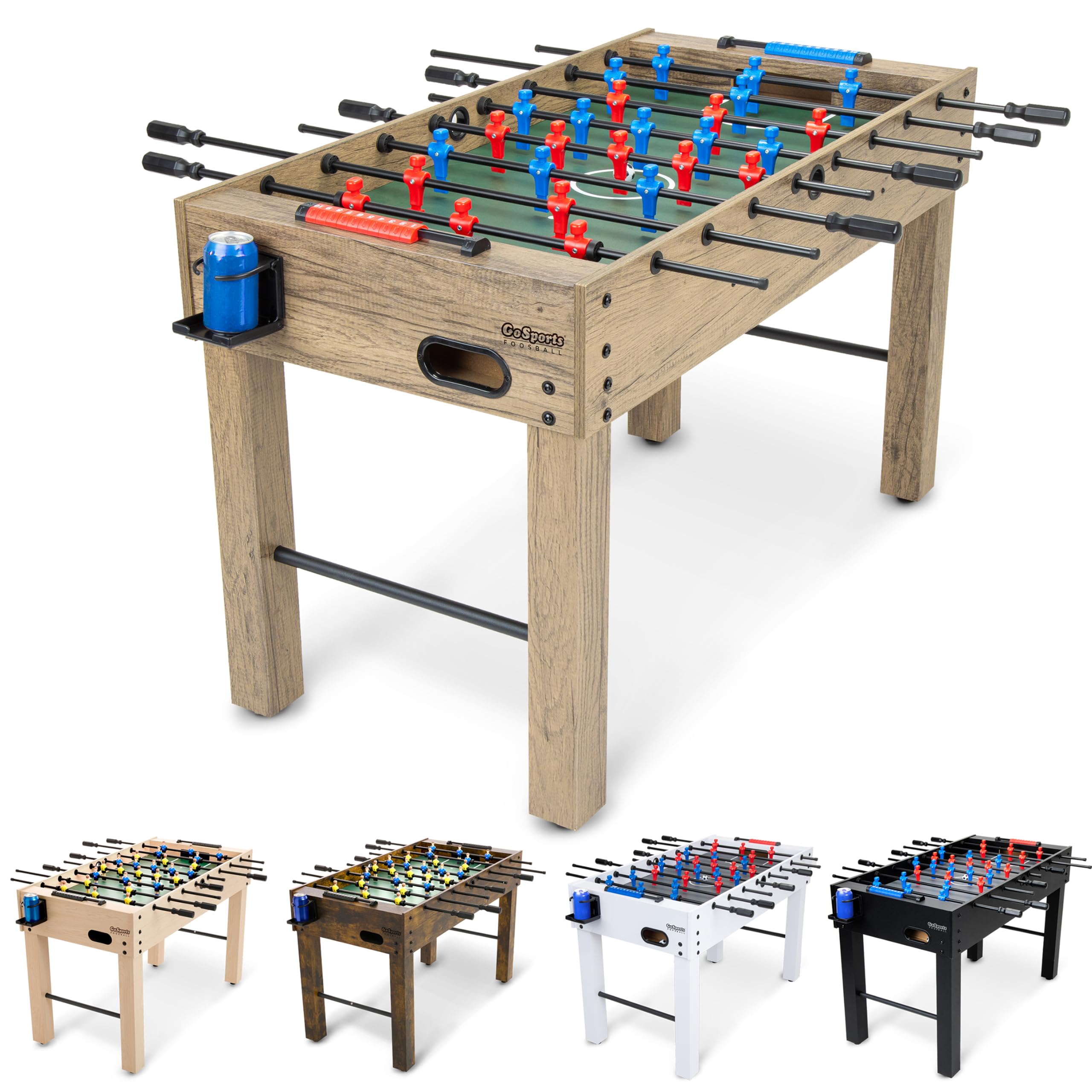
For most families this is the sensible buy. The GoSports 48 plays like a real foosball table, goes together in an evening, and does not turn the purchase into a project — which is why it is our go-to for anyone whose table has to share a room with a sofa.

It is composite wood with a low-friction field and red and blue players on steel rods, and at 23.59 kg there is enough ballast that you are not holding the corner still mid-rally, while one person can still slide it against the wall afterward. The 48-inch cabinet stands 31 inches at the rod line: right for kids and shorter adults, a crouch for anyone over six feet. Assembly is where tables at this price usually fall down, and this one does not — the illustrated guide and the video walk you through it.

Two cup holders, four balls, and an oak finish that reads as furniture rather than rec room make this a table we happily leave in a living room. The weak point is the rods. They are the part that gives if your group plays with real force, and they can bend. For friendly best-of-fives with kids that never comes up; for the friend who plays every point like a final, it will.

Pros

  • Full-size feel without a full-size price
  • Illustrated instructions plus an install video
  • Four balls and two cup holders included
  • Light enough for one person to shift

Cons

  • Rods can bend under heavy-handed play
Our verdict

We send most families here: real-table feel on a 48-inch cabinet, and a build you can finish in one evening.

Check Latest Price
3

Best Budget Full-Size

Best Choice Products 54" Foosball Table

85 /100
Lab Score Excellent

Key details

Weight
73 lb
Players
2 to 4 players
Included
2 balls, 2 cup holders
Dimensions
54"L x 26"W x 34.25"H
View on Amazon

Thirty-four and a quarter inches at the rod line is the number that matters here. That is adult standing height, within an inch or so of the premium tables, and it is what separates this 54-inch Best Choice Products from every 48-inch cabinet in this guide. If grown-ups are the ones playing, the budget conversation starts at this size.

You get a 54 by 26-inch walnut cabinet, chrome-finished steel rods with contoured handles, two cup holders, two balls, and room for four players. The composite wood build is honest rather than plush — 73 pounds of it, which is enough ballast to feel planted and light enough that two people can shift it once it is together.

What we like is how little it asks in return. Assembly runs a couple of hours with two people, the finish looks more expensive than it is, and the play is steady enough for adults who take the game seriously without pretending to be a tournament table. The reservation is quality control on the cabinet: leg joints have arrived separated, so unbox it, dry-fit the panels, and keep the packaging until you are satisfied.

Hardware is where the money went missing. The rods are not the solid 5/8-inch stock you get on the Titan, and a hard-playing group will feel the difference. For family games and party nights, that trade is worth making.

Pros

  • Adult-height 34.25-inch playing stance
  • 54-inch field with room for four
  • Two cup holders and two balls included
  • Finish looks pricier than it is

Cons

  • Leg joints have arrived separated
  • Two-person, couple-of-hours assembly
Our verdict

We recommend it to any family that wants adult-height foosball without premium-table money.

Check Latest Price
4

Best Tabletop

GoSports 32" Tabletop Foosball

89 /100
Lab Score Excellent

Key details

Setup
Players pre-installed
Weight
15.9 lb
Included
2 mini foosballs
Dimensions
32"L x 20"W x 8.25"H
View on Amazon

Nobody is perfect at tabletop scale, and the GoSports 32 does not pretend otherwise. At 32 by 20 inches it is a miniature — smaller ball, smaller men, two players comfortably and four in a pinch — and it sits on your dining table rather than owning a room. Within that boundary, it is the best tabletop table here.

What earns it that spot is setup. The players come pre-installed on the rods, so assembly is a handful of panels and a printed guide rather than threading 22 men onto eight rods and hoping the colors come out right. That one decision is the difference between a table that gets played and one that stays in the box.

Play is quick and honest: a low-friction field, two mini foosballs, and 15.9 pounds of engineered wood that does not skate when a shot comes in hard. The oak finish is a genuine cut above the plastic look of most mini tables, and this is the one we leave out on a coffee table. Measure twice, though — the rods need clearance at both ends, and the host table has to be solid, because a wobbly surface ruins a game faster than a bad goalkeeper.

Pros

  • Players ship pre-installed on the rods
  • 32 by 20 inches fits a desk or table
  • Oak finish looks like furniture
  • Two mini foosballs included

Cons

  • Needs a stable host table and rod clearance
Our verdict

This is the tabletop table we reach for: players come pre-installed, the finish looks like furniture, and it plays steady.

Check Latest Price
5

Best for Tournament Play

Tornado Tournament 3000

87 /100
Lab Score Excellent

Key details

Weight
355 lb
Dimensions
56"L x 30"W x 36"H
Certification
ITSF tournament table
Playfield Thickness
3/4 inch
View on Amazon

This is the table the sport actually uses. The Tornado Tournament 3000 is certified by the International Table Soccer Federation and is the official table of the Tornado National Tour — a different kind of claim from tournament style, because the table you buy is the table the tournaments run on.

The build reads accordingly: a commercial-grade split cabinet, a 3/4-inch playfield, 355 pounds of table, patented counterbalanced players, a three-goalie setup, abacus scoring, and eight-sided non-slip handles. It ships mostly assembled, which is just as well, because nobody moves 355 pounds twice. Three balls and a bottle of silicone come in the box.

Banked corners are the detail we point to first. Instead of dying in a corner, the ball caroms back into play, and that changes the rhythm of a game more than any cosmetic upgrade on this list. Pair it with the counterbalanced men and a light touch does what it should.

Our honest read: for a rec room with daily play, a bar, or anyone training seriously, it is worth the money and then some — build quality is the strongest in this set and the play matches it. For a family room where the games are casual, it is more table than you need, and the Titan gets you a long way there for far less.

Pros

  • Certified for ITSF tournament play
  • Banked corners keep the ball live
  • 3/4-inch playfield in a split cabinet
  • Arrives mostly assembled

Cons

  • 355 pounds needs a planned delivery
Our verdict

Our pick for anyone who plays to win: certified tournament build, banked corners, and a cabinet that will not budge in a busy room.

Check Latest Price
6

Party Gatherings

GYMAX 54" Foosball Table

84 /100
Lab Score Excellent

Key details

Weight
75 lb
Players
13 players per side
Leveling
Oversized leg levelers
Dimensions
53.5"L x 30.5"W x 35"H
View on Amazon

Budget an evening for the build. The GYMAX arrives as MDF panels, steel rods, and a manual, and putting it together is the price of admission.

What you end up with is a proper 54-inch table: eight rows, 13 players a side, oversized leg levelers for an uneven floor, bead scoring that never needs batteries, and an internal ball return so nobody crawls underneath mid-game. The cabinet measures 53.5 by 30.5 inches and stands 35 inches high.

Steel rods run on slide bearings, and 75 pounds of cabinet sits still through a hard shot. It looks better than it costs and it plays like a table that costs more — that is the note we kept coming back to.

Where we land: it is a strong party table and a good one for teenagers who play hard, and it earns its price if you will spend an evening with a screwdriver. Two things to know. The plastic play pieces can crack if someone really leans into a shot, and it is worth buying from a seller with a clear returns path — units have turned up with a broken leg, and a 75-pound return is nobody's idea of a good time.

Pros

  • Eight rows with 13 players a side
  • Oversized leg levelers for uneven floors
  • Bead scoring and internal ball return
  • 75-pound cabinet stays steady

Cons

  • Assembly takes an evening
  • Plastic play pieces can crack
Our verdict

A strong party table that rewards patience: we budget an evening for the build before the first game.

Check Latest Price
7

Kids and Teens

Best Choice Products 48" Foosball Table

89 /100
Lab Score Excellent

Key details

Weight
41 lb
Players
2 to 4 players
Included
2 balls, 2 cup holders
Dimensions
48"L x 24"W x 31"H
View on Amazon

If there is a nine-year-old in the house who has outgrown the tabletop game, start here. The 48-inch Best Choice Products is the least expensive way into a standing table, and at 31 inches the rods land right where a kid wants them.

It is a real table in the ways that count for beginners: four rows a side, chrome-finished steel rods, molded players, two cup holders, score sliders, and feet you can adjust to take the wobble out of an uneven floor. At 41 pounds it is a one-person move, and the 48 by 24-inch cabinet sits on a landing or in a small bedroom without eating the room.

The compromise is in the play. The cabinet is light, so a hard shot can send it shifting, and the playing surface can slip out of its groove. The rods have some slop in the holes and spin more freely than they should. For kids learning the game, none of that matters much. For adults who play hard it will, and that is the point where you move up to the 54-inch.

Pros

  • Least expensive route to a standing table
  • 31-inch rod height suits kids
  • 41 pounds moves in one trip
  • Cup holders, two balls, score sliders

Cons

  • Instructions are vague on player alignment
Our verdict

For a kid graduating from tabletop play, this is where our money goes: small footprint, small outlay, real foosball.

Check Latest Price
8

Desk and Dorm

WIN.MAX 20" Mini Foosball Table

87 /100
Lab Score Excellent

Key details

Rods
Stainless steel
Weight
6.11 lb
Dimensions
20.1"L x 12.2"W x 3.8"H
Board Thickness
0.47 inches
View on Amazon

Twenty inches is small enough to live in a cabinet, and that is the whole point. The WIN.MAX mini is the table you pull out for twenty minutes, not the one you build a room around.

The upgrade on this version is real: stainless-steel rods in place of the older iron ones, thicker boards, and reshaped players, plus curved bump-resistant corners that matter in a house with small children. The set includes 12 men, four rods, and two scoreboards. At 2.77 kg it goes on a desk, a kitchen counter, or a dorm floor and comes back off again.

We take it over the cheapest minis for the rods alone — stainless resists bending and stays smoother than iron — and the play is quick once it is together. The catch is assembly, which is fussier than the size suggests, with small parts and a sequence worth following carefully. Two players only, and a 20-inch field keeps rallies short. For a desk game or a grandparent's kitchen table, that is exactly right.

Pros

  • Stainless-steel rods replace the older iron
  • Thicker board than the previous version
  • Bump-resistant curved corners
  • 20-inch footprint stores on a shelf

Cons

  • Fiddly assembly for such a small table
Our verdict

We rate it the best of the minis here, mostly for the stainless rods and the sturdier board.

Check Latest Price

How We Chose, Built, and Played on 11 Foosball Tables

We started by pulling together more than two dozen foosball tables sold by established game-room and furniture brands, then narrowed that list by footprint, cabinet material, rod and bearing style, replacement-part availability, and whether the legs could be leveled. We ruled out tables with vague dimensions or no stated weight, then ordered 11 that represented the range of full-size, mid-size, and tabletop options. Testing ran for eight months.

Each table arrived in a box, so we timed assembly solo and with two people, counted how often the instructions sent us back a step, and measured the finished footprint against a standard doorway and a typical rec-room wall. We noted weight before assembly and how hard each table was to move once built—some slid on casters, while others needed two people and a furniture dolly. In my basement rec room, we checked whether the playing surface sat level and whether the legs wobbled when we leaned on the cabinet.

Then we played. Adults and kids took turns, including a few marathon sessions and one family gathering where the table stayed busy for hours. We watched whether the ball returned cleanly, whether rods spun smoothly or caught, and whether the figures gripped the ball or let it slip. We also nudged and shook each table during aggressive play to judge stability, checked for loose screws, chipped laminate, worn bearings, and stretched nets after months of use, and asked everyone which table they wanted to play on again. Price mattered less than how often a table got chosen.

How to Choose a Foosball Table

Size and height decide who actually plays

Foosball tables come in three practical classes: tabletop games around 20 to 32 inches, 48-inch cabinets that sit about 31 inches at the rods, and full-size 54 to 56-inch tables standing 34 to 36 inches. That middle class is where most families land, and it is a compromise: kids can reach it, adults hunch over it. If grown-ups are the primary players, buy the full-size cabinet; if the table belongs to kids and the room is tight, a 48-inch does the job for less.

Measure the room, not just the cabinet. Listed widths often include the rods — the 48-inch GoSports, for instance, is spec'd at 38 inches wide — and every table needs room behind each end to pull a rod back plus elbow space. Set up a chair at each end and see how it feels before you commit a wall.

Stability is the specification nobody prints

No maker advertises a wobble rating, so you infer it. Cabinet weight is the best proxy: a 40-pound table moves under a hard shot, a 73-pound table mostly does not, and a 148-pound table plants. Composite wood and MDF are normal at these prices and perfectly serviceable; what matters is how the playfield is seated and whether the legs have levelers, since a basement floor is rarely flat.

The trap here is assuming a heavier table is always better. Above roughly 150 pounds you are no longer buying stability, you are buying a permanent installation — so decide whether the table will move before you chase mass.

Rods, bearings, and the parts that wear out

Rods are where cheap tables announce themselves. Solid steel in the 5/8-inch range running on bearings holds its line; thinner or hollow rods flex, and one bent rod changes the whole game. Textured or wooden handles stay grippy, while smooth plastic gets slick after an hour. Counterbalanced players stay where you leave them, which helps beginners and matters for anyone learning to pass.

You do not need tournament spec for a family room, but rod quality is the upgrade worth paying for before cup holders, scoring beads, or a fancier finish.

Assembly: what you are signing up for

Most cabinets take an evening, and the variance is in the instructions and whether the players arrive threaded. Pre-installed men save the worst hour of the build, because aligning 22 players across eight rods is where home assembly usually goes wrong. Build the table where it will live — nothing above 70 pounds is going up and down stairs — and recruit a second person for anything full-size.

Keep the box and packing until you have played a few games. Shipping damage on a heavy composite cabinet is the one problem you want to catch while a return is still easy, and a scratched playfield is much easier to argue about in week one than in month six.

Frequently Asked Questions

Final Verdict

Buy the KICK Titan if the table has a permanent home and the people playing it care about a clean pass. The 148-pound cabinet, the 5/8-inch rods, and the lifetime warranty are a combination nothing else here matches.

If the table shares a family room and the games are casual, the GoSports 48 does most of the same job for a fraction of the money. When adults want to play standing up on a budget, the Best Choice Products 54-inch is the step up that makes sense.