Best Shuffleboard Tables of 2026

A shuffleboard table is a big, heavy piece of furniture that has to do one thing well: send a puck down a long, level lane with a satisfying glide. Over the past nine months, my team and I assembled, leveled, and played on seven tables, and the gap in quality is wider than the prices suggest. The right one gives you a sturdy, true playfield that friends gravitate toward after dinner; the wrong one wobbles, fights every adjustment, or looks like gym equipment in the rec room.

Assembly is where the fantasy meets the carpet. Some tables went together in an afternoon with two people and a level; others had me second-guessing the adjustable feet. Weight matters, too — you're not sliding this into a closet — so measure the delivery path before falling for a beautiful wood finish, and remember that the best values combined solid construction with a playfield that stayed true after repeated use. Below are the tables that earned their footprint, whether you care most about playability, appearance, or fun per dollar.

1

Best Overall

Playcraft Woodbridge 12'

89 /100
Lab Score Excellent

Key details

Length
12 ft
Weight
350 lb
Leveling
Pro-style climate adjusters
Playfield
1.75 in. vertical stave butcher block
View on Amazon

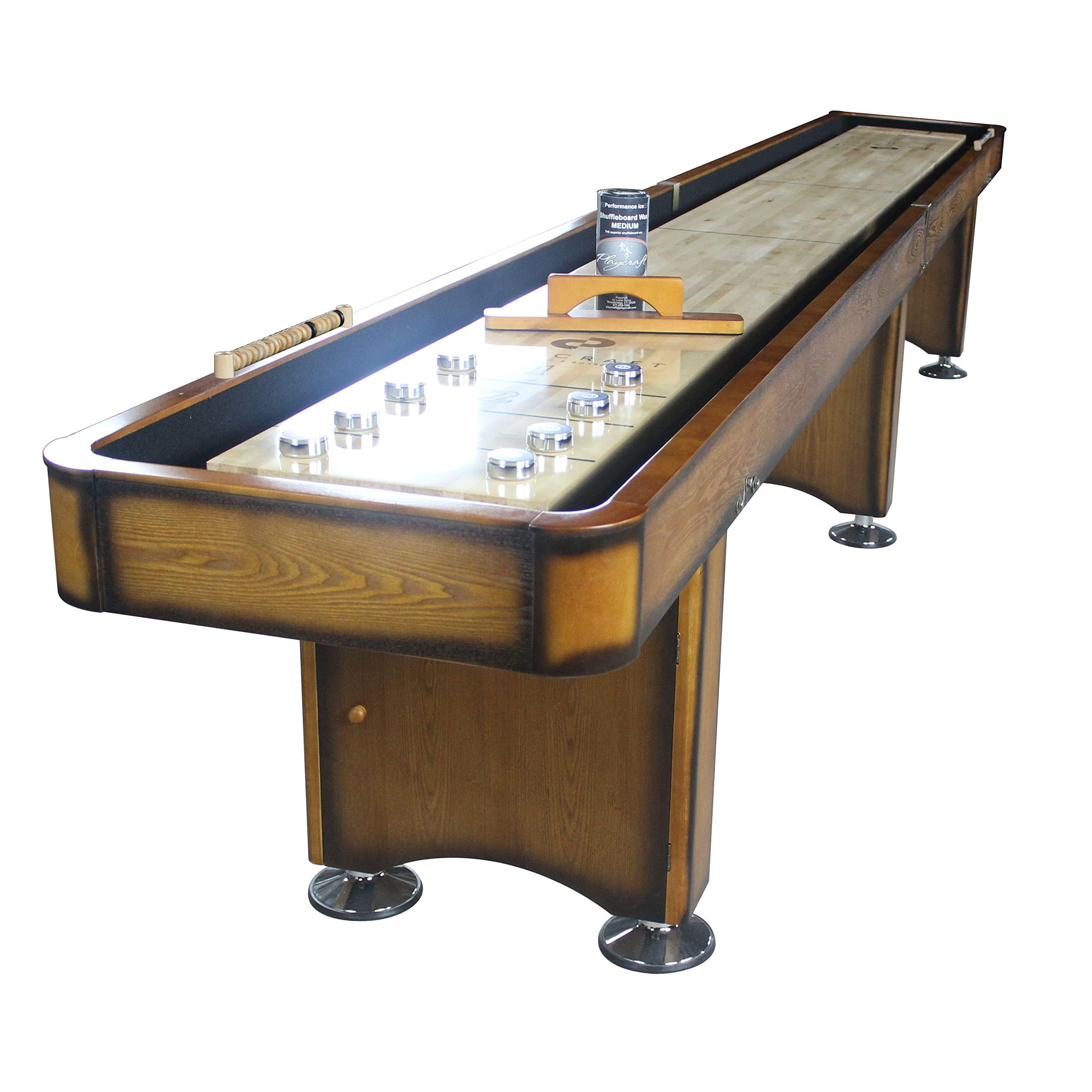
The playfield is where a shuffleboard table earns or loses its money, and the Woodbridge's is a 1.75-inch true vertical stave butcher block finished with multiple coats of satin polyurethane. Thickness is the number to remember: a slab that substantial resists the bow that ruins a cheaper table's roll. The staves are glued vertically rather than laid flat, which is the construction the better tables share, and it's most of why this one feels like equipment rather than a toy.

We came away thinking this is the table to buy if you're only buying once. Pro-style climate adjusters underneath let you take a bow out of the board as the room's humidity shifts, and the arched double-panel pedestal legs sit on 6-inch metal levelers, so you're not shimming a heavy cradle with folded cardboard. Twelve feet is a genuine runway, long enough that a hard shot has to be aimed rather than shoved.

The package is complete in a way that surprises people who have priced accessories separately: eight deluxe pucks, a matching wood abacus, a brush, and USA-made speed wax. There's a storage cabinet built into the cradle, which is where the pucks and brush actually live instead of on a shelf across the room. The abacus being wood rather than the plastic slide scorers on cheaper tables is a small thing you notice every single game.

Expect to spend an evening with the adjusters before both ends of the playfield play the same. That's the bargain with a wood surface, and it's exactly what the hardware is there for. The legs are the part of this build that travels worst, so open the crate and check both pedestals before you start assembly, because getting a table this size back into a box is nobody's afternoon. Past that, the biggest decision left is which of the four finishes matches your room.

Pros

  • True 1.75-inch vertical stave butcher-block playfield
  • Pro-style climate adjusters and 6-inch metal levelers
  • Storage cabinet plus eight pucks, abacus, brush and wax
  • Twelve feet of runway at a midrange price

Cons

  • Playfield ships as one piece, so plan the route
  • 350 pounds, and it stays where you place it
Our verdict

We recommend the Woodbridge to anyone who wants a serious table without the premium markup, since the butcher-block playfield, pro adjusters and built-in storage make it the best all-round buy here.
Check Latest Price
2

Best for Tight Access

Playcraft Georgetown 16'

92 /100
Lab Score Outstanding

Key details

Length
16 ft
Assembly
Two-piece cradle and playfield
Leveling
Pro-style climate adjusters
Playfield
1.75 in. butcher block
View on Amazon

A 16-foot table has an access problem before it has a playing problem. A stairway with a landing, a tight basement turn, a doorway narrower than the crate: any one of those turns a solid 16-footer into a delivery you have to send back. Playcraft builds this one in two pieces, splitting both the cradle and the playfield, so the table travels in sections and comes together in the room where it will live.

Everything else is the premium version of the same formula: 1.75-inch butcher block, pro-style climate adjusters, reinforced double-paneled arched pedestals on 6-inch metal levelers, and a hand-stained burnished frame that reads as furniture rather than arcade equipment. Sixteen feet is tournament length, and it plays like a different game from a 9-footer. Pucks have time to settle into a line, so a good shot is a placement rather than a lucky bounce.

Our judgement is that it suits one buyer very well: someone with a long room and a delivery path a one-piece table can't make. Measure the wall first. At 192 inches you need a room around 20 feet long with standing room at both ends, and there's no arrangement that puts this in a 14-foot space. Once it's inside, two people can lift and set it upright, though you'll want four for the carry.

The set matches our top pick: eight pucks, abacus, brush, wax. What the extra money buys is the two-piece construction and four more feet of runway, and for a room that can take it, that's a fair trade rather than a luxury.

Pros

  • Two-piece cradle and playfield clear tight stairs
  • 1.75-inch butcher block with pro-style adjusters
  • Sixteen feet of tournament-length runway
  • Hand-stained finish with a complete accessory set

Cons

  • Needs a room around 20 feet long
  • The most expensive table here
Our verdict

Buy the Georgetown if your game room is long and the way in is not, because it's the only table here that gets sixteen feet of tournament-length playfield down a tight stair.

Check Latest Price
3

Best Value 12-Footer

Hathaway Merlot 12'

85 /100
Lab Score Excellent

Key details

Length
12 ft
Weight
268 lb
Leveling
Built-in climate adjusters
Playfield
1.75 in. solid birch butcher block
View on Amazon

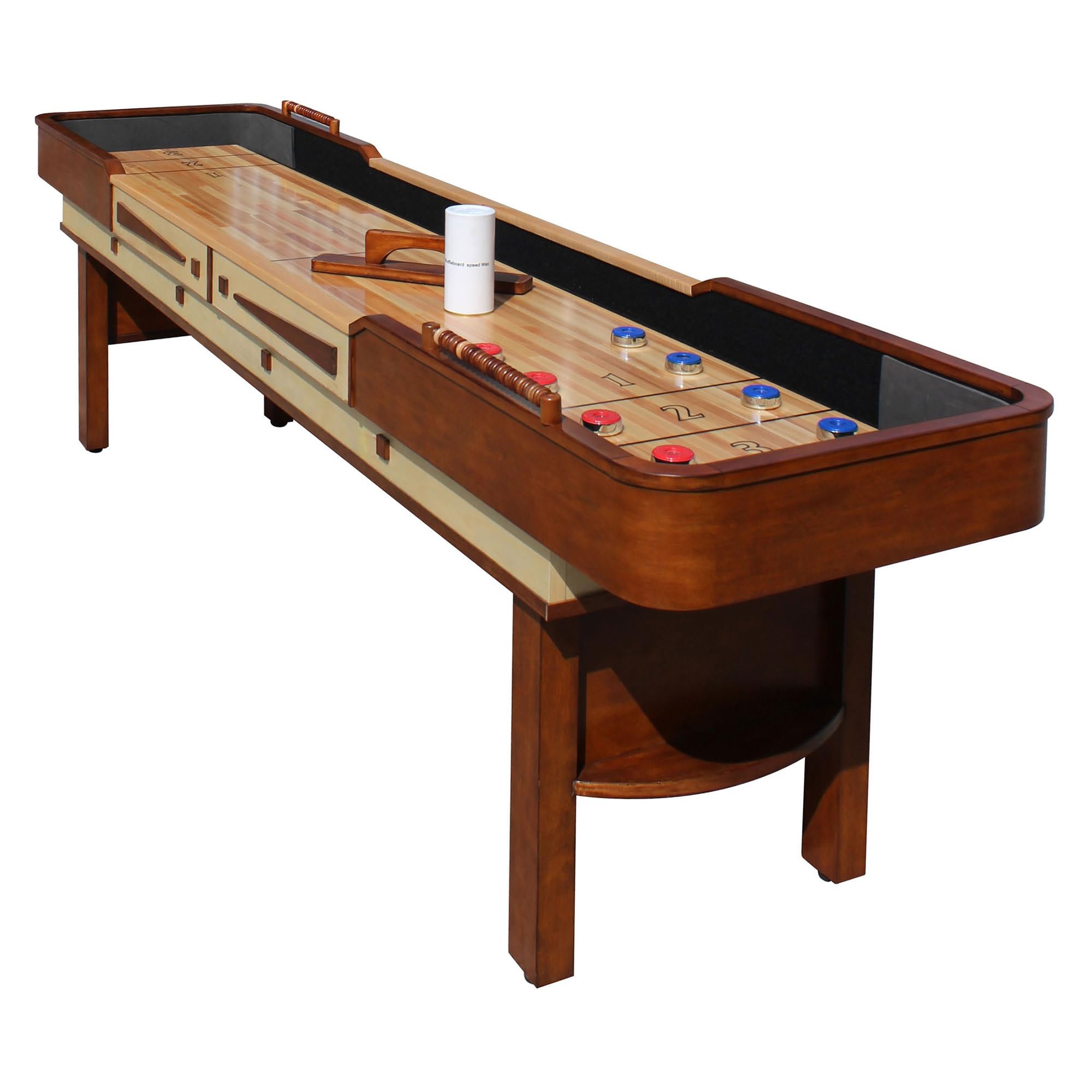
If you want our top pick's playfield without its price, this is where we point people. The Merlot runs the same 1.75-inch solid butcher block, birch rather than the Playcraft's stave build and finished with ten coats of lacquer, in a 12-foot table that weighs 268 pounds. That weight difference is the detail we kept coming back to: the same playing thickness with noticeably less table to wrestle down a basement stair.

Two details earn their keep once it's set up. The gutters are lined with EVA foam, which takes the clatter out of a hard shot in a way that matters when there's a television on the other side of the wall. And the scorers are built into the rails, so nobody reaches for a phone mid-game to remember whose turn it is.

The frame is solid wood, with 1-inch side and end aprons over double-paneled legs, and the walnut finish reads warmer than the gray game-room furniture that dominates this end of the market. There's a storage shelf under the cradle for the pucks and brush, one of those things you don't appreciate until you've owned a table without one.

Where it asks for patience is assembly. This is a two-person job, and the climate adjusters take some persuading to line up with their holes, the kind of afternoon where a file and a second pair of hands earn their keep. Go in expecting that and the table underneath is excellent value.

Pros

  • Solid 1.75-inch birch butcher block
  • Lighter than the Playcraft 12-footer
  • Foam-padded gutters keep play quiet
  • Built-in scorers and under-cradle storage

Cons

  • 180-day warranty is short for a table this size
Our verdict

Buy the Merlot if you want the top pick's playfield thickness without the top pick's price, and you can give up a little refinement in the hardware to get there.

Check Latest Price
4

Best for Small Rooms

GoSports Premium 9'

83 /100
Lab Score Excellent

Key details

Length
9 ft
Weight
180.8 lb
Assembly
Preassembled, legs attach
Playing Surface
8 ft x 14 in., butcher block veneer
View on Amazon

Nine feet is the length that fits where twelve won't, and the GoSports makes the most of it. The assembled frame runs 108.7 inches long and 24 inches wide, about the footprint of a sofa, and at roughly 180 pounds it's the lightest full-size table here. Two people can walk it into a room without renting a dolly or calling in favors.

Setup is the reason to hand this to someone who isn't looking for a project. The mainframe arrives assembled: you bolt on the powder-coated steel legs, the built-in levelers do the rest, and you're playing. Ours leveled without drama and the pucks tracked where they were aimed, which is a better first evening than plenty of tables at twice the money deliver.

The trade-off is the surface. The playing area is a composite butcher block with a veneer, 8 feet by 14 inches inside the 9-foot frame, so you give up runway compared with the 12-footers and a hard shot has less room to settle into a line. For family play, parties and a room that doubles as a den, we didn't find that it mattered. If you're chasing a tournament feel, it will.

In the box: eight 1.75-inch metal pucks, a 16-ounce can of wax, a brush and built-in scorers. The rustic oak frame and steel legs give it a modern look that doesn't read as a bar fixture, which is worth something when the table is going in a living space rather than a dedicated game room.

Pros

  • Mainframe arrives assembled; only the legs go on
  • Lightest full-size table here at about 180 pounds
  • Powder-coated steel legs with built-in levelers
  • Eight regulation pucks, wax and brush included

Cons

  • Veneer playfield rather than solid butcher block
  • 8-foot playing surface is short next to the 12-footers
Our verdict

Buy the GoSports when nine feet is what the room allows, since it's the easiest table here to get in, set up and start playing on the same evening.

Check Latest Price
5

First Table

Barrington Urban 9'

84 /100
Lab Score Excellent

Key details

Length
9 ft
Leveling
Wing-bolt climate adjusters
Warranty
90 days
Playfield
1.5 in. UV-coated engineered wood
View on Amazon

The lowest-priced table here is also the one with the most to accept. The playfield is 1.5-inch engineered wood with a UV coating rather than a butcher-block slab; the frame, apron and faux-concrete legs are MDF under a PVC laminate; and the warranty runs 90 days. None of that makes it ugly, because the gray-brown Urban finish is genuinely handsome, but it tells you what kind of purchase this is.

We still recommend it, as an entry point rather than a lifetime table. Nine feet fits a spare wall, the carpet-lined gutters keep play quiet, and two bead-style slide scorers on the rails mean nobody keeps score on a phone. At roughly 185 pounds it's manageable for two people to move, which is not something you can say about most of this list.

Leveling is the job to take seriously. The under-table climate adjusters are wing bolts rather than turnbuckles, so you get coarser adjustment to work with, and the hidden 1.5-inch leg levelers only correct so much floor. Check the playfield for flatness with a puck before you bolt the legs on, and if it arrives bowed, settle it with the seller before assembly rather than after. That's worth doing on any wood table and more so on engineered wood.

Eight pucks and a can of speed powder come in the box, though there's no brush, so add one. The mainframe arrives preassembled, which means the afternoon goes into legs and leveling rather than joinery, and the whole thing comes together faster than the spec sheet suggests.

Pros

  • The lowest-priced full-size table here
  • UV-coated, scratch-resistant playfield
  • Carpet-lined gutters and two bead-style scorers

Cons

  • 1.5-inch engineered wood playfield, not butcher block
  • 90-day warranty, the shortest here
Our verdict

Buy the Barrington if a nine-foot footprint and the smallest outlay are both fixed constraints, and check the playfield for flatness before you assemble it.

Check Latest Price

How We Chose and Tested Shuffleboard Tables

We built the shortlist by comparing published dimensions, weight, playfield materials, and price across a few dozen tables, then filtered out models that were too short for real shuffleboard, too heavy for a normal delivery path, or vague about how the legs adjust. That left seven tables, which we assembled and lived with for nine months in basements, garages, and rec rooms. We timed assembly with one person and with two, counted how many trips the boxes required, and noted whether the included tools and instructions actually matched the job.

Once each table was upright, we set a four-foot level along the playfield and across its width, adjusted the feet, and checked again a week later to see whether the table held its tune. We slid pucks from both ends during solo practice and after-dinner games, watching for drift, dead spots, and that sticky feeling that means a playfield needs wax or a better finish. To judge sturdiness, we leaned on the rails, bumped the cabinet while play was underway, and paid attention to any wobble or creak. We also lived with each table's appearance — how the finish looked under daylight and lamp light, whether seams and hardware felt furniture-grade, and whether guests actually gravitated toward it.

Weight and adjustability came up constantly: we noted how many people it took to shift a table for cleaning, whether the levelers could be reached without lifting the legs, and how much floor space the footprint really claimed once chairs and shooting room were added. At the end, we compared construction details and playfield condition against price to judge value, then kept playing to see which tables still felt fun after the novelty wore off.

How to Choose a Shuffleboard Table

Measure the Room, Then the Route

Shuffleboard needs standing room at both ends and walking room down at least one side. Barrington lists a 13-by-6-foot room for its 9-foot table, which works out to roughly two feet of clearance all around. Apply the same margin and a 12-footer wants a wall about 16 feet long, a 16-footer about 20. Then measure the path in: door widths, stair landings, the turn at the bottom. A two-piece cradle and playfield, as on the 16-foot Playcraft, is the one thing that solves a stairway a solid table can't make.

The Playfield Is Where the Money Goes

Two numbers tell you most of it. Thickness first: 1.75-inch slabs resist the seasonal bow that ruins a roll far better than 1.5-inch ones, which is why the better tables here share that figure. Then construction, meaning solid vertical stave butcher block, where strips are glued edge-up, versus engineered wood or a veneer over composite. A veneer plays well when it's new and leaves you very little material to work with later; a butcher-block slab has the depth to stay flat and to be kept true. If this is a ten-year purchase, pay for the thickness.

Adjusters, Leveling, and the Seasons

Wood moves. A playfield that's flat in October can crown by February, and the hardware under the cradle is what you tune it with: pro-style turnbuckles on the Playcraft tables, wing-bolt adjusters on the Hathaway and Barrington. Level the legs to the floor first, then true the surface in small increments, rolling a puck between adjustments instead of trusting your eye. Expect to revisit the setting when the heating season starts and again in spring. Finer adjusters hold a setting longer; simpler ones ask for more of your attention.

Wax, Powder, and Playing Speed

The sand in shuffleboard is wax, silicone beads that let a puck glide, and every table here ships with a can. The variable worth understanding is speed: a fast powder on a 9-footer sends pucks off the end, where the same powder on a 16-footer feels just right. If you find yourself holding back on every shot, that's the powder talking rather than the table, and a slower wax is a cheap fix. Wax is the only consumable in the box; the pucks, brush and abacus are not.

Frequently Asked Questions

Final Verdict

Buy the Playcraft Woodbridge. It pairs the playfield construction that actually matters, a 1.75-inch vertical stave butcher-block slab, with pro-style adjusters, a storage cabinet and a full accessory set, for less than the premium tables here.

If the delivery path is the problem, the two-piece Georgetown solves it. If the wall is short, the GoSports gets you playing with the least fuss. Start with the tape measure; the rest follows.