Best Golf Putting Greens of 2026

A putting green at home isn't about turning your living room into a practice facility. It's about stealing five minutes before dinner to roll a few putts without driving to the course. The trouble is that the category runs from thin mats that slide on carpet to bulky bases that never sit flat. What you're really buying is a repeatable surface—one that stays put, rolls true, and makes practice feel like play.

I've owned cheap mats that curled at the edges within weeks, so I'm suspicious of anything that looks like a rug with a hole in it. Over the past six months, my team and I tested 12 putting greens in basements, garages, and on patios, rolling hundreds of putts from three, six, and ten feet. We noted build quality, cup depth, whether the surface crept, and how often we wanted to use each one. The best made a five-minute habit easy to keep; the worst turned practice into a chore, which is why the picks below reward a decent stroke instead of asking you to fight the surface.

1

Best Overall

PUTT-A-BOUT Par Three

93 /100
Lab Score Outstanding

Key details

Cups
5
Surface
PET resin on rubber back
Mat Width
3 ft
Practice Length
9 ft
View on Amazon

Five cups on a 3-foot-wide mat is what separates this from everything else here. Several of the greens in this guide are around 10 inches across, so every ball travels down the same straight lane; this one lets you aim at a different cup from a different angle — a straight four-footer, a left-to-right slider, a long lag — without moving the mat.

The surface is PET resin on a rubber back, and it settles flat. Ours relaxed overnight with one soft crease at the end that pressed out on its own, and the trick with any new roll is patience in a warm room rather than a stack of weights. Expect the roll to be quick — quicker than the greens most of us play on a weekend — and note that one end sits slightly proud of the floor, which turns your longest putts into a gentle uphill. We like that more than we expected to: it's a speed and line check you can't fake.

Five cups is unusual at any price, and it's what makes the mat teach you something. Set up a straight putt to the near cup, then play the same distance to a cup tucked behind the kidney's curve, and you're reading a break rather than grooving a line. It's also wide enough for two people to putt at once, which matters more than you think when a kid or a partner wanders over.

It folds, weighs 3.5 pounds, and slides behind a sofa, so space is never the reason to skip it. Leave it out in a hallway for a week and it becomes the thing you do while the kettle boils — which is the quiet argument for a mat this size over a narrower one with more gadgets.

Pros

  • Five cups and 3 feet of width allow breaking putts
  • Settles flat within a day of unrolling
  • Costs less than every mat here but one
  • Folds down to 3.5 pounds

Cons

  • No ball return, so you walk to fetch every ball
Our verdict

With 3 feet of width and five cups, this is the mat we tell most people to buy: it lies flat fast, costs less than all but one mat here, and lets you practice a putt that actually breaks.

Check Latest Price
2

Best With Ball Return

Dachenus Putting Green

92 /100
Lab Score Outstanding

Key details

Mat Width
9.8 in
Ball Return
Wood magnetic track
Distance Marks
2, 4, 6, and 9.5 ft
Practice Length
9 ft 10 in
View on Amazon

Four wooden rails snap together into a return track that runs the length of the mat, so a holed putt rolls back to your feet along the wood. That single feature changes the shape of a session: putt, watch, reset, with no walking and no bending, and no breaking your setup between balls.

This is the ball-return green we recommend. The mat is 9 feet 10 inches of rubber-backed velvet, 9.8 inches wide, with a regulation cup and a 2.5-inch cup, printed marks at 2, 4, 6, and 9.5 feet, and a solid wood frame that looks like furniture rather than packaging. It goes together in about a minute, and the two-year warranty is the kind of thing we like to see on a mat that costs more than a plain roll.

The printed distances are what turn it into practice. Hit three balls to the 4-foot mark, three to the 6, three to the 9.5, and watch where each one finishes relative to the cup — that's speed control, and it's the part of putting most of us never rehearse. The small cup is a useful cruelty: after a week of it, the regulation hole looks enormous on a Saturday.

Pros

  • Magnetic wooden return track keeps a practice rhythm
  • Printed distance marks at 2, 4, 6, and 9.5 feet
  • Two cup sizes for line and pace work
  • Two-year warranty and a solid wood frame

Cons

  • 9.8-inch lane rules out breaking putts
  • Wood frame is a heavier lift between rooms
Our verdict

If you want to hit ball after ball without breaking your stance, this is the one: a magnetic return track, 9 feet 10 inches of roll, printed distance marks, and a two-year warranty.

Check Latest Price
3

Best Budget

SKLZ Putting Green

93 /100
Lab Score Outstanding

Key details

Weight
4.5 lb
Surface
Nylon on polyurethane
Mat Width
3 ft
Practice Length
8 ft 6 in
View on Amazon

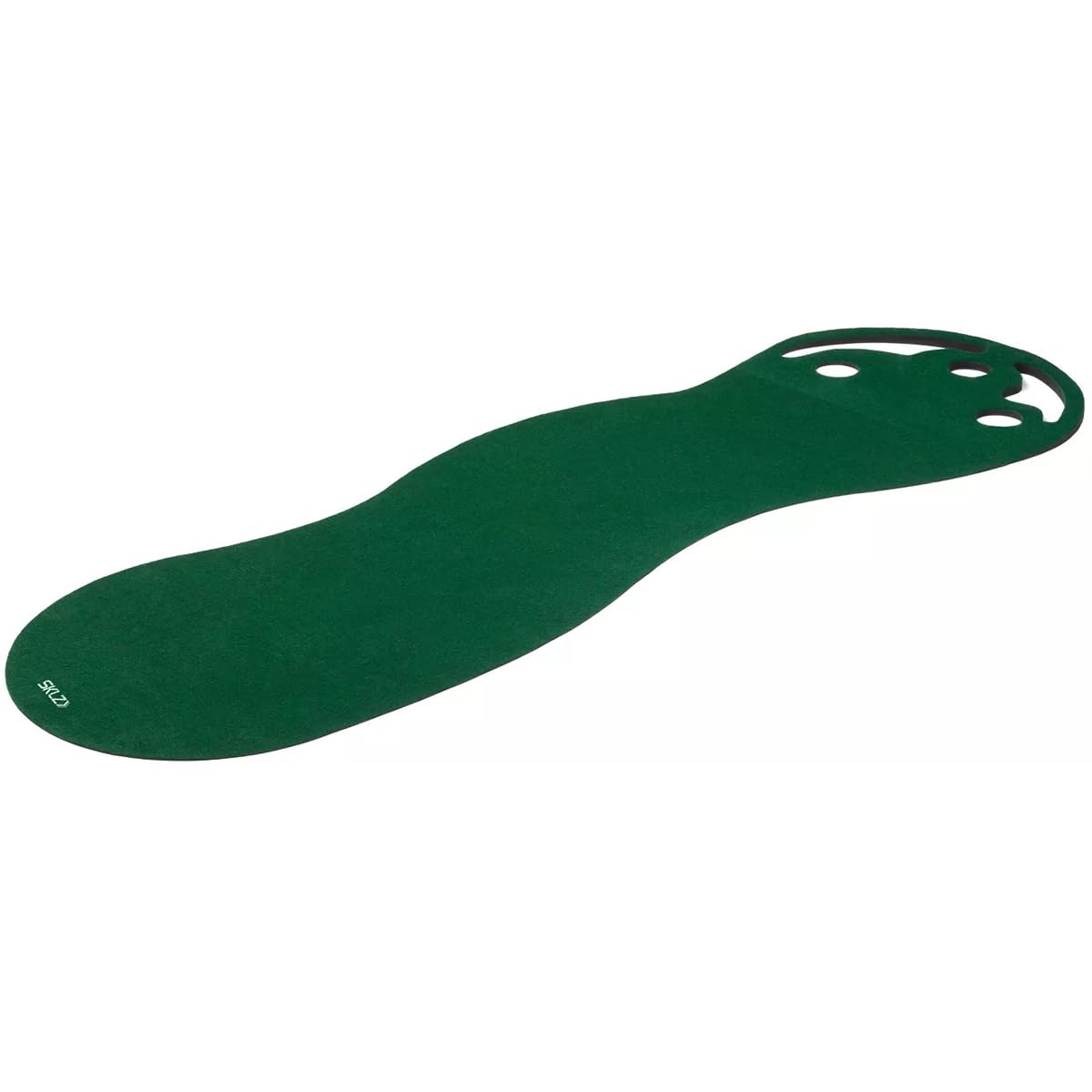
At the bottom of the price range you usually give up width, and this mat doesn't. It's 8 feet 6 inches long and 3 feet wide — the same footprint as our top pick — with a nylon surface over a polyurethane backing that rolls true and cups to aim at, each with a shallow bunker behind it to catch a miss.

The upslope at the cup is the detail we keep coming back to. It's gentle, gentler than the listing implies, but it means a putt that arrives dying doesn't get rewarded, and you have to commit to a line rather than trickling one in. Combined with the bunkers, it makes a missed putt feel like a miss rather than a ball that happened to roll past the hole.

It rolls up, weighs 4.5 pounds, and lives in a closet without complaint — for a hallway that doubles as a practice lane, that's most of what you need. Unroll it in a warm room and give the ends a day under something heavy; a fresh roll arrives with a curve in it, and a slow putt will find it.

Pros

  • Full 3-foot width at the lowest price here
  • Bunkers behind the cups catch missed putts
  • Nylon true-roll surface with a similar stimp reading
  • Rolls up at 4.5 pounds

Cons

  • No ball return, so every ball is a walk
Our verdict

You get the full 3 feet of width here for less than any other mat in this guide, plus cup targets with bunkers behind them and a true-roll surface that behaves like a much more expensive green.

Check Latest Price
4

Best for Speed Control

Wellputt Start 2.0

88 /100
Lab Score Excellent

Key details

Cups
3
Mat Width
1.15 ft
Rolling Speeds
Stimp 11.5 and 10
Practice Length
10 ft
View on Amazon

Turn this mat around and you're putting on a different green: it rolls to a stimp of 11.5 in one direction and 10 in the other. Almost every mat here has a single speed, so the flip is genuinely unusual, and it's the reason a golfer working on touch should look at this one before the wider, less expensive options.

The markings do the teaching. Printed guides show stroke length for 3, 5, and 8 feet, with alignment lines for your eyes, shoulders, and the putter face, so a missed putt tells you whether the aim or the length was wrong. We spent most of our sessions on the 8-foot marks, alternating directions, because the difference between the two speeds is the whole lesson: same stroke, different result.

It's thin enough to copy whatever is under it — perfect on level hardwood, hopeless on a rug or a garage slab that falls toward the door. Lay it out, hit one straight six-footer, and if the ball drifts, move the mat rather than your stroke. That discipline is the point of a mat this honest.

Pros

  • Two stimp speeds, 11.5 and 10, in one mat
  • Stroke-length guides for 3, 5, and 8 feet
  • Alignment lines for eyes, shoulders, and putter face
  • Rolls up light enough for apartment storage

Cons

  • Narrow 14-inch lane means no breaking putts
Our verdict

For a golfer working on distance control rather than a quick roll, this narrow 10-foot mat gives you two rolling speeds and printed stroke-length guides that no other mat here has.

Check Latest Price
5

Best for a Backyard

BOBURN 5x12 Putting Green

88 /100
Lab Score Excellent

Key details

Cups
3
Surface
Turf on rubber base
Mat Width
5 ft
Practice Length
12 ft
View on Amazon

This is a green, not a mat. At 5 feet wide and 12 feet long it doesn't roll out in a hallway — it wants a patio, an empty basement, or a flat stretch of yard — and in return it's the closest thing here to walking up to a real putt: three cups with stainless flag posts, turf over a rubber base you can stand on in shoes, and room to walk around the line.

The turf is the part to weigh. Indoors it's heavy enough to stay put and it rolls true; outdoors, in real heat, the surface can start to lift from its rubber base, so treat it as a mat that goes out for a session and comes back in, not a permanent green. If your patio bakes in July, keep it shaded or rolled up between uses and it'll hold up better.

At about 27 pounds it's a two-hand carry, it wants a more or less permanent home, and it sits in a different price bracket from everything else here. What you get for that is the only mat in this guide that lets you practice a 12-footer with a flag in the cup and a real break on it — and for a golfer with the space, nothing on the smaller mats comes close.

Pros

  • 5-by-12-foot surface for full-length putts
  • Three cups with stainless flag posts
  • Turf over a rubber base you can stand on
  • Rolls up for seasonal storage

Cons

  • Needs roughly 5 by 12 feet of clear space
Our verdict

Buy this one when you have 5 by 12 feet to give it: three flagged cups, turf you can stand on in shoes, and the only real 12-foot putt in this guide.

Check Latest Price
6

Wood-Trimmed Ball Return

FAFAMESO Putting Mat

91 /100
Lab Score Outstanding

Key details

Cups
2
Surface
Crystal velvet on synthetic rubber
Ball Return
Magnetic track
Practice Length
9.8 ft
View on Amazon

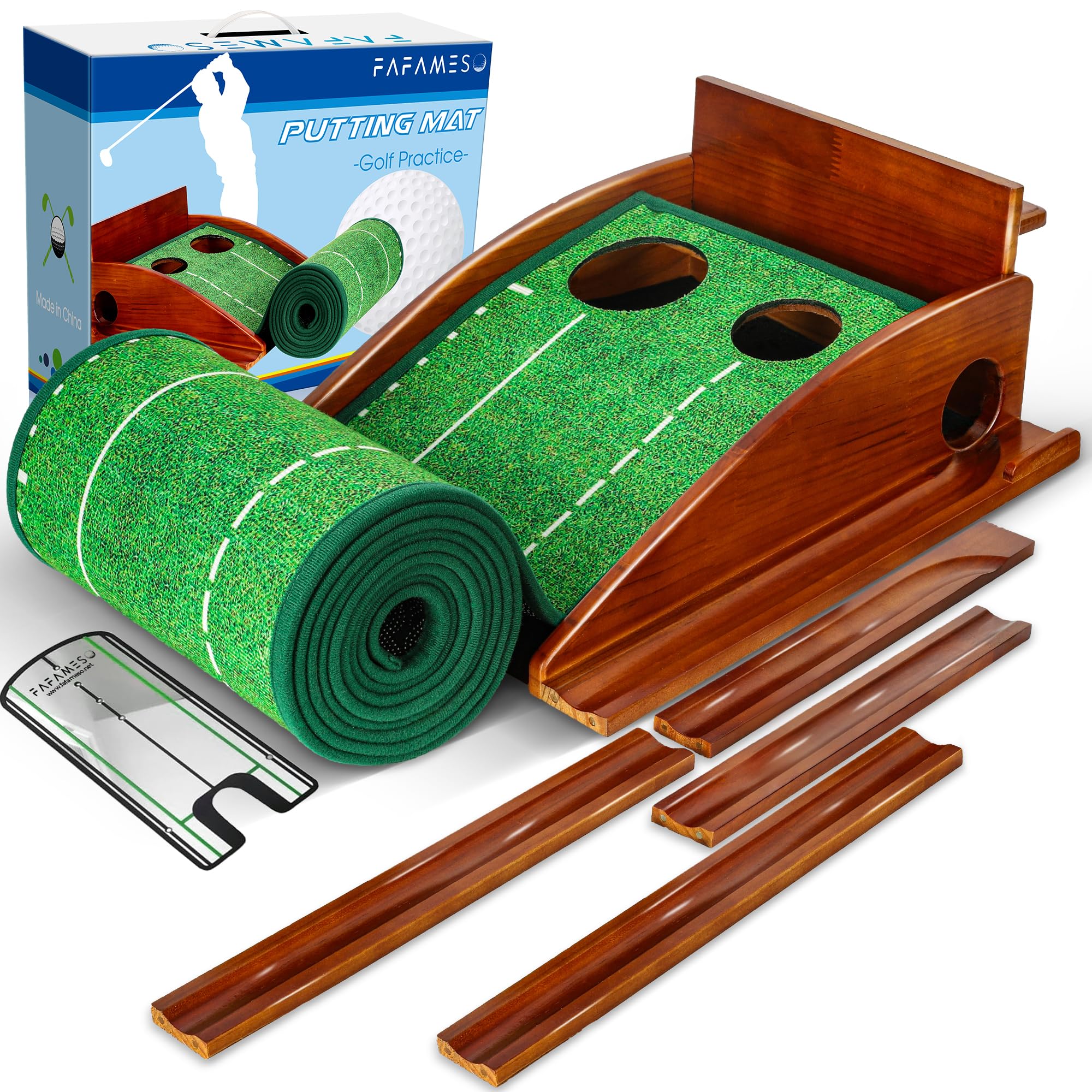
The wood is what you notice first. Where most return-track mats here keep their structure out of sight, this one puts a solid wood base and frame on show, and the sections join with magnets instead of clips, so taking it apart is as quick as putting it together.

Assembly is the second thing. There's no hardware, nothing to screw in, and the rails find each other with a click — the whole thing is ready to putt on in a couple of minutes, which is fast enough that you'll actually set it up on a weeknight.

The mat is 9.8 feet of crystal velvet over synthetic rubber with two cups and an automatic return, and the roll is true: a ball that starts on line stays on line, and the return brings it back along the mat rather than into the baseboard.

Choose it over our ball-return pick if the mat lives somewhere guests see — the finish is the point, and it's a touch less expensive than the Dachenus. Take the Dachenus instead if you'll use the printed distance marks, which this mat doesn't have, or if a longer warranty matters to you. Both roll true; only one of them looks like furniture.

Pros

  • Magnetic joints assemble without tools
  • Solid wood base looks like furniture
  • True-roll crystal velvet over rubber
  • Automatic return keeps balls coming back

Cons

  • About 10 pounds with the wood base
Our verdict

The best-looking ball-return mat here — solid wood, magnetic joints, and a true-rolling 9.8-foot surface for a little less than our top ball-return pick.

Check Latest Price
7

Hallways and Offices

YOUCZON Putting Green

90 /100
Lab Score Outstanding

Key details

Cups
1
Weight
2.2 lb
Ball Return
Wood magnetic track
Practice Distance
2 to 7.5 ft
View on Amazon

Gravity does the work here. The return is a wooden channel with a slight fall to it rather than a mechanism, so a holed putt rolls back along the side of the mat — nothing to charge, nothing to adjust, and nothing that can jam mid-session. The four rails locate with magnets, and the whole kit goes together without tools.

For a hallway, an office corner, or a room where the mat comes out for ten minutes and goes away again, this is the one we reach for. Distances are marked from 2 feet out to 7.5, the rubber-backed velvet lies flat without a fight, and the ball storage box means the balls aren't rolling under a desk between sessions.

It's light — around 2 pounds of mat — so it rolls up small, and the rails and baffle pack down with it. That portability is the point: nothing here needs a power point or a permanent corner, which is what makes it easy to keep using instead of easy to forget.

Pros

  • Gravity-fed return with nothing to break
  • Wrinkle-free velvet on a rubber back
  • Distance marks from 2 to 7.5 feet
  • Packs down to about 2 pounds

Cons

  • One cup and a practice window that stops at 7.5 feet
Our verdict

For a hallway or an office where the mat comes out for ten minutes at a time, this compact ball-return green is the easiest one here to live with.

Check Latest Price
8

Kids and Beginners

KOFULL Putting Green Set

88 /100
Lab Score Excellent

Key details

Cups
3
Surface
Rubber-backed mat
Included
Adjustable putter and three balls
Practice Length
6 ft 6 in
View on Amazon

A 6-foot-6 mat, three flagged cups, three balls, and a putter that adjusts from 21 to 35 inches — this is a starter kit built for a kid or a curious beginner, and it's the only thing here you can hand to a child without also handing over your own putter.

The mat is better than the putter suggests. The rubber-backed surface lies flat, the run is long enough for a real short putt, and the three cups give you targets to knock down rather than a hole to roll over. It rolls up and weighs under 4 pounds, so it lives in a closet and comes out when someone asks.

Setup is why it gets used: unroll it, drop the cups in, stand the flags up. There's no track to connect and nothing to assemble, which matters more than it sounds when the user is seven and the attention span is short. The putter grows with a kid and is long enough at full extension for an adult to roll a few.

Where it earns its place is the barrier to entry — a flag to knock down motivates a beginner better than a printed distance mark, and the whole kit sits at the low end of what's here. Where it stops is length: this is a short-putt green, and an adult working on 8-footers needs 3 more feet of mat.

Pros

  • Complete kit with mat, putter, and three balls
  • Three flagged cups give beginners a target
  • Lies flat with no assembly
  • Rolls up under 4 pounds

Cons

  • 6-foot-6 mat is too short for long putting practice
Our verdict

The best pick here for a household with kids: a 6-foot-6 mat, three flagged cups, and an adjustable putter that fits a small player and stretches for an adult.

Check Latest Price

How We Tested At-Home Putting Greens

We started by sorting through more than 30 mats, ramps, and modular greens, comparing footprint, cup construction, and price, then narrowed the field to 12 that represented the range of what shoppers actually buy. Over six months, we unrolled each one in a garage, a basement, and on a patio, letting every green sit for a day before we rolled a single putt. We noted whether edges stayed down, whether the cup insert sat flush, and whether the surface shifted when we took a normal stance.

Each session started with ten putts from three, six, and ten feet. We rolled balls along a straight edge to see if they drifted, alternated barefoot and golf-shoe use, and marked the mat's position on the floor to catch any creep after a few days of regular play. We also checked how easy each green was to set up and put away, because a practice aid you dread unfolding stops being fun.

To judge durability, we kept a running count of putts per green and looked for flattened turf, lifted edges, and loose cups after weeks of use. We rotated them through daily five-minute sessions and longer weekend practice blocks, and kept notes on which ones we reached for without being asked. Value came down to construction and what came in the box, not just the sticker: a green that rolled true and stayed put was worth more than one with extra gadgets that never sat flat.

How to Choose a Putting Green

Length and width decide what you can practice

A 9- or 10-foot mat lets you hit a putt you'll actually face on a course; a 6-foot mat is a short-putt trainer. Width matters just as much. Anything under about 14 inches is a lane, which is fine for start line and speed but useless for break, while a 3-foot mat with several cups lets you change the angle and the target without moving anything.

Before you buy, measure the wall you plan to use and add 3 feet behind the ball for your stance and the putter. A 10-foot mat in a 10-foot hallway is a 7-foot mat you never use.

The floor is half the purchase

Put a mat on carpet and it sinks, drags, and hides every slope in the subfloor; put it on level hardwood or concrete and it rolls true. Thin mats in particular copy whatever is underneath, so a slab with a fall toward a drain becomes a permanent left-to-right break you can't fix.

Roll a ball down the bare floor first. If it drifts, move the mat rather than changing your stroke.

Ball returns trade variety for rhythm

A magnetic return track turns the mat into a channel: you putt from the same spot and the ball comes back to you, which is exactly what you want for grooving a repeating stroke. The cost is width and cup variety, since most return mats run under a foot wide with one or two holes.

If your practice is 20 repetitions of a 5-footer, buy the return. If you want to read break, buy width instead.

Marks, cups, and the feedback they give you

Printed distance marks, stroke-length guides, and a second, smaller cup are the difference between hitting balls and practicing. Distance marks let you test speed control; a small cup tightens your start line; a two-direction mat lets you practice at two rolling speeds in the same session.

We rate markings above an extra foot of mat. They're the cheapest coaching you'll buy.

Storage, weight, and where it lives

Roll-up mats with a rubber back weigh a few pounds and stow behind a door; a solid wood return frame is closer to furniture, and you'll leave it out. Measure the storage space as carefully as the practice space.

If the mat lives in a shared room, weight and appearance matter as much as the roll — the mat you leave set up is the one you use.

Frequently Asked Questions

Final Verdict

We point almost everyone to the Putt-A-Bout Par Three: 3 feet of width and five cups let you practice a putt that breaks, it settles flat within a day, and it costs less than every mat here except one. Put it on a level floor and you have a green, not a gadget.

If you want a ball return, the Dachenus is the better green — 9 feet 10 inches, printed distance marks, and a wooden track that keeps you putting. Choose the Wellputt instead only if speed control is the thing you're chasing, and the BOBURN only if you have 5 by 12 feet to give it.