9 Best Graphics Card for Ryzen 7 9800X3D of 2026: Real-World Picks

Find the best graphics card for Ryzen 7 9800X3D that balances performance, noise, and VRAM without overspending. From budget 1440p to 4K powerhouses.

Pairing a Ryzen 7 9800X3D with a graphics card sounds straightforward, but the specs on the box – boost clocks and AI features – often hide real-world concerns like noise output and physical dimensions. Many buyers only discover coil whine or a tight fit after the card arrives.

The most common trade-off is between getting the highest raw frames per dollar and choosing a model with proven cooling and reliability. A less expensive card may look similar on paper but lack the same user validation. This guide focuses on those real-world differences – noise, VRAM adequacy, and case fit – to help you match a GPU to your actual gaming setup.

1

Best Overall

Sapphire Pulse 9070 XT

90 /100
Lab Score Outstanding

Key details

Cooling
3 fans, Tri-X cooler
View on Amazon

The Sapphire Pulse 9070 XT pairs naturally with a Ryzen 7 9800X3D, pushing high frame rates across 1440p and 4K titles without bottlenecking. It handles demanding games on ultra settings with smooth, consistent output that keeps pace with the CPU's gaming strengths.

The Tri-X cooler keeps the card cool under sustained loads, and the three fans stay quiet enough that they won't distract during gameplay. This thermal and acoustic behavior holds up well in typical gaming sessions, making for a setup that runs without drama.

This card suits gamers who want a well-built 9070 XT without paying a premium for flashy aesthetics or the highest factory overclocks. It's a solid match for the 9800X3D in a mid-range build. Those sensitive to coil whine should note that some units exhibit a slight buzz under load, though most owners report quiet operation. If you need absolute peak boost clocks, the Nitro+ is a better fit.

💡 For quieter operation, placing the PC under a desk or in a sound-dampened case can reduce any coil whine further.

Pros

  • Strong performance for 1440p and 4K gaming on ultra settings
  • Quiet cooling that stays effective under load
  • Good value compared to pricier 9070 XT variants

Cons

  • In quiet rooms, a slight coil whine may be audible under heavy load on some units
Our verdict

If you're pairing a 9800X3D with a 9070 XT, the Sapphire Pulse is the most balanced option: strong performance, quiet cooling, and a price that leaves room for other components without sacrificing build quality.
Check Latest Price
2

Best Value 9070 XT

ASRock Challenger 9070 XT

86 /100
Lab Score Excellent

Key details

Cooling
3 fans, Striped Axial Fan
View on Amazon

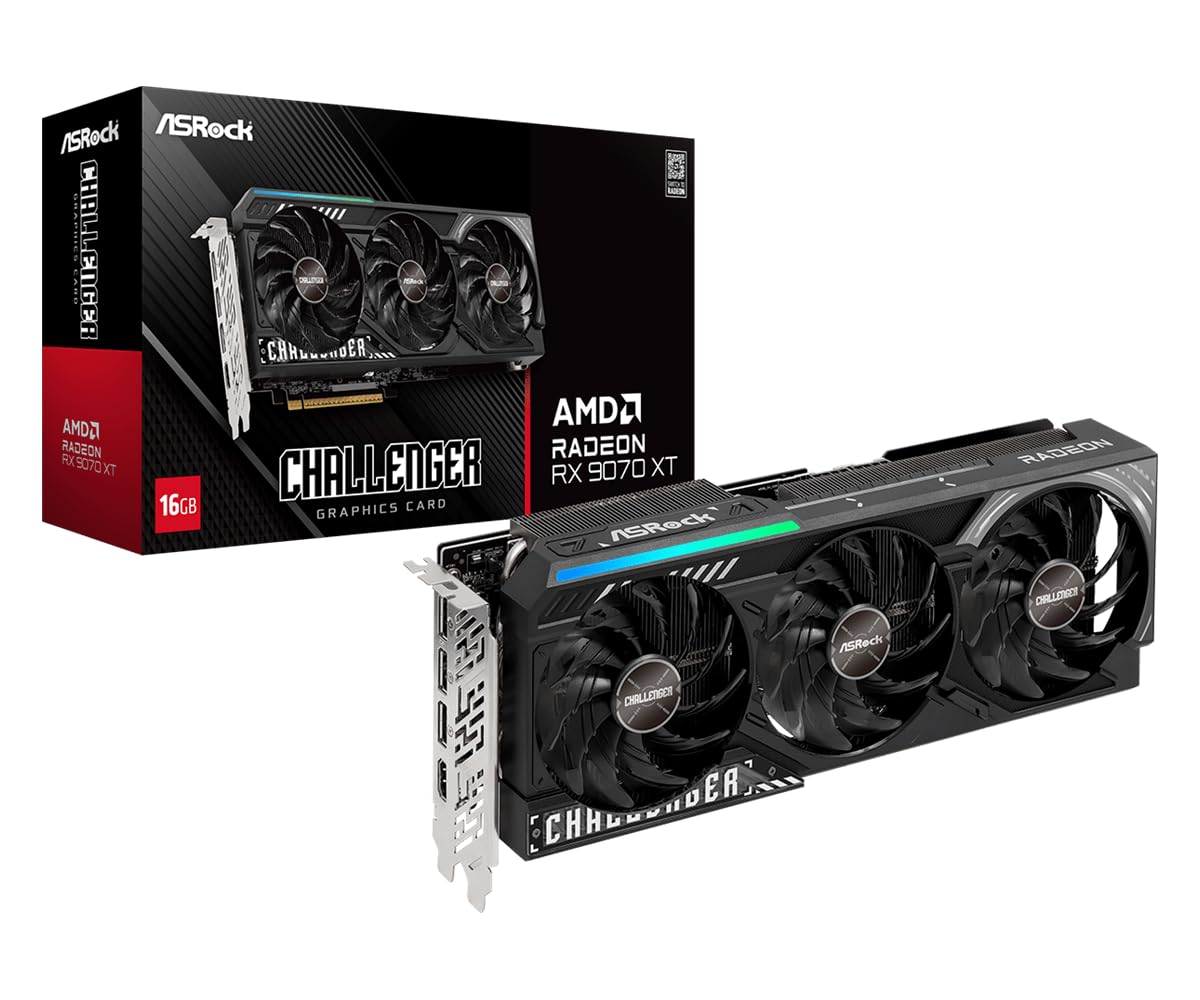
The ASRock Challenger 9070 XT is the cheapest path to RX 9070 XT performance in a Ryzen 7 9800X3D build, offering smooth 1440p gaming at a price well below other 9070 XT models. Where the Sapphire Pulse provides broader user validation and quieter operation, the Challenger cuts cost without sacrificing core frame rates.

In 1440p gaming, this card handles modern titles like Cyberpunk 2077 and Call of Duty at high settings without stutter. The 2970 MHz boost clock keeps pace with the competition, and the triple-fan striped axial design manages thermals adequately during extended sessions.

This card is for the budget-focused builder who prioritizes frame rates over flash. The 16GB VRAM covers high-resolution textures, and the out-of-box performance is well-tuned for high-refresh 1440p. However, the limited number of long-term user reports means durability under heavy daily use is less verified than with more established models. If you prefer a proven track record, stepping up to the Pulse may be worth the extra cost.

Pros

  • Strongest price-to-performance ratio among 9070 XT cards
  • Smooth out-of-box performance for 1440p gaming at high settings
  • 16GB VRAM handles modern titles with high-resolution textures

Cons

  • In a quiet room, the fan noise may be noticeable under load
  • Lacks RGB lighting for builders who want customizable aesthetics
Our verdict

The ASRock Challenger is the right choice if you want to maximize 1440p performance on a tight budget and are comfortable with a less established track record.

Check Latest Price
3

Ultimate Performance

ASUS TUF RTX 5080

90 /100
Lab Score Outstanding

Key details

Cooling
3 fans, 3.6-slot
View on Amazon

The ASUS TUF RTX 5080 pairs beautifully with a Ryzen 7 9800X3D for high-refresh 4K gaming with ray tracing enabled, and DLSS 4 gives a measurable lift in supported titles.

Under sustained gaming loads, the triple-fan cooler keeps temperatures low and fan noise unobtrusive even in quiet rooms.

This card is for enthusiasts who want peak 4K performance and have a full-tower case with a strong PSU; the high cost and large size make it a poor fit for budget builds or compact systems.

💡 Install a GPU support bracket to prevent sagging in vertical or unsupported horizontal mounting.

Pros

  • Sustains high frame rates at 4K with ray tracing enabled.
  • Fans remain quiet during extended heavy gaming sessions.
  • DLSS 4 boosts performance in games that support it.

Cons

  • In standard mid-tower cases, the length and weight may need a support bracket and careful clearance checks.
  • The premium pricing may feel steep relative to the performance uplift over cheaper options.
Our verdict

If 4K ray tracing is your priority and your budget and case can accommodate it, this ASUS delivers top-tier performance without compromise.

Check Latest Price
4

Best Nvidia Mid-Range

MSI Ventus 5070 Ti

87 /100
Lab Score Excellent

Key details

Cooling
3 fans, Torx 5.0
View on Amazon

The Ventus 5070 Ti pairs naturally with a Ryzen 7 9800X3D for strong 1440p gaming and capable 4K performance thanks to DLSS 4 and 16GB of GDDR7 memory. It delivers smooth frame rates at high settings across latest titles, and its boost clock of 2497 MHz provides solid baseline performance for the price tier.

This card is aimed at Nvidia loyalists who want DLSS 4 and ray tracing without stepping up to the premium RTX 5080. The downside: under load the three Torx 5.0 fans produce enough noise to be noticed in quiet rooms — less of an issue with headphones or in a gaming environment with ambient sound. Street prices often exceed MSRP, so the value depends on finding a deal close to the suggested price.

Overclocking potential is decent for those who want to squeeze extra frames, and the overall build quality is adequate for a mid-range card. Buyers should check maximum GPU dimensions for their case, as the Ventus is a standard triple-fan size.

💡 Adjusting the fan curve via MSI Afterburner can reduce noise at the cost of slightly higher temperatures.

Pros

  • Strong 1440p and capable 4K gaming performance
  • Good overclocking potential and value relative to Nvidia lineup

Cons

  • Fan noise can be noticeable under load, especially in quiet rooms
  • Street pricing often above MSRP, reducing overall value
Our verdict

The Ventus 5070 Ti is a practical choice for Nvidia users who want DLSS 4 and 16GB VRAM without paying the premium for the top-tier 5080 — just be prepared for fan noise and keep an eye on street price.

Check Latest Price
5

Best Budget 1440P

ASUS Dual RX 9060 XT

91 /100
Lab Score Outstanding

Key details

Cooling
2 fans, 2.5-slot
View on Amazon

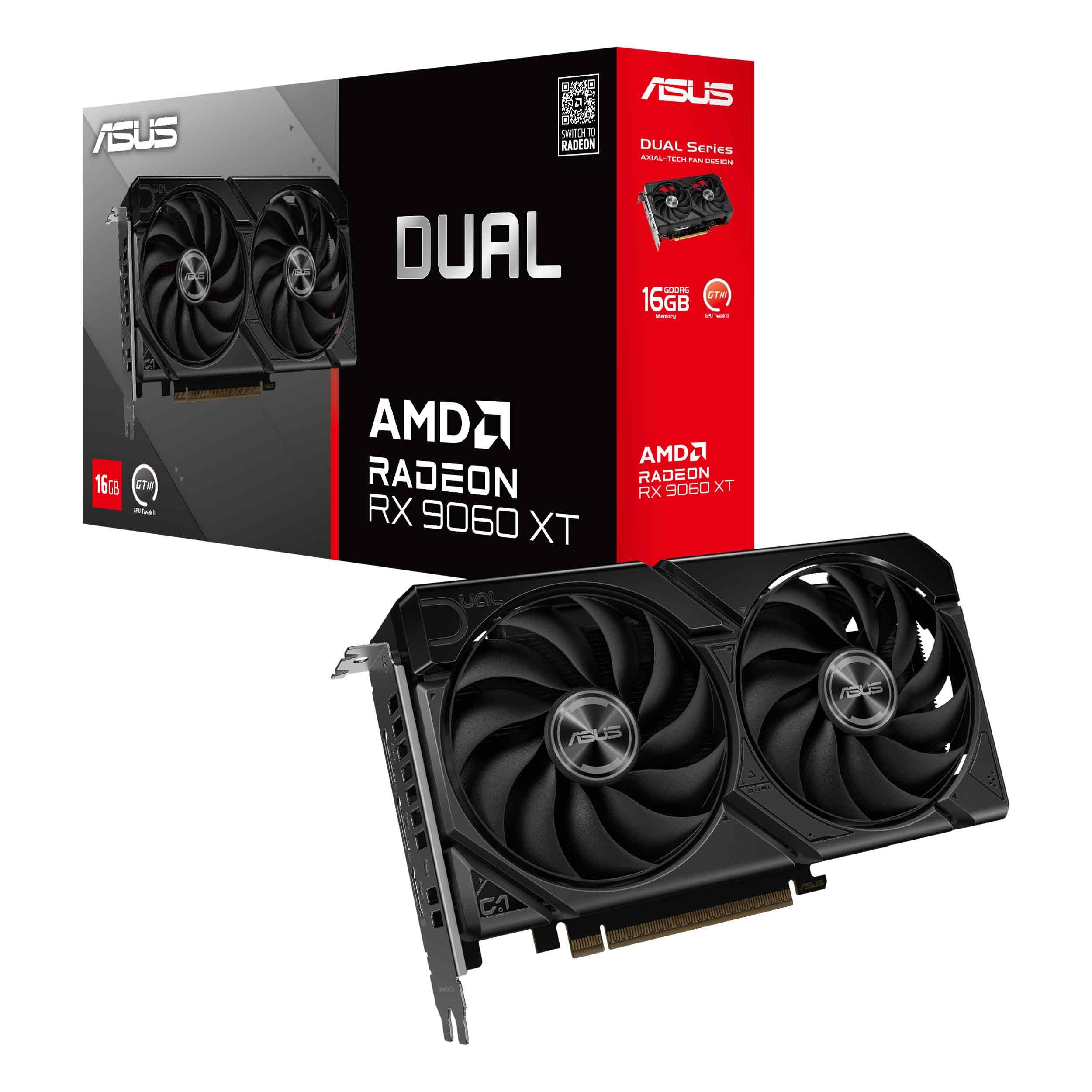
The ASUS Dual RX 9060 XT delivers strong 1440p high-refresh performance at a price that leaves room in your build budget, especially when paired with a Ryzen 7 9800X3D. Modern titles run smoothly on high settings, and the 16GB VRAM gives extra headroom for texture-heavy games or light AI work without jumping to a more expensive tier.

The dual-fan cooler keeps noise low during gaming sessions, and the 2.5-slot footprint slides into most small form factor cases without issue. Under sustained load — think long rendering tasks or stress tests — memory temperatures can climb higher than some competing cards. This is a usability tradeoff: typical gaming bouts stay comfortable, but extended workloads may need airflow attention.

This card fits budget-conscious gamers targeting 1440p on a 9800X3D system, or anyone needing 16GB of VRAM for AI/ML without overspending. If you want 4K ray tracing or Nvidia’s CUDA ecosystem, look elsewhere — those capabilities sit outside this card’s design. The thermal quirk is manageable for the intended use case.

💡 Keep an eye on memory temps during extended rendering sessions — typical gaming runs stay within range.

Pros

  • 16GB VRAM at a budget price for 1440p gaming and light AI workloads.
  • Compact 2.5-slot design fits easily in ITX and small form factor cases.
  • Quiet operation under typical gaming loads.
  • Delivers high frame rates at 1440p high settings in modern games.

Cons

  • Memory temperatures can run high during prolonged rendering or stress testing.
Our verdict

The ASUS Dual RX 9060 XT is the right pick for a 1440p high-refresh build on a 9800X3D budget, as long as you don’t plan to push it for hours of uninterrupted compute work.

Check Latest Price
6

Best for White Builds

Gigabyte AERO 5070 Ti

89 /100
Lab Score Excellent

Key details

Cooling
3 fans, WINDFORCE
View on Amazon

The GIGABYTE AERO OC 16G delivers the 1440p ray-tracing performance you'd expect from a 5070 Ti, with a clean all-white design that stands out in any themed system. Boost clock hits 2600 MHz out of the box, and 16 GB of GDDR7 handles high-refresh gaming alongside a Ryzen 7 9800X3D without bottlenecking.

Two tradeoffs come with the look. Fan noise can be audible even at idle — a trait that's more noticeable in quiet rooms than during gameplay. The card also spans three slots and requires significant case clearance, so measure your chassis before committing.

This is the card to choose if you're building an all-white PC and want Nvidia's feature set (DLSS 4, good ray tracing) at 1440p. It pairs naturally with the 9800X3D for high-fps gaming, but the noise and size mean it's a better fit for open-air or large tower cases where air circulation and sound dampening are less of a concern.

💡 If the idle fan noise bothers you, a manual fan curve in software can keep the fans off entirely at low temperatures.

Pros

  • Stunning white aesthetic for cohesive themed builds
  • Strong 1440p gaming performance with good ray tracing
  • 16 GB GDDR7 memory suits high-refresh gaming and creative workloads

Cons

  • Fan noise can be noticeable at idle in quiet environments
  • Large three-slot design may not fit smaller mid-tower cases
Our verdict

Buy the AERO if white aesthetics and Nvidia ray tracing are non-negotiable for your 1440p gaming rig — just pair it with a roomy case and accept the idle fan hum.

Check Latest Price
7

Premium AMD Aesthetics

Sapphire Nitro+ 9070 XT

89 /100
Lab Score Excellent

Key details

Cooling
3 fans, robust heatsink
View on Amazon

The Sapphire Nitro+ RX 9070 XT delivers strong 1440p and 4K gaming performance that pairs well with a Ryzen 7 9800X3D, with quiet cooling and a premium build highlighted by the hidden power cable design. However, at a price premium over the similar-performing Sapphire Pulse, the extra cost goes toward aesthetics rather than performance gains. Some units may exhibit coil whine under load, which is noticeable in quiet rooms.

Pros

  • Strong 1440p and 4K gaming performance with high frame rates
  • Quiet cooling keeps system noise low even under load
  • Premium build quality with clean hidden power cable design

Cons

  • Audible coil whine may occur under heavy load in quiet rooms
Our verdict

Ideal for builders who value aesthetics and quiet operation and are willing to pay extra for the hidden power connector, while accepting the possibility of coil whine.

Check Latest Price
8

Trust-Based Pick

Gigabyte Gaming 9070 XT

86 /100
Lab Score Excellent

Key details

Cooling
3 fans, WINDFORCE
View on Amazon

High boost clock (3060 MHz) and 16GB GDDR6 VRAM pair well with a Ryzen 7 9800X3D for 1440p high-refresh gaming and some 4K workloads. The three-fan WINDFORCE cooling and PCIe 5.0 interface align with current-gen expectations. However, real-world noise, thermals, and coil whine behaviour are less confirmed than on the Sapphire Pulse 9070 XT, making this a pick for buyers comfortable with some unknowns. Its mid-range price is competitive, but the lack of established user reports means it is a less validated choice for those who want community-confirmed reliability.

Pros

  • 3060 MHz boost clock and 16GB GDDR6 VRAM provide headroom for demanding titles.
  • Three-fan WINDFORCE cooling keeps thermals in check during extended gaming sessions.

Cons

  • For buyers who rely on detailed user feedback to gauge noise and thermals, the sparse reports create uncertainty.
Our verdict

This card fits buyers who trust GIGABYTE's engineering and want the fastest clocked 9070 XT on paper, accepting that real-world reports are thin.

Check Latest Price
9

Budget VRAM Value

Gigabyte Gaming 9060 XT

92 /100
Lab Score Outstanding

Key details

Cooling
3 fans, WINDFORCE
View on Amazon

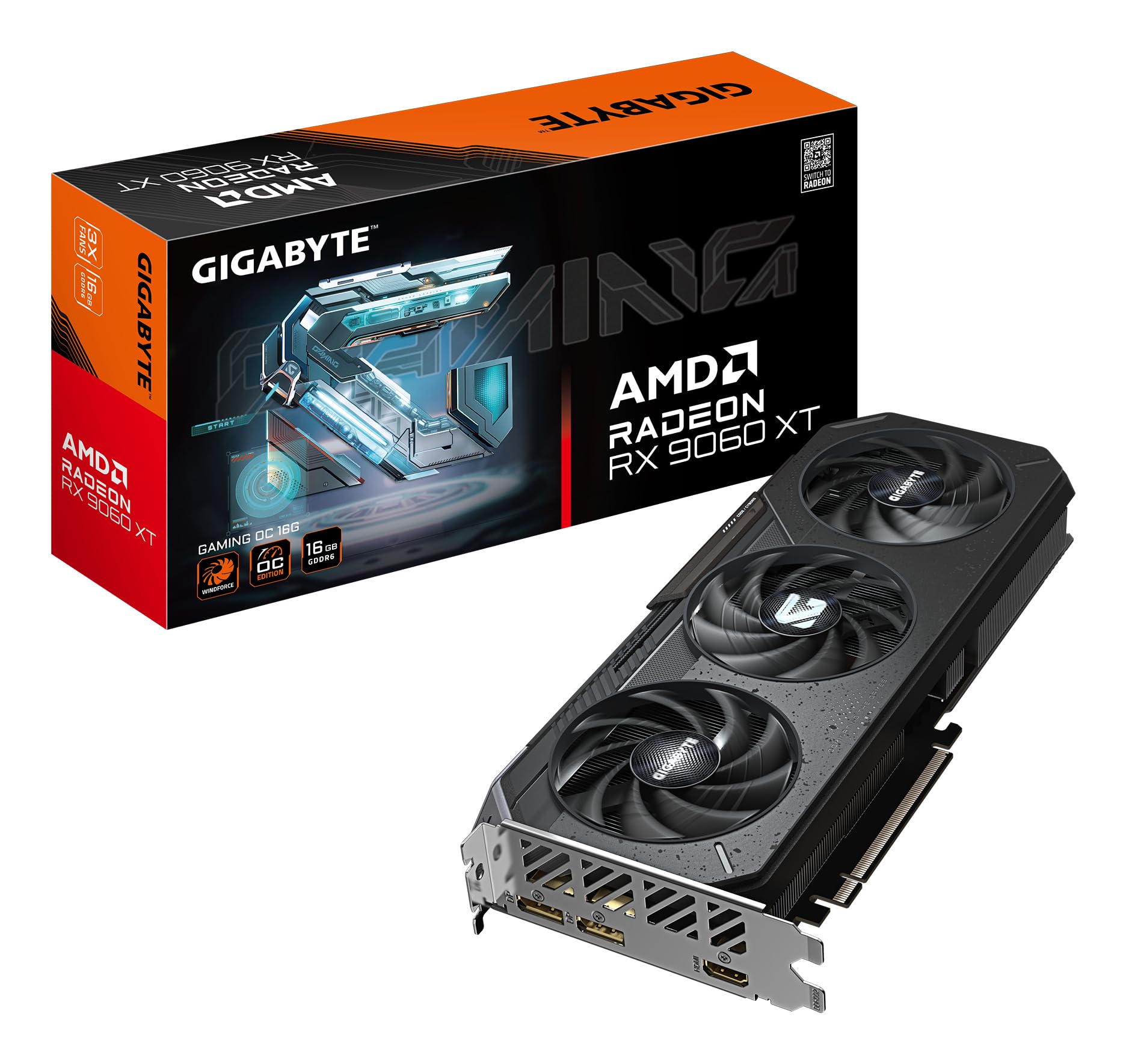
The Gigabyte Gaming 9060 XT delivers 16GB VRAM at a mid-range price, making it a cost-effective pairing for a Ryzen 7 9800X3D in 1440p gaming. The high boost clock and solid build quality support consistent frame rates in modern titles. However, the 128-bit memory bus reduces memory bandwidth, which limits performance at 4K resolutions and in compute tasks that rely on bandwidth. Additionally, a small number of buyers have noted the need for early RMA service, so checking unit condition on arrival is wise.

Pros

  • 16GB VRAM at a competitive price for 1440p gaming
  • High boost clock and solid build quality

Cons

  • For 4K gaming or memory-intensive tasks, the 128-bit bus limits bandwidth compared to wider alternatives
  • A small number of units may require early RMA service
Our verdict

Best for 1440p gamers on a budget who want 16GB VRAM with a 9800X3D and aren't targeting 4K or heavy compute workloads.

Check Latest Price

How to Choose

GPU Architecture and Generation

Newer architectures like AMD's RDNA 4 and Nvidia's Blackwell bring improved ray tracing and upscaling (FSR 4, DLSS 4). RDNA 4 offers competitive raw performance, while Blackwell excels in ray tracing and AI features.

Buyers should match architecture to their game library: Nvidia cards handle heavy ray tracing better, but AMD often provides higher rasterization value. Driver maturity also matters – early drivers for new architectures can have bugs, but tend to stabilize within months.

VRAM Capacity and Memory Bus Width

16GB VRAM is becoming the baseline for 1440p and 4K textures in demanding games. A 12GB card like the RTX 5070 may force lower texture settings in titles like Alan Wake 2 or Hogwarts Legacy.

Memory bus width affects bandwidth: a 256-bit bus (common on 9070 XT and 5080) provides faster data transfer than a 128-bit bus (RX 9060 XT). For 4K gaming, wider buses help maintain frame rates, while 128-bit cards are better suited to 1440p.

Cooling Solution and Noise

Cooling designs directly impact noise. Triple-fan cards with large heatsinks (like Sapphire's Tri-X) run quieter than dual-fan models under load. Coil whine varies per unit and isn't model-wide, so read recent reviews for a batch's reputation.

Undervolting can reduce both heat and fan noise, but not all cards respond equally. Some users accept slight noise for better thermal headroom, while others prioritize near-silent operation.

Physical Size and Slot Width

High-end cards are large: the RTX 5080 takes 3.6 slots and can exceed 350mm. Mid-range cards like the RX 9070 XT are usually 2.5–3 slots and around 330mm. Always measure your case's GPU clearance and PSU clearance before buying.

A card that looks good on paper may not fit a mid-tower case, especially if you have front-mounted radiators or cable management barriers. Check manufacturer dimensions against your case specs.

Ray Tracing and Upscaling Features

DLSS 4 (Nvidia) offers better image quality and performance in supported titles. FSR 4 (AMD) is competitive but relies on driver-level upscaling. If you play many ray-traced games, Nvidia's lead is clear.

For competitive esports, ray tracing matters less, and raw FPS is king. Choose based on your game library: Nvidia for single-player AAA, AMD for pure value.

Frequently Asked Questions