Best Green Screen Backdrops of 2026

A green screen looks simple: a big green surface, a couple of clamps, done. Then you hang one and watch wrinkles catch every bit of light, the bottom edge curl, and the whole thing bow when a door opens. What you're really buying is a clean, even color field that stays put through a take—or a dozen—without fussing. The right pick goes up fast, stays taut, and blocks the room behind you instead of turning it into a shadow puppet show.

I've shot enough video in bad overhead lighting to be picky about green—too yellow and the key gets muddy, too dark and the edges go crunchy. Over six months, my team and I tested 14 screens in a spare bedroom, a garage studio, and a sunny living room, judging color, opacity, stability, assembly, and value. The differences weren't subtle: a few were genuinely wrinkle-resistant, while others looked like crumpled receipts under a softbox. Whether you need portability, size, or a semi-permanent setup, the list below has a pick.

1

Best Overall

RAUBAY Collapsible Green Screen

93 /100
Lab Score Outstanding

Key details

Fabric
Composite polyester
Weight
10.02 kg (22 lb)
Mounting
Self-standing frame, retracts into hard case
Backdrop Size
78.7 x 82.7 in
View on Amazon

The RAUBAY comes out of its case as a finished panel: legs swing out, the handle lifts, and the fabric is already stretched flat on its frame. We stopped worrying about wrinkles the first time we raised it, and that is the whole argument for making it our top pick. A green screen only keys cleanly when it is flat and evenly lit, and this one is flat before you touch it.

At 78.7 by 82.7 inches it frames two people at a desk or one presenter standing, with room above the head. We set it behind a chair and still had green to spare at both edges, which is more than the five-foot kits here can manage. The composite polyester has a matte face that doesn't throw key light back at the camera, and the frame keeps it taut through a long afternoon of shooting.

It is a floor-standing screen and nothing else. You can't hang it from a rod, drape it over a rail, or fold it into a backpack, and a leg will go over if someone catches an edge, so give it a corner rather than a doorway.

What that buys is a setup you stop thinking about: pull it up, sit down, shoot. If you record weekly in one room, the retractable frame is the difference between a five-second setup and ten minutes of clamping and steaming. If the screen comes out a few times a year, save the space and the outlay and take one of the cloths below.

Pros

  • Stands itself up in seconds
  • Stays taut and wrinkle-free without steaming
  • Wide enough for two seated people
  • Retracts into a hard case

Cons

  • About 22 pounds with the case
  • Premium price for a home setup
Our verdict

Our top pick for anyone who shoots regularly in one room: it stands itself up, stays wrinkle-free without steaming, and frames two people at a desk.
Check Latest Price
2

Best Complete Kit

Hemmotop 8 x 7.5 ft Green Screen Kit

86 /100
Lab Score Excellent

Key details

Included
Stand, 5 clamps, carry bag
Max Width
7.5 ft
Stand Height
3.1 to 8 ft
Backdrop Size
8.2 x 6.5 ft
View on Amazon

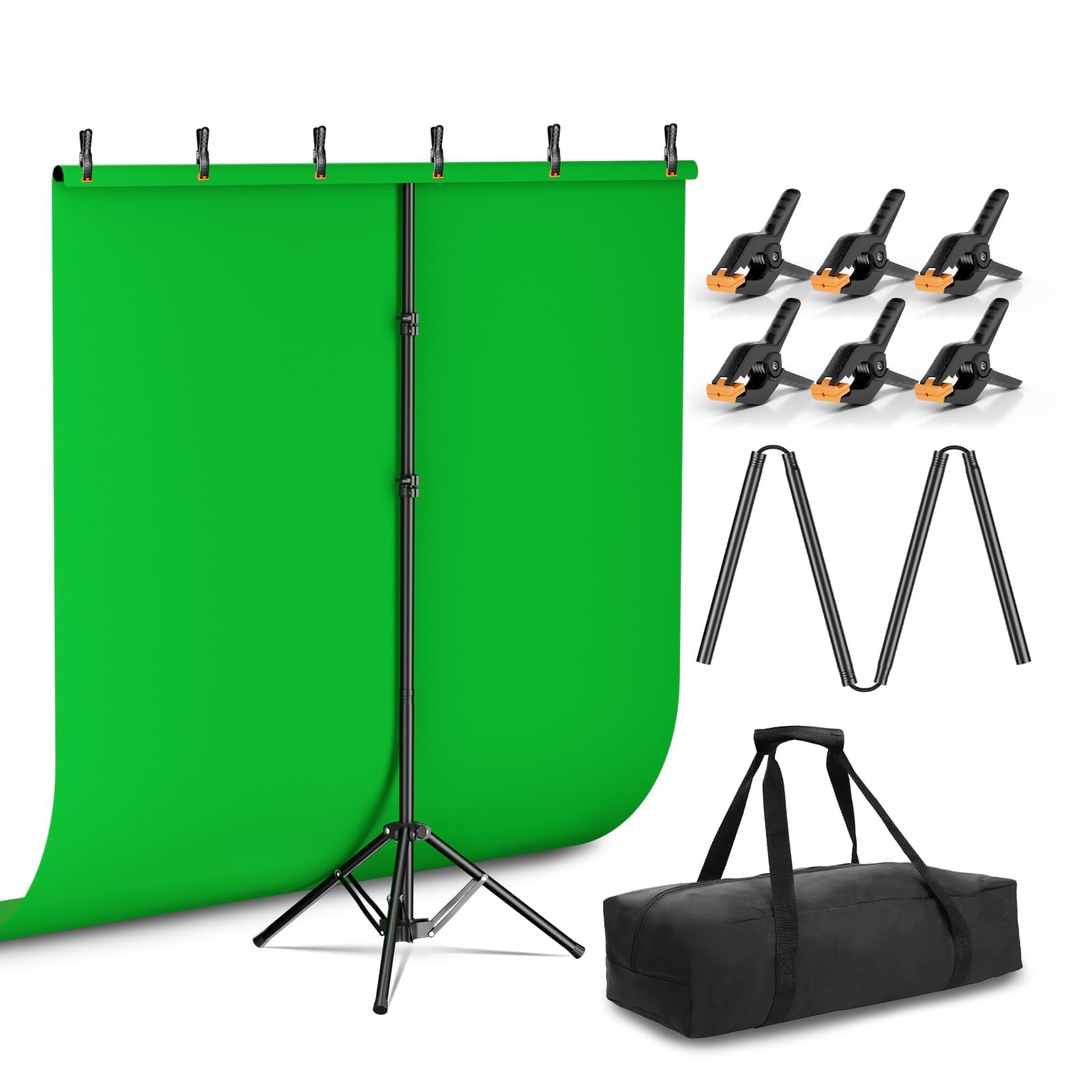
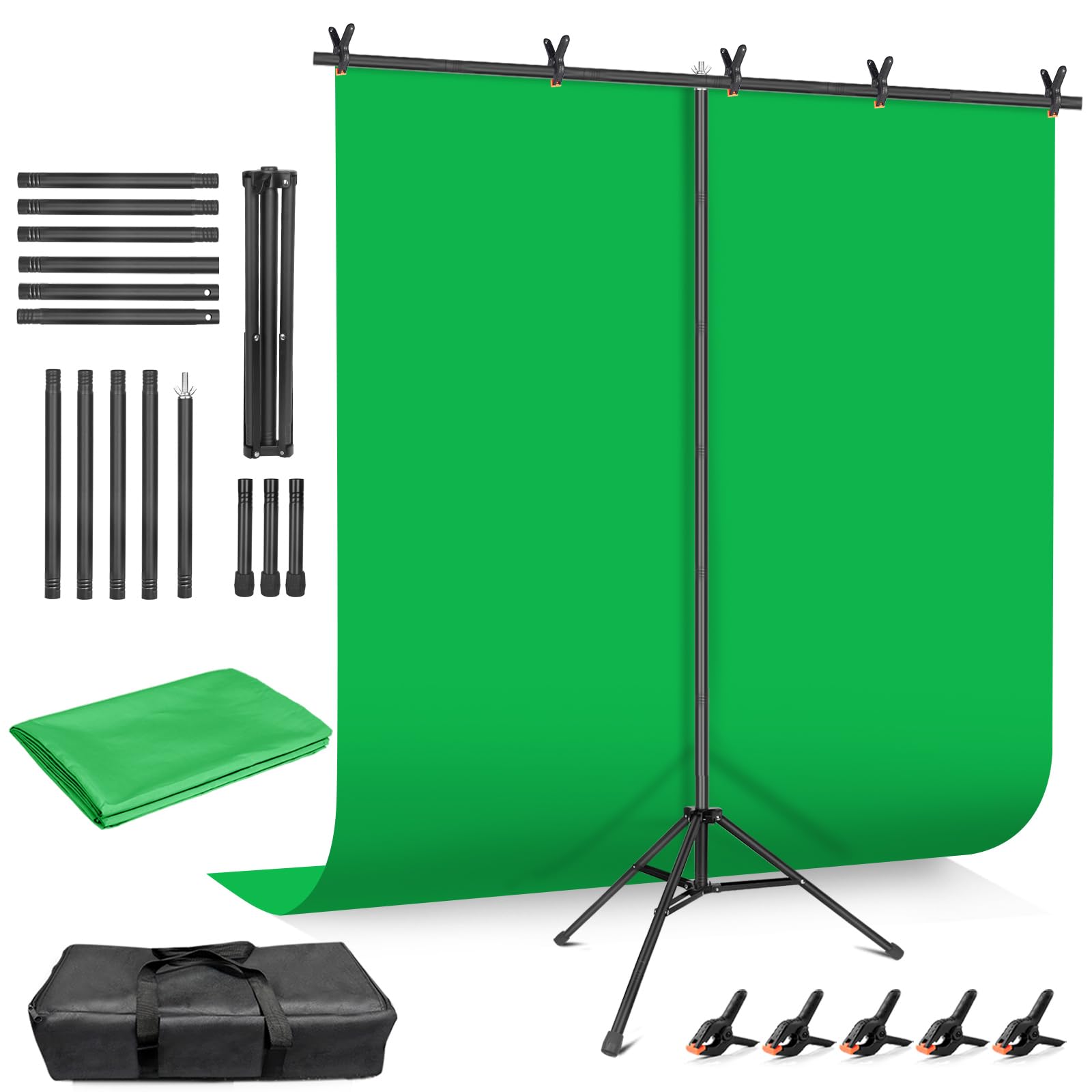
Out of the box you get a working studio: a T-shaped stand with five support rods, an 8.2-by-6.5-foot polyester cloth, five spring clamps, and a carry bag. The stand telescopes from 3.1 feet to 8 feet and sets at three widths up to 7.5 feet, which covers everything from a seated call to a standing presenter.

Height is where this kit separates itself from the five-foot bundles here. Eight feet of stand puts the top of the cloth above a standing adult's head, and we framed a chest-up shot without the crossbar creeping into the top of the picture, which is the most common annoyance with short kits. For a spare room that doubles as a studio, that reach is worth more than any feature printed on the cloth.

The cloth is where the corners show. The green runs a shade lighter than the product photos suggest, and at 8.2 feet on a 7.5-foot crossbar there isn't much fabric left at the ends for clamping. Under two soft lights neither matters much, but a darker, denser green keys with less fiddling.

Packed down the whole kit is 5 pounds and drops into the included bag, so it moves between rooms or into a closet without help. We kept it in rotation for shoots where height mattered and a permanent panel didn't fit.

Pros

  • Eight feet of stand height
  • Three widths up to 7.5 ft
  • Includes clamps, bag, and stand
  • Five pounds packed

Cons

  • Cloth ships creased and needs steaming
  • Light stand shifts when bumped
Our verdict

Buy this one when you need height and everything in a single box: eight feet of stand, clamps, and a bag for a home-office studio.

Check Latest Price
3

Best for Full-Body Coverage

JINSUI 10 x 10 ft Green Screen Backdrop

90 /100
Lab Score Outstanding

Key details

Fabric
Polyester, matte, water resistant
Weight
2.6 lb
Mounting
Rod pocket along top edge
Backdrop Size
10 x 10 ft
View on Amazon

Ten feet square at 2.6 pounds is an unusual combination: enough fabric to cover a standing subject head to toe, light enough to hang from a single rod pocket or a couple of clamps. The JINSUI is the pick here for anyone who already owns a stand and wants a bigger surface without buying another kit.

The material is why it earns a place. It's a dense polyester with a matte face, and we couldn't see the wall behind it even with a bright window on the far side of the room. The edges are folded and stitched rather than cut raw, which matters more than it sounds, because an unfinished hem curls and catches light right where the keyer is working hardest.

For full-body framing this is the best fabric-only pick in the set. Ten feet of width keeps green above the head and beside the shoulders when you stand up, which is exactly where the 5-by-7 cloths here run out. It's still a budget purchase, too, priced closer to the small cloths than to the kits.

It is a cloth, so the stand, the clamps, and the ten minutes with a steamer are yours to supply. Buy it to go with a stand you already trust rather than as a first purchase; if you need the whole rig in one box, the Hemmotop kit above is the simpler answer.

Pros

  • Ten feet square of opaque fabric
  • Matte face keys evenly
  • Under three pounds to hang
  • Machine washable and ironable

Cons

  • Backdrop only; no stand or clamps
  • Single rod pocket limits hanging
Our verdict

We recommend it if you already own a stand and want full-body coverage: ten feet of thick, matte fabric that hangs from a rod pocket.

Check Latest Price
4

Best for Wide Group Shots

CPLIRIS 10 x 20 ft Green Screen Backdrop

92 /100
Lab Score Outstanding

Key details

Fabric
Thickened polyester
Weight
4.63 lb
Backdrop Size
20 x 10 ft
Width Options
10 ft or 20 ft via dual pockets
View on Amazon

Two rod pockets, one on the 20-foot edge and one on the 10-foot edge, turn a single piece of fabric into either a wide banner or a tall drape. That is a trick we appreciate, and it is why the CPLIRIS is the pick here for group shots and wall-sized coverage: one purchase covers two framing problems that usually need different backdrops.

Hung from the long pocket it spans 20 feet, enough for four or five people in a row or a whole wall of green. Turned 90 degrees it becomes a 10-by-20-foot drop that covers a standing subject and the floor in front of them. The thickened polyester blocks backlight in normal room conditions, though in strong backlight it can read a little translucent near the edges, so keep your lights in front of it.

Hanging 20 feet of fabric is a two-person job. The pocket carries the weight along the top edge, but the middle sags without support, so plan on two stands or a rail rather than a single tripod. At 2.1 kg the cloth is light; it is the span, not the weight, that makes it awkward.

For two hosts at a desk, a dance channel, or anyone shooting against a long wall, it is the most coverage in this set for the money. For a single seated creator it is more fabric than the job needs, and the 10-foot orientation is the one that will actually get used.

Pros

  • Two rod pockets for wide or tall setups
  • Twenty feet of seamless coverage
  • Thick enough to block backlight
  • Light for its size at 2.1 kg

Cons

  • Ships deeply creased; a long steam
  • Backdrop only, no clamps or stand
Our verdict

The one to get for group shots or a wall of green: two rod pockets give you 20 feet wide or 10 feet wide from a single panel.

Check Latest Price
5

Best for Desk and Tabletop

Emart 5 x 6.5 ft Green Screen Kit

86 /100
Lab Score Excellent

Key details

Weight
6.15 lb
Included
Stand, 6 clamps, carry bag
Stand Height
4 to 6.5 ft; 2.7 to 5.1 ft without top pole
Backdrop Size
5 x 6.5 ft
View on Amazon

The reverse-folding base is the first thing you notice. The legs fold up around the center pole into a compact bundle that drops into the carry bag, which is quicker to deal with than the bolt-together stands on most kits here.

Height runs from 4 to 6.5 feet with the top pole fitted, and from 2.7 to 5.1 feet with it removed. That low setting is the point: on a desk it puts the crossbar below your webcam's field of view, where a full-height stand pushes it into the top of the frame. The crossbar breaks into four sections on internal cords, so it threads and stows fast.

The cloth is a plain 5-by-6.5-foot polyester and it is on the thin side, so keep your key light in front of the screen and the window behind you, not behind it, or the room shows through. Width is honest at five feet, which is exactly enough for one seated person.

For a desk in a shared room, this is the kit we recommend. It takes less floor than any other stand here, collapses without a fight, and the low setting means you don't have to hang a backdrop from the ceiling to keep it out of frame. Standing shots are somebody else's job; everything else about a webcam setup is this one's.

Pros

  • Tabletop height with the pole off
  • Folding base packs into a bag
  • Quick to assemble and break down
  • Small footprint for a desk

Cons

  • Too small for standing shots
  • Clamps and top pole feel lightly built
Our verdict

For a desk in a small room, this is the kit we hand people: it drops to tabletop height and packs into a bag in a minute.

Check Latest Price
6

Best Budget Backdrop

Hemmotop 5 x 7 ft Green Screen Backdrop

91 /100
Lab Score Outstanding

Key details

Sides
Matte front, reflective back
Weight
14.1 oz
Mounting
Rod pocket on 5 ft edge
Backdrop Size
5 x 7 ft
View on Amazon

A 5-by-7-foot piece of polyester, 14 ounces, with a rod pocket sewn along the 5-foot edge. One face is matte and non-reflective for shooting; the other has a reflective finish that bounces light back into the room.

It is the least expensive backdrop here, and the one we point at people who want to find out whether keying works in their room before spending on a kit. Hang it from a rod, a stand, or two clamps on a curtain rail, and you have an answer in an afternoon. The laser-cut edges are a small thing we appreciate: no fraying, nothing to straighten.

Five by seven is a seated-shot size. Stand up and you will be cropping your head or the edge of the cloth, so treat it as a webcam and streaming backdrop rather than a studio wall. It ships folded, like every cloth here, and one pass with a steamer is what separates a clean key from a mottled one.

Pros

  • Lowest-cost way to try keying
  • Matte front, light-bouncing back
  • Finished, non-fraying edges
  • Folds to almost nothing

Cons

  • Backdrop only; rod and stand separate
  • Thin enough to show backlight
Our verdict

A low-risk first green screen: cheap, matte on the shooting side, and small enough to hang anywhere for a seated shot.

Check Latest Price
7

Packable Travel Screen

Neewer 5 x 6.5 ft Pop-Up Backdrop

89 /100
Lab Score Excellent

Key details

Colors
Green and blue, reversible
Weight
1.1 lb
Folded Size
25.6 in disc
Backdrop Size
5 x 6.5 ft
View on Amazon

Opening it takes about a second: the steel spring frame snaps out of the bag into a taut 5-by-6.5-foot panel, green on one side and blue on the other. Closing it is a skill. The disc folds down to 25.6 inches, but the twist that gets it there is not obvious, and our first attempt needed a video tutorial and more patience than we expected.

Once it is up, it does its job. The frame holds the fabric flat with no clamping, you can hang it from the loop at the top or lean it against a wall, and at 1.1 pounds it is the lightest full-size screen here. The blue face is genuinely useful if your workflow keys blue or you want a different backdrop for stills.

Size is what it can't fix. Five by 6.5 feet covers a seated presenter and not much else; set it behind a standing subject and the top of the frame goes green-free.

We recommend it to people who can leave it hanging between sessions, on the back of a door or from a ceiling hook, because then the fold happens twice a year instead of twice a week. If it has to go back in the bag after every shoot, the fold will shape your opinion of it more than the green does.

Pros

  • Snaps open in about a second
  • Green and blue in one screen
  • Lightest full-size screen here
  • Frame holds the fabric flat

Cons

  • No stand or mounting hardware included
  • Folding it back takes practice
Our verdict

Worth it if the screen can stay hanging between shoots: it snaps open flat in a second and gives you green and blue in one disc.

Check Latest Price
8

Seated Video Calls

Aiuca Portable Chair Green Screen

80 /100
Lab Score Excellent

Key details

Fabric
Cotton, double sided
Weight
16 oz
Diameter
57 in
Mounting
Hangs over a chair back
View on Amazon

The Aiuca is built for one specific person: someone on video calls all day who wants a green background without giving up a corner of the room. It is a 57-inch cotton disc that hangs over the back of your chair, so there is no stand, no tripod footprint, and nothing to move when you are done.

It pops open from a flat ring and folds back to roughly the size of a windscreen sunshade. The cotton has a matte, slightly textured face that softens light rather than bouncing it, and at 16 ounces it won't drag a chair back over. Both faces are green, so it can face the camera at any angle.

For a seated, head-and-shoulders frame we found it the best of these for a home office: it covers the width of a chair and a little beyond, the cotton reads flat on camera, and there is no stand waiting to be knocked over mid-call. Stand up, though, and the disc runs out of coverage fast, which is the line between a desk accessory and a studio backdrop.

Pros

  • No stand; hangs on your chair
  • Covers a seated webcam frame
  • Matte cotton diffuses light
  • Folds flat for storage

Cons

  • Cover is dry clean only
  • Needs a solid chair back to hang from
Our verdict

A sensible buy for a small room where a stand has nowhere to live: it hangs on your chair and covers a seated frame.

Check Latest Price

How We Tested Green Screens for Real Rooms

To build the shortlist, I started with the formats people actually buy—collapsible panels, fabric-and-frame kits, and simple cloth with clamps—then filtered out anything with vague dimensions, missing mounting hardware, or a return policy that made a wrinkled screen a gamble. We landed on 14 screens across a range of sizes and spent six months using them in a spare bedroom, a garage studio, and a sunny living room. Each one went up and came down a dozen times, solo and with help, and we recorded test clips against every screen.

Color and opacity got checked first: I aimed a softbox at the fabric and looked for hot spots, seams that showed through, and whether the green shifted toward yellow or gray on camera. For opacity, I placed a lamp behind the screen and watched for a glow or silhouette; for wrinkle resistance, I noted whether creases dropped out after ten minutes of hanging or needed steam. Size mattered in a practical way—I measured the backdrop area and the floor footprint, then asked whether it fit behind a chair without swallowing the room.

Stability and durability were the slow part. I bumped frames while recording, opened and closed a nearby door, and watched for wobble; over six months, I tracked whether seams held, clamps lost grip, and folding joints loosened. Assembly time was timed solo, from opening the bag to a taut surface, and I packed each screen back down to see how small it got and whether the carry bag survived.

Value came last: we compared what was in the box, whether the screen did its job without extra rigging, and whether it still looked clean after repeated setups. The ones that made the list were the ones I stopped thinking about once the camera was rolling.

How to Choose a Green Screen

Start With Your Framing, Not the Fabric

Measure the shot you actually record before you shop cloth sizes. A seated webcam frame, head and shoulders, fits inside a 5-by-7-foot backdrop with a little room to spare, which is why those cloths dominate the budget end of this list. Stand up and you want roughly 10 feet of width to keep green above your head and beside your shoulders, and two people at a desk push you toward a 78-inch panel or a 10-by-20-foot drape.

The mistake is buying the small cloth for a standing shot and finding out at the crop. If you are between sizes, go up: extra green can be clamped out of frame, and missing green cannot be added.

Opacity, Finish, and Creases

Keying software removes a color, so a screen that lets room light through gives it a moving target. Dense polyester with a matte face is the safe choice; a shiny surface bounces your key light back and leaves hotspots that survive the key. Every folded cloth arrives creased, which is shipping rather than a defect, so budget a steamer and ten minutes before the first shoot.

A self-standing panel or a pop-up frame skips that step entirely, because the fabric is never folded flat in the first place.

Stand, Frame, or Nothing at All

Three routes put green behind you. A kit bundles cloth, stand, and clamps and is the simplest first purchase, though the lightest stands shift when someone walks past, so weight the feet or set the thing against a wall. A cloth plus a stand you already own is the cheapest route and the most flexible. A self-standing or pop-up panel trades money and storage space for speed.

Whichever you pick, check that the stand's top height clears your frame and that the crossbar spans at least the cloth's width, or the ends will sag toward the middle.

Storage and the Fold

Packing matters more than most shoppers expect. A cloth folds to the size of a paperback, a panel with a hard case needs closet depth, and a pop-up disc needs a shelf plus the patience to learn its twist. Weigh that against how often you take the screen down.

One that stays up between shoots can be heavier and slower to fold. One that lives in a bag has to open and close in about a minute. In a shared room, packed size decides whether you use the thing at all.

Frequently Asked Questions

Final Verdict

The RAUBAY is the screen we recommend to anyone who shoots in the same room more than once a month. It stands itself up, stays flat without steaming, and frames two people, which are the three things that decide whether a green screen gets used or ends up in a closet.

If you need height without a floor-standing panel, the Hemmotop 8 x 7.5-foot kit puts a stand, clamps, and eight feet of clearance in one box. If a stand is already in your kit, the JINSUI 10 x 10 cloth covers a standing subject for a lot less fabric money than you might expect.