Best LEGO Display Cases of 2026

Minifigures are small, which is exactly why they get lost, dusty, or knocked off a shelf. A good display case solves all three at once: it gives the collection a home, keeps the dust off, and makes the whole thing look intentional rather than like it landed on a dresser. But the difference between a case that shows off your figures and one that hides them behind glare or cramped shelves comes down to details—shelf height, door fit, lighting, and how the whole thing feels when you bump the table.

I've spent the past eight months living with 10 display cases, from snap-together acrylic boxes to glass-front cabinets, and the pattern is clear: the best ones are easy to load, sturdy enough to trust, and priced like they respect your collection. Some assembled in minutes; others needed a screwdriver and a careful read of the instructions. What surprised me most was how often a case that looked great online failed the basics—a shelf too short for a taller figure, a door that stuck, or a wall unit that felt shaky until we found the studs. The picks below are the ones that got those everyday details right.

1

Best Overall

Room Copenhagen Minifigure Case (3 Pack)

96 /100
Lab Score Outstanding

Key details

Capacity
16 minifigures per case
Mounting
Wall or desktop
Set Size
3 cases
Dimensions
15 x 1.9 x 7.2 in
View on Amazon

Every compartment in these cases has its own square LEGO baseplate, so a minifigure clicks onto studs and stays standing when you slide the case across a desk or lift it onto a hook. That detail is why we send people here first: nothing else in this group is built on real LEGO studs, and a wall of figures seated on baseplates reads as a collection rather than a row of toys.

The three-pack is the sensible unit. Each case gives you 16 figures across a 15-inch width, stands on a shelf, or hangs from two holes in the back, and three of them turn 48 figures into a grid you can add to a case at a time. The clear fronts keep dust off and let you read a torso print without opening anything, which after a year of collecting is most of the point.

Fit is the one place these ask something of you. The compartments are sized around standard minifigures, so a wide molded cape, an oversized helmet, or a figure gripping a big accessory crowds the plastic or ends up standing at an angle, and the loose 4x3 plates that come with the figures do not always seat on the baseplate. Ordinary figures look superb; the awkward ones need a different case. Buy the three-pack even if you own ten figures today, because these only look like a display once two or three are lined up.

Pros

  • Baseplate in every compartment holds figures upright
  • Hangs on a wall or stands on a desk
  • Three cases hold 48 figures and stack
  • Clear fronts keep dust off the figures

Cons

  • Doors are stiff to open, especially when stacked
  • Stacked cases do not latch to one another
Our verdict

We recommend these first for minifigures: real LEGO baseplates in every compartment, wall or desk mounting, and a three-pack that stacks into a display wall.

Check Latest Price
2

Best Wall Cabinet for Minifigures

DisplayGifts Pro Minifigure Cabinet

91 /100
Lab Score Outstanding

Key details

Door
Lockable, 98% UV acrylic
Assembly
None
Capacity
About 80 minifigures
Shelf Height
2.25 in
View on Amazon

Eighty figures in a case that arrives in one piece is a specific promise, and it holds: the shelf height of 2.25 inches clears a standard minifigure with headroom to spare, the felt back gives black plastic something soft to sit against, and there is nothing to assemble. You hang it and start filling.

We think it is the value pick of this group for straight minifigure storage. The acrylic door filters 98% of UV, which matters when the only free wall faces a window, and it locks, a real lock, worth having in a shared room or a house with young children. Foot supports for the figures come in the box, so figures do not have to balance on a bare shelf.

The shelves themselves are plain, with no studs or grip, so a narrow-based figure can shift when the door swings or the case gets knocked, and the included foot supports are not optional if you want tidy rows. Hanging is the other thing to take seriously: a loaded case this size needs anchors matched to the weight, not whatever came in the bag.

Pros

  • Around 80 figures in one wall cabinet
  • Lockable door filters 98% of UV
  • Arrives assembled, nothing to build
  • Foot supports included for standing figures

Cons

  • Figures slide on plain shelves without the foot supports
  • Shallow interior limits thick accessories
Our verdict

We think this is the value pick of the group: around 80 figures behind a lockable, UV-filtering door, no assembly, and shelf height that suits standard minifigures.

Check Latest Price
3

Best for Huge Collections

DisplayGifts 200-Figure Wall Case

91 /100
Lab Score Outstanding

Key details

Rows
Two per shelf
Capacity
Up to 200 minifigures
Mounting
Wall, hardware included
Shelf Height
2.5 in
View on Amazon

If the minifigures have already taken over a bookshelf, this case gives the shelf back. It hangs flat like a framed print, 38 inches wide and 2.3 inches deep, and with two rows on each shelf it swallows close to 200 figures, which is more than most collections will ever reach.

That extra quarter inch of shelf height over the smaller DisplayGifts case is what makes this one work for a mixed collection. Figures with molded hair, helmets, and capes that crowd a 2.25-inch shelf stand cleanly at 2.5 inches, and on a wall this wide the difference shows up in every row rather than in one lucky gap.

Hang it into studs, since 38 inches almost always spans two, and count on a second pair of hands because the panel is awkward overhead. Inside, the black felt background and the included baseplates do most of the work, and the metal brackets on the back are spaced for a standard stud bay rather than a single hook.

Pros

  • Close to 200 figures on one wall panel
  • 2.5-inch shelf height clears taller figures
  • Baseplates and hanging hardware included

Cons

  • Only 2.3 inches deep, so accessories sit close to the glass
  • Frame is a painted shell rather than solid wood
Our verdict

We point big collections here: a flat 38-inch panel, 2.5-inch shelves that clear taller figures, and room for close to 200 minifigures in two rows.

Check Latest Price
4

Best for Corners

BROTTAR Corner Curio Cabinet

92 /100
Lab Score Outstanding

Key details

Doors
Magnetic glass
Tiers
4
Lighting
3-color LED, motion sensor
Dimensions
33.5 x 65 x 23.6 in
View on Amazon

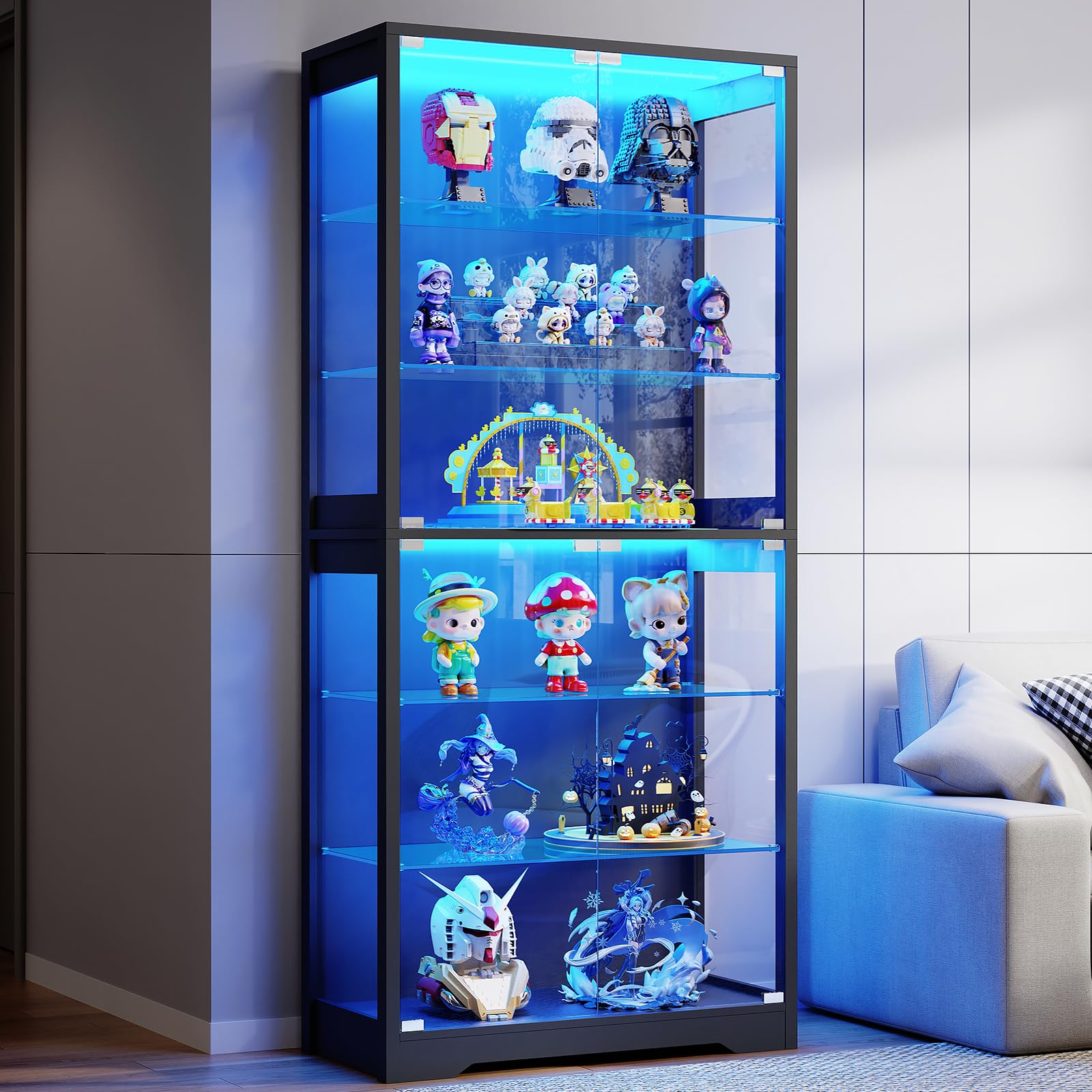
Where the other cabinets here want a flat run of wall, this one is built for the corner you have not found a use for: a 90-degree body that sits into the angle and puts four glass-fronted tiers where a lamp would otherwise stand.

The lighting is the part we keep coming back to. Three colors, dimmable, and a motion sensor that switches the cabinet on when you come within two or three meters and off again when you leave, so the corner glows while someone is looking at it and stays dark the rest of the evening. The magnetic glass doors pop up and out of the way, which gives a cleaner view of a shelf than a door that swings.

At 82 pounds empty it takes two people to stand upright, and it is worth fixing to the wall once it is in place. Set against the floor space it uses, which is almost none, it is the most display per square foot in this group, and the black finish and glass read as furniture rather than storage.

Pros

  • 90-degree body uses dead corner space
  • Dimmable 3-color LED with motion sensor
  • Magnetic glass doors lift clear of the shelves
  • Four glass tiers in a 65-inch cabinet

Cons

  • Assembly takes an evening and instructions are uneven
  • LED strips on some units stop working
Our verdict

Our pick for corners: four lit glass tiers in a 90-degree body, with a motion sensor that lights the display as you walk past.

Check Latest Price
5

Best Full-Size Cabinet

BROTTAR 71-Inch 6-Tier Cabinet

87 /100
Lab Score Excellent

Key details

Door
Pop-up glass
Tiers
6 glass shelves
Lighting
3-color LED, motion sensor
Dimensions
31.5 x 71 x 13.8 in
View on Amazon

Two people, a free evening, and a screwdriver: that is the entry price of a 71-inch cabinet, and this one does not pretend otherwise. It arrives as engineered-wood panels weighing 108 pounds in total, with a glass door that has to hang square before anything inside looks right.

What you get for the effort is the most usable tall cabinet here. Six tiers, shelves that move in 2.5-inch steps so you can open a tall bay for a set with a tower and close the rest down to minifigure rows, a pop-up glass door, and the same three-color LED and motion sensor as the corner model. At 31.5 inches wide and 13.8 inches deep it takes less wall than its height suggests.

Our verdict is that it earns the assembly. This is the cabinet for a collection of built models rather than loose figures, because six glass tiers show a set from three sides and the lighting is what separates a shelf from a display. Plan the build for a day when you are not rushed, and the rest of the evening is the fun part.

Pros

  • Six tiers, shelves adjustable in 2.5-inch steps
  • Motion-sensing 3-color LED lighting
  • Anti-tip hardware included
  • 31.5-inch width fits a short wall

Cons

  • Wobbles until it is anchored to the wall
  • Door panels scratch easily
Our verdict

For built models we like this best of the tall cabinets: six adjustable glass tiers, motion-sensing light, and a footprint under three feet wide.

Check Latest Price
6

Best Budget Tabletop Case

SANKEU 4-Tier Acrylic Case

91 /100
Lab Score Outstanding

Key details

Door
Magnetic acrylic
Tiers
4 with 3 dividers
Mounting
Desktop, stackable
Dimensions
14.2 x 8.7 x 10.6 in
View on Amazon

Four tiers, a magnetic door, and the lowest price in this group: the SANKEU is what we point to when someone wants their figures sealed away without buying furniture.

Three dividers lift out or move, so you can keep four shallow rows for figures or clear a taller bay for something bigger, and the whole thing snaps together without tools in about the time it takes to clear a shelf. The magnetic door holds shut against a knock, and the acrylic is clearer than the price suggests, so figures read properly from the front and the sides.

It is a figure case rather than a model case: the interior is one 14-by-9-inch footprint, and a built set with any span to it will not go in. For a desk collection of a dozen or two figures, though, we think it is the best value here, and it is the case we suggest to anyone who is just starting to need one.

Pros

  • Four tiers with three movable dividers
  • Magnetic door keeps dust out
  • Snaps together without tools
  • Stacks with additional units

Cons

  • Acrylic scratches easily and panels can arrive scuffed
  • Door magnet needs a firm pull to open
Our verdict

For a first case, this is the one we hand people: four sealed acrylic tiers, movable dividers, and a magnetic door at the bottom of the price range.

Check Latest Price
7

Small, Changing Displays

Attelite Acrylic Display Case

89 /100
Lab Score Excellent

Key details

Door
Magnetic, front or top
Tiers
2, adjustable shelf
Mounting
Desktop, stackable
Dimensions
10.6 x 8.7 x 14.2 in
View on Amazon

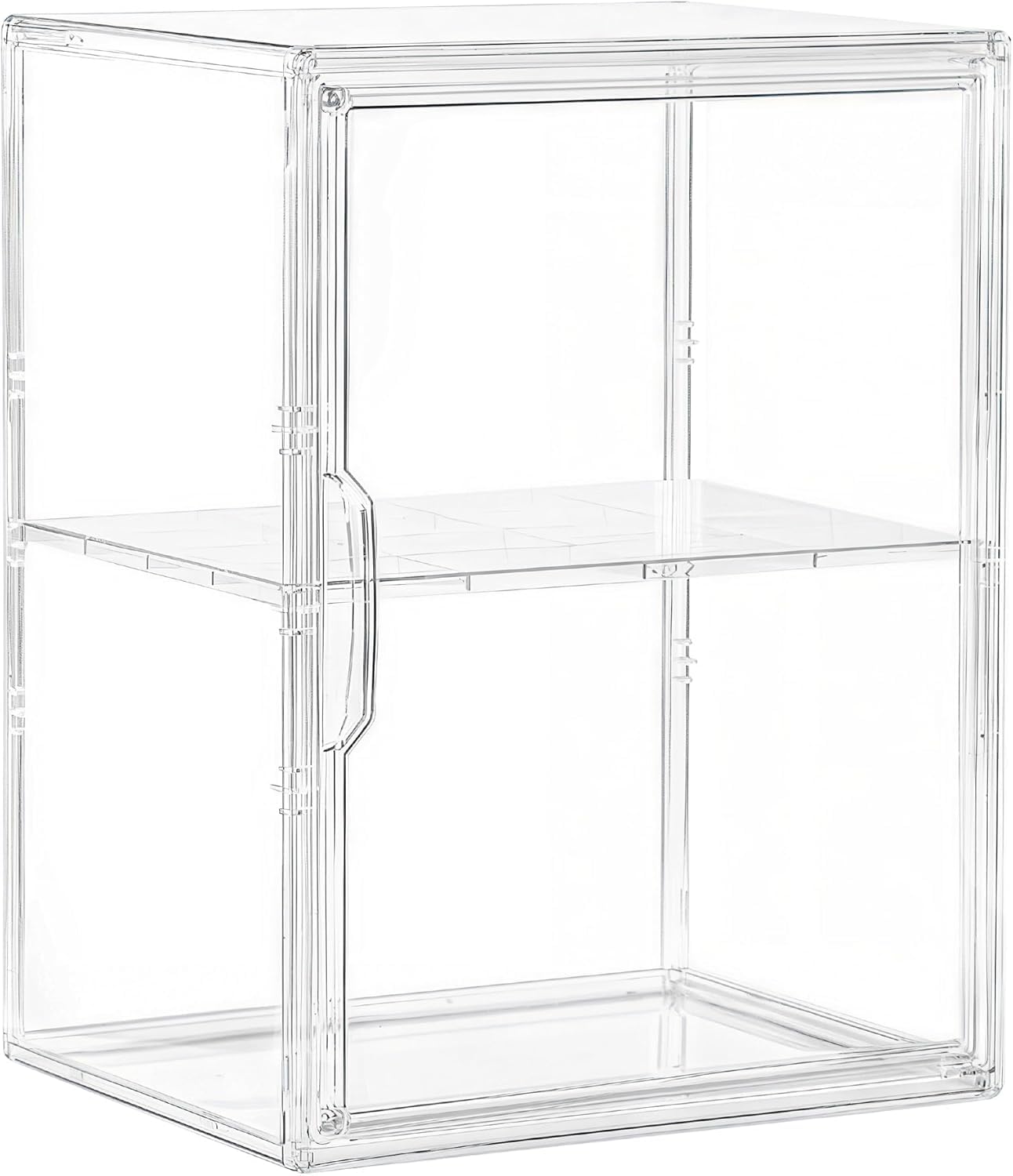
Three grooves run up the inside walls, so the single shelf drops into whichever height suits what you are showing, and the door can face front or lie flat on top. That second option is a better trick than it sounds: the same box becomes a front-opening case on a shelf or a lidded case on a desk.

It goes together without tools in a couple of minutes, and the magnetic closure is strong enough that the door does not drift open. Units stack, so three or four along a shelf read as one cabinet rather than a pile of boxes.

It is sold as much as a storage bin as a display case, and that shows in one place: nothing inside is sized around LEGO. There are no studs, so figures stand on flat acrylic, and the interior is a single 10.6-by-8.7-inch footprint with no dividers to help you space a row.

Where it earns a place is the shifting display: designer vinyl figures, a small build, whatever is currently on the desk. We think that flexibility beats a bigger fixed case for this kind of use, and it is the one here you will not fuss over, because a knock costs you an acrylic box rather than a cabinet.

Pros

  • Shelf sits at one of three heights
  • Door works at the front or on top
  • Tool-free assembly in minutes
  • Stacks with matching units

Cons

  • Panels feel light for the price
  • One shelf only, with no dividers
Our verdict

We like it for a small, changing display: an adjustable shelf, a magnetic door that works at the front or the top, and a box that stacks.

Check Latest Price
8

Game Rooms

AODK 5-Shelf Display Cabinet

89 /100
Lab Score Excellent

Key details

Front
Open, no doors
Shelves
5, three glass
Lighting
App-controlled RGB
Mounting
Floor, anti-tip
View on Amazon

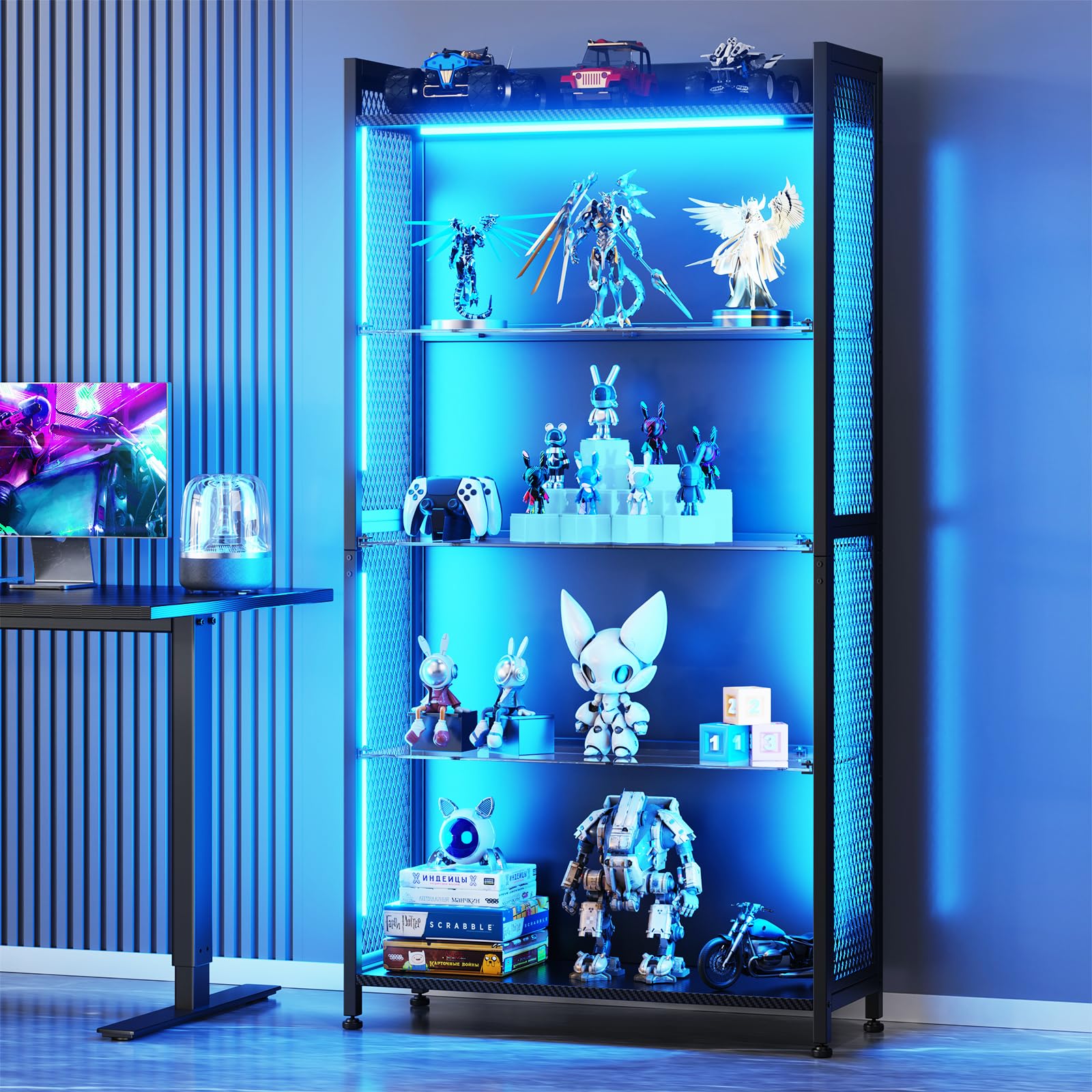
There are no doors on this one, and that decides everything else. You can lift a built set off the shelf one-handed, and you will be dusting it every few weeks for as long as you own it.

What you get instead is light. Five LED strips, thousands of colors through an app, and a music-sync mode that a game room will either love or switch off within a week. The shelving is three tempered glass tiers plus two metal mesh panels, and the industrial frame reads as furniture in a way the acrylic boxes do not.

Assembly is straightforward: labeled parts, a full toolset in the box, and a frame that squares up as you tighten it. The anti-tip hardware is included, and on a unit this tall it should be used, because open shelving invites a lean and a reach.

For a game room where the collection is part of the decor, we think the open front is the right call: nothing between you and the model, and the RGB does more for a built set than a white cabinet light ever does. It is also the least precious cabinet here, with no glass door to swing past and no latch to line up.

Pros

  • App-controlled RGB lighting with thousands of colors
  • Five shelves, three of them tempered glass
  • Open front makes swapping sets easy
  • Anti-tip hardware included

Cons

  • Color control runs through a phone app
Our verdict

We recommend it for a game room, not a storage closet: five open shelves, app-controlled RGB, and nothing between you and the model.

Check Latest Price

How We Tested Minifigure Display Cases

We started by pulling together dozens of display cases sold for minifigures and small collectibles, then narrowed the field to 10 based on interior shelf height, material, door style, mounting options, and price. We ruled out anything with shelves too short to clear a standard minifigure with a hat or accessory, and we favored cases with adjustable or removable dividers so the layout could change with the collection.

Over eight months, the cases lived where collections actually live: on a dresser in a sunny bedroom, on a shelf in a dim rec room, wall-mounted in a hallway, and in a kid's room near a doorway. We loaded each with minifigures and small accessories, opened and closed the doors daily, and dusted on a normal schedule. We also timed assembly alone with the included instructions, noting every skipped step, stripped screw, and magnet that needed an extra nudge.

To judge appearance and display, we viewed each case in daylight and in a dark room, checking whether LEDs flattered colors or washed them out and whether glare hid the figures. We nudged shelves, bumped the cabinets, and tested wall units with and without studs to see how much stability and mounting hardware actually mattered. Finally, we compared what each case held against what it cost—counting how many figures fit comfortably, whether the door felt solid, and whether the materials looked as good after a few months of handling as they did on day one.

How to Choose a Lego Display Case

Match the Case to the Collection

A minifigure stands a little over an inch and a half tall, and the cases built for them use shelf heights of 2.25 to 2.5 inches, which leaves room for a helmet or a small accessory. If your collection is mostly loose figures, buy a minifigure case and skip the furniture: compartments hold each figure upright and spaced, where a cabinet shelf lets a row drift and slide.

Built models are a different measurement. A cabinet gives you 13.8 to 23.6 inches of depth and shelves you can move, which is what a set with any span needs. Measure the tallest and widest thing you want behind glass before ordering; a case that fits your figures but not your biggest build is the wrong case.

Wall Panel, Tabletop Box, or Floor Cabinet

Wall panels take no floor space and hold the most. Our two DisplayGifts cases fit close to 80 and 200 figures on panels 14 and 38 inches wide, and both hang flat like a framed print. Tabletop acrylic boxes are the cheapest way in and stack into a wall of their own, but each one holds a dozen or two figures.

A floor cabinet is furniture, and it changes the room rather than just the shelf. Corner bodies earn their place because they use an angle nothing else fits into; a flat cabinet needs its width of clear wall plus room for the door to open.

Sealed or Open

Everything here that closes will save you dusting. Acrylic boxes and glass cabinets keep figures visible and clean, and you pay for that by opening a door every time you want to touch anything. Open shelving is faster to use and shows a built set from every side, at the cost of a microfiber cloth every few weeks.

If children or pets share the room, weight sealing heavily. A magnetic door that holds shut is doing more work than it looks like it is, and a lock is worth the small premium on a case that lives in a hallway or a shared room.

Lighting: Worth Paying For, Worth Checking

A lit cabinet does more for a collection than a bigger cabinet does. White light shows color honestly, warm light flatters older bricks, and a motion sensor means the display is only lit when someone is in the room, which is both a power saving and a nicer effect at night.

The catch is that built-in LED strips are the most frequent long-term failure on a lighted cabinet; when they stop, you still own a cabinet. If the light matters more to you than the furniture, add a replaceable plug-in strip to a plain case and keep the ability to swap it.

Assembly, Mounting, and Loaded Weight

Acrylic snap cases take minutes. Flat-pack cabinets take an evening and two people, and instructions are uneven from brand to brand, so plan the build rather than resenting it. None of that shows once the case is loaded and lit.

Whatever goes on a wall should be anchored for the loaded weight, not the empty one; figures, glass, and the case itself add up quickly, and a panel that pulls out takes the collection with it. Use studs where the wall gives you two, and rated anchors where it does not.

Frequently Asked Questions

Final Verdict

When someone asks us where to start, the answer is the Room Copenhagen three-pack: real LEGO baseplates in every compartment, a wall or desk setup, and 16 figures per case that grow with the collection. It is the least fuss and the most LEGO-looking answer on this page.

The second decision is what is actually on the shelf. If built models are the main event, the 71-inch BROTTAR gives you six adjustable glass tiers and motion-sensing light for less than the corner cabinet; if the only free space you have is an unused corner, that cabinet is the one that earns its keep.