Best Miniatures Games of 2026

Miniatures games have a reputation problem: a rulebook that reads like a tax code, a hundred parts still attached to a sprue, and a veteran at the shop promising it gets fun around your third session. The good ones don't ask for that kind of patience. What separates them is how fast a box turns into a game you can actually sit down and play, and whether the figures inside still feel worth the shelf space once the excitement of opening the box wears off.

Over the past seven months, my team and I assembled, painted, and played 11 miniatures games, from small boxed starters to fuller skirmish sets. Here's the thing nobody tells a first-time buyer: you don't have to paint a single figure to play, and anyone who insists otherwise is really selling you paint. What you want instead is a box that hands you two workable forces and a rulebook you can finish in one sitting, with enough variety in factions and units that the tenth game doesn't feel like the second. That's roughly the bar we held every box to, and the games that cleared it are below.

1

Best Overall

HeroQuest Game System

97 /100
Lab Score Outstanding

Key details

Quests
14
Players
2-5
Miniatures
65+
View on Amazon

Lift the HeroQuest lid and the box keeps going: 65-plus miniatures, 15 pieces of dungeon furniture, 21 doors, 93 cards, a game master's screen, and a quest book holding 14 adventures. Very few boxes in this category are that complete on day one. You can play the first quest the same evening you open it, with nothing else to buy.

That completeness is the reason it's our top pick. Nothing else here hands a group a full campaign, every monster, and a screen for the dungeon master in one purchase. It's also the gentlest introduction to miniatures gaming in this set: one player runs the evil sorcerer Zargon, everyone else takes the Barbarian, Dwarf, Elf, or Wizard, and the rules resolve almost everything with a handful of dice. Our first session cleared a quest with the rulebook open once, in the first room, and never again.

The figures are the pleasant surprise. The 25mm bases keep the corridors feeling cramped the way a dungeon should, and the furniture — tables, racks, a throne — does more for the atmosphere than the monsters do. A board with actual furniture standing on it reads as a place rather than a grid, and that's the detail that gets a group to set up a second quest.

What it asks in return is a group of at least two, one of whom is willing to run the dungeon rather than play a hero. That's the price of a game this easy to teach: a live dungeon master can improvise when the players ignore the obvious door, and the included rules for writing your own quests mean the 14 adventures aren't a ceiling.

Pros

  • 65+ miniatures plus doors and furniture in one box
  • 14 quests and rules for building your own
  • Rules you can teach in a single sitting
  • Semi-cooperative play that suits families

Cons

  • Takes up serious table and shelf space
Our verdict

If you want one box that turns a family or a skeptical group into miniatures players, this is the one we hand over — complete, teachable, and generous with figures.

Check Latest Price
2

Best Competitive Game

Blood Rage

92 /100
Lab Score Outstanding

Key details

Players
2-4
Playtime
60-90 min
Miniatures
46
View on Amazon

A turn in Blood Rage is a small argument with yourself: draft a hand of cards, then decide how much rage to spend proving you were right. We expected the 46 miniatures to be the draw and found the draft is what pulls us back — every age you're choosing between a monster, a quest, and the clan upgrade that changes how you score.

The figures earn their place anyway. Studio McVey sculpted the clans, the longships, and the legendary monsters, and the coloured bases let you read four armies across a crowded board without squinting. Summoning a monster into a province is the best moment in the game precisely because it changes what everyone else is willing to contest.

Where it gets sticky is the first game. The box says 60 to 90 minutes, and two-player games land at the quick end of that, but everybody spends their first age learning that a card you pass is a card your neighbor will play against you. Play one age, then restart — the second run is the actual game.

What keeps it near the top of this set is that there's more than one route to victory. Points come from winning battles, from dying gloriously, and from quests, so the player who loses every fight can still take the night. Point it at a group that will play it monthly; a one-off games night spends most of its time on the teach.

Pros

  • Card drafting gives every age a real decision
  • 46 detailed Studio McVey miniatures with color-coded bases
  • Three scoring routes, so losing battles can still win

Cons

  • Costs more than most picks here, before expansions
Our verdict

Buy it if your group plays the same game repeatedly; the draft is where Blood Rage earns its price, and the 46 figures make the losing memorable.

Check Latest Price
3

Best Quick Two-Player Game

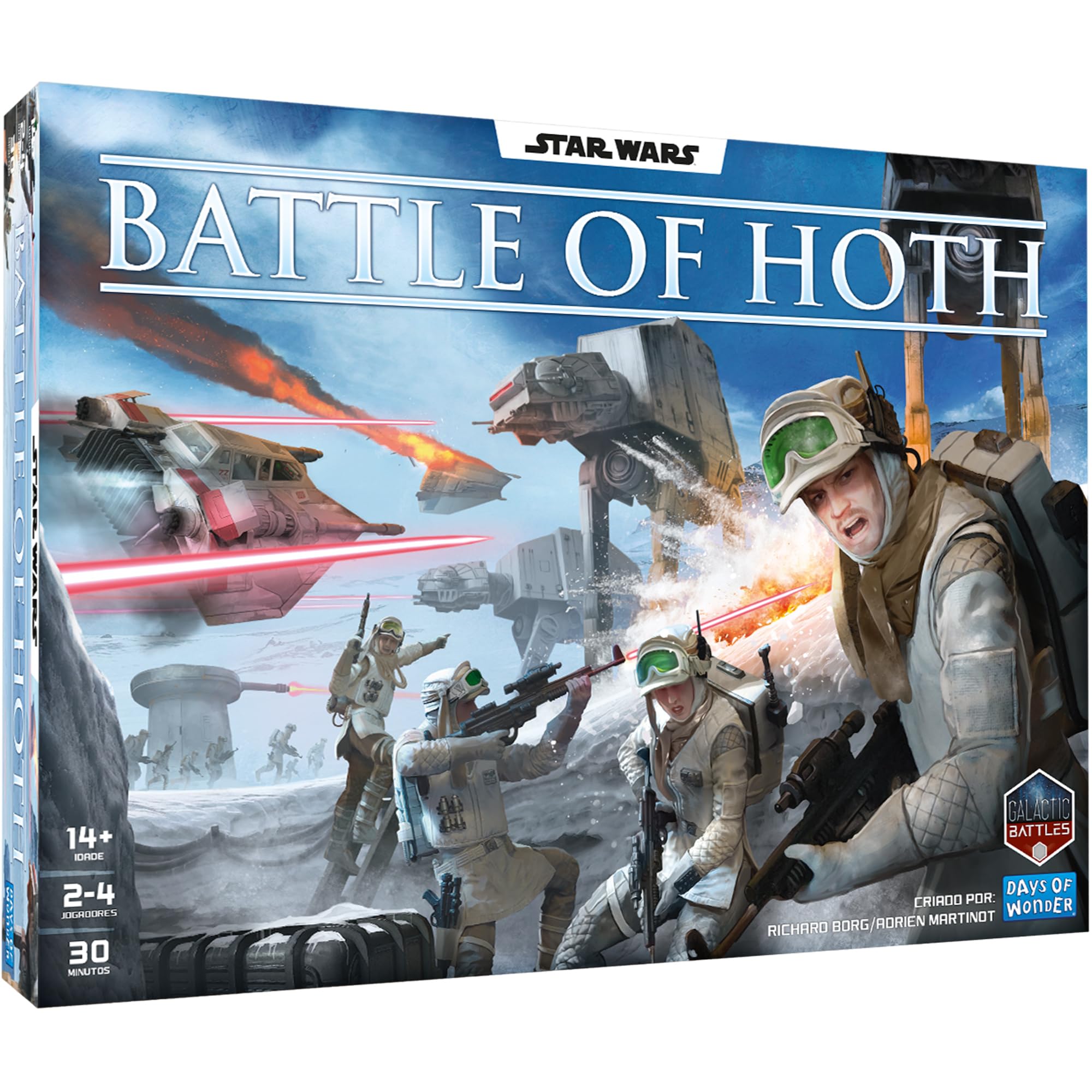
Star Wars: Battle of Hoth

91 /100
Lab Score Outstanding

Key details

Players
2
Playtime
30 min
Age Range
8 and up
Miniatures
74, both armies
View on Amazon

Seventy-four miniatures in a single box is the headline: 32 snowtroopers and three AT-ATs on one side, 24 Echo Base troopers, nine snowspeeders and two artillery pieces on the other, with Imperial probe droids thrown in. Add a double-sided board, 19 double-sided terrain hexes, and command cards for each army, and it's the least expensive way here to put two full forces on a table.

The rules are a streamlined descendant of Memoir '44. You play a command card, order the units on that flank, roll custom dice, and apply hits — which means the whole turn fits on one card and a scenario wraps up in around half an hour. A scenario book and four campaign books come in the box, and more scenarios are published online for free.

This is the box we reach for when there are exactly two of us and an hour to fill. It sets up in minutes, fits on a coffee table, and doesn't demand a dedicated room the way the campaign games do. The scale is tight and the miniatures are small beside a full wargame's, but that's the trade for a complete tactical game you'll actually get to the table.

It's also the most kid-friendly box in this group. The manufacturer lists it for ages 8 and up, and a card-and-dice turn means a young player can run the Imperial side without being taught a hundred exceptions. Groups of four and anyone hunting a narrative campaign should look at HeroQuest or Stranger Things instead.

Pros

  • 74 miniatures covering both armies completely
  • Scenarios run around half an hour
  • Light rules a child can pick up
  • Scenario book plus four campaign books included

Cons

  • Dice can decide a close scenario
  • Miniatures are small and fiddly to paint
Our verdict

Our pick for two players on a weeknight: two armies, half-hour scenarios, and rules light enough that a newcomer is competing in the first game.

Check Latest Price
4

Best for Solo and Campaign Play

Fallout: Wasteland Warfare

90 /100
Lab Score Outstanding

Key details

Modes
Solo, co-op, versus
Scale
32mm
Players
1-8
Playtime
30-240 min
View on Amazon

A two-player starter that also plays solo is an unusual thing to find in a miniatures box, and the AI deck is where most of our time with this one went. Draw the right cards and the Super Mutants push across the board on their own, which means a single player gets a real skirmish instead of a puzzle about guessing the designer's intent.

That flexibility is what earns it a spot. Most boxes here want a fixed number of people and a fixed evening; this one scales from a solo scenario to an eight-player afternoon and asks you to build a crew and a list rather than pick a side. If you already love the Fallout setting, the factions, perks, gear, and loot all carry the tone of the video games rather than a thin license pasted onto a ruleset.

Inside the box you get two substantial books, a set of 32mm figures spanning Survivors, Brotherhood of Steel, and Super Mutants, scenery, and paper play mats instead of a board. Games run from half an hour to a full afternoon across three modes — head to head, co-op, and solo — with points-based battles, random missions, and narrative campaigns to string them together.

Two things to check before ordering. The miniatures line has shifted materials over the years, so confirm what a specific box contains if you plan to paint a matched force. And this is a gateway rather than a closed box: it's a starter for a large range, which is either the appeal or the warning, depending on how much shelf you have.

Pros

  • Solo AI deck alongside versus and co-op play
  • Scales from a 30-minute skirmish to a full campaign
  • Crew building with perks, gear, and loot
  • Two rulebooks, scenery, and 32mm figures in the starter

Cons

  • Heaviest rulebook in this group
  • Paper play mats instead of a board
Our verdict

We recommend the starter to anyone who wants to play alone or build a crew across a campaign, and who doesn't mind the heaviest rulebook here.

Check Latest Price
5

Co-Op Fans

Stranger Things: Upside Down

89 /100
Lab Score Excellent

Key details

Board
Double-sided, Seasons 1 and 2
Players
2-4
Playtime
60 min
Miniatures
11
View on Amazon

The board is the reason to own this one: it's double-sided, one side for Season 1 and one for Season 2, so a licensed tie-in becomes two campaigns instead of one evening's novelty. Flip it and the whole map of Hawkins changes, which is more than most show tie-ins bother to do.

Play is fully cooperative. The kids work together to clear token stacks around town before time runs out, with 11 miniatures — the Demogorgon and Demodogs among them — 131 cards, six character dashboards, and fear trackers pushing the pressure up each round. It's a puzzle with a theme rather than a combat game, and the theme lands.

The rulebook is the weak link. Setup and the first round eat most of the first evening, and someone at the table needs to arrive having read it properly — this isn't a box to open cold with a young group. Get the loop into your head, though, and it moves quickly, with the clock doing the work of keeping a co-op table tense.

For a household that has watched the show, that's a reasonable trade, and 12 and up is a fair listing, since the horror is implied rather than graphic. If your group wants a cooperative crawler with more figures and no prior knowledge required, HeroQuest is the easier sell.

Pros

  • Double-sided board covers Seasons 1 and 2
  • Fully cooperative for two to four players
  • 11 miniatures including the Demogorgon and Demodogs

Cons

  • Rulebook makes the first game a slow teach
Our verdict

Fans of the show get two seasons of co-op on one board, and we think that's worth a patient first teach.

Check Latest Price
6

Budget Co-Op

DCeased: Gotham City Outbreak

89 /100
Lab Score Excellent

Key details

Players
1-4
Crossover
Marvel Zombies
Miniatures
10, plus 56 standees
View on Amazon

Read the contents list before you buy this one: 10 plastic miniatures — six heroes and four zombie heroes — plus 50 zombie standees and six bystander standees. That mix is deliberate and it's what makes this the least expensive box on this page, but if a horde of painted figures is the whole point of a miniatures game for you, this isn't it.

What you get instead is the Zombicide engine at a smaller scale: one to four players, Batman, Harley Quinn, Robin, Poison Ivy, Bane and Batgirl in plastic, four sturdy double-sided tiles, and 83 mini cards of missions and gear. Turns are quick, the rules are the lightest co-op read here, and it works with a mixed-age group because nobody has to hold a strategy in their head for ten minutes.

That's the slot it fills: it's the box we hand to a group who has never played a co-op game and doesn't want a three-hour first night. Mission variety keeps it from feeling like a demo, and there's enough Zombicide in it that a table which enjoys it can graduate to a full box later — or bolt these heroes onto Marvel Zombies, which the rules explicitly support.

Set against the rest of this list, it treats miniatures as a component rather than a hobby. No assembly, no painting required, and the whole thing goes back on the shelf in ten minutes. Buy it to play, not to build.

Pros

  • Least expensive box in this group
  • Plays one to four, solo included
  • Light, quick turns for mixed-age tables
  • Combines with Marvel Zombies

Cons

  • Only ten miniatures; the horde is cardboard standees
Our verdict

The least expensive way here to try a co-op miniatures game, and the only one nobody has to assemble.

Check Latest Price

How We Tested the Best Miniatures Games

We started by rounding up every game we could find that ships with figures in the box, covering two-player starters, skirmish sets, and a few larger army boxes, then cut anything that required a separately purchased rulebook or figures sold on their own. That left 11 games, which we bought at retail rather than accepting samples, and we lived with them for seven months.

Each one got identical handling. I clipped and cleaned every model at my desk, counting how many pieces needed mold-line scraping and how the plastic held up when we deliberately knocked a couple off the table. Two of us timed assembly from breaking the seal to the last base glued, then read the rules cold with a stopwatch running, marking every page we flipped back to and every term that went unexplained. After that, we handed the same book to someone who had never played a miniatures game and watched where they stalled.

Every game got at least three sessions: a weeknight kitchen-table game with two players, a Saturday afternoon in a game store back room with four, and a family game that included a 12-year-old, since rules that work head-to-head often collapse in a group. We logged how often we reached for the rulebook mid-game and whether the third session ran smoother than the first. We also primed and partly painted several figures to see how the detail took paint, and counted factions, unit options, and usable models per box against what buying comparable kits piecemeal would run.

How to Choose a Miniatures Game

Start With Who's Playing, and Who Runs It

The biggest split in this set isn't theme, it's structure. HeroQuest is semi-cooperative: one player runs the dungeon as the sorcerer Zargon while everyone else plays a hero, which is exactly why it's so easy to teach and slightly lopsided if all four of you want to be the Barbarian. DCeased and Stranger Things are fully cooperative, so the table wins or loses together and nobody sits out as the enemy. Blood Rage and Battle of Hoth are head-to-head competitions.

Count your regular players before anything else, then ask whether anyone is happy running the opposition all night. A group of four where nobody wants that job will get more out of a co-op box; a pair who like beating each other will find the co-op games soft.

Count the Figures, Then Check What They're Made Of

Figure counts here run from 10 to 74, and the number alone tells you very little. DCeased spends its plastic on ten heroes and represents the zombie horde with cardboard standees — a fair trade at its price, but a letdown if the point of buying was to paint a mob. Scale matters as much: HeroQuest uses 25mm bases, Fallout and most modern skirmish lines use 32mm, and figures from different games rarely look right in the same scene.

If painting is half the appeal, check material as well as scale. The Fallout starter's figures and the resin in its expansion range are not the same thing, so confirm what a specific box contains before committing to a painting project.

Match Playtime to the Night You Actually Have

Printed times here run from half an hour for a Battle of Hoth scenario to a four-hour ceiling on Fallout, with Blood Rage and Stranger Things around the hour mark. Treat all of those as the length of a game once everybody knows the rules; a first session adds teaching and setup on top, which is why the lighter boxes in this group get played more often than the heavier ones.

If your group meets for two hours after work, a scenario-based game that ends cleanly beats a campaign you pack up mid-quest. Save the campaign boxes for a table that can leave the board out.

Decide Whether You Want a Closed Box or a Hobby

Some of these are complete in themselves: HeroQuest's 14 quests and its quest-building rules can keep a family going for a year, and Battle of Hoth includes a scenario book, four campaign books, and more scenarios published online. Others are doorways — the Fallout starter leads into a large range of factions and expansions, and Blood Rage plays well alone but opens up with extra clans.

Neither approach is wrong, so budget for the one you're choosing. Then check the shelf: HeroQuest is a heavy box with dozens of components, and every game here wants a table you can leave set up overnight.

Frequently Asked Questions

Final Verdict

For most people, HeroQuest is the box to buy. It's the only game here that arrives with a full campaign, more than 65 figures, and a rule set you can teach over a first pot of coffee — and the quest-building rules keep it alive long after the 14 included adventures are done.

If your group prefers competition, Blood Rage is the better game and worth the extra money. If you play with one other person and an hour to spare, Battle of Hoth costs the least and asks the least of you.