Best Roll and Write Games of 2026

A roll-and-write game is a small miracle of design: you roll dice, write on a sheet, and somehow make real choices instead of just filling in boxes. The best ones teach in a couple of minutes, travel in a bag, and still give a table of adults something to argue about. A good one fixes the gap between a five-minute filler and a full game night—fast to start, easy to keep moving, and just strategic enough that you want another round.

Over the past six months, I played 14 roll-and-write games with family and friends, plus a few solo sessions at my kitchen table and a couple on a train tray and in a hotel room. We wanted games that make sense after one read, keep kids and grown-ups engaged together, move fast enough that nobody reaches for their phone, and still offer a real decision beyond rolling and hoping. Portability mattered too: if the box, sheets, and dice couldn't survive a tote bag, it didn't make the list. What follows is what survived.

1

Best Overall

Qwixx

96 /100
Lab Score Outstanding

Key details

Age
8 and up
Format
Score pad and dice
Players
2–5
Play Time
15 minutes
View on Amazon

Fifteen minutes, a tin that disappears into a coat pocket, and nobody sitting out a roll: that combination is why Qwixx is the one we tell most people to buy first. Everyone scores off the same throw, so a five-player game runs about as long as a two-player one, and there's nothing to pass around the table.

Inside the tin there's a score pad, the dice and the rules. Setup is opening the lid, which is the whole reason it survives restaurant tables, campsite benches and the ten minutes before dinner is ready. We've had it out on a train tray table without losing a die.

The decision on each roll is small but not empty. Rows fill in one direction, so a number taken too early can shut you out of the high ones later, and a roll you can't use costs points. We've watched people who claim not to like games get loud about the last two rolls of a sheet.

The paper is the part nobody warns you about. The pad is the game, a household that plays twice a week will work through it, and refills are a separate purchase — budget for them the way you budget for printer ink. Eight and up is about right, and the addition is genuine practice for the younger end of that.

Pros

  • Everyone scores on every single roll
  • Taught inside one practice round
  • Tin-sized and light enough to carry daily
  • Works across a wide age spread

Cons

  • Five players is the hard ceiling
Our verdict

Start here if you want one roll-and-write for family dinners and travel bags: we've found it teaches in a round, seats five in fifteen minutes, and packs smaller than a paperback.

Check Latest Price
2

Best for Large Groups

Welcome To...

93 /100
Lab Score Outstanding

Key details

Age
13 and up
Format
Flip-and-write sheets
Players
1–100
Play Time
25 minutes
View on Amazon

The number that matters on this box is 100. Welcome To... is a flip-and-write — cards rather than dice — and one copy seats as many people as you can fit around the table, each of them marking the same turned-up cards on their own street sheet.

That's why it's our answer for game nights that outgrow a normal box. We've played it at two and we've played it at a table that kept pulling in chairs, and the twenty-five minutes barely moved; nobody waits for a turn because everyone marks the same flip.

You pay for that scale in table space. A full table needs a full table's worth of elbow room, and everybody wants their sheet square to themselves. What you get back is the rare game where a late arrival can be dealt in without restarting anything.

Pros

  • Seats up to a hundred on one box
  • Twenty-five minutes at any headcount
  • Solo play is supported
  • Cards instead of dice, so no rolling surface needed

Cons

  • Priciest of the light games here
Our verdict

One copy seats the whole room, and the twenty-five minutes hold whether you're three players or ten — that's why we keep recommending it for big nights.

Check Latest Price
3

Best for Strategy Players

Fleet: The Dice Game

92 /100
Lab Score Outstanding

Key details

Age
8 and up
Edition
2nd Edition
Players
Up to 4
Play Time
30 minutes
View on Amazon

Fleet is the one that stopped us calling roll-and-writes a filler. It's still half an hour with a pad in front of you, but the decisions stack: what you write in round two changes what's worth taking in round five, and a good chain can swing the last third of a sheet.

The second edition sets up in a couple of minutes — dice sorted, sheets handed out — and plays up to four at eight and up. It's the most strategic thing here that still finishes inside half an hour, which is a narrow slot and the reason it stays in rotation.

Solo is where this one earns its keep. With nobody to talk to, the sheet turns into a small optimisation problem, and a bad run is easier to blame on your own planning than on the dice — usually the sign of a roll-and-write with something underneath it.

Pros

  • Combos build across the whole sheet
  • Solo plays as well as the multiplayer game
  • Easy rules, half-hour sessions

Cons

  • Scoring takes a few plays to read
  • Bigger box than the tin games here
Our verdict

Buy it when half an hour needs to feel like a real game: we reach for it for combo-chasing, a scoring arc, and a solo mode worth playing alone.

Check Latest Price
4

Best for Two Players

Lost Cities: Roll & Write

90 /100
Lab Score Outstanding

Key details

Age
8 and up
Dice
3 colored, 3 number
Players
2–5
Play Time
30 minutes
View on Amazon

Every round asks the same uncomfortable question: how far do you push an expedition when the numbers have to keep climbing? Small numbers start a route, larger ones extend it, and the dice decide which of those you get to use.

The box is small — under two inches tall and light enough to forget you packed it — and inside are three colored dice, three number dice and the sheets. Two to five players, thirty minutes, eight and up, which makes it the easiest thing here to bring along and then actually play.

What we appreciated most is that it gives two people a proper game without a proper game's setup. Reiner Knizia's name on the box is a fair signal for how it feels: simple rules, sharp little decisions, and a score that sneaks up on you.

Pros

  • Plays properly at two, not just legally
  • Under two inches tall in the bag
  • Simple rules with real push-your-luck

Cons

  • Dice can strand an expedition
Our verdict

Two players who want a real game rather than a party filler should start here — it's the one we pull out when the table is just us.

Check Latest Price
5

Best Travel Pick

Railroad Ink Challenge

90 /100
Lab Score Outstanding

Key details

Age
8 and up
Edition
Lush Green
Players
1–6
Play Time
20–30 minutes
View on Amazon

Six players and a different set of goals every time, in a box six inches square: Railroad Ink Challenge is the smallest thing here that still feels like a board game rather than a pad.

We keep coming back to it for the shared drawing. Everyone rolls the same dice and draws the same routes, so a rough round is rough for the whole table, and four people producing four completely different maps from one roll is the entertainment.

The Forest and Trail dice add variety to the base puzzle, but the goal cards do the heavier lifting — they change what a good route looks like from one game to the next, which matters more than any single die. Twenty to thirty minutes and eight and up is accurate. If your table wants story and theme, this is the wrong shelf.

Pros

  • Six seats from one small box
  • Goal cards change every game
  • Forest and Trail dice included

Cons

  • Abstract puzzle with almost no theme
Our verdict

The one we pack when six people might end up at the table: a six-inch box, shared dice, and goal cards that redraw the puzzle every game.

Check Latest Price
6

Best Family Flip-And-Write

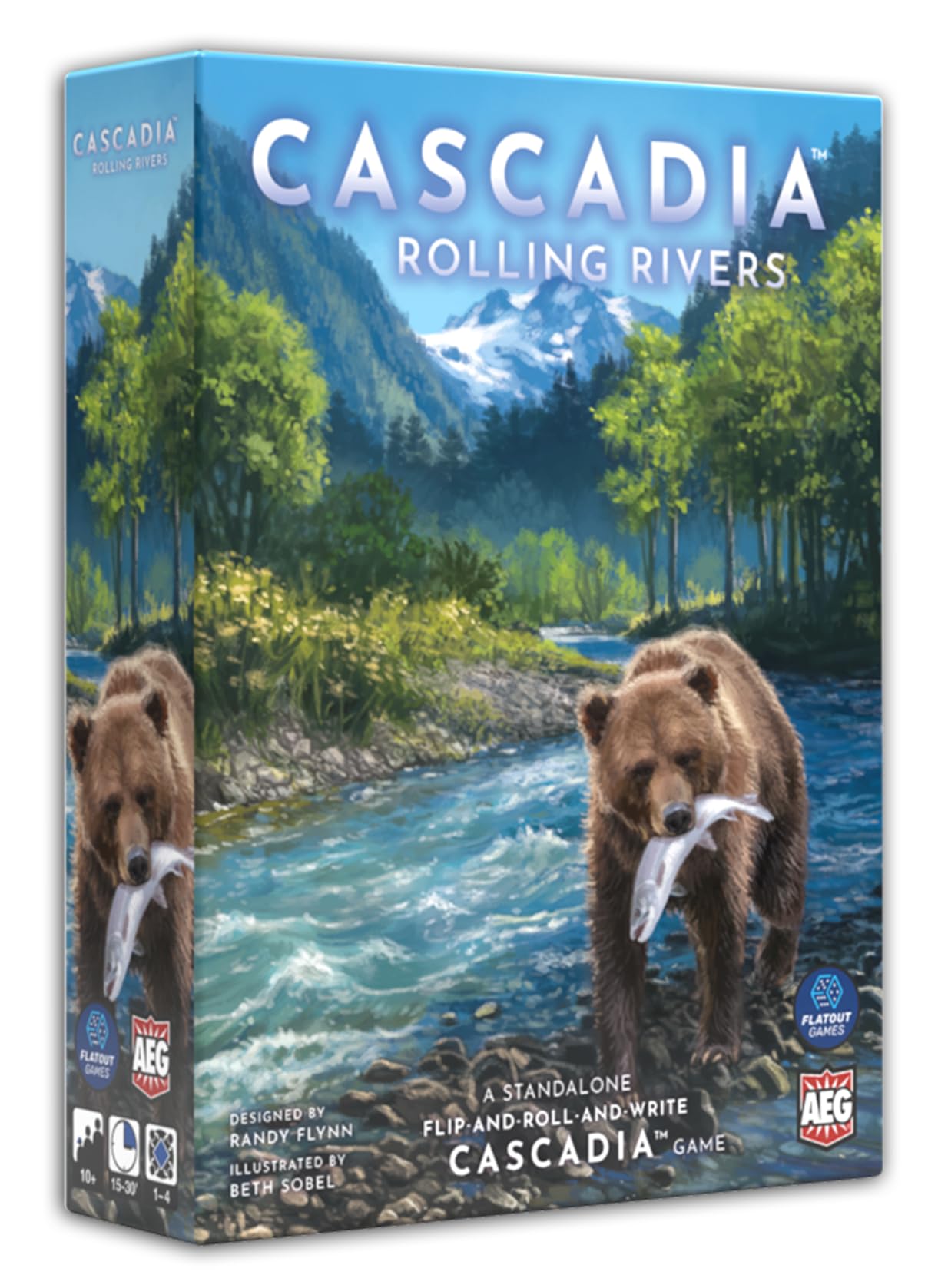
Cascadia: Rolling Rivers

88 /100
Lab Score Excellent

Key details

Age
10 and up
Players
1–4
Play Time
15–30 minutes
Components
Wooden dice and paper sheets
View on Amazon

Wooden dice and Beth Sobel's Pacific Northwest artwork make this the prettiest thing on the list, and that counts for more than it sounds like: a game left on the coffee table is a game that gets played.

Under the art is a flip-and-roll puzzle that plays one to four in fifteen to thirty minutes. Family mode is why this is the one we hand to a mixed-age table, and solo mode is a real mode rather than a line in the rulebook. A second copy or the Rolling Hills set takes it to eight.

What surprised us was how much the sheets reward patience. There are habitats and wildlife to balance against each other, and the sheet you fill on instinct in game one is the one you regret by game three. Rolling wood instead of plastic is a small thing that makes the whole box feel considered.

Pros

  • Wooden dice and Beth Sobel artwork
  • Family mode plus a full solo mode
  • Two copies or Rolling Hills seat eight

Cons

  • Paper sheets rather than reusable boards
Our verdict

Hand this to a mixed-age table and everyone finds a level — gentle scoring, wooden dice, and a solo mode we're glad is there.

Check Latest Price
7

Best Themed Pick

Dinosaur Island: Rawr 'n Write

90 /100
Lab Score Outstanding

Key details

Age
10 and up
Players
1–4
Play Time
30–45 minutes
Components
10 DNA dice, 2 sheet pads
View on Amazon

Ten amber DNA dice come out of the bag on turn one, and that's the moment a table of dinosaur-obsessed kids stops asking how long the game takes.

The box is fuller than most here: a board, a dice bag, season and first-player markers, two pads of double-sided park sheets, twenty specialist cards, twenty building cards and ten solo AI cards. Setup is a few minutes rather than a few seconds.

Play runs thirty to forty-five minutes for one to four, and choosing DNA dice, hiring specialists and building attractions makes this a genuine little engine rather than a row of numbers to fill in. Two pads of double-sided sheets mean plenty of plays before paper becomes the issue.

It's our pick when the table includes people who would never call themselves board gamers. The theme does the recruiting, the dice do the rest, and the solo AI cards mean the box still earns its shelf space on a quiet night.

Pros

  • Ten custom amber DNA dice
  • Solo AI cards included in the box
  • Double-sided park sheets, two pads

Cons

  • Wants more table than a pad-and-dice game
Our verdict

We bring this out when the table includes someone who would rather look at dinosaurs than rules — the theme recruits, the engine keeps them.

Check Latest Price
8

Long Game Nights

Twilight Inscription

87 /100
Lab Score Excellent

Key details

Age
14 and up
Players
1–8
Play Time
90–120 minutes
Components
32 player sheets, 8 markers
View on Amazon

Ninety to a hundred and twenty minutes is not a roll-and-write's usual number, and Twilight Inscription is unapologetic about it: this is the one for a whole evening, not the twenty minutes before dinner.

Four tracks — Navigation, Expansion, Industry and Warfare — carry the whole game, and every turn is a decision about how far to push on each. The sheets are big and plentiful: thirty-two player sheets plus a Mecatol Rex sheet, enough for a full eight without a photocopier.

Eight dry-erase markers come in the box, which is a nicer touch than it sounds when you're seating eight, and the cards cover factions, events, objectives, relics, agendas, references and the speaker token — the full apparatus of a big-box strategy game, redirected onto paper.

Fourteen-plus is honest about the density: four interlocking systems and a lot of icons. The Play as You Learn guide is the part we point a new table at before the first turn.

We think it's worth owning for a specific kind of night rather than every night. If your table already likes sprawling science fiction strategy and wants that scope without a four-hour setup, this is as close as a roll-and-write gets.

Pros

  • Seats eight with sheets to spare
  • Four interlocking tracks to balance
  • Dry-erase markers included

Cons

  • Needs a committed two-hour table
  • Big box to store between games
Our verdict

We keep this for a committed game night: eight seats, four interlocking tracks, and a two-hour arc no fifteen-minute filler can give you.

Check Latest Price
9

Gifts for Hikers

Parks Roll & Hike

80 /100
Lab Score Excellent

Key details

Age
10 and up
Players
1–4
Components
Spiral journals, dice, pencil box
View on Amazon

Somebody at Keymaster decided a roll-and-write should feel like a gift, so Parks Roll & Hike ships with individual spiral journals, camp-ready dice and a pencil box with a deluxe eraser — and the eraser is a proper block rather than an afterthought.

The journals are the idea. You sketch landmarks, spot wildlife and record a route through six named parks: Yosemite, Death Valley, Glacier, Arches, Great Smoky Mountains and Acadia. Every player gets their own book, which is a very different feeling from a shared pad.

One to four players, ten and up, and the magnet-closure box is built for a backpack rather than a shelf. Setup is opening a magnetic flap, and the whole thing packs back down without a plastic insert to fight.

The family that hikes is the family this is for, and so is the person who owns three games and wants a fourth that looks good between them. It's the nicest thing here to hand somebody.

Pros

  • Spiral journals and a pencil box
  • Magnet-closure box for travel
  • Six named national parks

Cons

  • Lightest strategy of the group
Our verdict

It's the one we hand over as a gift: spiral journals, a pencil box and six national parks make it the nicest thing here to open.

Check Latest Price

How We Tested the Best Roll and Write Games

We started by pulling together a shortlist from a year of game-night recommendations, publisher catalogs, and the shelves of a local board-game cafe, then filtered for player count, playtime, age range, and price—anything that needed a dedicated table or a 30-minute teach was set aside. That left 14 games, which we played over six months.

Testing happened where these games actually get played: Tuesday dinners, weekend game nights with kids and adults, a long train ride, a hotel room, and a picnic table that turned out to be slightly too small. Each game got at least three plays, and I timed setup and the first teach, then watched for the moment someone asked "wait, what do I do?" We noted whether the rulebook answered that question or sent us to a video.

For gameplay, we watched whether turns stayed interesting after the first round and whether anyone was playing on autopilot. For strategy, we compared score sheets after repeated plays to see if experience changed decisions, or if luck flattened the field. Family-friendly meant watching a younger player's turn without a referee and checking whether the iconography made sense without reading every line aloud. Portability got a blunt test: we packed each game into a tote with a notebook and a water bottle, then checked whether sheets stayed flat and dice stayed accounted for. For game speed, we timed setup and the first teach, then noted whether players stayed engaged through a full sheet or started drifting.

How to Choose a Roll and Write Game

Dice or cards: two different engines

Roll-and-writes run on dice; flip-and-writes run on a deck of cards, and the difference shows up in the last third of a game. A die can produce any face on any turn, so a badly planned sheet can still be rescued. A deck runs down, and once the good cards are gone, everybody at the table knows it.

Choose dice if your group likes pushing its luck and the clatter of a shared roll; choose cards if you want a puzzle with a shape you can plan around. Qwixx and Railroad Ink Challenge are pure dice. Welcome To... is cards. Cascadia: Rolling Rivers uses both, which is part of why it feels gentler than either.

Seats, downtime and playing alone

Most games here are built so everyone scores on every turn, which means a five-player game doesn't take three times as long as a two-player one. Check that before you buy for a group: a box that claims eight players but passes the dice around will leave somebody waiting with an empty sheet.

Player count and solo support are separate questions. Fleet: The Dice Game, Cascadia and Dinosaur Island all include a one-player mode or deck, and that is the difference between a game that gets played on a Tuesday and one that waits for guests.

Match the play time to the evening

Fifteen minutes and two hours are different purchases. A short game earns its place in a bag and on a weeknight; a long one needs a table that has already committed. The number on the box is play time for people who know the rules — add ten to fifteen minutes for a first teach.

Work backwards from your worst case. If the group meets for ninety minutes, Twilight Inscription at ninety to a hundred and twenty is the whole evening, while Railroad Ink's twenty to thirty leaves room for three games and an argument about the second one.

Pads, pens and the cost of playing again

Paper is the part of this hobby that keeps costing. Most of these games are a pad plus dice, and a household that plays often will finish the pad; refills are sold separately, so check that you can buy them before you fall for a game with a beautiful sheet.

Dry-erase boards are the alternative: they last, but they need wiping between rounds and the markers dry out. Whichever you end up with, use pencils on paper sheets — a felt-tip bleeds through and turns a double-sided sheet into a single-sided one.

Frequently Asked Questions

Final Verdict

Qwixx is the one we'd put in most hands if we could only pick one: shortest, simplest, cheapest to live with, and the game people ask to play again. For a bag, a restaurant table or a family dinner that has fifteen minutes to fill, nothing here does the job more easily.

Change the requirement and the answer changes. Regularly more than five players? Welcome To... solves a problem Qwixx can't. A group that wants a game with an arc and a score to chase should go to Fleet: The Dice Game, and a long night with committed players belongs to Twilight Inscription.