Best Sim Racing Wheel Stands of 2026

A sim racing wheel stand is supposed to disappear under your wheel and pedals — not become another thing to fight. If your wheel base rocks under braking or your pedals slide away mid-corner, you're not racing; you're managing a wobbly table. The right stand locks everything down so you can feel the tires, not the flex. We tested 10 stands over eight months to find the ones that actually do that.

I've clamped wheels to desks and coffee tables, and I've learned that the best stand isn't the one with the most knobs — it's the one that stays put when you stomp the brake. Value matters here, but so does assembly: a stand that takes an hour to build and another ten minutes to unfold every time will end up in a closet. I also care about weight and mounting options, because a stand that's too heavy to move or won't fit your wheel base is a stand you'll resent. Below are the picks that survived real laps and real living rooms, sorted by how they handle the messy reality of a home rig.

1

Best Overall

GT Omega Apex Wheel Stand

90 /100
Lab Score Outstanding

Key details

Fold
Folds with wheel attached
Frame
Steel Y-frame box tubing
Weight
35.3 lb
Adjustment
Height and wheel tilt
View on Amazon

A single run of steel box tubing bent into a Y is the whole idea here, and it's why this stand took the top spot: the two arms run forward under the pedal plate while the spine rises from behind them, so a hard brake pushes into the floor rather than tipping the frame away from you. Height and tilt both adjust at the wheel deck, and the shifter plate bolts to either side.

Rigidity is where it separates from the cheaper stands in this group. Under a mid-range belt-driven base the deck barely moves on a fast correction, and the pedal plate doesn't creep forward when you stamp on the brake — the two things that wreck a lap and that no amount of adjusting fixes afterwards. The fold surprised us as well: the frame swings down with the wheel, pedals and shifter still bolted on, so clearing the room takes seconds rather than a toolkit.

What that steel costs is weight. At 16 kg it's a two-handed lift, and the only stand here heavier is the Next Level Racing 2.0 — if this has to go up a flight of stairs every night, be honest about whether you'll do it. For a setup that lives in one room and folds against the wall between sessions, the trade is worth making.

Pros

  • Y-frame keeps the deck quiet under braking
  • Folds with wheel, pedals and shifter attached
  • Height and tilt adjustment at the wheel deck
  • Shifter plate fits either side

Cons

  • 16 kg frame is a two-handed lift
Our verdict

Our default recommendation: a rigid Y-frame that takes a shifter either side and folds with the wheel still attached.

Check Latest Price
2

Best for Desk Chairs

GTPLAYER Sim Racing Wheel Stand

90 /100
Lab Score Outstanding

Key details

Weight
22 lb
Wheel Tilt
20 degrees
Chair Fixing
5 fixed and 2 sliding wheel cups
Height Range
20 cm
View on Amazon

Two sliding wheel cups and five fixed ones come in the box, and that's the detail that makes this our pick for anyone racing from an office chair: drop the castors into the sliding cups, park the fixed set behind them, and the chair stops rolling backwards when you brake. It's a low-tech answer to the most annoying part of chair-based racing, and it works. At 10 kg it's also the easiest stand here to shift out of the way, and the whole Logitech G-series range bolts straight on.

Height adjusts through 20 cm on a rotating knob, and the wheel deck tilts 20 degrees up or down — enough to move between a tall adult and a child in a couple of minutes, which matters in a house where more than one person races.

The savings show up at the contact points. The feet are plastic, and they skate on hardwood and laminate when you brake hard; a rug or a chair mat under the front legs fixes most of it. The pedal plate slots are tight as well, and not every pedal set lines up with all four holes without persuasion.

Pros

  • Chair wheel cups included in the box
  • 10 kg, easy to move between sessions
  • 20 cm height and 20 degree tilt
  • Covers the full Logitech G-series range

Cons

  • Plastic feet slide on hard floors
  • Tight pedal plate slots
Our verdict

This is the stand we hand to a Logitech owner with an office chair: it locks the castors, folds flat, and the plastic feet just need a rug.

Check Latest Price
3

Best for Fast Setup

DIWANGUS Racing Wheel Stand

89 /100
Lab Score Excellent

Key details

Weight
21.1 lb
Assembly
90% pre-assembled
Pedal Angles
15, 30, 45, 60 degrees
Wheel Deck Height
20 to 34 in
View on Amazon

Three main pieces, a bag of bolts and a printed manual is what comes out of the box, and it's why this one had us driving sooner than anything else here. The wheel deck, pedal plate and shifter bracket arrive pre-drilled for the Logitech, Thrustmaster and Fanatec patterns, so there's nothing to drill and very little to guess.

The frame is an A-frame rather than the single spine most budget stands use, and the difference shows up where it counts: the legs take braking force straight down, and the deck stays composed under a mid-range base. It also folds with the wheel, pedals and shifter attached, which is the feature we kept coming back to in a small room.

Push a stronger force-feedback base and the deck starts to flex, which is the honest boundary of this one. The shifter bracket sits at a single height with no adjustment, and the plastic rack-and-pinion lock that holds the fold is the piece to keep an eye on; engaged properly, it's fine.

Pros

  • Arrives 90 percent pre-assembled
  • Folds with wheel, pedals, shifter attached
  • A-frame takes the braking load
  • Wheel deck 20 to 34 in, four pedal angles

Cons

  • Deck flexes under strong force feedback
  • Shifter bracket height fixed
Our verdict

Set up in minutes and folds with the wheel still on — we keep coming back to it for a mid-range base in a small room.

Check Latest Price
4

Best Upgrade Path

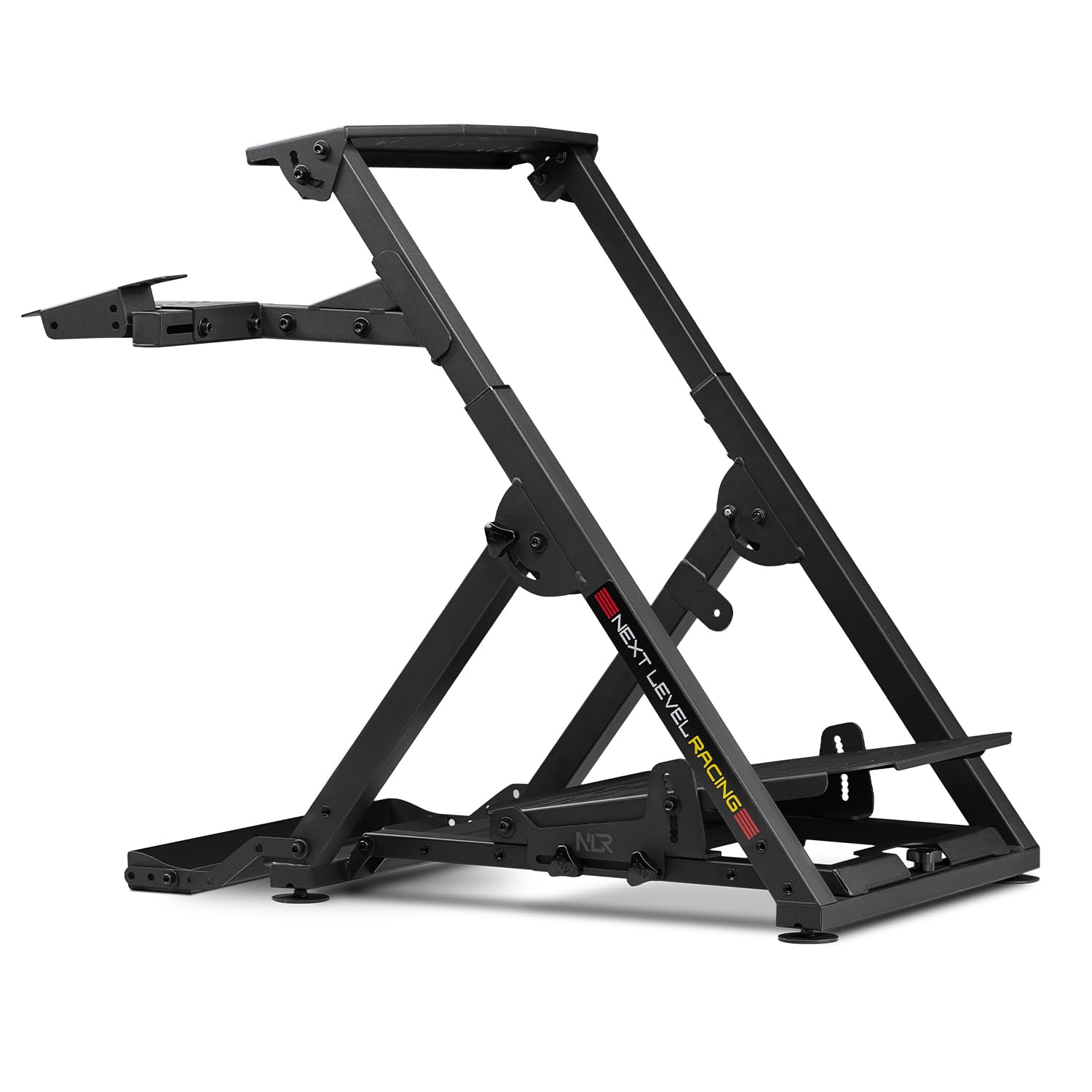
Next Level Racing Wheel Stand 2.0

87 /100
Lab Score Excellent

Key details

Fold
Foldable for storage
Weight
48.5 lb
Upgrade
GTSeat add-on, sold separately
Shifter Mount
Gear shifter and handbrake, either side
View on Amazon

The GTSeat add-on is what separates this from every other stand here: bolt the seat frame on and you have a full cockpit without replacing the base you already bought. That's the reason to spend more, and the reason this is the stand we point at for anyone who expects to still be racing in three years.

Until then it's a heavy, quiet frame. The wheel deck doesn't budge under a T300-class base, the pedal plate adjusts through a wide arc, and the shifter and handbrake plates can sit on either side at their own height. The chair cradle at the front is a small piece of bent steel that solves a bigger problem than it looks like: it catches your gaming seat before it slides away under braking.

Rigidity is where this one is strongest in the group, and it's the stiffness plus the upgrade path that keeps it in the conversation at its price rather than the fold or the finish.

The trade is 48.5 lb of frame. It folds, but folding and moving it are two different jobs and the second one is a chore without castors or a second pair of hands. If it's staying in one spot, none of that matters.

Pros

  • Converts to a full cockpit with GTSeat add-on
  • Shifter and handbrake, either side
  • Chair cradle stops seat slide
  • Near-zero deck movement under load

Cons

  • 48.5 lb and awkward to move alone
Our verdict

The stand we point at if you want a frame that grows into a full cockpit: rock-solid under load, with shifter and handbrake support on either side.

Check Latest Price
5

Best for Entry-Level Wheels

Next Level Racing Wheel Stand Lite 2.0

86 /100
Lab Score Excellent

Key details

Weight
30.9 lb
Upgrade
Victory Seat add-on
Chair Cradle
Included
Wheelbase Rating
Up to 10 N.m
View on Amazon

Ten newton-metres is the number to read first. That's the wheelbase rating Next Level Racing puts on the Lite 2.0, and it comfortably covers a Logitech G923, a Thrustmaster T300 or a T248 while ruling out the strong direct-drive bases — so for an entry-level wheel this is the sensible spend, with the same chair cradle and shifter plate the bigger stand uses at a weight one person can fold.

Within that envelope it does most of what the 2.0 does. Height, distance and angle all adjust at the wheel deck, the shifter plate moves to either side, and the cradle at the front stops your seat sliding back. At 14 kg it's a far easier object to carry than its heavier sibling, and the fold takes seconds because nothing has to come off first.

Two things to know before you commit. The bolts at the adjustment joints work loose over a few sessions and want a check with an Allen key, and there's a little fore-and-aft play at the deck if you pull on the rim. Neither showed up with entry-level force feedback; both would bother someone running a stronger base, which loops back to the rating.

Pros

  • Rated for wheelbases up to 10 N.m
  • Chair cradle included at the front
  • 14 kg and quick to fold
  • Shifter plate fits either side

Cons

  • Not for high-torque direct drive
  • Adjustment bolts work loose
Our verdict

Our pick for an entry-level belt-driven wheel: the same chair cradle and shifter plate as the bigger stand, at a weight you'll actually fold.

Check Latest Price
6

Best for Odd Base Patterns

CAMMOO Racing Wheel Stand

85 /100
Lab Score Excellent

Key details

Wheel Tilt
30 degrees
Wheel Panel
31 mounting holes
Height Range
25.2 to 34.3 in
Shifter Panel
26 mounting holes
View on Amazon

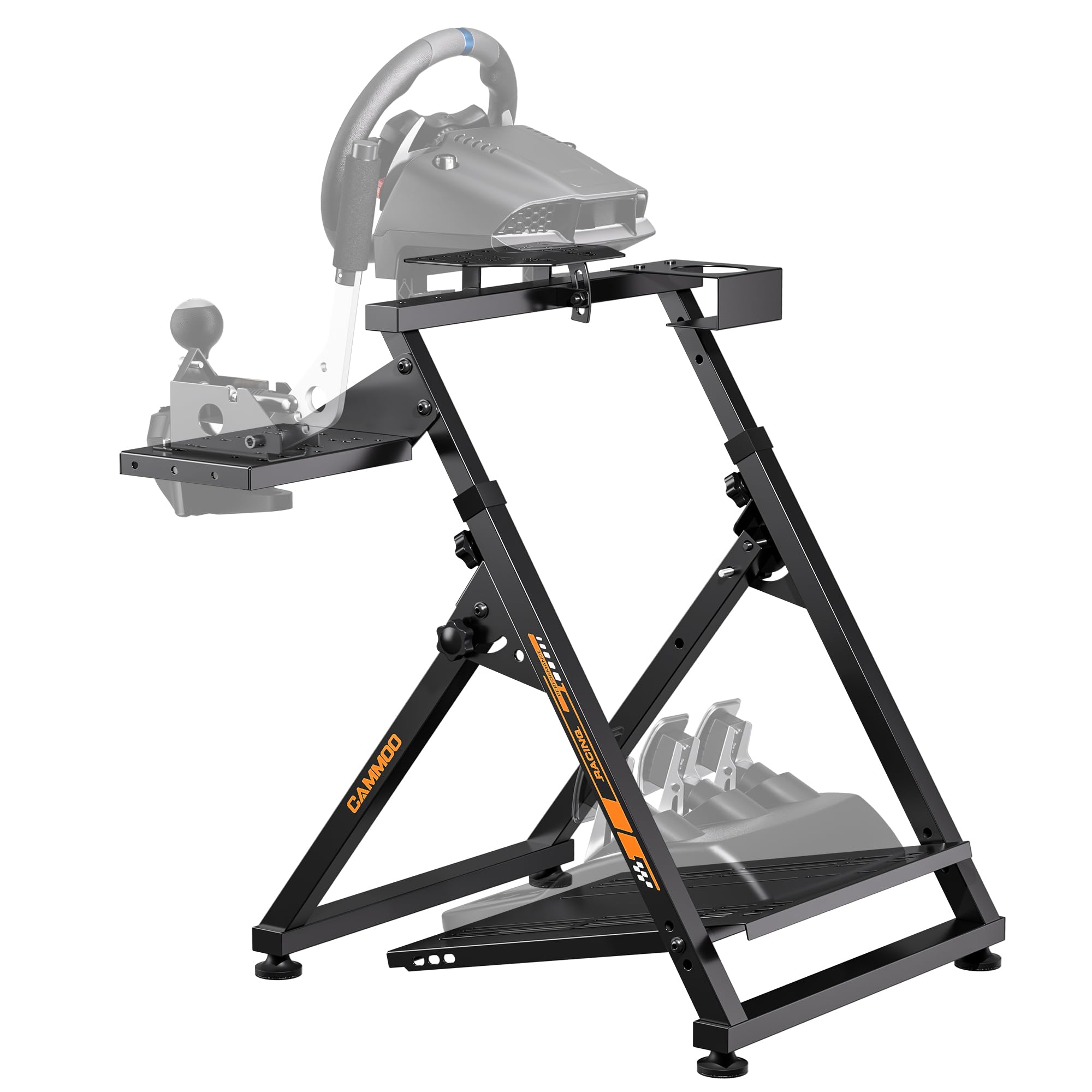
Thirty-one holes in the wheel panel and 26 in the shifter panel is the pitch, and the practical version is simple: whatever odd base, handbrake or third-party shifter you own, there's probably a pair of holes that lines up. That's not a small thing in a category where plenty of stands only really fit a Logitech.

The rest of the specification is unusually complete for the money. The wheel deck runs from 25.2 to 34.3 inches with 30 degrees of tilt, the pedal plate has three positions, and the frame is rated for direct-drive wheels up to 25 N.m — a bolder number than anything else at this level, and one to treat as a ceiling rather than a target.

Folding happens at the fixing knobs rather than on a hinge, which is slower than the swing-fold stands here but still gets it under a bed. There's a cup holder and a set of cable straps in the box; the wheel mounting bolts don't come with it, so plan on M6 hardware if your base doesn't include a clamp you like.

For a mixed-brand setup or a base with an awkward footprint, this is the one we reach for. Worth checking before each session: the shifter and handbrake plate works loose under repeated hard pulls, and a quick tighten keeps it honest.

Pros

  • 31-hole wheel panel and 26-hole shifter panel
  • Rated for direct-drive wheels up to 25 N.m
  • 25.2 to 34.3 in height and 30 degree tilt
  • Cup holder and cable straps included

Cons

  • Wheel mounting bolts not included
Our verdict

We reach for this one with an awkward base pattern: the widest hole coverage here, and the only budget stand claiming direct-drive torque.

Check Latest Price
7

Best for Hard Floors

Marada X Frame Wheel Stand

86 /100
Lab Score Excellent

Key details

Extras
Cup holder, swappable shifter panel
Weight
31.5 lb
Assembly
Over 80% pre-installed
Seat Slot
Holds chair castors
View on Amazon

A slot at the front of the frame catches your chair's castors and holds the whole setup together, and that's the part we ended up relying on, because it turns an office chair into something that behaves like a fixed seat under braking.

The rest is well judged for the money. The X-frame with its double triangle is stiff through the wheel deck, the rubber feet hold on hardwood in a way the plastic-footed stands here don't, and it arrives over 80 percent built. The cup holder and the shifter panel swap sides if you race with the shifter in your left hand.

Sit it on a hard floor in front of an office chair and it behaves like a much dearer stand: it's stiffer than the budget group and it doesn't need a rug under it to stay put.

Pros

  • Seat slot holds a rolling chair in place
  • Rubber feet grip hard floors
  • Over 80 percent pre-installed
  • Stiffer than the budget frames

Cons

  • Shifter plate rocks under firm shifts
  • Few pedal plate mounting holes
Our verdict

For a rolling chair on a hard floor, this is the stand we trust: a stiff X-frame, a seat slot that works, and rubber feet that grip.

Check Latest Price
8

Lowest Cost

VEVOR Racing Wheel Stand

87 /100
Lab Score Excellent

Key details

Fold
Folds without disassembly
Weight
19.1 lb
Chair Bar
Front crossbar
Shifter Mount
Left or right, height adjustable
View on Amazon

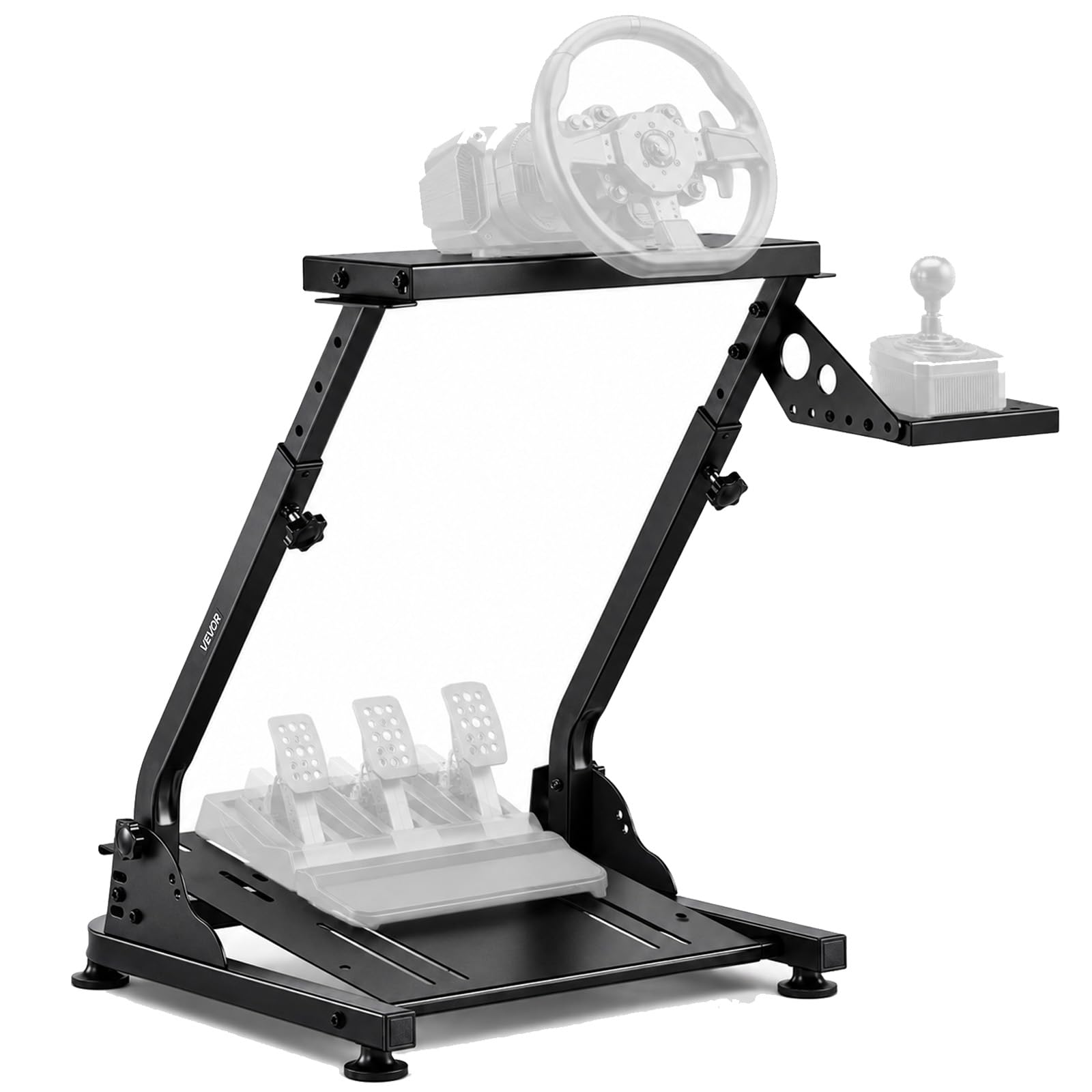
This is the least expensive stand in the group, and it's worth being clear about what that does and doesn't buy. The carbon steel frame and pre-drilled deck cover the Logitech, Thrustmaster and Fanatec patterns, the shifter bracket moves left or right, and the whole thing folds without taking the wheel off.

The detail we appreciate most is the front crossbar. It sits low across the base and stops a chair's castors rolling forward — the cheapest possible version of the chair cradles on the Next Level Racing stands, and it does most of the same job. Height and pedal angle adjust on knobs, and at 19.1 lb you can move it one-handed.

Where it loses ground is at the top of the column. Under a strong base the wheel deck wobbles, and the higher you set it the more of that you feel; keep the deck low and it behaves.

The instructions are diagram-only and the hardware bags don't always match the pictures, so line up a build video before you start. For a light Logitech base at low height, it covers the essentials for less than anything else here.

Pros

  • Front crossbar blocks chair castors
  • Folds without removing the wheel
  • Shifter bracket either side, height adjustable
  • 19.1 lb and easy to move

Cons

  • Wheel column wobbles under a stronger base
  • Diagram-only instructions
Our verdict

Our budget entry point: a chair crossbar, a shifter bracket and a fold, for a light Logitech setup in a small room.

Check Latest Price

How We Tested the Best Sim Racing Wheel Stands

We built our shortlist by reading owner threads and spec sheets for mid-range wheel stands, filtering out anything with known flex complaints or vague mounting patterns. From that pool, we ordered 10 stands — folding designs, fixed frames, and adjustable rigs — and used each one for eight months in a home office and a living room. Testing happened on carpet and hardwood, with a belt-driven wheel base and a direct-drive unit, plus two pedal sets (one with a load-cell brake).

Each stand arrived flat-packed, and we timed assembly from opening the box to the first lap using only the included instructions. We noted whether the steps were clear, whether bolts lined up without force, and how often we had to re-read a diagram. We also folded and unfolded each stand ten times, timing the process and checking whether hinges loosened or adjustments held. Height, angle, and pedal distance were adjusted on every stand, with notes on whether tools were needed and whether settings survived a session.

On track, we ran laps in iRacing and Assetto Corsa and watched for front-to-back rocking, side-to-side sway, and creaking from the pedal plate under heavy braking. We measured how far each stand crept across the floor after 30 minutes and checked whether the wheel deck flexed when we pulled on the rim. We test-fit three wheel bases and two pedal sets, noting pre-drilled holes, slots, and clamp options, and we weighed each stand to judge whether one person could move it between rooms. Finally, we compared what each stand offered for its price — sturdiness, adjustability, mounting flexibility, and finish quality — to judge value.

How to Choose a Sim Racing Wheel Stand

Frame shape does more than steel thickness

Braking sends force forward and down through the pedal plate; steering sends it sideways through the wheel deck. A single-spine frame resists the first badly and the second barely at all, which is why the cheapest stands here wobble at the top of the column. Triangulated shapes — the Y-frame on the GT Omega Apex, the A-frame on the DIWANGUS, the X-frame on the Marada — route that load into the floor instead.

The practical rule: if you run a load-cell brake or a strong direct-drive base, buy triangulation first and features second. On a Logitech G923 with its standard pedal set, a budget single-spine stand on a rug is genuinely enough.

What actually folds, and what you unbolt first

Folding means two different things here. On the GT Omega Apex, the DIWANGUS and both Next Level Racing stands, the frame swings down with the wheel, pedals and shifter still bolted on. On others you loosen knobs and collapse it in stages, which is fine once or twice a year and tedious nightly.

Weigh the folded object, not the bare frame. A 16 kg stand carrying a wheel, a pedal set and a shifter is a two-handed lift, and the stands people stop putting away are the ones that hurt to move. If the stand is staying in one spot, this whole section is optional.

Adjustment has to match the chair you already own

Every stand here adjusts, but not in the same directions. Height and wheel tilt are near-universal; pedal angle is common; fore-and-aft distance is where the budget frames fall short. The CAMMOO deck runs from 25.2 to 34.3 inches, the DIWANGUS from 20 to 34, and the Next Level Racing stands add more travel in both directions than either.

One trap: on several of these frames, pulling the wheel closer to you also raises it, so a comfortable reach leaves you peering over the rim. Set height first, then distance, then pedal angle, and check the wheel's center finishes below your shoulders.

Check the hole pattern before anything else

There's no standard bolt pattern, so every stand relies on a panel of pre-drilled holes and slots. Wide panels matter most with Fanatec, Moza or Simagic bases; the CAMMOO's 31-hole wheel panel and the DIWANGUS's Logitech, Thrustmaster and Fanatec coverage are the broadest answers in this group, and the GTPLAYER's tight pedal slots are the narrowest.

Shifter and handbrake plates are usually the afterthought: check the plate moves in height and swaps sides, and expect to supply your own bolts in some cases. Then match the frame to the base — the Next Level Racing Lite 2.0 is rated to 10 N.m, so a strong direct-drive unit belongs on the 2.0 instead.

Feet, floors and keeping the chair where it is

A stand that stays put while your chair rolls backwards is only half a solution. Chair wheel cups on the GTPLAYER, the seat slot on the Marada, the cradle on both Next Level Racing stands and the low front crossbar on the VEVOR all do the same job by different means. Any of them beats nothing.

Feet matter just as much. Plastic pads skate on wood and laminate; rubber grips. On a hard floor, buy a stand with rubber feet or put a rubber mat under the front legs — and the same mat that stops the sliding usually kills the last of the deck wobble.

Frequently Asked Questions

Final Verdict

Buy the GT Omega Apex. It's the stand that gave us the least to think about while driving: the deck stays quiet under hard corrections, the shifter sits where you want it, and it folds with everything still bolted on. The one question is whether you'll genuinely move it, because 16 kg is a two-handed job.

If your wheel is a G923 or a T300 and the frame needs to be lighter, the Next Level Racing Wheel Stand Lite 2.0 is the better fit. If you want to be racing before the box is fully flattened, choose the DIWANGUS.