Best Stacking Games of 2026

Game night is going well right up until the tower starts leaning on its own. That slow, unearned collapse — nobody touched it — usually isn't the players' fault; it's the set's. Blocks cut a hair too thin or sanded too slick turn a game of nerve into a game of luck, and a splintered edge can end the round early. A good stacking game makes the opposite promise: pieces that slide out cleanly, stack true, and land with a satisfying clack, so the only thing wobbling is your hand.

I've been the one pulling a block from the middle while the whole table holds its breath. Over the past six months, my team and I played our way through 14 stacking games — classic hardwood sets, oversized lawn versions, a few colorful plastic twists — on coffee tables, kitchen counters, and one memorably uneven picnic blanket. The surprise: thickness consistency matters more than tower height, and a well-sanded finish is what keeps the game fair for a six-year-old and a grandparent alike. The picks below are the ones that held up.

1

Best Overall

Jenga Classic

96 /100
Lab Score Outstanding

Key details

Ages
6 and up
Blocks
54 hardwood blocks
Players
1 or more
Included
Stacking sleeve with instructions
View on Amazon

Nobody needs the rules explained, and that is most of why this is the one we recommend first. Fifty-four hardwood blocks, a stacking sleeve, and a tower that gets more interesting the longer it stands: that is the whole game. Setup takes about a minute, the box says ages 6 and up, and it plays with one person or a dozen.

What the hardwood buys you is predictability. The blocks are machined to the same size and finished so they slide out with a steady pull instead of snagging halfway, which is what makes a collapse feel fair rather than random. We also like how far down it scales: it is the only pick here that plays properly on a small coffee table and still feels tense with four people crowded around it. And on a rainy afternoon, one person can stack alone — the rules cover that, and hardly anyone remembers it.

The sleeve is the weak link. It is the piece that squares the tower when you rebuild, and it is thin card rather than anything sturdier, so it softens long before the blocks show wear. Lay it flat between games instead of folding it into a drawer and it holds up fine.

Pros

  • Fifty-four machined hardwood blocks that slide predictably
  • Rules that need no explanation for any age
  • Plays solo as well as with a group

Cons

  • Stacking sleeve is thin card, not wood
Our verdict

This is the stacking game we tell most people to buy: simple enough for a 6-year-old, tense enough for adults, and it works on any kitchen table.

Check Latest Price
2

Best Travel Stacking Game

Tinderblox

95 /100
Lab Score Outstanding

Key details

Ages
6 and up
Players
2 to 6
Packaging
Mint tin
Play Time
15 minutes
View on Amazon

The game is in the tweezers. You pick up a tiny wooden log with a pair of plastic tweezers and set it on the growing campfire, following a card that dictates which way the piece has to face. That single constraint turns a pile of blocks into a real test of a steady hand.

What we appreciate most is how small the whole proposition is: a mint tin about the size of a deck of cards, 2.72 ounces, and a round that can be finished before the food arrives. It plays two to six, the box says 6 and up, and it holds up with a six-year-old and with an adult who assumed their fine motor control was better than it is.

Two practical notes. It needs a firm, flat surface — a picnic blanket or a sofa cushion makes the whole thing pointless — and if the tweezers are too much for a younger player, set them aside and let that player build by hand. The stack is just as unforgiving either way, which is the point.

Pros

  • Tweezers turn stacking into a real dexterity test
  • Mint tin fits in a coat pocket at 2.72 ounces
  • Rounds short enough to play while waiting

Cons

  • Pieces are small enough to lose easily
Our verdict

If the game has to travel, this is the one we pack: a tin that disappears into a bag and a tweezers-based stack that is genuinely hard to win.

Check Latest Price
3

Best Backyard Tower

Megwoz Giant Tumble Tower

94 /100
Lab Score Outstanding

Key details

Ages
6 and up
Blocks
57 pine blocks
Players
2 to 12
Included
2 dice, scoreboard, carry bag
View on Amazon

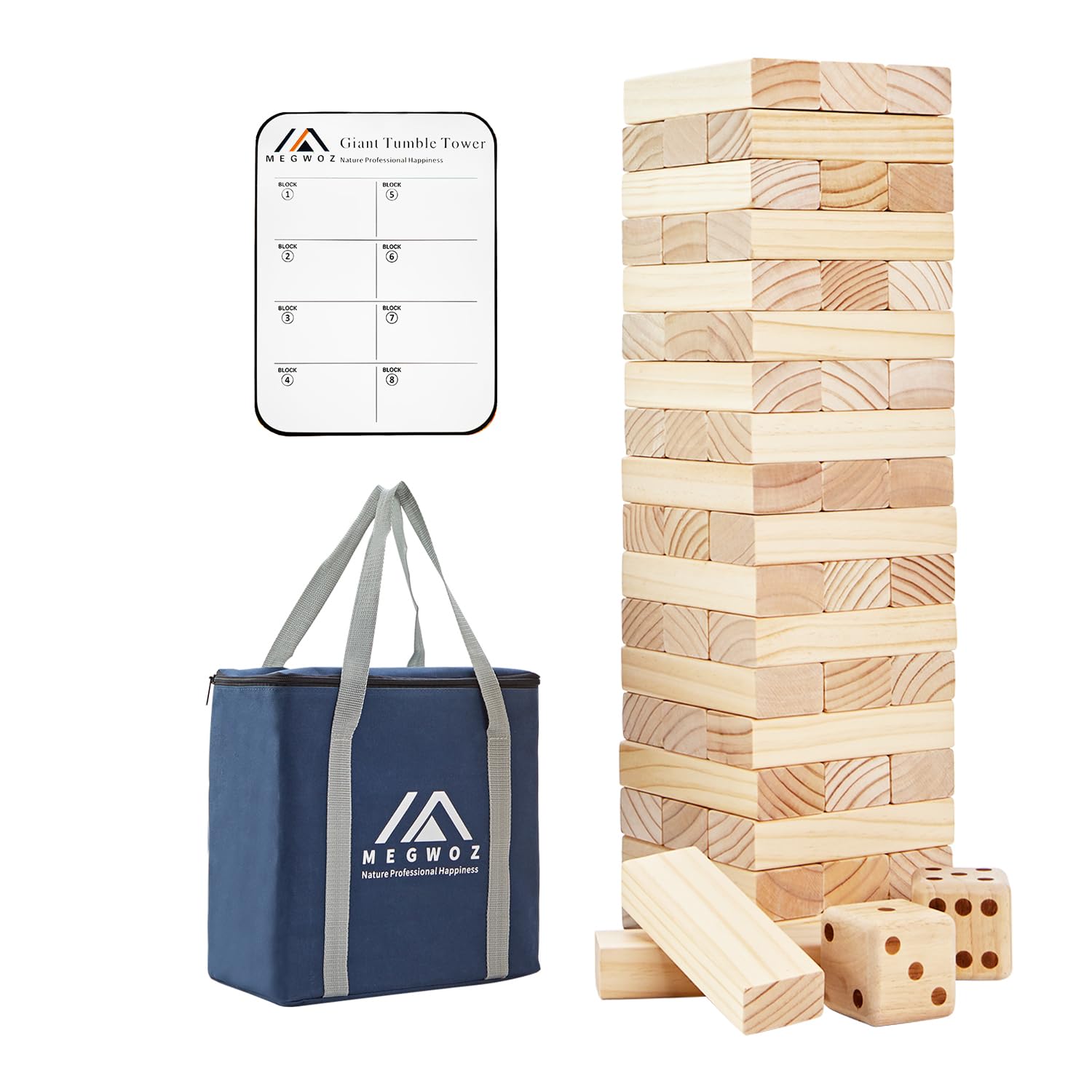
Two dice and a scoreboard do not sound like much, but they change what a giant tower is for. Instead of pulling blocks until something falls, you are rolling, scoring, and playing to a finish. We think that is what makes this the set to buy for a party where someone will inevitably want to know who won.

Fifty-seven blocks is three more than a standard tumbling set, which matters more than it sounds when a block disappears into the grass. The blocks are New Zealand pine, the zippered bag swallows the whole set, and the box claims two to twelve players and ages 6 and up. That range is the appeal: a six-year-old and a grandparent can take turns in the same round.

Where it earns its place is the format. Set it up at the start of an afternoon and it stays out, because a round lasts as long as people want it to and the scoring gives the next one a shape. Ours goes to tailgates and birthdays before any tabletop set in the cupboard.

Pros

  • Dice and scoreboard turn it into a scored game
  • Fifty-seven blocks means spares
  • Zippered bag carries the full set

Cons

  • Pine edges dent if the set is handled roughly
Our verdict

For a yard, a deck, or a tailgate, this is the tower we reach for: the dice and scoreboard give a crowd something to play for.

Check Latest Price
4

Best Fast-Paced Family Game

BUILDZI by TENZI

95 /100
Lab Score Outstanding

Key details

Ages
6 and up
Cards
32 tower cards, 32 block cards
Blocks
32 plastic blocks
Players
2 to 4
View on Amazon

This is the stacking game for a family that would rather race than take turns. Flip a card and everyone builds the same tower at the same time; the first to match it takes the round. We recommend it for households where a careful, communal tower gets boring after two goes.

The box holds 32 chunky plastic blocks, 32 double-sided tower cards, 32 block cards, and rules for seven different games, from a straight race to versions where the cards dictate which pieces you are allowed to touch. The pieces are tough enough for a classroom and wipe clean, and there are printed directions for packing everything back in, which sounds trivial until you have tried to close a game box in a hurry.

Two to four players out of the box; the party variants push it higher, and the usual fix is a second set, which plenty of families end up buying once the first one lands. Rounds are over in minutes, so treat it as the opener rather than the whole evening.

Pros

  • Seven different games in one box
  • Simultaneous play keeps everyone busy
  • Plastic pieces survive classrooms and family rooms

Cons

  • Rounds end in minutes
Our verdict

Families who want a race rather than a slow build should start here: seven games, tough pieces, and rounds short enough for a school night.

Check Latest Price
5

Best Solo Skill Builder

Speed Stacks Stacking Set

94 /100
Lab Score Outstanding

Key details

Ages
36 months to 20 years
Cups
12
Carrier
Holding stem
Players
1
View on Amazon

Every other game on this list needs a second person. This one does not. Twelve cups and a holding stem, and the entire game is how quickly you can stack the patterns and collapse them again, which makes it the pick for a kid who wants to practice in the hallway on a Tuesday.

We were struck by how cleanly the cups release. The design is centerless, so there is no suction between them when you pull one off a stack, and the plastic is low-friction so cups slide past each other instead of grabbing. That is the difference between a toy and something a child can actually get faster at over a month.

The gap is measurement. There is no timer and no stacking mat in the box, and both are how you track progress — a phone stopwatch covers the first and a mousepad or non-slip mat covers the second. Add those two and a solo game becomes a personal record attempt, which is what keeps it out of the cupboard.

Pros

  • Centerless cups release without suction
  • Holding stem keeps the set together
  • Made to official sport-stacking specification

Cons

  • Instructions are online only, not printed
Our verdict

Buy this for the kid who practices alone: the cups release cleanly, the stem keeps all twelve together, and progress is easy to measure.

Check Latest Price
6

Preschool Bluey Fans

Bluey Tumbling Tower

92 /100
Lab Score Outstanding

Key details

Ages
3 and up
Blocks
54 printed wooden blocks
Weight
1.7 lb
Players
Up to 6
View on Amazon

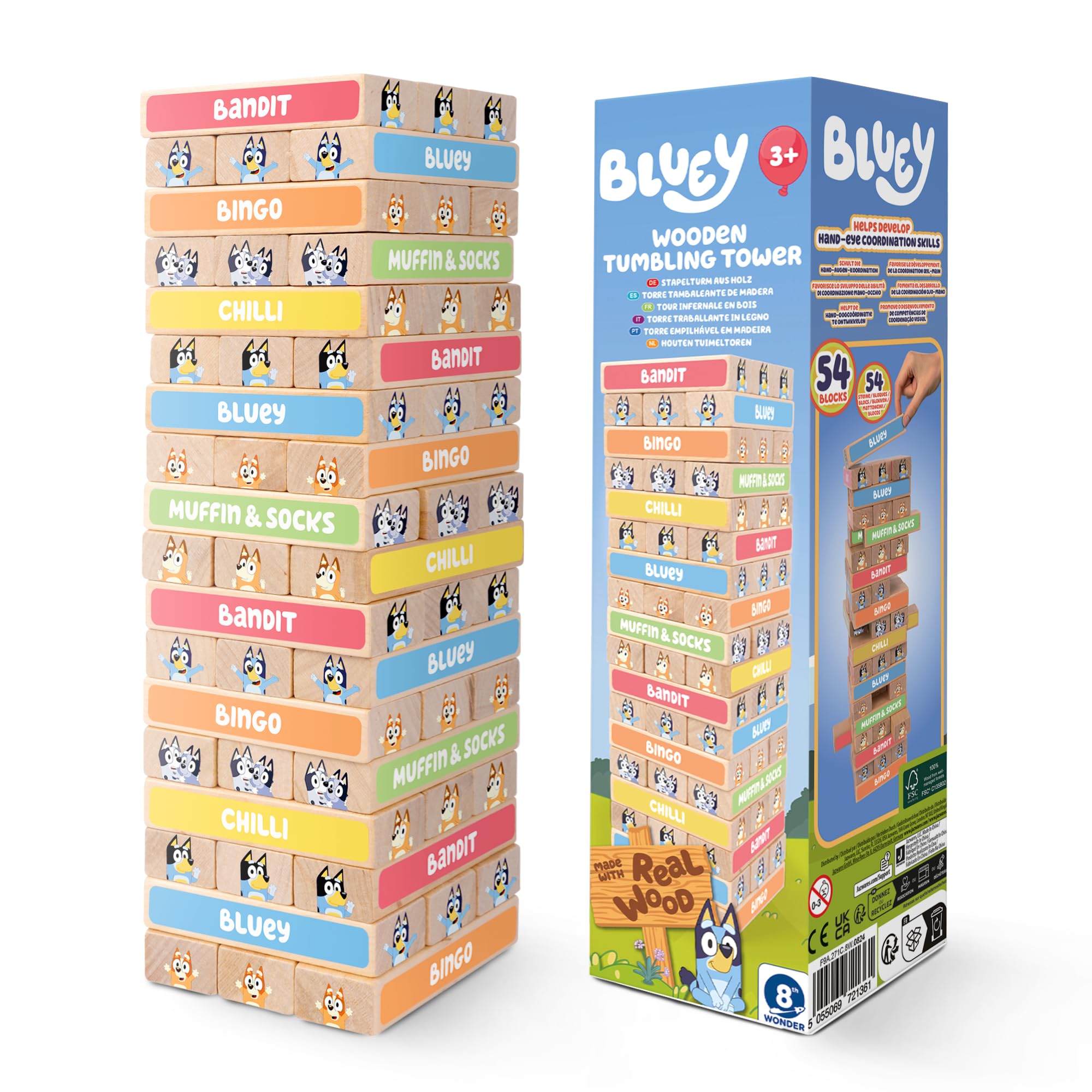
Fifty-four wooden blocks printed with Bluey, Bingo, Bandit, Chilli and the rest of the family. That is the pitch, and for a small child it is a convincing one.

Underneath the print it is a standard tumbling tower, and the blocks are about the size you would expect from any Jenga-style set. That is worth knowing, because the box says 3 and up while the classic version says 6 and up for very similar pieces, and the weight sits at 1.7 pounds. The print is what gets a preschooler to sit and take turns, and the set is pitched at up to six players, so siblings can join without a second box.

The finish is the catch. Printed blocks are slicker than bare wood, so the tower tends to slide before it topples, and a careful pull can still shift the stack. We treat it as a first tower rather than a serious one — and a first tower that actually gets played is worth more than a perfect one that stays in the box.

Pros

  • Fifty-four wooden blocks with recognisable characters
  • Familiar rules a young child can follow
  • Covers up to six players from one box

Cons

  • Printed blocks slide more than bare wood
Our verdict

A real tumbling tower with the Heeler family on it — the version that gets a preschooler to sit down and take turns.

Check Latest Price
7

Teen Game Nights

Tower Stack

91 /100
Lab Score Outstanding

Key details

Ages
14 and up
Players
1 or more
Material
Plastic
Components
Blocks, tower body, base, cards
View on Amazon

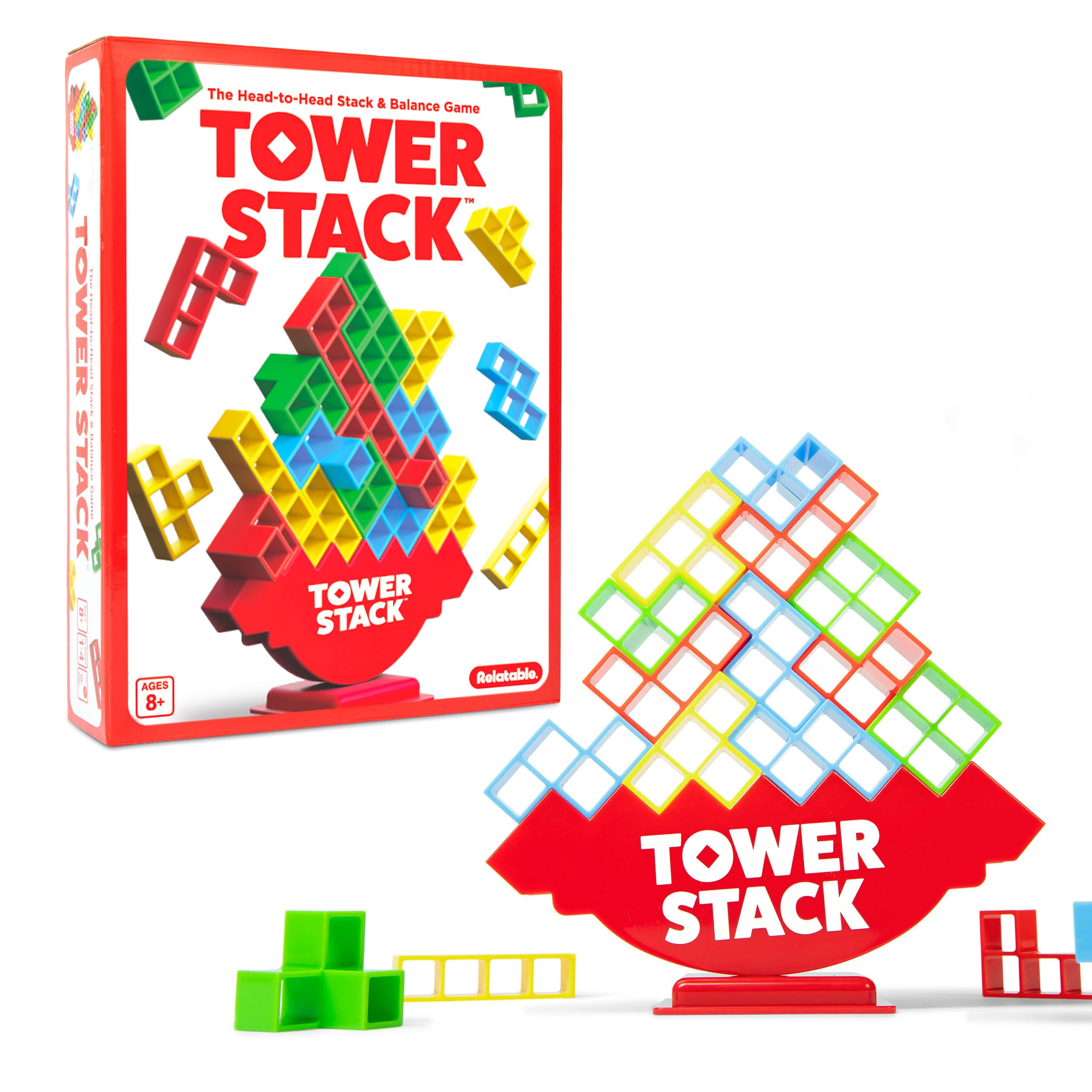
Most games here are a pile of blocks. This one comes with a tower body and a base, so the stack grows up through a frame rather than standing on its own. That frame is the entire idea, and it makes the first few turns far less of a disaster with younger players.

Cards drive it: you draw, then place pieces to match, and the tower gets top-heavy quickly. The box says 14 and up, which is well above the eight- and ten-year-olds who end up playing it, so be ready to explain that discrepancy if you are buying it as a gift for a younger child. Everything packs back into a small box that lives in a drawer.

It is built as a head-to-head challenge, and that is how it plays best: two people watching each other's tower wobble. Add more players and there is a lot of waiting between turns, which is the difference between this and the big party sets on this list.

Pros

  • Frame and base steady the stack for younger players
  • Cards add a task to every placement
  • Packs into a small box for storage

Cons

  • Built for two
Our verdict

A card-driven stacking duel with a frame that keeps the tower honest, and it plays best with two players and a competitive streak.

Check Latest Price
8

Restaurants and Bars

Cards vs Gravity

91 /100
Lab Score Outstanding

Key details

Ages
10 and up
Cards
Waterproof with color-blind symbols
Players
2 to 4
Requires
A bottle or can
View on Amazon

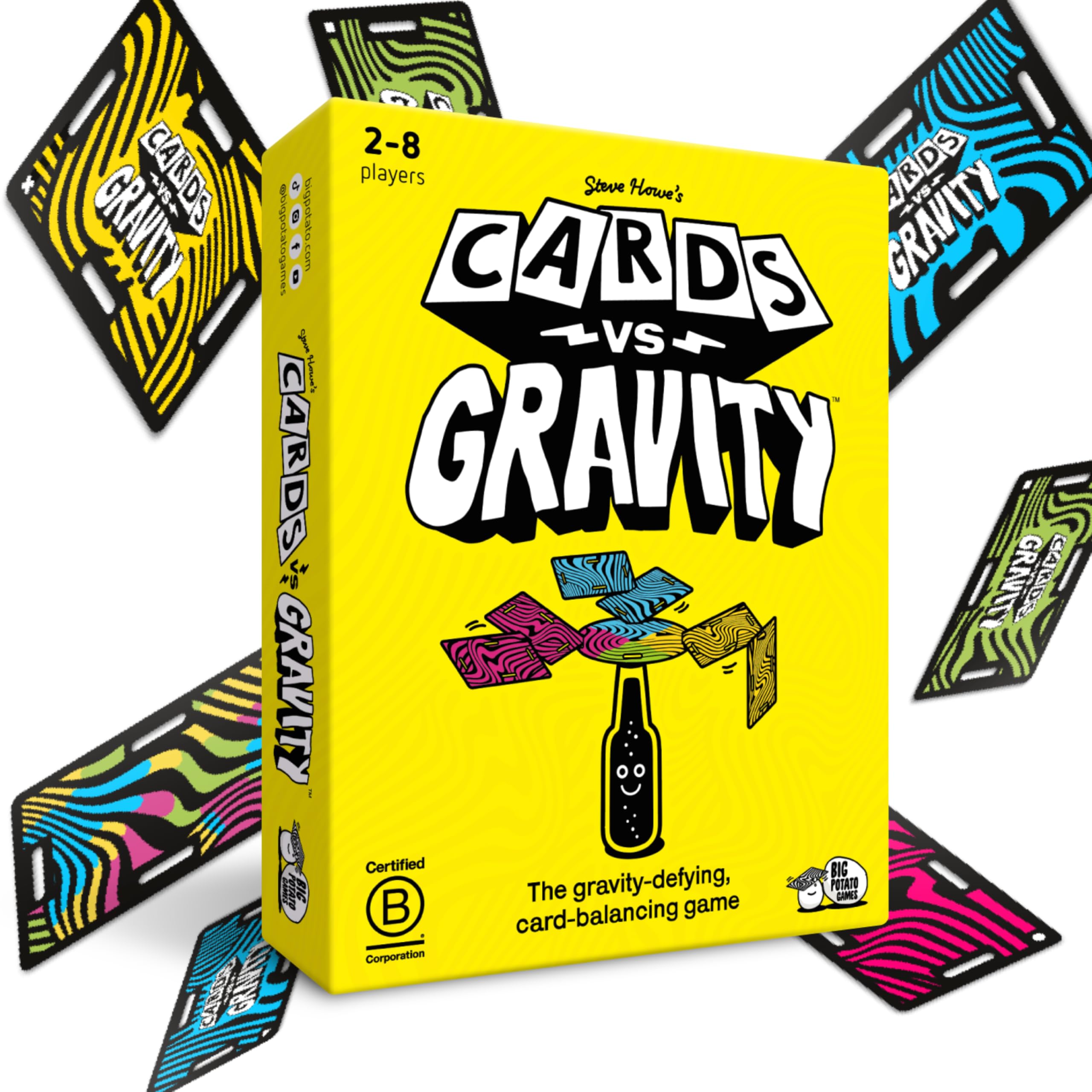
You need a bottle. That is the whole catch: a magnetic topper clips onto any bottle or can, and cards balance, hang, and stack off it until someone brings the lot down. It is a stacking game that fits in a coat pocket, and it is the one we reach for in a restaurant.

The cards are waterproof, which matters more than it sounds when they are balanced over a drink, and each of the five card types carries a symbol as well as a colour, so color-blind players are not guessing. It plays two to four, the box says 10 and up, and a round lasts as long as the card tree stays upright.

The deck is the ceiling. Play through most of the cards and the tree gets tall enough that the tension drains out of it, and there is no second deck in the box. Treated as a filler for the ten minutes before food arrives, it earns its place in the bag every time.

Pros

  • Waterproof cards survive a table full of drinks
  • Magnetic topper grips any bottle or can
  • Symbols as well as colours on every card type

Cons

  • You have to supply the bottle
  • Deck runs short before the tension does
Our verdict

The one to keep in the glovebox: waterproof cards, a topper that grips any bottle, and a stack that gets tense in about five minutes.

Check Latest Price
9

Classroom Play

ALKISTA Tetra Tower

90 /100
Lab Score Outstanding

Key details

Ages
13 and up
Base
2.7 x 6.7 inches
Cards
22 draw cards
Blocks
48 ABS blocks
View on Amazon

Forty-eight blocks in four colours, twenty-two draw cards, and a small base to build on. It is the least expensive way onto the table here, and it is the pick we point to when someone wants a balancing game for a classroom, a waiting room, or a bag rather than a game night.

What we noticed first is the base: 2.7 by 6.7 inches, smaller than most phone screens. Everything scales down with it. The blocks are small, the balance points are fine, and an adult has to concentrate. That is exactly right for a dexterity puzzle and wrong for a five-year-old, so the 13-and-up label on the box is worth taking seriously rather than treating as a formality.

The cards are where repeat plays come from, because they let a table invent rules once the basic stack gets familiar. The blocks are ABS, so there is no paint to peel and nothing to splinter, and the whole set packs into a tall, narrow box. It is the sort of thing that survives a term in a classroom.

Pros

  • Lowest-cost way to add a balancing game
  • Draw cards let a table invent its own rules
  • ABS blocks cannot peel or splinter

Cons

  • Small pieces and a 2.7 by 6.7 inch base
Our verdict

An inexpensive, small-footprint balancing game that suits classrooms and older kids — just do not expect it to be a toddler toy.

Check Latest Price
10

Custom House Rules

SPORT BEATS Wooden Tower

94 /100
Lab Score Outstanding

Key details

Ages
8 and up
Blocks
54 pine blocks, 6 x 2 x 1.3 inches
Players
2 to 6
Included
Dry-erase board, marker, carry bag
View on Amazon

Half of the fifty-four blocks are printed with numbers from one to eight, and the set ships with a dry-erase board and marker. The idea is that you write your own rules, dares, or scoring before the game and then play whatever you invented.

We think that is the best use of a big tower set. Straight pull-a-block rules wear out by the second round at a party, and a numbered block plus a whiteboard is enough structure to keep a group playing past dessert. The blocks are six inches long and stack from around 23 inches, and the whole set drops into a carrying bag that fits in a trunk.

Smoothness is the inconsistency. The blocks are sanded with rounded edges, but they do not all come out of the bag equally slick, so the odd pull catches and jerks the tower instead of sliding free. Sort the rougher blocks toward the bottom of the stack and the game runs noticeably smoother.

Pros

  • Twenty-seven numbered blocks for custom rules
  • Six-inch blocks make a substantial tower
  • Carry bag for transport and storage

Cons

  • Finish varies across the set, so some pulls catch
Our verdict

The giant tower to buy if you want house rules: numbered blocks, a dry-erase board, and six-inch pine that packs into a bag.

Check Latest Price

How We Tested the Best Stacking Games

We started by pulling together roughly 40 stacking games from major retailers, then narrowed the field by reading listings closely: block dimensions, wood species or plastic type, piece count, and whether replacement blocks were sold separately. Sets with mixed-thickness pieces or no stated materials got cut. Fourteen made it to testing, and we played each one for six months.

Every block in every set got measured with calipers — all of them, not a sample — since one thick piece can throw off an entire tower. We dropped blocks waist-high onto tile to see whether corners dented, ran a thumb along each edge for splinters, and noted how the finish felt. Then we played: sliding blocks out one at a time and recording whether they released cleanly or caught, and whether the tower shifted when it shouldn't have.

Setup and cleanup got timed, because a game that takes ten minutes to unpack rarely comes out twice. Most rounds happened at a kitchen counter after dinner and on a living room rug, with players from age six to seventy; we watched whether the rules clicked without an adult explaining them twice and whether smaller hands could grip the blocks comfortably. The oversized sets went outside, onto a picnic blanket and a slightly sloped patio.

To test balancing and stability, we stacked deliberately off-center and counted how many turns a tower survived before it fell, which separated the sets with consistent thickness from the ones that lean on their own. We also tallied blocks per dollar and checked whether the storage box or bag held up after six months of use. Anything that chipped, warped, or shed a finish went back on the watch list, and we'll update as we keep playing.

How to Choose a Stacking Game

Fit the footprint to the surface

Start with where the tower will stand, because that decides almost everything else. A tabletop set with blocks a few inches long — Jenga, Tinderblox, Tetra Tower — works on a coffee table and disappears into a drawer afterwards. A six-inch pine tower needs a floor, a deck, or a patio, and a four-foot stack wants a firm, level surface; grass, gravel, and a sloped driveway are all bad hosts.

Watch the word outdoor on a listing. It usually means the set packs into a car trunk and survives a picnic, not that it stands up on a lawn. If you want a tower on grass, plan on a flat board or a picnic table underneath it.

Read the height claim carefully

Advertised heights describe the tower at its tallest, which is the end of a long game once every pulled block has been returned to the top. The starting stack is much shorter — one six-inch set begins around 23 inches — so judge a set by its block dimensions and starting height rather than the headline figure.

That matters most at a party, where the game may only run a few rounds before someone knocks it down. A shorter tower that gets rebuilt three times beats a four-foot tower nobody reaches.

Consider the finish, not just the wood

Bare, sanded hardwood is the most predictable thing to play on: blocks release with a steady pull instead of snagging. Printed, painted, or varnished blocks look better and slide differently — often slicker, which makes the tower shift before it actually falls. Rough or chipped edges do the opposite and catch halfway through a pull.

Plastic is the practical choice for outdoor or classroom use. It wipes clean, does not splinter, and survives being dropped in a bag, though light pieces move more when the table gets bumped.

Match the crowd, not the label

Box ages vary enormously for near-identical games — one tumbling tower here says 3 and up, a wooden classic says 6, and a framed plastic duel says 14 — while the pieces are much the same size. Look at the block size and the dexterity the game demands, then treat the label as a starting point.

Player counts matter too. Some sets are genuinely solo-friendly; others are built for two; the party versions claim up to a dozen. If you regularly have a crowd, a set with spare blocks and a scoring twist keeps more people involved.

Think about how it packs away

Storage is a buying decision, not an afterthought. Zippered bags swallow a full set and take the knocks a trunk dishes out; tins are smaller and better for cards and pocket games; display boxes are for shelves.

If the game leaves the house, weigh the container as part of the purchase. A tin that fits in a coat pocket or a waterproof deck gets played in places a boxed tower never will.

Frequently Asked Questions

Final Verdict

Start with Jenga. It sets up in a minute, plays with one person or eight, and the blocks behave the same way every time you pull one, which is why it is still the game we hand to people who ask what to buy.

If your tower lives outdoors, take the Megwoz set for the spare blocks and the dice. If it travels in a bag, take Tinderblox. Neither replaces Jenga; they answer a different question about where you play.