Best Tabletop Pool Tables of 2026

A tabletop pool table has one job: convince everyone it's not a toy. Cheap ones give themselves away fast—wobbly legs, felt that pills after a week, cues that feel like chopsticks—and the fun ends before the first rack. The good ones feel solid, roll true, and look like something you'd leave out on purpose. They turn a spare corner or a rainy afternoon into a real game of pool without dedicating a whole room to it.

I grew up with a foldable mini table that lived under the bed, and I remember the groan when the rails sagged. Over the past six months, my team and I have put 12 tabletop pool tables through their paces, from compact foldaways to furniture-grade cabinets, and the differences show up by the second game. Felt weight and cushion rebound matter more than footprint—a slightly larger table with cheap cushions plays worse than a small one with tight rails. The keepers store without drama, come with usable cues, and feel worth the money every time you pull them out.

1

Best Overall

Mainstreet Classics 20-Inch Mini

88 /100
Lab Score Excellent

Key details

Weight
5.6 lb
Pockets
Six, with automatic side ball return
Included
2 cues, ball set, triangle, chalk, brush
Table Dimensions
20.2"L x 12.4"W x 3.7"H
View on Amazon

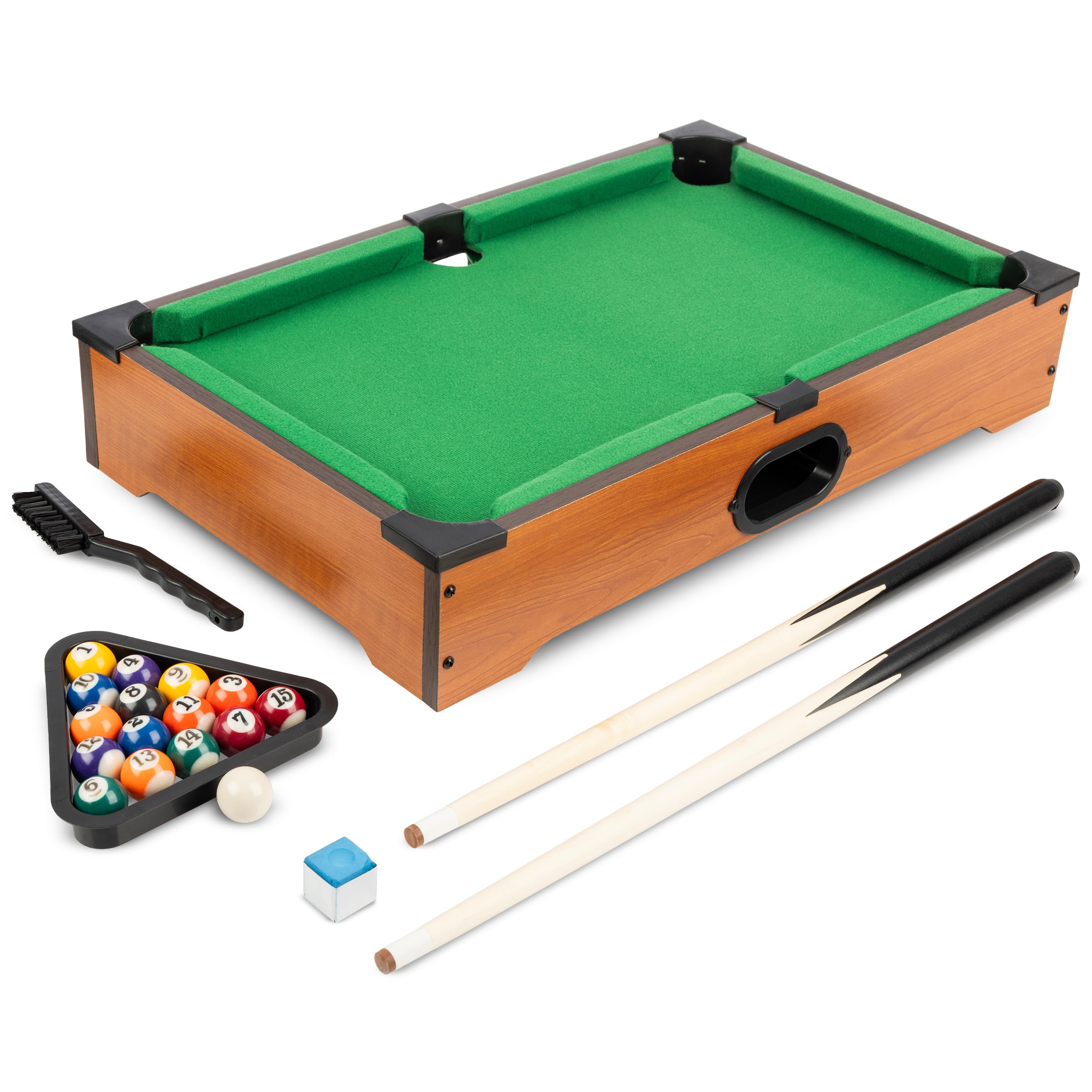
Six pockets feed a single automatic side return, which means a ball never has to be dug out of a net. The cabinet measures 20.2 by 12.4 inches and stands 3.7 inches tall, so it drops onto a coffee table or the end of a kitchen counter and reads as a shrunken pool table rather than a toy: green felt, rails, a proper triangle, two cues, chalk and a brush all in the box.

For most people shopping this category, that's the one. It's the closest thing to a real table at this size, there's no assembly at all, and at about 5.6 pounds it goes into a closet or under a bed without a second thought. We've had it out on a dining table for an evening and packed away the same night, which is more than the bigger sets here allow.

Hardware is the part to watch. Rail screws work loose with enthusiastic play, and a screwdriver plus two minutes puts them right; do it in the first week and the rails stay true. Beyond that the cabinet has held up without complaint, and the felt has stayed put along the rails.

It's labeled 13 and up, and that fits: the cues and balls are scaled for adult hands, and younger kids will get more out of a cheaper set nobody minds them being rough with. As a dorm-room table, a desk toy for a small apartment, or a way to settle an argument after dinner, it earns its spot.

Pros

  • Automatic side return keeps play moving
  • Complete set with no assembly
  • About 5.6 pounds, easy to stash
  • Felt and rails look like a real table

Cons

  • Side pockets cut into the playfield
Our verdict

This is the one we tell people to buy: complete in the box, small enough for a coffee table, and the ball return keeps a game moving.

Check Latest Price
2

Largest Playfield

Best Choice Products 40-Inch

88 /100
Lab Score Excellent

Key details

Legs
Removable, storage bag included
Weight
16 lb
Included
2 cues, ball set, chalk, triangle, brush
Table Dimensions
40"L x 21.5"W x 8"H
View on Amazon

Forty inches of playfield is roughly twice the length of the 20-inch sets here, and it is the difference between a novelty and a game you can actually play. You can lag a ball the length of the table, work a rail shot, and miss for a reason you can name. This is the one we set up when a dining table is going spare and the evening has settled in.

It asks for that space back. The cabinet runs 40 by 21.5 inches and weighs 16 pounds, so it wants a full table and a corner to live in. The legs come off and everything packs into the included storage bag, but that bag is the size of a golf bag rather than something you tuck into a drawer. Assembly is a short job involving legs and bolts, not an afternoon.

What the size buys is a composite wood frame with non-slip strips under the legs and panel bottoms, cue clips underneath for the sticks, and a full accessory set. The balls are not close to regulation size whatever the marketing suggests, and they run fast and fussy on the smaller bed. The table itself we found sturdy and level, with no wobble once the legs were seated.

For adults and older kids who want a proper game and have somewhere to leave it set up, this is the best of the bunch. If it has to go back into a cupboard every night, the 20-inch tables are far easier to live with.

Pros

  • Twice the playfield of the 20-inch sets
  • Sturdy frame with non-slip feet
  • Legs come off and pack into the bag

Cons

  • Needs a full dining table's worth of space
Our verdict

Buy this if there's a dining table to spare: 40 inches of playfield turns a mini set into a game with real angles and real misses.

Check Latest Price
3

Best Budget

Hey Play 20-Inch Mini

85 /100
Lab Score Excellent

Key details

Age Range
14 years and up
Ball Size
1 inch
Cue Length
18.75 inches
Table Dimensions
20.25"L x 12.25"W x 3.5"H
View on Amazon

Two numbers on this listing do the real work: the balls are 1 inch across and the cues are 18.75 inches long. Scale those against a real table and the trade every mini set makes becomes obvious. You stand closer, you see less of the angle, and the cue ball covers more of the distance between the rails than your hands expect.

At the lowest price of the four, this is the set we recommend to anyone who wants a table for occasional evenings rather than a hobby. The wood cabinet measures 20.25 by 12.25 inches and stands 3.5 inches tall, and it arrives with two sticks, 16 balls, chalk, a brush and a triangle, so there's nothing to buy before the first frame.

Six pounds of wooden table sits solidly on a counter and still goes back on a shelf afterwards, and the felt has stayed taut where cheaper cabinets start to ripple. Nothing about the build feels disposable at this price.

Height is what decides where you play. On a kitchen counter the 3.5-inch cabinet puts the playfield at a workable height for an adult standing over it; on a coffee table it becomes a floor-sitting game. The counter is where this one plays best.

Pros

  • Least expensive set in this group
  • Ball and cue sizes stated up front
  • Full accessory set, ready to play

Cons

  • Fourteen-and-up rating rules out younger kids
Our verdict

Our budget pick: it's the least expensive set here, lists its ball and cue sizes, and comes with everything needed for a first game.

Check Latest Price
4

Young Players

Matty's Toy Stop 20-Inch

83 /100
Lab Score Excellent

Key details

Weight
5 lb
Included
16 balls, 2 cues, 2 chalk cubes, brush, triangle
Age Range
6 years and up
Table Length
20.3 inches
View on Amazon

Fifteen colored balls, a cue ball, two sticks, two cubes of chalk, a brush and a racking triangle: the box that arrives here is the most complete of the four, and it's what makes this one a gift rather than a purchase you assemble from parts.

The table itself is the familiar 20-inch formula, a felted cabinet 20.3 inches long and 3.7 inches tall with rails and pockets in scale. The wood-grain finish reads warmer than the plain painted frames on some of the others, and at 2.27 kg we found it easy to shift between rooms while the game follows you around the house.

Rated from age 6, it's the youngest-friendly set in this group, and a seven- or eight-year-old is clearly who it's built for. That's also the honest limit: grown-ups will find the 20-inch bed cramped after a few frames, and a tall player leaning over it will feel the short cues.

Two cubes of chalk is a small thing to get right, but it's the sort of detail that separates a gift set from a bag of parts, and the brush means the felt gets looked after from the first evening rather than the tenth.

Pros

  • Complete 16-ball set with chalk and brush
  • Rated from age 6, the lowest here
  • Wood-grain cabinet finish

Cons

  • One to two month shipping window
Our verdict

The pick for a household with young players: rated from age 6, with a full 16-ball set, chalk, brush and triangle in the box.

Check Latest Price

How We Tested the Best Tabletop Pool Tables

We started by pulling together every tabletop pool table we could find that was actually playable—wood or composite frames, replaceable felt, and cues longer than a drumstick—then narrowed the list by footprint, folded dimensions, and whether the box included balls, cues, chalk, and a rack. We ended up with 12 tables and lived with them for six months, rotating them through a finished basement, a dining room, and a small apartment living room. Weeknight games after dinner and weekend two-player tournaments were the real test.

Setup and storage came first: we timed how long each table took one person to assemble, then folded or disassembled it and tucked it into a closet, under a bed, or on a shelf for a week to see if the mechanism held. During play, we ran full racks, bank shots, and cut shots, noting whether balls rolled straight or drifted toward the rails. We banked the same shot 20 times on each table to check cushion rebound, and we inspected the felt after a month for pilling, stretching, and cue marks.

Cue quality got its own pass—we checked straightness, tip condition, and weight, and had a 10-year-old and a six-foot adult take turns shooting. We also left each table out in the living room for a week to judge appearance: did it look like furniture or a toy? Finally, we compared what came in the box against what we had to buy separately, because a cheap table that needs new cues and a better rack isn't a bargain.

How to Choose a Tabletop Pool Table

Measure the Table, Not the Room

For a tabletop set the question isn't floor space, it's whether the surface you have in mind is wide enough and whether you can stand at the long side. A 20-inch table needs roughly 20 by 12 inches of flat, level surface, plus about a foot of clear space along each long side for your stance. The 40-inch Best Choice Products model wants a dining table, not a coffee table.

Watch how the word compact gets used. A 40-inch cabinet is compact next to a real pool table and enormous next to a serving tray, and a set that ends up on the floor because no table fits is a set that stops being played.

Ball Size and Cue Length Tell You Who It's For

Mini tables shrink the balls before they shrink anything else, and that's what changes the game. A 1-inch ball covers a 20-inch bed quickly, so speed control matters more than spin, and a hard stroke is punished. Cue length matters just as much: an 18.75-inch stick makes you stand right over the table, which suits a child at a kitchen counter and feels cramped for a tall adult at a low coffee table.

The age rating is the fastest guide. The Matty's set starts at 6, the Mainstreet at 13, the Hey Play at 14, and those numbers track the size of the parts as much as the difficulty.

Pockets, Returns, and Getting the Balls Out

Two pocket designs dominate at this size: drop pockets you reach into, and an automatic side return that funnels balls to one collection point. On a small table we prefer the return, because you rack every few minutes and fishing a ball out of a shallow net breaks the rhythm of a game.

Look at the side pockets too. On 20-inch tables they are cut further into the playfield than regulation pockets would be, so bank shots off the rails play differently than they do on a full table. That's not a defect, but it explains the first ten minutes of confused shots.

What to Check in the First Month

These are light cabinets held together with small hardware, so treat the first few weeks as a shakedown. Tighten the rail screws once the table has had some play on it, and keep an eye on any felt that starts lifting at a corner. Store the table flat and dry rather than propped against a wall.

The cues in the box are the first thing worth replacing on any of these sets. A straighter, heavier stick does more for the experience than any other accessory, and upgrading one cue costs less than moving up a whole size class.

Frequently Asked Questions

Final Verdict

Buy the Mainstreet Classics 20-inch if you want a tabletop pool table you can use tonight. It's complete, the ball return keeps a game moving, and it takes up no more room than a serving tray — which is why it stays in rotation instead of ending up behind a sofa.

The exception is a household with room to spare and adults who want a real game: the Best Choice Products 40-inch plays differently enough to be worth the space and the money. Everyone else should start at 20 inches and see how often it comes out.