Best Tile Games of 2026

The best tile game turns a quiet table into a shared puzzle: everyone leaning in, sorting colors, arguing over one last placement. The category's built-in tradeoff is simple enough for a first-timer, deep enough that adults don't check out. A pretty set won't save a game if the colors blur under a lamp, the tiles slide when someone bumps the table, or a missing piece derails round three. The right one fixes that: clear tiles, a stable table presence, rules you can teach in a minute, and decisions that matter on the last turn.

I’ve spent four months playing 14 tile games with my family and a rotating crew of neighbors. The ones that stayed on the shelf weren't the flashiest; they were the sets where new players understood the goal by the second turn and experienced players still had a real choice. Tile games are sneaky that way — the real test is the tenth shuffle, when corners soften and one tile inevitably goes missing. The picks below survived that kind of repetition.

1

Best Overall

Rummikub

96 /100
Lab Score Outstanding

Key details

Ages
8 and up
Weight
1.1 lb
Players
2 to 4
Tile Material
Plastic
View on Amazon

The rule that sells Rummikub is the one people forget between games: on your turn you can pick up the tiles already on the table and rebuild them. A run of blue 4-5-6 becomes something else when someone lays a five beside it, and a layout one player spent three turns assembling can be re-sorted by the next person. That freedom is why a game with a one-page rulebook still leaves a table full of decisions.

We put it first because almost nobody is shut out. The tiles carry numbers in four colors, so a child who reads slowly plays the same game as an adult, and runs-and-groups is the only thing to teach. The first round or two are slow while everyone works out what counts as a legal group; by the third, the same players are rearranging without asking. That short hump is the only learning curve here, and it is worth sitting through.

Two players is fine and four is better, because more tiles on the table means more to rearrange and more to spoil. Eight and up is honest: a younger child can match colors and numbers, but the pleasure is in rebuilding, and that takes a little arithmetic nerve. It is a boxed game that lives on a shelf rather than in a bag, the trade for getting this much game into one box.

Pros

  • Rearranging the table is part of a turn
  • Numbers instead of words, so ages mix
  • One rule to teach, then real decisions
  • Plays well at two and better at four

Cons

  • Plain plastic racks and a cardboard box
Our verdict

Start here if you want one tile game everyone can play: numbers instead of words, a rulebook you can teach in a minute, and a table that changes on every turn.

Check Latest Price
2

Best Strategy

Azul

96 /100
Lab Score Outstanding

Key details

Ages
8 and up
Tiles
100 resin tiles
Players
2 to 4
Play Time
45 minutes
View on Amazon

The tiles are the first thing anyone picks up. They are resin rather than plastic, they click when they land, and the four player boards are thick enough that they do not skate when someone reaches across. Azul is the best-looking game in this group by a distance, and the components carry it: 100 patterned tiles, a linen bag worth drawing from, and a box that holds everything flat.

Play is a draft, and the meanness is the point. You take every tile of one color from a factory display, the leftovers slide to the middle, and the person after you is suddenly choosing between two bad options. Building your own mosaic is half the game; the other half is what you leave behind, which is why this one still holds up with adults who have played it a dozen times.

With two players the denial is sharp and personal. With four it gets loud and social, and the tiles run out faster than you expect. We happily play it either way, which is rare for something this tactical.

The rulebook is longer than the game. Read cold it takes a while; played once, it is obvious, and a group that deals a practice round gets to the interesting decisions sooner. If your table refuses to sit through rules, learn this one by doing.

Pros

  • Resin tiles with real weight and click
  • Draft and deny keeps every turn tense
  • Sharp at two, loud at four
  • Best-looking components in this group

Cons

  • Denying tiles is the point, and some tables hate it
Our verdict

Our pick when the table wants a real strategy fight: heavy resin tiles, a rule everyone learns in one round, and a draft that keeps adults quiet.

Check Latest Price
3

Best Tile-Laying Game

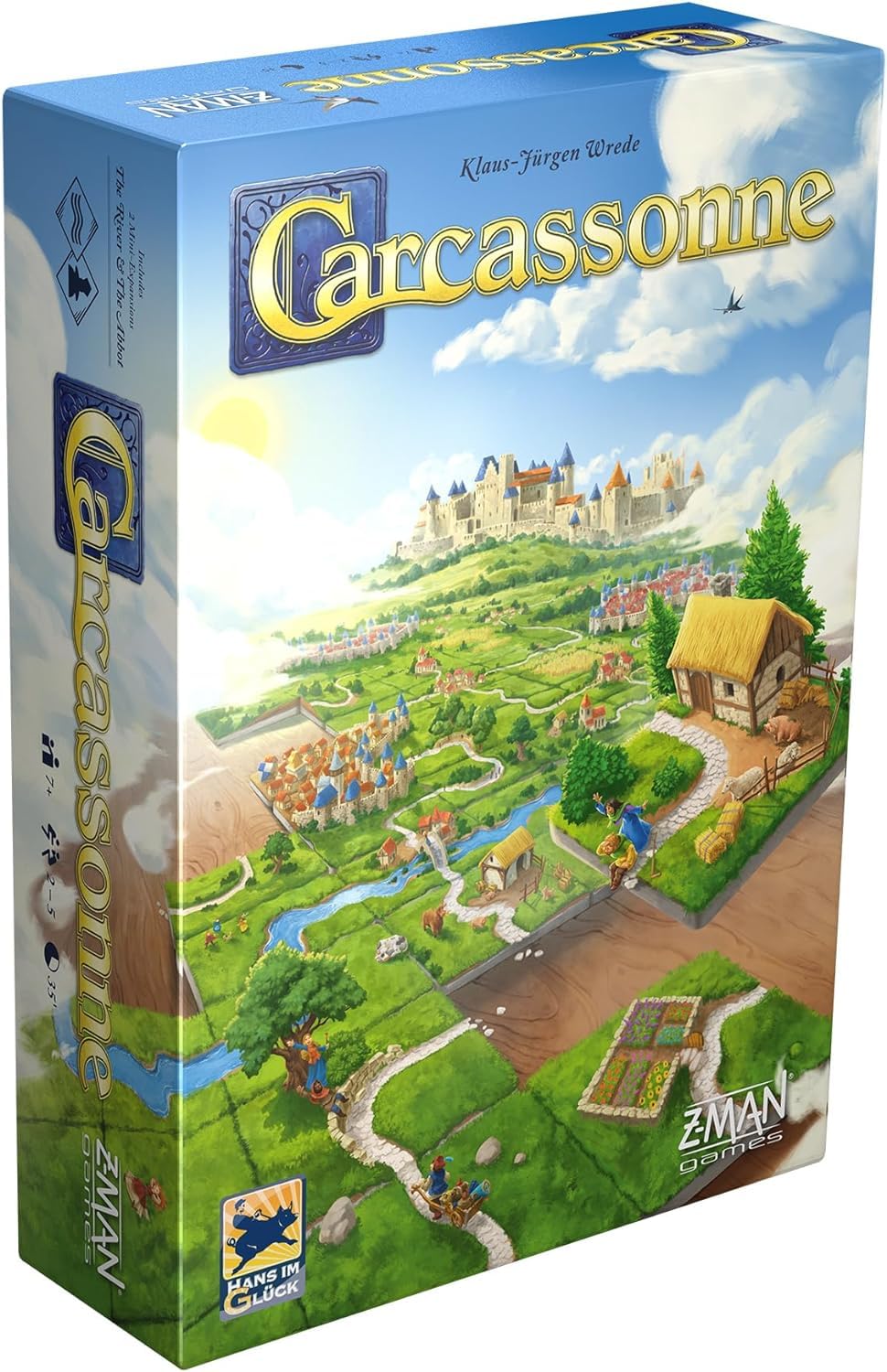
Carcassonne

96 /100
Lab Score Outstanding

Key details

Ages
7 and up
Players
2 to 5
Play Time
35 minutes
Mini-expansions
The River and The Abbot
View on Amazon

Where Azul has you staring at your own board, Carcassonne puts one landscape in the middle of the table and lets the whole room build into it. You draw a tile, match its edges to what is already down, and place a meeple on the road, city, or field you are claiming. That is a turn: thirty-five minutes of small decisions that add up to a map nobody planned.

No words appear on any tile, and that changes who can sit at the table. A seven-year-old places tiles as well as an adult and usually spots the open city first; scoring is the only part that needs translating for the first game or two. The cardboard is thick, thick enough that a slightly uneven picnic table does not bother it, and the insert holds the tiles in rows so setup is quick.

Of the tile-layers here, this is the one we recommend to a family that wants a game rather than an activity: there is real competition over cities and fields, and the final count rewards the player who planned two turns ahead. This edition throws in The River and The Abbot, two mini-expansions that change the opening and add variety without a second purchase. Neither is required to enjoy the base game, and both are nice to have by the tenth play.

Pros

  • No text on the tiles, so pre-readers play
  • One shared map keeps everyone involved
  • Thick cardboard that handles a picnic table
  • Includes The River and The Abbot

Cons

  • Five-player games run past the listed 35 minutes
Our verdict

The family tile game we hand to a mixed-age table: nothing to read on a tile, one decision per turn, and a shared map everyone builds.

Check Latest Price
4

Best Word Game

Bananagrams Classic

98 /100
Lab Score Outstanding

Key details

Ages
7 and up
Tiles
144 letter tiles
Players
2 to 8
Play Time
15 minutes
View on Amazon

Bananagrams is built for the people who spell quickly and do not want to wait four turns to prove it. Everyone builds a crossword in front of them at the same time from a shared pile of letters, and the whole table is muttering and rearranging at once. There is no turn order and no downtime, which is either the appeal or the reason to play in the next room.

It is also the easiest game here to carry: 144 tiles in a stitched banana pouch that weighs almost nothing, with no board and no scorepad. We have set it up on a small cafe table and on a picnic blanket in the same week, and packing up takes one sweep of the hand. The pouch is sturdier than it looks, and the fifteen-minute estimate is real.

The honest limit is spelling, and it cuts both ways. A weak speller has nowhere to hide when everyone plays at once. But speed matters more than vocabulary here, and the quickest teenager at the table usually beats the adult who wins at slower word games. Play it with anyone who can spell a three-letter word unaided and the race stays close; play it with someone still sounding out words and it will not be.

Pros

  • Everyone spells at once, so nobody waits
  • Banana pouch travels anywhere
  • Fifteen-minute rounds make a rematch easy
  • Speed beats vocabulary

Cons

  • Needs spelling, so a weak speller is exposed
Our verdict

For the fast spellers at your table: everyone builds at once, nobody waits a turn, and the whole game travels in a banana.

Check Latest Price
5

Best for Young Kids

Qwirkle

96 /100
Lab Score Outstanding

Key details

Ages
6 and up
Weight
15.9 oz
Dimensions
10.5 x 10.5 x 2.75 inches
Tile Material
Wood
View on Amazon

A five-year-old can take a legal turn in Qwirkle before reading a word, and that is why we hand it to young families ahead of anything else here. Each wooden tile is a color and a shape, and a line has to share one and differ on the other, so matching is the whole rule. There is no board to set up and nothing to read aloud.

The thinking arrives later. Finishing a line is where the points pile up, and because everyone plays into the same spread, you can see the move that would complete someone else's line a turn before they make it. Our grown-up rounds got quietly competitive; our rounds with a five-year-old were still recognizably the same game, which is more than most family games manage.

Because there is no board, the game grows across the table as the lines get longer, and the drawstring bag is what keeps the set together between games. It is the one game here we have taught to a child and an adult in the same breath, and nobody had to be given a handicap.

Pros

  • No reading, only colors and shapes
  • Solid wooden tiles
  • One ruleset scales from kids to adults
  • No board, so setup takes seconds

Cons

  • Red and orange tiles blur under indoor light
Our verdict

The pick for a household with young kids: colors and shapes only, no reading anywhere, and enough second-guessing that adults stay interested.

Check Latest Price
6

Best Two-Player Game

Hive Pocket

96 /100
Lab Score Outstanding

Key details

Ages
9 and up
Weight
8.8 oz
Players
2
Includes
Ladybug and Mosquito expansions
View on Amazon

There is no board in the box, and that turns out to be the entire idea. The first piece goes down, everything after it has to touch the hive, and the shape of the game is whatever the two of you build. It plays on the smallest surface in the house and packs into a bag the size of a fist.

The pieces are the next surprise. They are dense and heavy for their size, cool in the hand, and they feel like something that will outlast the box. Dense enough, in fact, that a bag of them can draw a second look at airport security, which is the only travel complaint this game has.

Portability got it into the bag; the depth is why it stays. Each insect moves its own way, and after the first game the thinking is entirely about how the hive's shape changes what a piece can reach. Rounds run five to ten minutes, which suits a lunch break, and the Ladybug and Mosquito come in the box; the instructions suggest leaving them out until the base pieces click, and that is the right way in. For two players and a small table, this is the one we recommend.

Pros

  • No board: the hive is the board
  • Dense pieces that feel indestructible
  • Five-to-ten-minute rounds
  • Ladybug and Mosquito included

Cons

  • Strictly two players, so it sits out family night
Our verdict

The best two-player tile game here, and the only one that needs no table: the pieces are the board, so it works on a plane tray or a cafe napkin.

Check Latest Price
7

Big Groups

Mexican Train Dominoes

95 /100
Lab Score Outstanding

Key details

Ages
8 and up
Case
Aluminum carrying case
Players
2 to 8
Dominoes
91
View on Amazon

Ninety-one dominoes is a lot of dominoes, and it is the reason this set suits a crowd: the double-12 numbering means a round can stretch to eight players without the pool running dry, and there are nine plastic trains so nobody sits out. The aluminum case is the other half of the pitch, rigid enough to stack in a closet and shaped so every piece has a place.

The rules are the easiest teach on this page. Match an open end; if you cannot, draw and start your own train. We had six people playing inside a minute, ages from eight up, and the double-12 tiles make longer, more satisfying chains than the double-six set most houses already own.

It is a workhorse rather than a showpiece: plastic trains, a paper scorepad, and a case doing the unglamorous job of keeping 91 pieces in one place. That case is why the set comes off the shelf without a rummage, which matters more than it sounds for a game with this many parts.

The recommendation comes down to your guest list. If game night regularly runs past four people, this is the set to own, and it is the only one here that seats eight without splitting into two games. If your table is two or three, a sharper design is the better buy.

Pros

  • 91 double-12 dominoes seat up to eight
  • Aluminum case keeps the set together
  • Rules anyone learns in one turn
  • Longer chains than a double-six set

Cons

  • Yellow and orange dots look alike
  • Thin tiles tip when the table is bumped
Our verdict

The set to buy if game night means eight people and a big table: 91 dominoes, nine trains, and an aluminum case that holds it all.

Check Latest Price
8

Mahjong Regulars

American Mahjong Set

94 /100
Lab Score Outstanding

Key details

Tiles
166
Players
4
Includes
Blue printed carrying bag
Material
Melamine
View on Amazon

This is the only set here that assumes you already know the game. American mahjong is not learned from a box insert, and the one thing the box cannot give you is the current card that lists the legal hands for the year, which is sold separately and changes annually. Budget for the card before you budget for tiles.

What you are paying for is tile quality. The 166 melamine tiles are scratch-resistant, white, and engraved with both Arabic numerals and Chinese characters, which is the detail that makes this a decent first serious set: a beginner reads a tile by its number instead of memorizing symbols. The four all-in-one rack and pusher units are color-coded, and the printed bag holds the lot.

It also feels like a set rather than a kit. The wind indicator, dice, and chips are all in the box, the sleeves that hold the tiles are thick and fasten with Velcro, and everything has a home, which matters in a game where a stray tile can stop a hand.

Our reservation is the racks: clear plastic, lighter than the tiles they hold, so treat them as table furniture rather than luggage. Everything above them is sound, and for a group that plays weekly the tiles are the part that matters. That is why this is the set we recommend to a group buying its first real one, and not to anyone still learning the game.

Pros

  • 166 melamine tiles with numerals and characters
  • Racks, pushers, dice, chips, and bag included
  • Readable for newcomers to the tiles
  • Tiles feel solid and scratch-resistant

Cons

  • The annual mahjong card is not included
  • Racks feel light next to the tiles
Our verdict

If your group already plays mahjong every week, this is the set that covers the table: 166 legible melamine tiles, four racks and pushers, and a bag to carry them.

Check Latest Price

How We Chose and Tested the Best Tile Games

We started by assembling a shortlist of 14 tile games from standbys and newer releases, filtering for playable group sizes, table footprint, and whether the rules could be taught from a single read-through. Over four months, I hosted weekly game nights at my kitchen table and a few Sunday-afternoon sessions in the living room, with family members and neighbors rotating in — including kids, grandparents, and people who usually avoid strategy games.

Before the first play, we counted every tile against the inventory and noted how the set stored; after each session, we counted again and checked whether inserts or bags made missing pieces likely. We taught each game aloud from the rulebook once, then watched first-time players take their opening turns, noting where they hesitated, whether they asked what to do next, and how long setup and cleanup took. During play, we tracked pace, downtime, and whether the decisions players made actually changed the outcome or if luck flattened the strategy.

For quality, we shuffled each set repeatedly, stacked tiles, and looked for worn corners, faded printing, and color shifts under warm lamp light and daylight; we also checked whether suits or numbers stayed distinct for everyone at the table. We bumped the table on purpose to see whether tiles slid or toppled, and we paid attention to whether the colors were consistent across the whole set, not just a few face tiles.

How to Choose a Tile Game

Start With What Is Printed on the Tiles

There are four families on this page, letters, numbers, shapes, and pictures, and the printing is the real gatekeeper. A letter tile game requires spelling, which quietly excludes a six-year-old and anyone who finds word games stressful. A number game like Rummikub or a shape game like Qwirkle asks for neither, so a mixed-age table plays under identical rules.

Carcassonne goes further and prints nothing on a tile at all, which is why it works with children who cannot read yet. If your group spans reading levels, choose the tiles before you choose the theme, and save the word games for a table of adults.

Count the Seats You Actually Fill

Boxes advertise a maximum, and the maximum is rarely the best number. Hive Pocket is a two-player game and only a two-player game, while the Mexican Train set stretches to eight with its double-12 dominoes. In between, Rummikub and Carcassonne are content at two and better with four.

Be honest about the usual guest list rather than the holiday one. A game that sings with four and goes flat with two spends most of its life on the shelf, and the reverse is just as true.

Weigh the Rulebook Against the First Round

Tile games split into two kinds of teaching. Rummikub, Qwirkle, and the dominoes are explainable in a minute, with the strategy arriving over the following games. Azul and Carcassonne carry rulebooks longer than their play deserves, and a group that deals a practice round learns faster than one that reads the booklet aloud.

Our rule is simple: if the rules run past a page, play the first game open-handed and look things up as they come. Nobody remembers a rule they heard before they had a board in front of them.

Check the Tiles in Your Own Light

Color is a mechanic in half of these games, and color is where cheaper sets stumble. Qwirkle's reds and oranges blur under warm bulbs, and domino sets that color-code their pips often have two shades that read the same from across the table. Prefer tiles with a second cue, a numeral, a shape, or a printed character, so the game survives a dim room.

Size matters too. Chunky wooden and resin tiles are easier for small hands and for arthritic ones than thin plastic, and a tile you can pick up without pinching keeps a long game pleasant.

Decide Whether It Leaves the House

A pouch beats a box and a box beats a tin, at least in a carry-on. Bananagrams and Hive Pocket are the two here that genuinely travel, one a bag of letter tiles, the other a bag of tiles with no board at all, which is what makes a tray table usable.

If the game stays home, a rigid case is worth having: the aluminum one around the Mexican Train set keeps 91 pieces in one place far better than cardboard. Buy for the trip you take most often.

Frequently Asked Questions

Final Verdict

Rummikub is the tile game we recommend to almost everyone, because it gets the widest range of people playing the same rules on the first turn: numbers instead of letters, a rulebook you can teach standing up, and a table that is never finished.

If your game night is two people and a coffee table, Hive Pocket is the better buy. If it is a strategy crowd, Azul. And if eight people show up, the Mexican Train set is the only one here with enough seats.