Best Legacy Board Games of 2026

A legacy board game is the rare thing you play once and can never reset: you write on the board, sticker the map, tear up cards, and open sealed envelopes that rewrite the rules for every session after. That's the appeal — a story that actually sticks because your group's decisions are physically baked into the box. It's also why choosing one matters more than choosing an ordinary game. If the campaign drags, the rules get fiddly, or your group loses steam at session five, you're out more than an evening — you're out a dozen planned nights and the price of something you can't resell or replay.

The pattern I keep running into: groups rarely abandon legacy games over complexity. They abandon them when someone misses two weeks and nobody wants to re-teach the rules. Across the ten we played this past year, cooperative campaigns held our table together far better than competitive ones, where a player who falls behind by mid-campaign tends to quietly check out. Below are the ones that earned their nights — campaigns we finished, argued over, and, in a couple of cases, genuinely wished we could wipe and start again.

1

Best Overall

Pandemic Legacy: Season 1

95 /100
Lab Score Outstanding

Key details

Age
13+
Players
2-4
Campaign
12 months
Play Time
60 min
View on Amazon

Losing a game of Pandemic Legacy does not just cost you an evening. The board keeps the damage: a sticker here, a scar there, a card that is gone for good. That permanence is why this is our top pick. The 12-month cooperative campaign turns a familiar disease-fighting puzzle into a story your group writes together, and the next session begins with the consequences of the last one.

We went in expecting the legacy tricks to feel bolted on, and instead they became the reason to keep setting up. Sealed boxes introduce new rules and components at a pace that kept our table talking between sessions, while writing on characters and tearing cards made decisions land harder than any score pad. The 60-minute play time is realistic, and the two-to-four-player range means a small group can run the whole campaign without recruiting a crowd.

Pandemic is built around shared victory and shared defeat. Because everyone wins or loses together, the campaign works for pairs as well as fours, and the story gives quieter players a reason to speak up. We found the tension built best when the group resisted quarterbacking and let each player own a role; the game rewards that division of labor.

If your group wants a campaign to finish, this is the one we trust to hold attention across a year of game nights. The early rules take a little patience, but the payoff is a season of shared near-misses, inside jokes, and a board that looks like your group's history.

Pros

  • Permanent choices make every campaign session matter
  • Cooperative play keeps the whole table involved
  • Sealed boxes keep the story unpredictable
  • Two to four players fit most tables

Cons

  • No reset once the campaign begins
Our verdict

We recommend Pandemic Legacy: Season 1 to any regular group that wants a cooperative story where a bad night leaves a mark worth talking about.

Check Latest Price
2

Best for Families

Ticket to Ride Legacy

93 /100
Lab Score Outstanding

Key details

Age
10+
Players
2-5
Campaign
12 games
Play Time
20-90 min
View on Amazon

Twelve games is a lot to ask of a family board game, but Ticket to Ride Legacy earns the commitment by making the table itself the souvenir. The campaign begins with the route-building you already know, then adds frontier boxes, events, and a map that accumulates the story of your railway. By the end, you are not just playing a campaign; you are keeping a record of it.

We appreciated that the first game is easy to teach, because the legacy material arrives in small doses rather than all at once. The 2-to-5-player range is the widest in this group, and the 20-to-90-minute sessions make it plausible to fit one game into a weeknight. The trade-off is that later chapters ask more of casual players, especially if they have never played Ticket to Ride before.

What makes it work at a mixed table is not that it is simple; it is that the competition stays readable. Everyone is building routes, drawing tickets, and reacting to the same unfolding map, so a parent and a ten-year-old can sit at the same table without one carrying the other. We also like that there are rules for playing after the campaign; the board does not become landfill when the story ends.

Pros

  • Twelve-game arc leaves a personalized board
  • Familiar route-building rules ease the start
  • Seats two to five players
  • Post-campaign rules extend its table life

Cons

  • Big box needs shelf space
  • Premium price for one campaign
Our verdict

For families who want a competitive campaign they can finish together, this is the legacy box we reach for first.

Check Latest Price
3

Best for Humor

Clank! Legacy

94 /100
Lab Score Outstanding

Key details

Players
2-4
Campaign
10+ games
Play Time
30-120 min
Post-campaign
Playable
View on Amazon

Clank! Legacy has the sharpest sense of humor in this group. The campaign casts your group as adventurers climbing a corporate ladder, and the writing leans into the absurdity of performance reviews, office politics, and dangerous shortcuts. We found ourselves reading story entries aloud even when it was not our turn, which is not something we can say for every legacy box.

The choices are the real draw. Cards, board spaces, and campaign decisions carry forward, so the Clank! you finish with is not the one you started with. What we liked most is that it does not stop there: there is a post-campaign game, so the customized board keeps earning shelf space after the 10-plus-game story wraps. That makes it an easier sell for a group that worries about one-and-done purchases.

Sessions can stretch to two hours or more while the campaign is adding new material, and the story text can slow the pace between turns. We did not mind because the table was usually laughing, but a group that wants crisp half-hour episodes should look at My City instead. For everyone else, this is the legacy game that feels like a game night, not a history assignment.

Pros

  • Humor keeps the table engaged
  • Choices customize the board and cards
  • Post-campaign game keeps the box useful

Cons

  • Story text can slow turns
Our verdict

We choose Clank! Legacy when the group wants jokes, big swings, and a campaign that stays playable after the story ends.

Check Latest Price
4

Best Budget Pick

My City

93 /100
Lab Score Outstanding

Key details

Age
10+
Players
2-4
Campaign
24 episodes
Play Time
30 min
View on Amazon

My City is the budget-friendly way into a legacy campaign here, and it is also the easiest to teach. Each of the 24 episodes takes about 30 minutes, and the rules arrive through envelopes rather than a dense upfront rulebook. That makes it the one we reach for when the group is mixed ages or the game night has a hard stop.

Everyone builds on their own board at the same time, so there is little waiting between turns. We liked that the competition stays close: you are laying tiles, watching your city grow, and trying to score better than the neighbors without needing to memorize a stack of exceptions. The flip side offers a replayable experience after the campaign, which softens the usual legacy sting.

Story is not the main event. Where Pandemic and Ticket to Ride use narrative to pull you forward, My City uses the slow satisfaction of seeing your settlement become a city and your ruleset grow more interesting. If your group wants twists and reveals, choose one of the story-driven picks; if you want a sharp, friendly campaign that actually gets finished, this is the one.

Pros

  • Twenty-four short episodes suit busy tables
  • Rules unlock gently through envelopes
  • Flip side supports replay after the campaign

Cons

  • Caps at four players
Our verdict

This is the legacy game we give to mixed-age tables that need short sessions and a gentle rules ramp.

Check Latest Price
5

Horror Story Fans

Betrayal Legacy

94 /100
Lab Score Outstanding

Key details

Theme
Horror
Box Size
16 x 10.63 x 4 in
Campaign
Story chapters
Box Weight
2.2 lb
View on Amazon

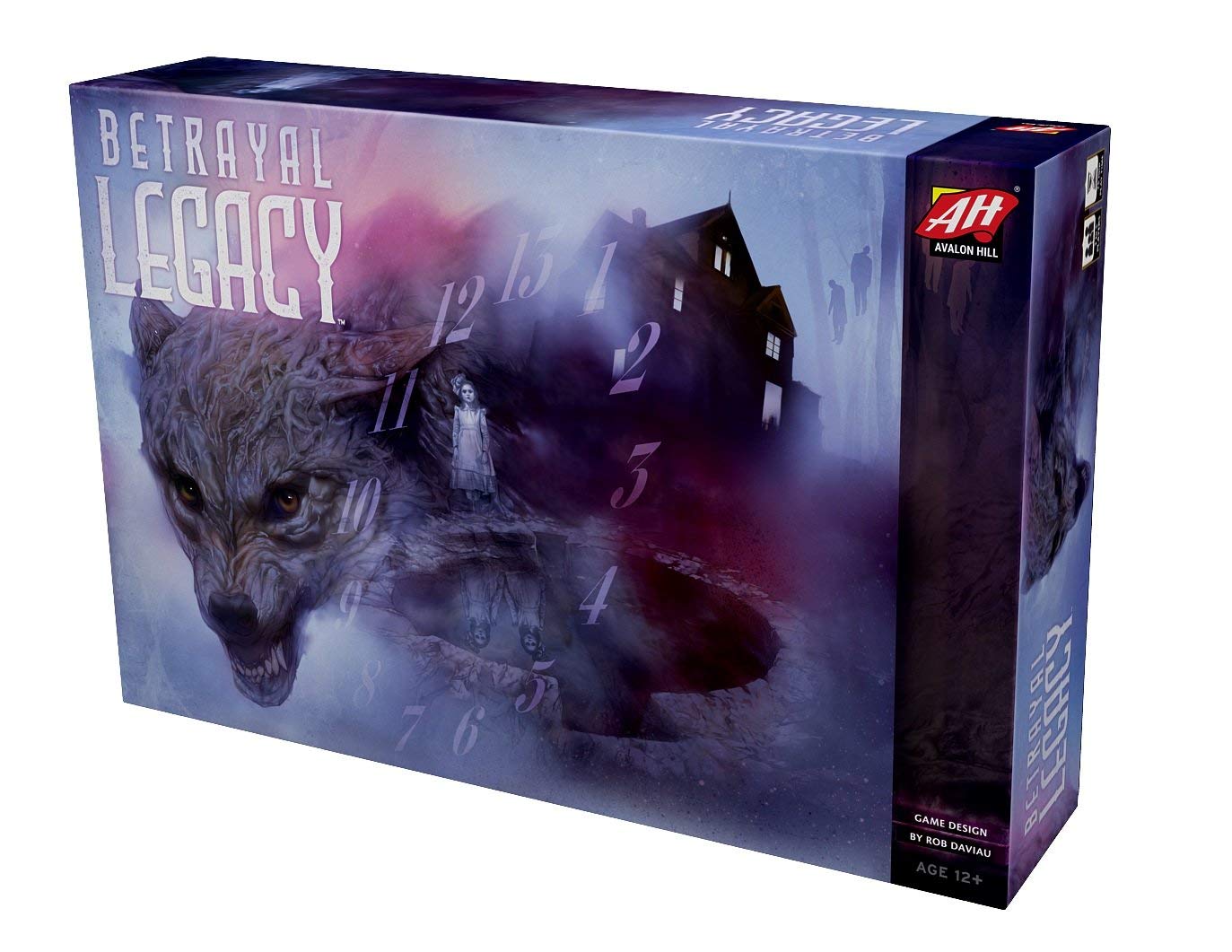
Betrayal Legacy is the horror story in this group, and that is the reason to choose it. The campaign builds a haunted-house narrative across chapters, with the kind of plot twists that make a regular group want to come back. It is not the default legacy game here, but it has the strongest atmosphere of the set.

The creative work is what stands out. The game takes the Betrayal at House on the Hill idea and gives it a memory, so each chapter can build on the last rather than resetting to the same haunted house. We liked the way the table starts telling its own story between sessions, arguing over what happened and what it means for the next chapter. That is the point of a legacy game, and Betrayal leans into it harder than the rest.

Just know what you are buying. This is a horror-themed campaign with a lot of story to manage, and it suits a group that enjoys a little theatrical gloom. If your table wants cooperative problem-solving, Pandemic is the safer recommendation; if you want family-friendly route building, Ticket to Ride is the one to open first.

Pros

  • Horror story builds across chapters
  • Legacy choices give the campaign memory
  • Creative spin on the Betrayal formula

Cons

  • Rulebook can leave edge cases unclear
Our verdict

We keep Betrayal Legacy for horror-loving groups who will trade rules polish for a story that sinks its hooks in.

Check Latest Price

How We Played Through and Judged 10 Legacy Campaigns

We started by rounding up every legacy title still available new — roughly two decades' worth — then cut anything out of print, anything that only worked at exactly five players, and anything priced like a collector's item. That left 10 games, which we played over the course of a year: one campaign at my dining table with a steady weekly group, a second set with friends who play twice a month at best, and a few two-player runs squeezed onto kitchen counters.

Each campaign got played through to the end where the schedule allowed, and we logged every sitting — how many sessions the whole thing took, how long each ran once setup and the sticker-and-envelope bookkeeping were counted, and how often we had to stop mid-turn and dig through the rulebook. We also paid attention to what happened after a two-week break: whether anyone could pick the thread back up or whether the first twenty minutes became a full recap.

Story and gameplay got judged together. By session ten, did we remember the characters and care what happened next, or were we just moving pieces to reach the end? For dynamics, we watched who did the talking and whether a player who was losing or knocked out early stayed at the table. Replayability we checked directly wherever a reset pack or second campaign existed, and where it didn't, we asked honestly whether anyone wanted to start over. Value came down to the box price divided by the sessions we actually finished together.

How to Choose a Legacy Board Game

Count sessions before you count players

A legacy campaign is a commitment measured in game nights, not hours. Pandemic Legacy runs across 12 months, Ticket to Ride Legacy across 12 games, Clank! Legacy across 10 or more, and My City across 24 short episodes. A monthly group can turn a 12-game campaign into a year-long project; a weekly group can finish My City in a couple of months by playing two episodes at a time.

Session length matters just as much. My City's 30-minute episodes fit after dinner, while Clank! can stretch to two hours once the story starts moving. If your table has a hard stop, choose the shorter format rather than planning to quit mid-chapter.

Decide whether your group wants to win together

Cooperative and competitive legacy games ask for different table chemistry. Pandemic Legacy is the clear co-op choice here: every player shares the same loss, so a quiet group still has a reason to talk through each turn. Ticket to Ride Legacy, Clank! Legacy, and My City are competitive, which suits families and friends who enjoy a little rivalry.

If your group has mismatched experience, co-op lowers the fear of being the weak link. If game night is more fun when someone wins bragging rights, choose a competitive box; My City is the gentlest, Ticket to Ride the most familiar, Clank! the most theatrical.

Treat the one-way door as part of the purchase

Legacy games are built to change permanently: stickers go down, characters get written on, cards are torn, and sealed boxes stay sealed until the story reaches them. That is the pleasure, not a flaw. What matters is buying with your group's future in mind. Pandemic Legacy is the clearest one-campaign purchase in this set.

Several picks soften the ending. Ticket to Ride Legacy has post-campaign rules, Clank! Legacy includes a post-campaign game, and My City's board flips for a replayable side. If you might run a second group through the same story, buy a fresh copy rather than trying to undo the campaign.

Match rules weight to the people at the table

My City is the easiest teach here, with rules that arrive one envelope at a time and a 10-and-up age rating. Ticket to Ride Legacy starts with a familiar route-building loop before adding frontier boxes and events, which makes it a good bridge from the base game. Pandemic Legacy asks more of a group but rewards planning and table talk.

Clank! Legacy layers its humor and customization on top of the existing Clank! framework, while Betrayal Legacy is the story-first choice for a table that values atmosphere over a tidy rulebook. If you are teaching new players, start with My City or Ticket to Ride; save the heavier campaigns for a table that already finishes games.

Frequently Asked Questions

Final Verdict

Pandemic Legacy: Season 1 is our default recommendation for a regular group. It turns a cooperative game night into a campaign with memory, and the shared loss is what makes the next session matter. If your table is family-first and prefers competition, choose Ticket to Ride Legacy instead; its 12-game arc is gentler to teach and leaves a board you can keep playing. For a shorter, budget-friendly on-ramp, My City gets a mixed-age group through a campaign without the same calendar weight.