Best Gaming Footrests of 2026

Somewhere in hour three of a long session, your feet start sending messages: they go cold, they tuck under the chair, they wedge against a desk leg until something goes numb. A footrest is a small fix for that — a raised, angled surface that keeps your legs from dangling and your posture from collapsing forward. I ignored this for years, propping my feet on a subwoofer and calling it ergonomics, until my knees started complaining louder than my back. What a good one actually fixes is the quiet stuff: circulation, leg fatigue, and the fidgeting that pulls your attention off the screen.

The catch is that a footrest only works at the right height, and the wrong one becomes an obstacle you kick aside by week two. Over six months, my team and I used 11 of them under real desks — marathon ranked nights, work-from-home afternoons, slouched weekend sessions — and the gap between a thoughtful design and a cheap one shows up within an hour. Measure the space between your chair seat and the floor before you fall for a rocker; it's the one number that decides everything. The picks below are the ones that stayed under the desk.

1

Best Overall

StrongTek Wooden Rocking Footrest

94 /100
Lab Score Outstanding

Key details

Motion
Rocking
Dimensions
17.7 x 10.5 x 4.4 in
Weight Capacity
350 lb
Platform Material
Wood
View on Amazon

For active gaming, the StrongTek is our default. Its wooden platform feels like something you can push against without worrying that it will flex, and the 350-pound capacity backs that up. The 17.7-by-10.5-inch deck is wide enough to shift your stance, and the rockers let your feet move while you play instead of locking them in one spot. We kept coming back to that motion: it gives restless legs somewhere to go without turning the footrest into a toy that skates away.

The 4.4-inch height is fixed. That suits a desk where your feet already hang a little, but it is not the right answer if you need a taller platform or a precise lift. The wood is finished well enough to leave out, and the unit arrives ready to use. We also like that it doubles as a stretching or balance platform during breaks, though gaming is where it earns its place.

At 3.4 pounds it is light enough to move aside when you switch to a standing desk, and the open wooden shape is easy to wipe down. We like it best for players who want a firm surface under socks or shoes; barefoot gamers who want a soft landing should look at the foam picks instead. The rocker is the reason it stays in our rotation.

Pros

  • Stable wooden platform handles heavy feet
  • Rocking motion keeps legs moving
  • 350-pound capacity supports standing stretches
  • Ready to use with no assembly

Cons

  • Rubber grip strips can peel or slide on smooth floors
Our verdict

For active gaming, the StrongTek is our default: the wooden rocker is stable under restless feet, and the 350-pound rating gives it an unusually solid feel. Check the fixed height against your desk first.
Check Latest Price
2

Best Memory Foam

Everlasting Comfort Memory Foam Footrest

93 /100
Lab Score Outstanding

Key details

Base
Flip-over rocking
Height
6 in
Firmness
Shore 00 50
Dimensions
17.5 x 13 x 6 in
View on Amazon

The Everlasting Comfort footrest is the one that flips the script on a basic foam pillow. One side gives you a flat, slightly elevated surface; turn it over and the base becomes a gentle rocker. At 17.5 by 13 by 6 inches, it has a broader footprint than many foam rests, and the high-density memory foam is rated at 50 on the Shore 00 scale, which translates to a soft landing with enough pushback to feel supportive.

We choose it for barefoot lounging and relaxed controller sessions. The foam warms up and contours underfoot, and the flip-over base adds just enough movement for fidgety feet without asking you to balance on a platform. It is also light, at just over two pounds, so moving it between a desk and a couch is no chore. This is comfort first, not a firm ergonomic wedge for pushing against.

The non-slip bottom helps on carpet and tile, and the foam rebounds after you stand up. Very heavy feet can press it down farther than a denser cushion does, so it is not the firmest option here. That is the trade-off for the soft landing: it cushions more than it supports a hard push.

Pros

  • Soft memory foam cushions bare feet
  • Flip-over base adds gentle rocking
  • Broad surface for shifting feet
  • Light enough to move easily

Cons

  • Fixed six-inch height is not adjustable
Our verdict

Barefoot gamers get the softest landing from the Everlasting Comfort, and we like the flip-over rocker for relaxed controller sessions.

Check Latest Price
3

Best Adjustable Foam

ComfiLife Adjustable Memory Foam Footrest

93 /100
Lab Score Outstanding

Key details

Cover
Removable, machine washable
Height
Two settings
Weight
1.7 lb
Dimensions
17.5 x 12 x 6 in
View on Amazon

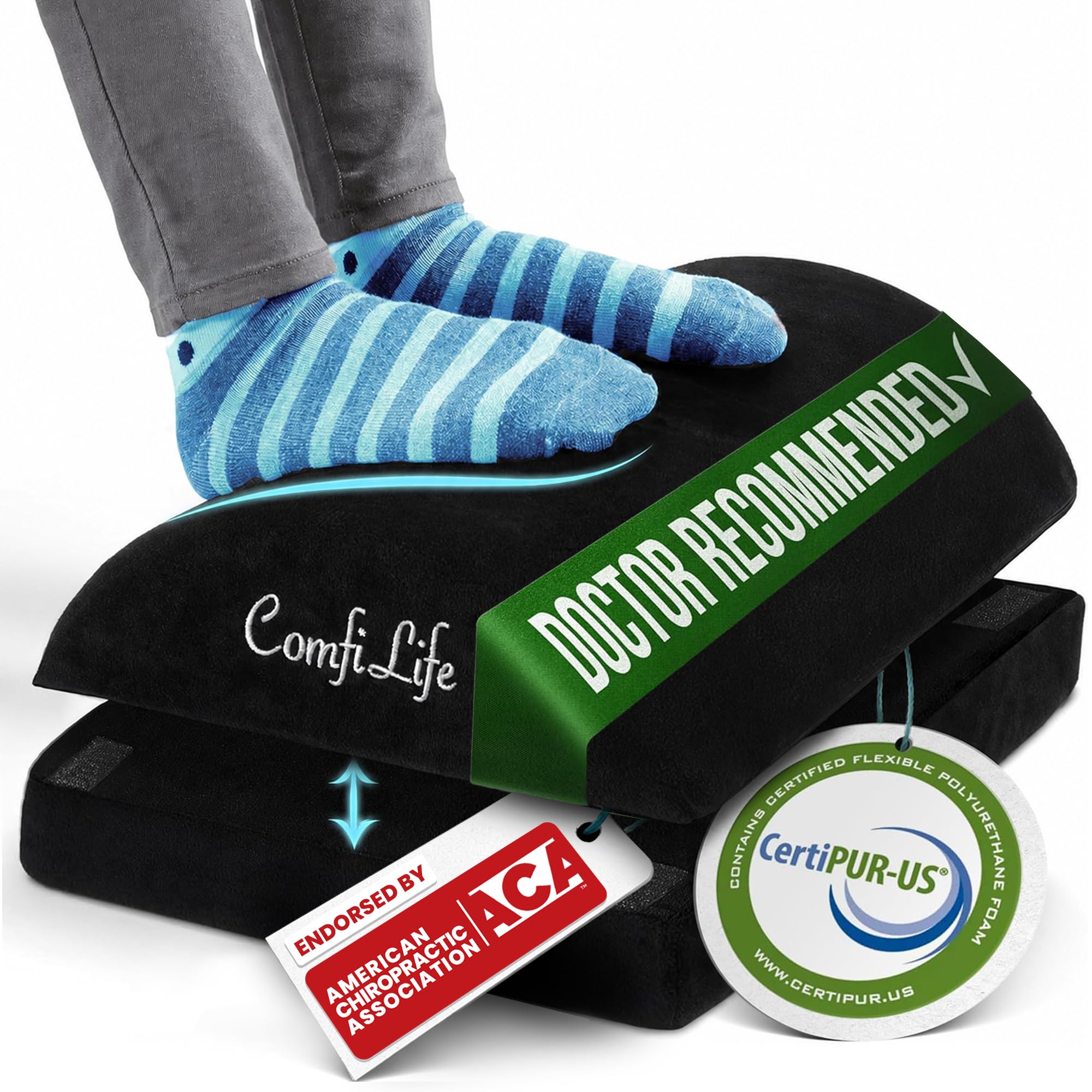
ComfiLife takes the basic memory-foam footrest and makes it easier to live with. The cover unzips and goes in the wash, which matters more than it sounds when you use the thing barefoot every day, and a carry handle lets you move it from desk to couch without hugging a pillow. The half-moon shape is 17.5 by 12 by 6 inches and weighs 1.7 pounds.

Two foam layers give you a lower and a higher setup, so it covers more chair-and-desk combinations than a single-height cushion. The high-density foam is plush but still has enough structure to support your arches, and the half-moon curve gives your calves somewhere to rest. We like the washable cover best: it turns a fussy fabric item into something you can actually keep clean.

This is the foam footrest we choose when one cushion has to serve two people or move between rooms. The base can slide on smooth hard floors, so it is less planted than a wooden or metal platform. For a shared gaming desk, though, the washable cover and carry handle make it the more practical foam pick.

Pros

  • Washable cover handles bare feet
  • Carry handle makes it easy to move
  • Two height layers cover more desks
  • High-density foam balances soft and firm

Cons

  • Only two height positions
Our verdict

We choose the ComfiLife for a shared or movable setup: the washable cover and carry handle make it easy to live with, and two foam layers add useful height flexibility.

Check Latest Price
4

Best Tilting

Eureka Ergonomic Tilt Footrest

91 /100
Lab Score Outstanding

Key details

Frame
Metal
Weight
5.16 lb
Dimensions
15.35 x 11.81 x 3.35 in
Tilt Range
0 to 20 degrees
View on Amazon

The Eureka is the footrest we reach for when a player cannot keep their feet still. Its metal platform tilts through about 20 degrees as you push, so your ankles get a constant, low-effort range of motion instead of a fixed surface. The 15.35-by-11.81-inch deck is smaller than the foam picks, but the 5.16-pound metal frame feels substantial, and the massage texture gives socks something to grip.

The tilt is free rather than locked, which is the point: you can change the angle with a gentle push and let your feet settle where they want. That suits a reclining gaming chair, where a fixed wedge can suddenly feel wrong. The massage bumps are subtle, not a substitute for a roller, but they add a little stimulation during a long session. If you want to hold a steep stretch, this is not the footrest for that.

At 3.35 inches tall, the Eureka sits low, so it works best for desks where your feet are already close to the floor or for players who mainly want tilt rather than lift. The rubber feet protect hard floors, but the platform can shift if you push hard. We like it as a motion tool, not as a one-and-done ergonomic solution.

Pros

  • Metal frame feels solid underfoot
  • Twenty-degree tilt follows ankle movement
  • Massage texture adds grip
  • Rubber feet protect hard floors

Cons

  • No height adjustment at all
Our verdict

Choose the Eureka if you want your feet moving under the desk; we like the free 20-degree tilt and solid metal frame, but it adds motion rather than height.

Check Latest Price
5

Best Multi-Height Foam

TranquilRelax 3-Height Footrest

89 /100
Lab Score Excellent

Key details

Cover
Removable, machine washable
Layers
3.7 in plus two 2 in
Motion
Flip to rock
Height Settings
3
View on Amazon

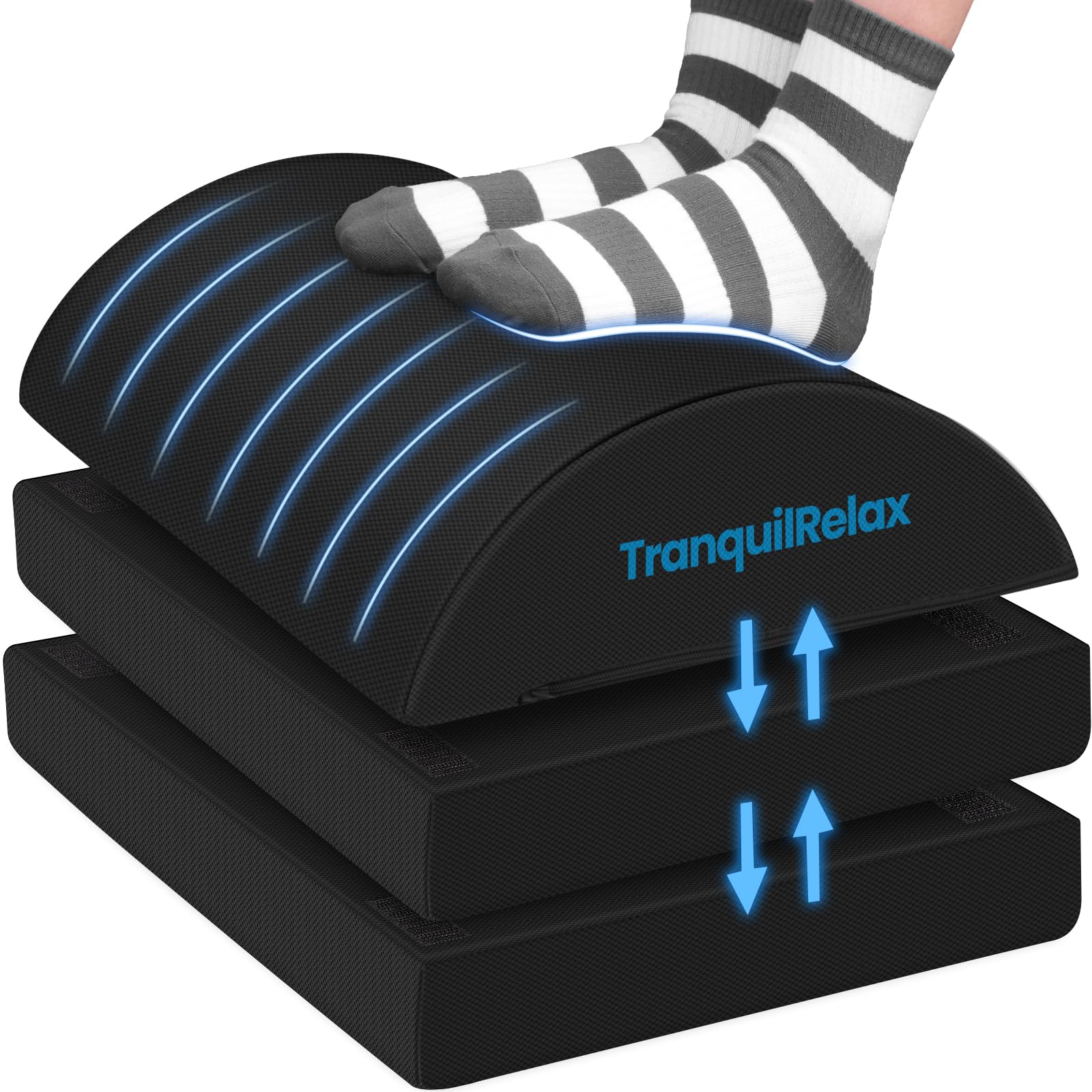
TranquilRelax builds height into the cushion itself. A 3.7-inch main pad sits on two removable 2-inch base layers, so you can run it low, medium, or tall without swapping products. The top surface is curved to support your arches, and the whole thing flips over to become a rocking footrest when you want movement instead of a static perch.

The foam is high-density and holds its shape better than a cheap pillow, with a cover that unzips for washing. At 0.91 kg it is light enough to drag around with a foot, and the non-slip bottom keeps it from wandering on carpet. We like the three-layer system because it gives shorter players a real range without making them buy a plastic platform.

The foam softens the longer you sit, so it is not the firm push-back surface that a wooden rocker provides. It works best as a comfortable, adjustable cushion rather than a performance platform. The lower settings are the ones we use most; the top one is for players who really need the lift.

For a gaming desk where comfort matters more than feedback, this is our pick of the multi-height foam options. The three settings cover more positions than the two-layer cushions here, and the flip-over rocker adds a little motion for fidgety feet. We recommend it for shorter players and anyone who wants to fine-tune height without giving up a soft surface.

Pros

  • Three heights from removable layers
  • Soft but supportive high-density foam
  • Machine-washable cover simplifies cleanup
  • Flips over for rocking

Cons

  • Tall top setting needs desk clearance
Our verdict

We recommend the TranquilRelax for shorter players who want a soft footrest with real height choices; three foam layers and a rocking flip make it the most versatile cushion here.

Check Latest Price
6

Best Height Range

CasaZenith 6-Height Footrest

88 /100
Lab Score Excellent

Key details

Weight
2.87 lb
Massage
Four rollers
Dimensions
16.5 x 12.2 x 7.5 in
Height Settings
6
View on Amazon

CasaZenith approaches the footrest as a small adjustable platform rather than a pillow. Six height settings let you dial the deck to your chair and desk, and the top surface has four massage rollers plus a textured field for your arches. The ABS frame is 16.5 by 12.2 inches and weighs 2.87 pounds, and it breaks down into a few pieces for storage or travel.

The legs click into place before the first session, and once together, the frame feels sturdy for a plastic unit. The rollers are a useful way to work out a tight arch without stopping your game. The height range is the real advantage; few footrests here let you fine-tune this closely.

This is the one we choose when the desk height is the problem. If your chair leaves your feet dangling or your knees sitting high, the six positions give you a better chance of finding a neutral setup than a single foam block. The massage rollers are a nice extra during a long session, and the deck breaks down when you need the space. We like it as a height-tuning tool.

Pros

  • Six height settings fine-tune desk fit
  • Four rollers add a massage option
  • Breaks down for storage
  • Sturdy ABS frame handles daily use

Cons

  • Firm plastic is less comfortable barefoot
  • Assembly required before first use
Our verdict

When desk height is the problem, we reach for the CasaZenith: six settings and massage rollers make it the best fine-tuning pick here.

Check Latest Price
7

Best Premium

C Cushion Lab Ergonomic Footrest

90 /100
Lab Score Outstanding

Key details

Base
Non-slip
Weight
1.65 lb
Surface
WaveMassage ridges
Dimensions
17 x 11 x 5.5 in
View on Amazon

The C Cushion Lab footrest is the plushest thing in this group. Its CloudSupport foam is shaped with raised WaveMassage ridges, so the surface feels like a gentle foot massage rather than a flat pad. At 17 by 11 by 5.5 inches and 1.65 pounds, it is sized like a standard foam cushion, with a non-slip base that keeps it in place on hardwood.

We reach for it when barefoot comfort is the priority. The foam has more give than the denser cushions here, yet it does not bottom out under normal use, and the ridges give your arches something to press into during a long session. It is a premium pick, and it earns that mostly through the surface: the shape and texture are noticeably more considered than a plain memory-foam block.

One limit matters. The light fabric cover shows dirt quickly; we keep it for socks or bare feet rather than shoes. If that suits your setup, it is a lovely thing to have under a desk. If you need height adjustment, CasaZenith is the more practical choice.

Pros

  • Raised ridges stimulate bare feet
  • Dense foam supports without bottoming out
  • Non-slip base stays on hardwood
  • Premium surface feels considered

Cons

  • Fixed 5.5-inch height
Our verdict

The C Cushion Lab is the premium barefoot pick we keep for socks and bare feet; the massage ridges and dense foam make it the plushest surface here.

Check Latest Price
8

Tight Budgets

CushZone 2-Height Footrest

90 /100
Lab Score Outstanding

Key details

Cover
Removable, washable
Layers
Two detachable
Weight
1.39 lb
Dimensions
16.2 x 9.9 x 5.7 in
View on Amazon

The CushZone is the budget foam footrest we keep recommending because it does the basic job without fuss. Two memory-foam layers combine for about six inches of height, and you can pull them apart for a lower setting. The cover unzips for washing, the bottom is non-slip, and the whole thing weighs 0.63 kg.

At 16.2 by 9.9 inches, it is a compact footprint, so it suits a small desk or a player who does not need a wide platform. The foam is soft but not flimsy, and the two layers stay put with hook-and-loop strips. We like it as a first footrest or a second one for a console setup.

The height is the main catch. It tops out lower than the multi-layer models, so it suits a desk where your feet are already close to the floor. It is also a foam cushion, so it will not give you the firm push-back of a wooden rocker or a metal tilt platform. For a compact setup, that is a fair trade.

Still, for a tight budget or a small gaming desk, this is an easy recommendation. It covers the essentials, cleans up easily, and does not slide around on carpet. We choose it when the goal is simple support without spending much, not when you want the last word in adjustability or surface area.

Pros

  • Affordable two-layer foam footrest
  • Removable cover simplifies washing
  • Non-slip base grips the floor
  • Light and easy to move

Cons

  • Smaller surface than full-size cushions
Our verdict

For a tight budget, we recommend the CushZone: it covers the basics with two foam layers and a washable cover, and it is a sensible fit for a compact desk.

Check Latest Price

How We Tested 11 Gaming Footrests

We started by gathering every footrest marketed for desk and gaming use, then cut the list by height range, footprint, surface material, adjustability, and price. Anything fixed at a single height had to justify itself, and anything that looked wobbly in the product photos got dropped. That left 11, which we rotated under real desks for six months.

Height came first. I measured each one against three different chair-seat heights and noted where my knees landed, since a rest that's two inches too tall is worse than none at all. Adjustability got the same treatment: when a model claimed a range, I moved it through that range with my feet rather than my hands, then checked whether the setting held once weight was on it. Fit was a tape-measure job, because anything that fouls chair wheels or crowds a cable tray ends up in the closet.

Then the longer sessions. I logged three-hour stretches in socks, bare feet, and slippers, paying attention to whether the surface got hot, whether my heels sank through the padding, and whether the arch support sat where a foot actually rests. Stability was a lean test — weight shifted to one side, then the other. For non-slip, I pushed each rest across hardwood in socks mid-session to see if it skated, then watched whether my feet slid off the top.

Durability came from the calendar: six months of daily use, checking foam for flat spots, fabric for pilling, and hinges for the looseness that turns a rocker into a rattle. Value was the final filter, and several of the cheaper rests held up as well as ones costing three times more.

How to Choose a Gaming Footrest

Start with height, not features

The picks here range from low platforms around 4 inches to tall foam stacks that approach 8 inches, and the difference matters more than the length of the feature list. If your feet already rest close to the floor, a low wooden or metal platform keeps your knees from rising too high. If your chair leaves your feet dangling, a two- or three-layer foam model gives you a useful step up.

Count the positions, too: a two-layer cushion is really a low and high setting, while the CasaZenith's six settings let you fine-tune. Set the footrest so your thighs stay level and your feet rest flat, not so high that your knees lift above your hips.

Match the motion to how you play

Rocking and tilting footrests suit players who fidget; a fixed cushion suits players who want to plant their feet and forget them. The StrongTek's wooden rockers move with a gentle push and feel stable on carpet. A free-tilting platform is useful if you recline during cutscenes, but check whether it locks if you want to hold a steep angle.

Foam models with a flip-over base give you a softer version of the same idea. If you share the desk, a fixed surface is easier to reset.

Choose foam for bare feet, a frame for push-back

Memory foam is the friendlier surface if you game barefoot or in socks. It warms up, cushions your arches, and hides the hard edge of a plastic platform. The trade-off is that soft foam compresses under heavy feet and gives you less to push against.

A wooden or metal platform feels firmer and more planted, and it is easier to wipe clean, but it is less forgiving on bare soles. We prefer foam for lounging and a frame for active, fidgety play. If you wear shoes at your desk, the surface matters less than stability.

Check stability, footprint, and cover care

A footrest that slides is worse than no footrest, because you spend the session chasing it. Rubber feet and non-slip bottoms help, but they work differently on carpet and hard floors. Measure your knee well before you buy a tall stack, since a high setting can crowd a shallow desk.

A removable, washable cover is worth having if you use the footrest barefoot. If the cover is fixed, keep it for socks or shoes.

Frequently Asked Questions

Final Verdict

Start with the StrongTek. Its wooden rocker is the most convincing all-rounder here for gaming because it gives you something solid to push against while still letting your feet move, and the 350-pound rating means it does not feel fragile.

If you game barefoot and want a cushion instead of a platform, the Everlasting Comfort is the softer route; if your desk height is the real problem, the CasaZenith's six settings solve it better.