11 Best Gaming Graphics Card 2026: Match Your Resolution and Budget

Which GPU delivers the frames you need at the price you want, from 1080p to 4K.

Every graphics card purchase involves a trade-off between VRAM capacity and day-to-day noise. Generous VRAM future-proofs against demanding textures, but larger coolers and faster memory often produce audible coil whine or fan rush. This guide cuts through the spec sheets to match the right balance to your actual gaming habits — whether you are upgrading an old rig or building fresh.

For 1440p players, 12GB remains viable, but 16GB gives breathing room for upcoming titles. Meanwhile, budget 1080p builders can hit 60fps without overspending on VRAM they won't use. The picks below prioritize real-world fit over paper specs.

1

Best Overall

ASUS Prime RTX 5070

92 /100
Lab Score Outstanding

Key details

GPU
RTX 5070
Size
Compact
VRAM
12 GB GDDR7
Memory
GDDR7
View on Amazon

The ASUS Prime RTX 5070 delivers impressive 1440p performance while running quieter and cooler than most cards in its price bracket. Its efficient dual-fan setup and compact heatsink keep temperatures in check even during extended sessions, making it a strong fit for small form factor builds where airflow is limited.

Installation is straightforward thanks to the card's 2.5-slot design and lack of unnecessary RGB. The anodized aluminum backplate adds a clean look without adding bulk. Under load, the fans remain near-silent below 60% speed, ramping up only to maintain stable clock speeds.

This card targets 1440p gamers who want solid frame rates without the noise of larger, more power-hungry alternatives. The 12GB GDDR7 handles today's titles at high to ultra settings, but future games with heavier texture packs may push past that limit – particularly at 4K. If you are set on 1440p or comfortable using DLSS for upscaling, this limitation is unlikely to affect your experience.

Compared to bulkier RTX 5070 models like the TUF, the Prime is noticeably smaller and quieter, while also costing less. It undercuts most AMD RX 9070 XT options on price and noise, though those cards offer 16GB VRAM for greater headroom in 4K scenarios.

💡 The 12GB VRAM is comfortable for 1440p; if you move to 4K, enabling DLSS helps stay within memory limits.

Pros

  • Impressive 1440p gaming performance at a mid-range price
  • Quiet and cool operation even under sustained gaming loads
  • Sleek design fits easily into small form factor cases
  • Easy installation with no unnecessary extras

Cons

  • 12GB VRAM may limit performance in future 4K ultra texture-heavy titles
Our verdict

For 1440p gamers who prioritize quiet operation and a compact footprint, the Prime RTX 5070 is the most balanced pick in its price range.

Check Latest Price
2

Best Value for 16GB VRAM

GIGABYTE RX 9070 XT OC

89 /100
Lab Score Excellent

Key details

GPU
RX 9070 XT
Size
Large
VRAM
16 GB GDDR6
Memory
GDDR6
View on Amazon

For buyers prioritizing VRAM capacity over absolute silence, the GIGABYTE RX 9070 XT OC offers 16GB of GDDR6 at a mid-range price — a meaningful advantage over similarly priced 12GB options. This card delivers strong frame rates across 1440p ultra settings and can handle lighter 4K scenes, making it a capable alternative to the top pick for those who value future-proofing memory.

Build quality is solid with an appealing design, and the 3060 MHz boost clock keeps performance competitive. In a quiet room during sustained gaming sessions, the fans become audible under load — a tradeoff that stems from the cooling capacity needed to maintain those clock speeds. Manual fan curve adjustments via AMD software can reduce noise, though that requires some willingness to tweak.

This card suits gamers who want 16GB VRAM for high-refresh 1440p or entry-level 4K and are comfortable using software fan control to dial down noise in exchange for slightly higher temperatures. Those seeking a drop-in silent card without tweaking should look to the top pick’s quieter fans and lower price.

💡 Adjusting the fan curve via AMD Adrenalin software can reduce noise under load while keeping temperatures within safe limits.

Pros

  • Delivers strong frame rates at 1440p ultra settings and handles lighter 4K scenes.
  • Consistent gaming performance across a wide range of resolutions and titles.
  • Visual quality and image fidelity are well-regarded by users.
  • Sturdy construction with an attractive, functional design.

Cons

  • In a quiet room, fan noise under sustained load can be noticeable without manual fan curve adjustments.
Our verdict

For 1440p and entry-level 4K gamers who want 16GB VRAM and are willing to tweak fan settings, this is a cost-effective choice that punches above its price class.

Check Latest Price
3

Best Budget 1080P Card

ASUS Dual RTX 5060

91 /100
Lab Score Outstanding

Key details

GPU
RTX 5060
Size
Compact
VRAM
8 GB GDDR7
Memory
GDDR7
View on Amazon

The ASUS Dual RTX 5060 stands apart from other budget 8GB entries by offering a full PCIe 5.0 x16 interface and a higher 2535 MHz core clock, delivering better bandwidth and out-of-the-box performance. Its dual-fan cooling keeps noise low during sessions, and the GDDR7 memory provides enough speed for fast texture loading at 1080p.

This card is built for builders on a tight budget who game at 1080p and don't plan to upgrade monitors soon. First-time builders will appreciate the straightforward installation and consistent frame rates in popular titles like Fortnite and Valorant. However, the 8GB VRAM limits texture detail in demanding AAA releases and makes 1440p gaming impractical - this is a pure 1080p solution, and its performance will show its age within 2-3 years as game requirements climb.

In practice, the card handles esports titles at high refresh rates and modern single-player games at medium-to-high settings with DLSS enabled. The 8GB frame buffer requires some settings tweaks in the latest releases, but the overall experience remains smooth for the resolution it targets.

💡 To avoid VRAM bottlenecks in newer titles, try Medium texture settings and enable DLSS Performance mode for consistent frame rates.

Pros

  • Best-in-class value for entry-level gaming
  • Strong 1080p performance with DLSS 4 for smoother frame rates
  • Full PCIe 5.0 x16 interface ensures compatibility with modern motherboards

Cons

  • 8GB VRAM may require lowering texture quality in demanding AAA titles at 1080p
  • Not suitable for 1440p gaming - performance drops sharply above 1080p
Our verdict

For gamers who know their monitor's resolution isn't changing soon, this ASUS card delivers the best price-to-performance ratio in the budget segment - just pair it with realistic expectations about VRAM longevity.

Check Latest Price
4

Best 4K Performance

ASUS TUF RTX 5080

90 /100
Lab Score Outstanding

Key details

GPU
RTX 5080
Size
Large
VRAM
16 GB GDDR7
Memory
GDDR7
View on Amazon

While the top pick in this roundup targets 1440p, the TUF 5080 aims at 4K Ultra with noticeably quieter fans and a more rugged build. Its triple-fan cooler keeps the card silent under load, a rare trait for a 5080. Military-grade components reinforce long-term durability, setting it apart from the slimmer Gigabyte 5080 which trades some cooling for a smaller footprint.

At 4K, the RTX 5080 paired with DLSS 4 sustains high frame rates even in ray-traced games with max settings. The 16GB GDDR7 memory provides ample headroom for upcoming titles, and the core clock boost helps extract maximum performance without overclocking. Ray tracing performance is strong, with DLSS 4 enabling playable frame rates even at 4K Ultra with full ray tracing.

This card is best for enthusiasts who want the latest Blackwell technology and silent 4K gaming. The higher price above MSRP and large physical size mean it fits only in spacious cases with strong power supplies – budget builds and compact rigs should look elsewhere. If silence and longevity matter more than saving money, the TUF 5080 is a strong choice, though the top pick's 5070 delivers excellent 1440p performance at roughly half the cost.

💡 Measure your case interior clearance and ensure your power supply can handle the peak draw – an 850W unit is recommended.

Pros

  • Sustained 4K gaming at max settings with DLSS 4 for smooth frame rates.
  • Fans operate nearly silently under load, making immersive gaming sessions quieter.
  • Military-grade components and robust construction improve long-term build quality.

Cons

  • Price sits well above standard MSRP
  • Large and heavy design requires a spacious case and may need additional support.
Our verdict

For 4K enthusiasts who prioritize quiet operation and are ready to invest in a capable case and power supply, the TUF 5080 is a compelling 4K card – though budget-conscious gamers will find better value in the lower 5000-series options.

Check Latest Price
5

Best Premium AMD Card

Sapphire Nitro+ RX 9070 XT

89 /100
Lab Score Excellent

Key details

GPU
RX 9070 XT
Size
Large
VRAM
16 GB GDDR6
Memory
GDDR6
View on Amazon

The Nitro+ RX 9070 XT's build quality sets it apart — a full-metal shroud and a hidden power connector that routes cables through a bracket for a clutter-free look.

Under the hood, the card delivers strong 1440p and 4K gaming performance, matching other RX 9070 XT models. Its cooling system keeps temperatures well in check, though coil whine may be audible in quiet scenes — a trade-off for the premium construction.

This card is for the builder who wants a card that looks as good as it performs and is willing to pay extra for that finish. Content creators benefit from the 16GB VRAM, and gamers who value aesthetics over saving money will appreciate the design. Just be aware that the price premium over value-oriented 9070 XT models is significant, and quiet environments may reveal coil whine.

Pros

  • Outstanding 1440p and 4K gaming performance
  • Excellent build quality and premium design
  • Hidden power connector for clean cable management

Cons

  • Coil whine may be audible in very quiet rooms or during low-load scenes
  • Higher price than other RX 9070 XT models, making it less appealing for pure value seekers
Our verdict

If build quality and aesthetics matter more than a few dollars off the price, this is the card to get — just accept the possibility of coil whine.

Check Latest Price
6

Rugged Build

ASUS TUF RTX 5070

90 /100
Lab Score Outstanding

Key details

GPU
RTX 5070
Size
Large
VRAM
12 GB GDDR7
Memory
GDDR7
View on Amazon

The TUF RTX 5070 handles 1440p gaming with solid frame rates, backed by a cooling system that keeps noise in check during long sessions. Its construction uses higher-grade components than typical mid-range cards. The trade-off is its physical footprint: at 327mm and 2.5 slots, this card requires a full-tower case and careful measurement before purchase. It also costs slightly more than the slimmer Prime 5070, making it best for buyers who value long-term durability over space savings.

💡 Measure your case's GPU clearance — this card is 327mm long and occupies 2.5 slots.

Pros

  • High-quality build with military-grade components for extended lifespan
  • Solid 1440p gaming performance with effective heat management

Cons

  • Large size demands a spacious case and dimension check before ordering
Our verdict

Choose this card if you have a full-tower case and want the added peace of mind from military-grade construction, even if it means paying a small premium over the slimmer alternative.

Check Latest Price
7

16GB Mid-Range

ASUS Dual RTX 5060 Ti

91 /100
Lab Score Outstanding

Key details

GPU
RTX 5060 Ti
Size
Compact
VRAM
16 GB GDDR7
Memory
GDDR7
View on Amazon

The ASUS Dual RTX 5060 Ti pairs a generous 16GB of GDDR7 memory with a compact two-fan design, making it a natural fit for tighter builds that still want room for future game installs. Its cooling keeps fan noise low even during extended sessions, and 1080p/1440p gaming remains fluid across most titles. That said, performance tops out before 4K ultra settings; ray tracing headroom is also limited. This card suits buyers who value VRAM capacity over raw frame rates and need a size that slides into smaller cases without hassle.

Pros

  • 16GB VRAM at a mid-range price
  • Compact footprint fits easily in smaller cases where full-size cards won't go.
  • Cooling keeps noise low during gaming sessions.

Cons

  • 4K gaming at high settings pushes the card beyond its comfortable range.
  • Ray tracing performance may feel underwhelming for users chasing higher frame rates with effects enabled.
Our verdict

Gamers building compact 1080p/1440p rigs who prioritize VRAM capacity over raw speed will find this a fitting choice.

Check Latest Price
8

Budget 16GB

ASUS Dual RX 9060 XT

91 /100
Lab Score Outstanding

Key details

GPU
RX 9060 XT
Size
Compact
VRAM
16 GB GDDR6
Memory
GDDR6
View on Amazon

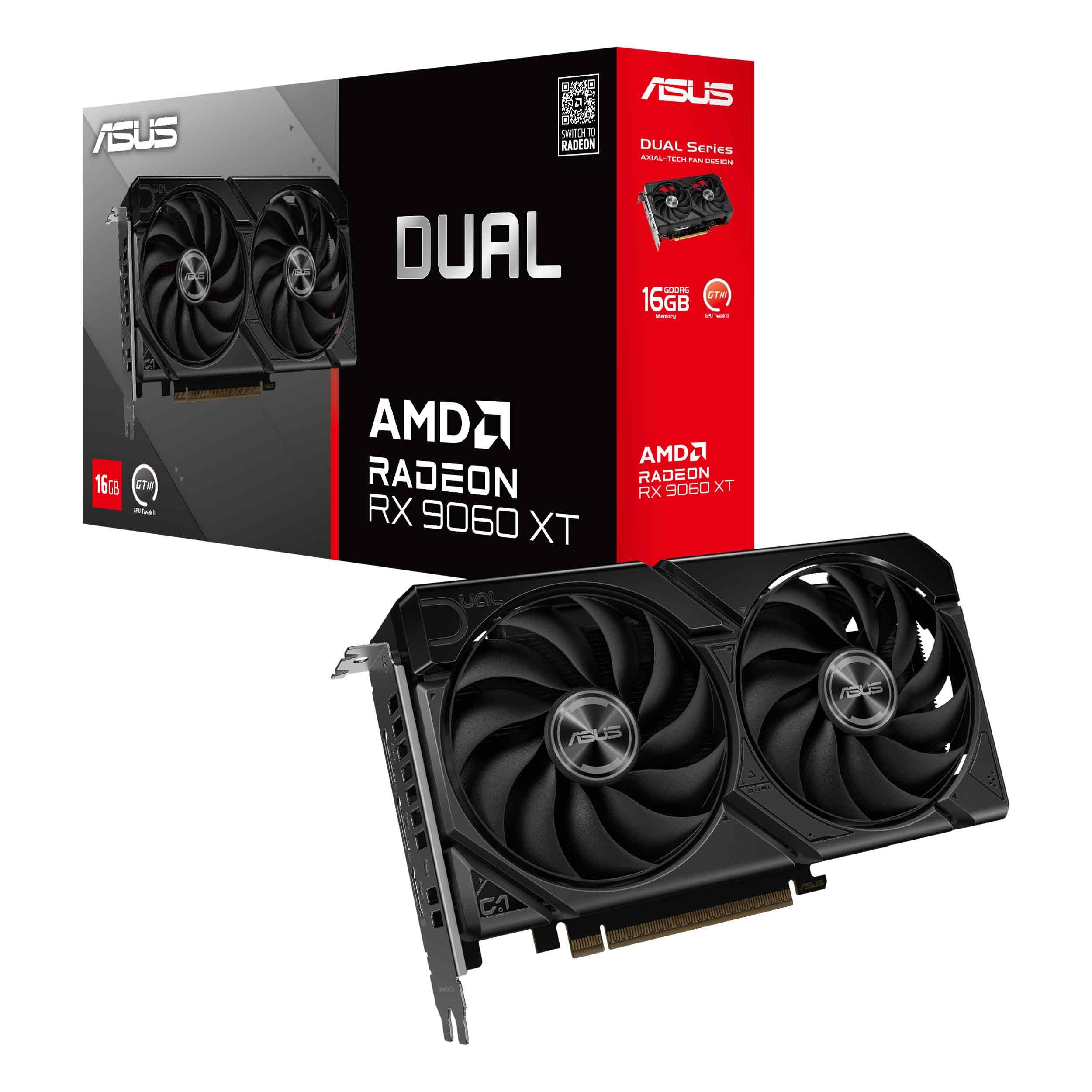
This ASUS Dual RX 9060 XT brings 16GB of GDDR6 memory to the mid-range at an approachable price, making it a strong fit for 1080p and high-refresh 1440p gaming where VRAM-intensive textures and mods are in play. The card runs quietly under load and delivers a solid price-to-performance ratio. However, memory temperatures can climb during extended gaming sessions, and the GPU lacks the raw horsepower for 4K ultra settings — buyers needing 4K should look at higher-tier cards.

💡 Adjusting the fan curve via ASUS GPU Tweak can help manage memory temperatures during long sessions.

Pros

  • Affordable 16GB VRAM for 1080p/1440p gaming
  • Excellent price-performance ratio
  • Quiet and cool operation

Cons

  • Memory temperatures can rise noticeably under sustained gaming load
  • Performance caps out at 1440p
Our verdict

For budget-minded builders who want 16GB VRAM for 1080p or 1440p gaming without overspending, this ASUS card delivers — just keep an eye on memory temps under prolonged load.

Check Latest Price
9

RGB 4K Gaming

PNY RTX 5080 Epic-X

85 /100
Lab Score Excellent

Key details

GPU
RTX 5080
Size
Large
VRAM
16 GB GDDR7
Memory
GDDR7
View on Amazon

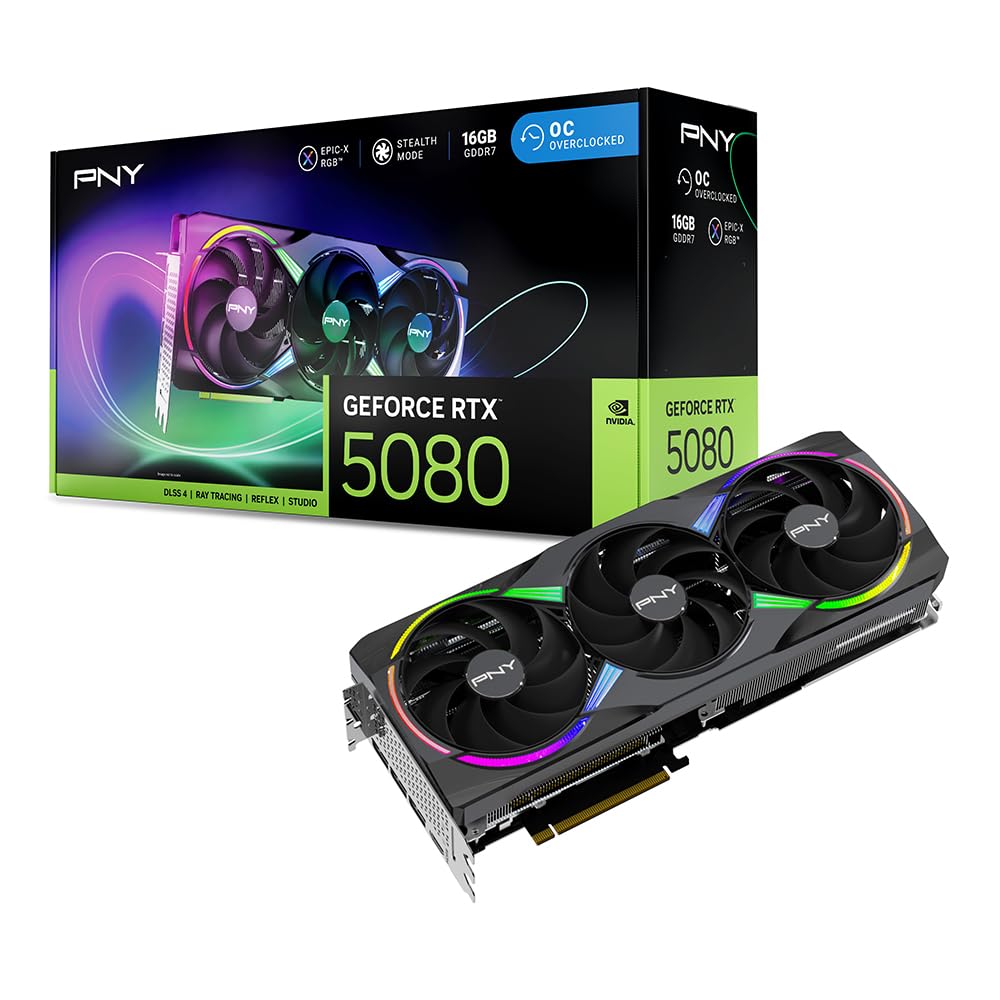
The PNY RTX 5080 Epic-X delivers solid 4K gaming performance with DLSS 4 and offers good overclocking headroom, plus its ARGB lighting adds visual appeal. However, fan noise and coil whine may be noticeable under load, and some units have been reported as non-functional on arrival or failing early, making it a less consistent option than the ASUS TUF 5080 for buyers who prioritize silence and reliability.

💡 Adjusting the fan curve may reduce audible coil whine during lighter gaming sessions.

Pros

  • Strong 4K gaming performance with DLSS 4 support
  • Attractive ARGB lighting and design
  • Good cooling and overclocking headroom

Cons

  • In a quiet room, fan noise and coil whine may be present under load
  • Some units have arrived non-functional or failed early; testing promptly after delivery is recommended
Our verdict

Fits gamers who want flashy RGB and overclocking potential at a slightly lower price than premium 5080s, provided they can accept occasional noise and the need for immediate unit inspection.

Check Latest Price
10

Quiet 4K Gaming

GIGABYTE RTX 5080 OC

84 /100
Lab Score Excellent

Key details

GPU
RTX 5080
Size
Large
VRAM
16 GB GDDR7
Memory
GDDR7
View on Amazon

The GIGABYTE RTX 5080 Gaming OC brings strong 4K gaming performance and notably quiet fan operation, thanks to its WINDFORCE cooling design. It's a solid alternative if the ASUS TUF 5080 is out of stock, but the large three-fan cooler demands a spacious case, and the cost sits above NVIDIA's suggested retail — a tradeoff that makes sense only if you value near-silent operation and have room to spare.

💡 Measure your case clearance carefully; the card exceeds 300mm in length and is 2.5 slots thick.

Pros

  • Delivers high frame rates at 4K, up to 240 fps with DLSS
  • Fans remain quiet under load, and the cooler handles heat well

Cons

  • Physical size requires a wide case; may not fit compact builds
  • Priced above MSRP, with a perceived gap in value compared to other RTX 5080 options
Our verdict

Choose this 5080 if quiet cooling is a priority and you have a roomy case — but only if the ASUS TUF 5080 isn't available.

Check Latest Price
11

Last-Gen Premium

ASUS ROG RTX 4070 Ti

91 /100
Lab Score Outstanding

Key details

GPU
RTX 4070 Ti
Size
Large
VRAM
12 GB GDDR6X
Memory
GDDR6X
View on Amazon

The ROG Strix RTX 4070 Ti delivers strong 1440p performance with DLSS 3 support and a premium build that stands out in any system. However, it uses last-generation architecture, so current-gen cards at similar prices outperform it — this card only makes sense if you find it significantly below MSRP. Its large dimensions also require a spacious case, so check clearance before buying.

Pros

  • Strong 1440p gaming performance with DLSS 3
  • Premium build and striking appearance
  • Quiet fan operation under load

Cons

  • Premium price for a last-gen card
  • Very large size may not fit compact cases
Our verdict

This card fits ROG fans or anyone who can snag it well below MSRP; otherwise, newer alternatives offer more performance for the same money.

Check Latest Price

How to Choose

GPU Chipset and Architecture

The GPU chipset determines the core performance ceiling and supported features. NVIDIA's Blackwell architecture (RTX 50-series) brings DLSS 4 and improved ray tracing, while AMD's RDNA 4 (RX 9000 series) offers competitive rasterization at lower prices. Older architectures like Ampere (RTX 30-series) lack modern upscaling and efficiency improvements, making them a poor choice unless heavily discounted.

For 4K gaming, a higher-end chipset like the RTX 5080 or RX 9070 XT is necessary to maintain frame rates. For 1440p, an RTX 5070 or RX 9070 XT provides a good balance. Budget 1080p builds get solid performance from RTX 5060 or RX 9060 XT chips. Architecture also affects longevity: newer chipsets receive driver optimizations longer.

VRAM Capacity

VRAM acts as the card's short-term memory for textures and assets. 8GB is the floor for 1080p gaming, but modern AAA titles at high settings can exceed this, causing stuttering or texture pop-in. 12GB is the current sweet spot for 1440p, while 16GB provides headroom for 4K and future titles with heavier texture packs.

The physical consequence is simple: running out of VRAM forces the card to use system RAM, which is orders of magnitude slower. This manifests as sudden frame drops or micro-stutters. If you play texture-heavy games like 'Cyberpunk 2077' or 'Hogwarts Legacy' at high resolutions, prioritize 16GB. For competitive shooters at 1080p, 8GB is sufficient.

Memory Type and Speed

Memory type (GDDR6 vs GDDR7) and clock speed affect how fast the GPU can access and process data. GDDR7 offers higher bandwidth and lower latency than GDDR6, which benefits high-resolution textures and ray tracing. However, the difference is marginal in most gaming scenarios — a well-implemented GDDR6 card can still perform excellently.

The hidden trade-off is that faster memory often runs hotter and can contribute to coil whine. Buyers chasing every last frame may pay a premium for GDDR7, but for most gamers, GDDR6 with adequate VRAM is a more cost-effective choice. Thermal implications: higher memory speeds increase heat output, which the cooling solution must handle.

Cooling Design and Noise Levels

Cooling design directly impacts noise levels and thermal throttling. Triple-fan coolers with large heatsinks (like ASUS TUF or Sapphire Nitro+) run quieter under load than dual-fan budget models. However, some dual-fan cards (like the ASUS Prime RTX 5070) achieve exceptional silence through optimized fan curves and efficient heatsinks.

A common mistake is assuming that more fans always mean quieter operation. Fan blade design, bearing type, and case airflow play larger roles. Card stock fan profiles often prioritize cooling over silence; tweaking the fan curve in software can dramatically reduce noise without sacrificing performance. But this requires manual adjustment — not suitable for plug-and-play users who should look for cards with proven quiet defaults.

Physical Size

One of the most overlooked specs is card dimensions. High-end GPUs can exceed 13 inches in length and take up 3-4 expansion slots. This demands a spacious case with sufficient clearance for the card's length, width (to avoid hitting the side panel), and slot height (to avoid interfering with other components like front USB headers).

Measure your case's maximum GPU length and width before buying. The ASUS Prime RTX 5070 is relatively compact and SFF-ready, while the ASUS TUF RTX 5080 is a large card that may require removing drive cages or using a vertical mount. Also consider GPU sag — many large cards include a support bracket or reinforcement frame. Small form factor builders should specifically seek SFF-ready models or compact dual-fan designs.

Frequently Asked Questions