Best Graded Card Display Cases of 2026

A graded card is a strange thing to own. You wait weeks for the submission, then it comes back sealed, labeled, and too thick for a binder. Mine sat in a shoebox for a year — a poor reward for a card that survived a decade in a top-loader.

Display cases fix that, but they aren't interchangeable. Measure the slab, not the card: a standard PSA holder and a thicker BGS or CGC holder don't share a footprint, so a case that swallows one will let the other rattle. And plain acrylic looks great while doing nothing about a sun-facing wall — a pane without UV filtering quietly undoes the grade you paid for.

We've spent six months with 12 of them, from single-slab frames to cabinets holding more than 20, and the gaps in fit, sturdiness, and finish are bigger than product photos suggest. What follows survived six months of me rearranging slabs on weekends.

1

Best Overall

Bivitre Graded Card Display Frame

91 /100
Lab Score Outstanding

Key details

Capacity
10 graded slabs
Mounting
Wall mount
Slab Fit
PSA, CGC, TAG
Frame Size
22 x 15.8 x 1.5 in
View on Amazon

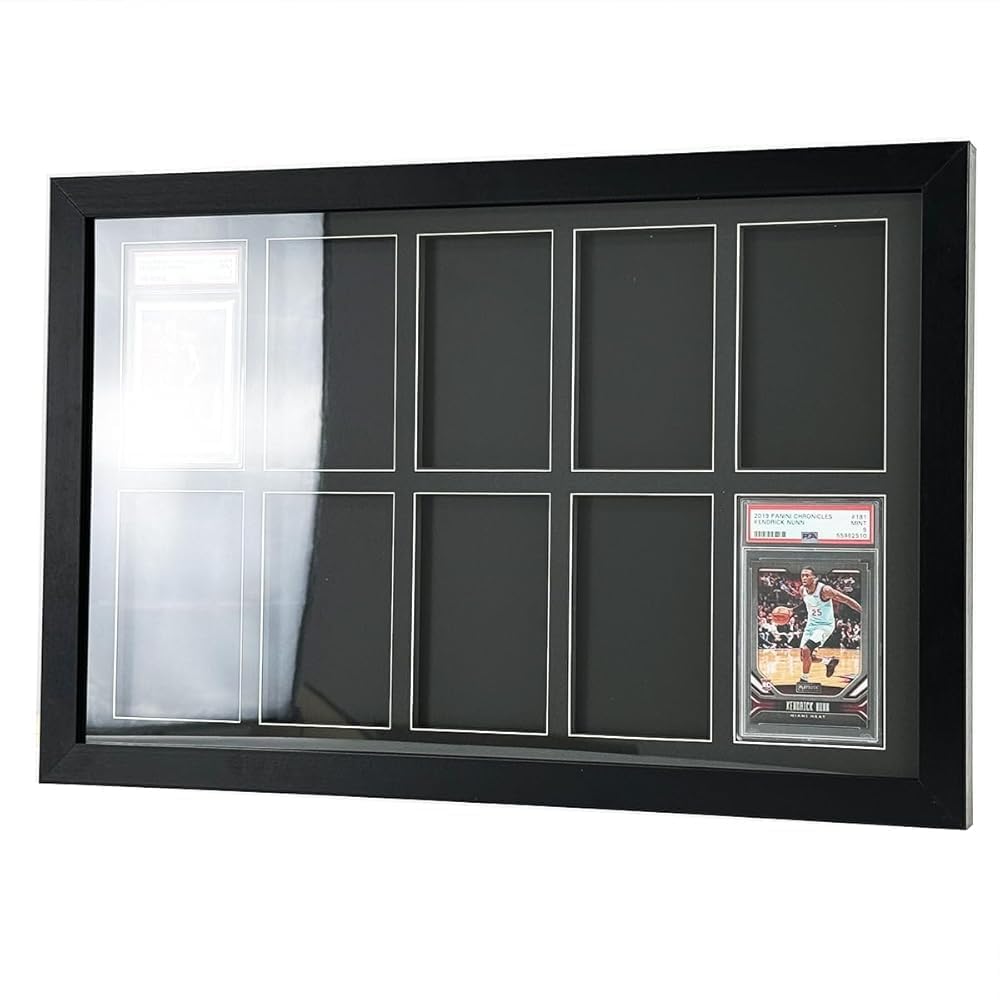
Ten slots is the whole pitch, and it is a good one. The Bivitre frame is 22 by 15.8 inches of black wood that hangs flat on a wall and works like a photo frame: lift off the back panel, press each slab into its foam cutout, close it up, hang it. PSA, CGC, and TAG slabs all fit, and the hanging kit comes in the box.

The foam is why this sits at the top of our list. Each cutout is angled and recessed, so a slab sits back into the frame instead of standing on a flat shelf waiting to pitch forward every time a door moves. Because the rows tilt, the grade and the label are readable from across a room rather than from a foot away. A wall of these looks like a display; a wall of shelf-style cases looks like storage you can see into.

What it does not do is scale. Ten slabs is a curated wall, not a collection, and the cutouts want one card per slot with nothing stacked behind it. It is also the lightest case here at four pounds, which makes it the easiest of these to hang — a level, two hooks, and you are done.

Pros

  • Foam cutouts hold slabs at a readable angle
  • Fits PSA, CGC, and TAG slabs
  • Mounts like a photo frame, no tools
  • Wood frame looks better than acrylic here

Cons

  • Only 10 slots, so a big collection will not fit
  • No door or lock
Our verdict

We recommend the Bivitre frame to anyone with a handful of slabs and a free stretch of wall — the foam cutouts hold cards still and show the labels better than anything else here.
Check Latest Price
2

Best for Large Collections

DisplayGifts Pro-Collector's Case

92 /100
Lab Score Outstanding

Key details

Panel
98% UV acrylic
Mounting
Wall mount, horizontal
Dimensions
30.5 x 24.25 x 2 in
Slab Height
Up to 5.5 in
View on Amazon

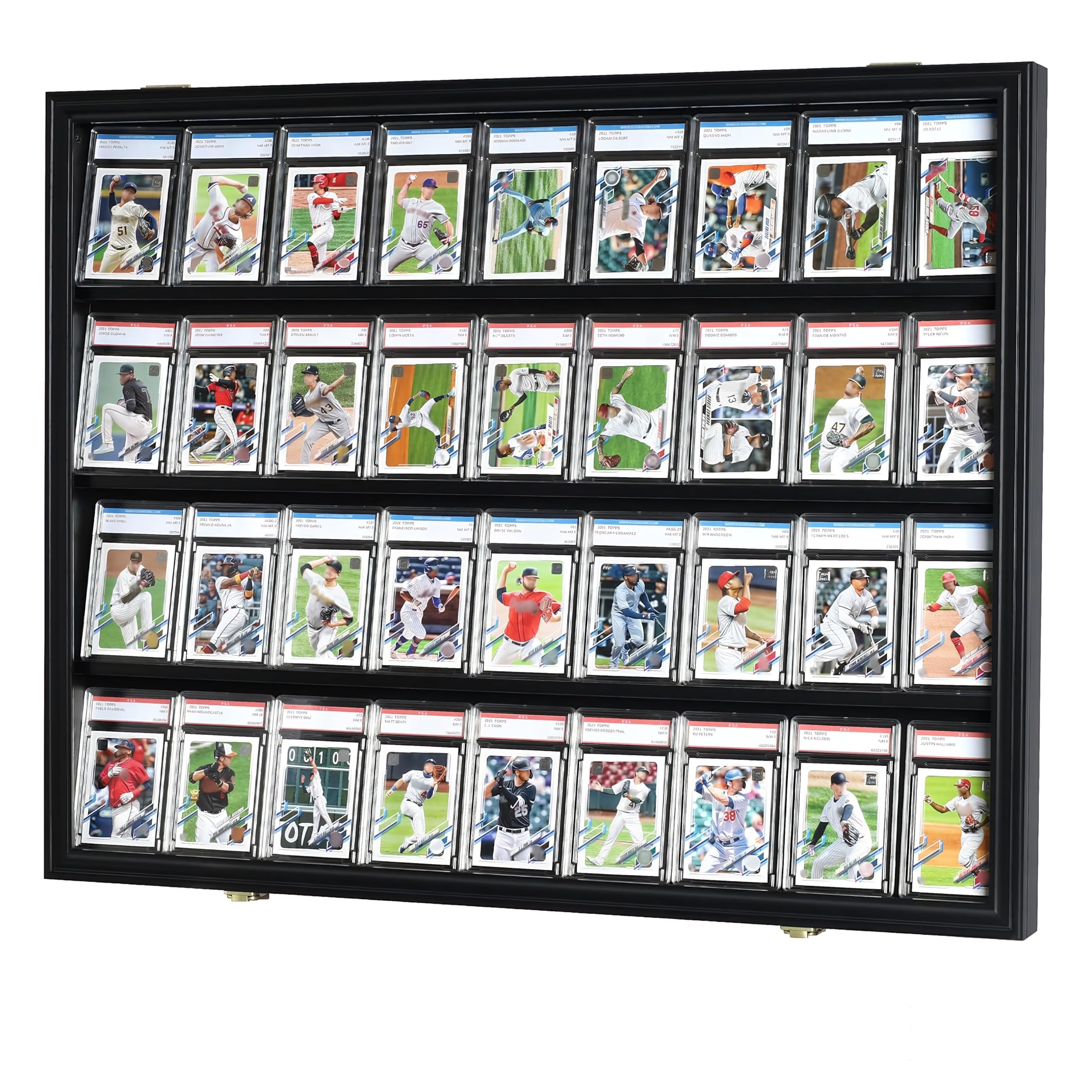
This is the case you move up to when ten slabs stop being enough. At 30.5 by 24.25 inches it asks for a real stretch of wall, and it is the one here that turns a whole box of graded cards into something you can stand back and look at. The acrylic is rated to block 98% UV, the door locks, and the hanging brackets are already fixed to the back with hooks in the box.

Loading it takes patience. The rows are flat shelves with no lip and no foam, so a slab sits on its edge and can tip forward until the door is shut and everything is pinned in place. Work from the bottom row up and keep the door propped while you go. Graded cards up to 5.5 inches tall fit, PSA and CGC slabs included, and the rows are deep enough for raw cards and top loaders too.

Up close the black engineered-wood frame looks like what it is, but from across a room the case reads as furniture, and the clear panel stays the thing you notice. Slide a card out of a top loader and it displays raw cards just as well, which is more than the slab-specific frames here can say.

Pros

  • Holds dozens of slabs behind one door
  • 98% UV acrylic protects the cards
  • Takes raw cards and top loaders too
  • Brackets and hooks included for hanging

Cons

  • Takes 30 inches of wall and 12 pounds of anchoring
  • The keyed lock is a basic deterrent
Our verdict

If your collection runs to dozens of slabs, this is the case we point you to: UV-blocking acrylic, a lock, and room to fill a wall.

Check Latest Price
3

Best Clear Acrylic Case

NIUBEE Acrylic Graded Card Case

90 /100
Lab Score Outstanding

Key details

Door
Magnetic acrylic
Panel
UV protection, 180° view
Capacity
Up to 8 graded cards
Mounting
Wall mount
View on Amazon

There is no wood anywhere in this one. The case is clear acrylic front, back, and sides, with a magnetic door that lifts away, a lipped shelf that holds up to eight graded cards, and UV-blocking acrylic rated for a 180-degree view. Because the whole body is transparent, the wall behind becomes the background and the slabs look like they are floating on it.

That is what we like about it for a hallway or a small room: a black cabinet is furniture, and this is closer to glass. The door comes off completely rather than swinging on a hinge, so lining up eight slabs is a two-hand job without a door in the way, and the lip does the work of keeping them upright once they are in.

Eight slabs is a small display rather than a collection, so this is the case for the cards you want in the room with you. Treated kindly — microfiber, a little water, no paper towels — the acrylic stays invisible, which is the entire point of buying a clear case.

Pros

  • Transparent on all sides, so nothing blocks the view
  • Magnetic door lifts off for loading
  • Lip-edge shelf keeps slabs upright

Cons

  • Holds eight slabs at most
  • Dust and fingerprints show quickly
Our verdict

For a small wall and a modern look, we pick the NIUBEE — eight slabs, no wood, and a clear view from every angle.

Check Latest Price
4

Best Budget

TrendTrust 5-Tier Card Stand

90 /100
Lab Score Outstanding

Key details

Size
12 x 8.5 x 13 in
Tiers
5
Assembly
Tool-free snap
Material
PET plastic
View on Amazon

Set this on a folding table at a card show and the reason for it is obvious: five tiers, each angled back, so someone walking past reads the labels without picking anything up. It snaps together without tools in a couple of minutes, and it comes apart flat enough to go back in a bag between shows.

It is also light — just under two pounds — and made of PET rather than acrylic, which is the right call for something that travels, because it flexes instead of cracking when the table gets knocked. The tiers are 12 inches wide, so slabs sit two or three to a row rather than four, and the whole stand fits on a shelf 8.5 inches deep.

For a desk, a booth, or a first show table, this is the least expensive route into a real display, and the only pick here built to be taken apart and carried. It is a stand, not a case: nothing covers the slabs, so dust and a bright window are still your problem.

Pros

  • Snaps together and apart with no tools
  • Angled tiers keep labels readable
  • Light enough to carry to shows
  • Cheapest display in this set

Cons

  • Shallow front lip lets slabs slide if bumped
  • Shelves can arrive scuffed or slightly warped
Our verdict

Buy this one if your cards travel: it sets up without tools, packs flat, and costs less than any other display we recommend.

Check Latest Price
5

Best Lockable Cabinet

Grintus 24-Card Wall Cabinet

85 /100
Lab Score Excellent

Key details

Locks
Two keyed locks
Lining
Black felt
Capacity
24 cards
Dimensions
22.1 x 24.8 x 2.1 in
View on Amazon

Two small keyed locks sit on the front of this cabinet, and the rows inside are lined in black felt — details that make a mid-priced case read as something more considered. Twenty-four slabs go in, PSA, BGS, and CGC all fit, the door is UV-rated acrylic, and the whole thing measures 22.1 by 24.8 inches, roughly the wall space of a poster.

The detail we appreciated most shows up when you open the door: every row has an inside edge, a small lip that keeps slabs from sliding out while you are loading or swapping. Load it top down and nothing ends up on the floor. That single edge is what separates this from bigger, flatter cases where cards tip forward the moment the door moves.

Twenty-four slots in about two feet square is the best slots-to-wall-space here, and the felt keeps a full cabinet from looking busy. If you want a wall that holds a real collection and still looks deliberate rather than packed, this is the one to hang.

Plan for a proper anchor, since it is close to ten pounds once it is full, and know that the frame is plain black wood. Neither is the point. The rows are what you are buying.

Pros

  • Inside lip on every row keeps slabs in place
  • Black felt lining makes the display look finished
  • 24 slots in about two feet square

Cons

  • Acrylic front scratches easily
  • Locks are small and stiff to turn
Our verdict

Our pick for a lockable wall cabinet — 24 felt-lined slots with an inside lip that keeps slabs where you put them.

Check Latest Price
6

Best for One Card

Dinavio Single-Slab Acrylic Case

83 /100
Lab Score Excellent

Key details

Stand
Included
Closure
Magnetic
Capacity
One PSA or CGC slab
Thickness
1 in acrylic
View on Amazon

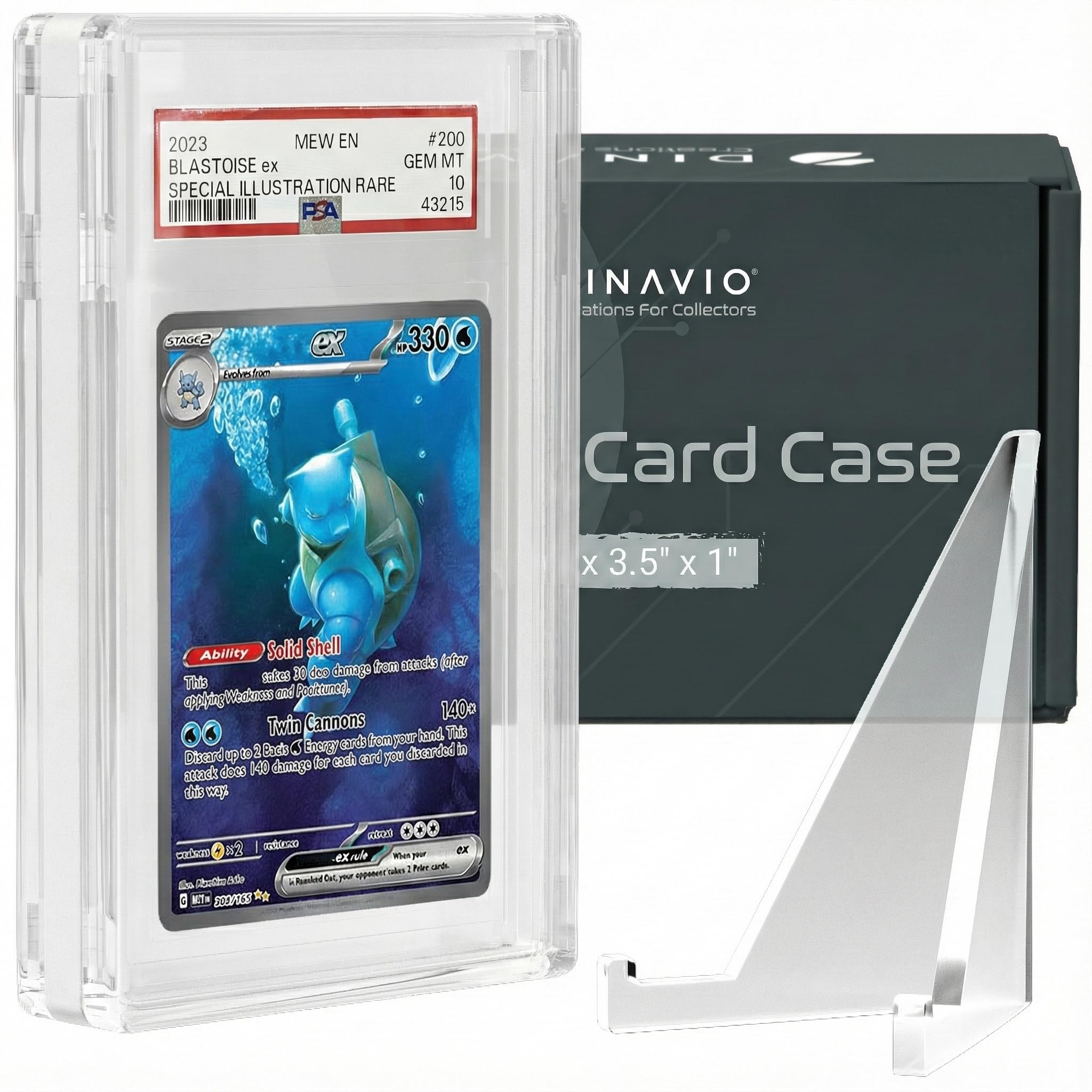
One slab, one inch of acrylic, a magnetic lid, and a small stand: that is the entire product, and for a single card it makes far more sense than a cabinet. It is cut for standard PSA and CGC slabs, the acrylic is rated to block 98% UV, and the border comes in colors if you want the case to pick up a team.

It reads as an object rather than packaging, which is the reason to spend on it. The lid clicks down on magnets instead of sliding or snapping, so a card goes in one-handed, and the included stand holds the block back at an angle that makes the label legible from a chair. It also keeps your hands off the slab, and handling is what actually wears a graded card out.

Fit is fussy in the way single-slab cases always are. The cavity is sized for PSA, so a CGC slab has enough slack to shift when you turn the case over, and a thicker slab can stop the lid sitting flush. A strip of clear plastic under the slab takes up the slack and the lid closes clean.

Pros

  • Thick one-inch acrylic feels substantial
  • Magnetic lid opens and closes one-handed
  • Stand included, so it sits at a readable angle
  • 98% UV protection for one card

Cons

  • One card per case
Our verdict

We like it best for a single grail card on a desk, where its magnetic lid and UV-blocking acrylic earn the shelf space.

Check Latest Price
7

Modular Gallery Wall

Emfogo 3-Pack Card Frames

84 /100
Lab Score Excellent

Key details

Pack
3 frames
Access
Front-opening panel
Mounting
Wall mount, linked or separate
Frame Size
16.73 x 7.08 in
View on Amazon

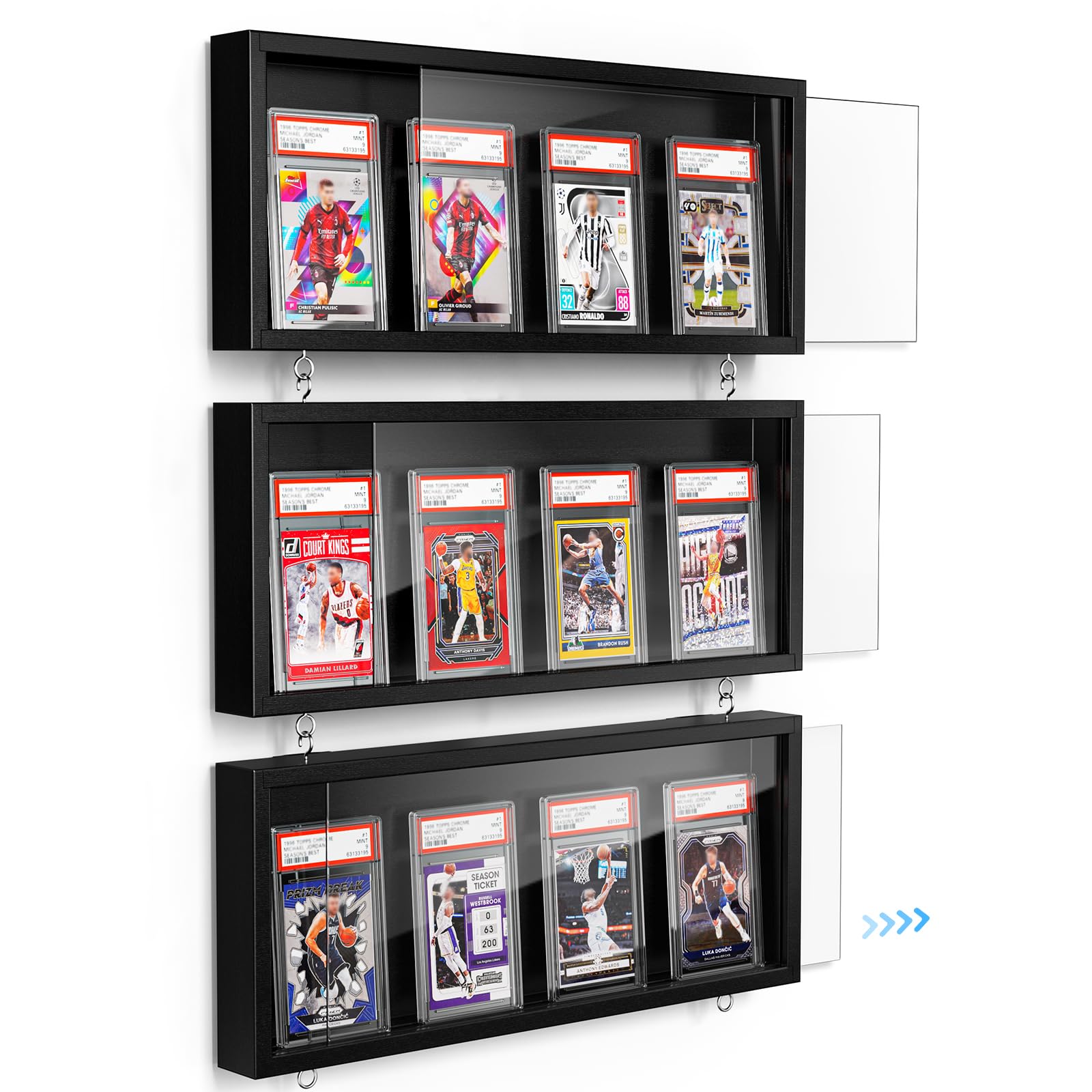
Three frames, each about 17 by 7 inches, in a rustic black wood: hang them in a column, in a row, or split them across two rooms. The backs have a hook-and-loop connection so the frames line up tight when you want them together and come apart when you do not.

Each frame opens at the front. The clear panel lifts out, slabs drop into the slots, and the panel goes back — quicker than swinging a cabinet door open, and better for a display you change with the season.

The wood is solid but light, and the whole set weighs about three and a third pounds. The finish is deliberately rustic, with visible grain and a matte black that sits easily in a room. Graded slabs sit in the slots without wobbling, and raw cards and top loaders work in the same slots if you want to mix.

Three small frames turn out to be more flexible than one large case, and that is the argument for the set: start with one, add the others as the collection grows, and rotate what is showing without emptying anything. What you give up is scale — three frames is a corner of a wall, not a whole collection.

Pros

  • Hang them linked or in separate rooms
  • Front-opening panel makes card swaps quick
  • Slots hold graded cards without wobbling

Cons

  • Front panel must be reseated squarely
  • Light wood feels less solid than the cabinets
Our verdict

Three small frames beat one big case when you want to grow a display slowly, and this set hangs together or apart.

Check Latest Price
8

Minimal Open Display

Famaster 4-Piece Card Shelves

87 /100
Lab Score Excellent

Key details

Cover
Open front, no glass
Shelves
4
Capacity
5 cards per shelf
Shelf Size
15 x 1.18 x 0.7 in
View on Amazon

No glass, no door, no frame: four 15-inch black ledges that screw to a wall and hold up to five cards each. That sounds like less product, and it is, but it is also the only pick here you can restock in seconds — lift a slab off, set another down, walk away.

Hidden screw holes keep the look clean, so what you see is four crisp lines with cards standing on them. Each shelf is rated for two pounds, far more than five slabs weigh, and four of them give you twenty cards in a column, a grid, or a line across a room.

The bargain is access for protection. Cards sit in open air, which is why swapping one takes seconds and also why this is the wrong wall for a card you would hate to watch fade. Set it away from a window and it is the least fussy display in this guide.

Pros

  • Cards sit in the open, so swaps take seconds
  • Hidden screw holes keep the line clean
  • Two-pound capacity per shelf

Cons

  • No cover, so no UV or dust protection
  • Twenty cards across four shelves
Our verdict

We recommend it to collectors who swap cards constantly — no glass, no door, and four ledges that take seconds to restock.

Check Latest Price

How We Tested Graded Card Display Cases

We started by pulling every case that stated its slab dimensions — about 40 listings — and cut anything promising to fit "standard" slabs without saying which grader. That left 12 in three shapes: single-slab wall frames, tiered stands, and cabinets built for 20 to 24 holders. We bought them at retail, set them up in a home office, a bedroom, and on a vendor table at a local card show, and lived with them for six months.

Fit came first, because a case that doesn't hold the slab is just a shelf. We loaded each one with a PSA holder, a thicker BGS-style holder, and a bare top-loader, noting which let the slab rock, which pressed the door against the label, and which had enough slack that the card slid when we nudged the frame. Then we opened and closed every door 50 times, checked whether the latch seated flush, and worked each lock empty and full.

For UV claims, we taped a strip of UV-sensitive paper behind each glazing panel and left the cases in a sun-facing window for four weeks to compare the fade. Sturdiness got tested the boring way: hung on drywall with the included hardware, filled to capacity, then checked monthly for sag, loose corners, and rattling acrylic. And we shot each one in daylight to see how the border cropped the label, how much glare the pane threw at eye level, and how long a full cabinet took to load from scratch.

Value was the last filter — what each case cost against how it was built and how much of a collection it could hold. The winners were the ones where the slab sat still, the door closed with a solid click, and the frame got out of the way of the card.

How to Choose a Graded Card Display Case

Fit the Slab Before You Fit the Room

A standard PSA slab runs a little over five inches tall, which is why so many cases advertise a 5.5-inch interior — the DisplayGifts cabinet and the Bivitre frame are both built around that number. Width and thickness vary by grader and by whatever bag or sleeve the slab lives in, so a slot cut for PSA can be snug on a thicker holder. Measure the exact slab you plan to display, sleeve included, and compare it against the slot dimensions rather than the outside dimensions of the case.

Watch the word graded in a listing, because it often means PSA only. If your collection runs across PSA, CGC, BGS, and TAG, lean toward a frame with soft foam cutouts or a cabinet with generous row depth instead of a channel cut to a single slab's tolerances.

Pick the Format Around How Often You Swap Cards

Open ledges and tiered stands are for rotation: the Famaster shelves and the TrendTrust stand let you change what is showing without opening anything. Frames with foam cutouts are for a settled wall of favorites — slower to load, tidier to look at. Cabinets do volume, behind a door and sometimes a lock.

In general, the more slabs a case holds, the less each one reads as an individual card. A full 24-slot cabinet looks like texture from across a room, while a ten-slot frame reads card by card. Decide whether you are building a display or an archive before you buy the biggest thing that fits.

UV Protection Only Works Where the Panel Covers

A 98% UV rating describes the acrylic panel, not the room. It slows fading on the face of a slab, but light reaching the cards from an open side and heat from a sun-facing wall still do damage. The Bivitre, DisplayGifts, and Grintus cases all rate their front panels; an open ledge or a tiered stand has no panel at all.

Treat the rating as a reason to buy a covered case, not as permission to hang one beside a window. Keep any display out of direct sun, and if a wall gets strong afternoon light, rotate what is on show there rather than leaving a grail card in it year-round.

Lips, Foam, and Doors Decide Whether Slabs Stay Put

A flat shelf with no lip is the most common frustration in this category: slabs lean forward and slide whenever the door swings. A small inside edge, as on the Grintus rows, or a recessed foam cutout, as on the Bivitre frame, holds cards through daily traffic and the occasional bumped wall.

Magnetic doors lift away completely, which is easier for loading than a hinged door that will not stay open. Keyed locks on these cases are simple cam locks — worth having for a curious guest, not worth counting on as security.

Check the Footprint and the Load

A 30-inch cabinet asks for wall you are willing to give up plus hardware that can carry it; a 22-inch frame fits above a desk. Weigh the empty case, add the slabs, then choose the anchor — a loaded cabinet belongs in framing or on a proper toggle, not a drywall plug.

If you rent, the smaller frames and the single-slab cases leave the fewest holes to explain when you move out.

Frequently Asked Questions

Final Verdict

For most collectors the Bivitre frame is the answer: ten slabs, foam cutouts that hold them at a readable angle, and an install that takes a level and two hooks. When the collection outgrows ten, the DisplayGifts cabinet holds dozens behind UV acrylic and a lock — plan the wall before you order it.

And if the cards travel to shows, the TrendTrust stand packs flat and costs the least of anything here.