Best Halloween Board Games of 2026

The trouble with Halloween board games is that too many are all cobwebs and no game—fun to look at, dull by the second round. What you actually want is a game that gets a mixed table talking, keeps the rules out of the way, and still feels worth pulling out next October. That's what separates a novelty from a keeper: it has to work as a game first and a Halloween decoration second.

We've spent the past eight weeks playing 12 of them—with family groups, adult friends, and one cousin who reads rulebooks aloud—and the pattern was clear. The keepers explained themselves in under ten minutes, set up without a hunt for missing pieces, and got requested again the next week. Whether your group likes to solve a puzzle together or turn on each other, the best ones made the rules feel invisible. The right pick should be the reason people stay at the table, not the reason they drift toward the snack bowl.

1

Best Overall

Horrified

96 /100
Lab Score Outstanding

Key details

Ages
10 and up
Players
1 to 5
Play Time
60 minutes
Monster Miniatures
7 sculpted
View on Amazon

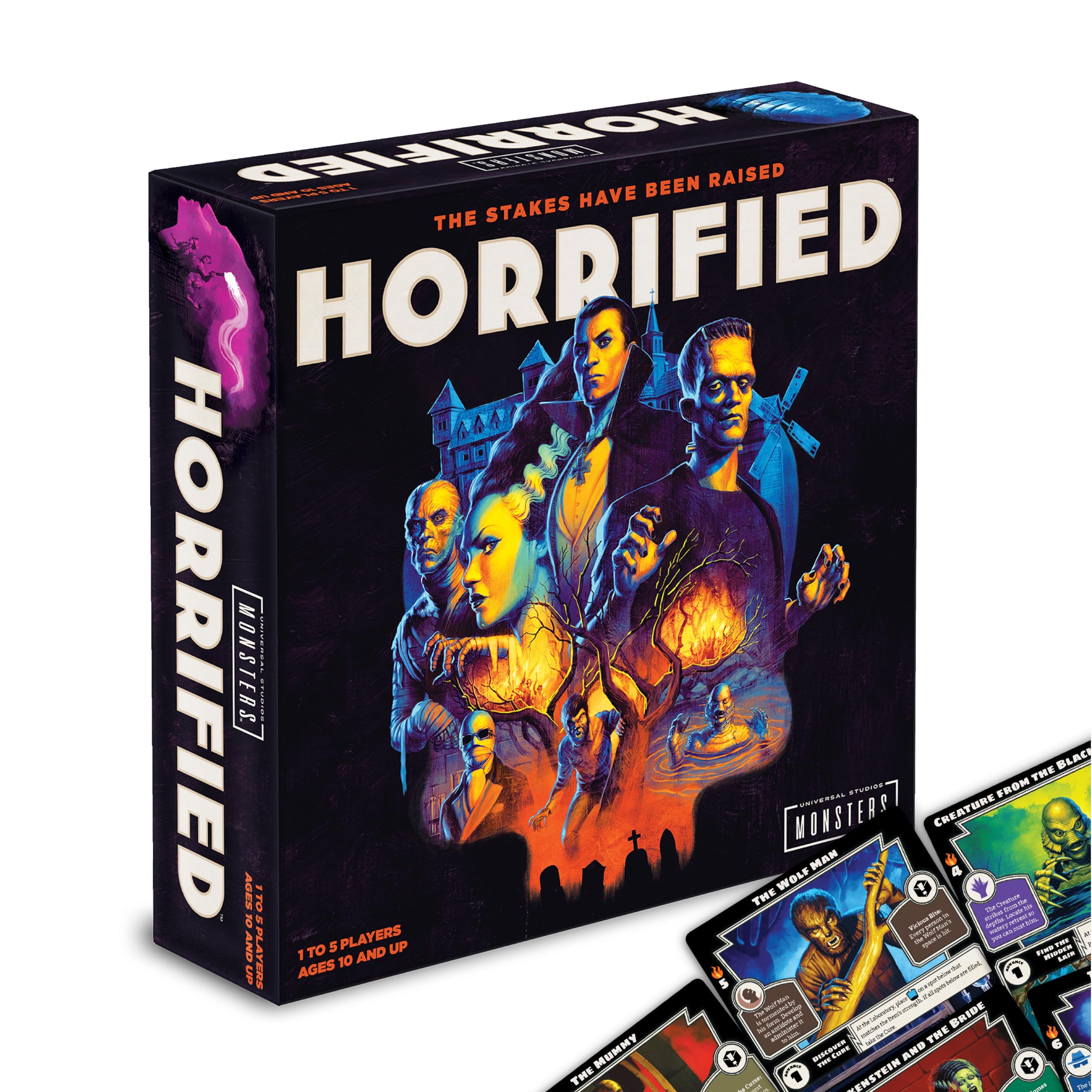
Seven monsters come in the box, and the game only asks for two or three of them at a time. Pick Dracula and the Creature from the Black Lagoon and the town, the cards and the threats rearrange themselves around that pair; swap in Frankenstein and the Mummy and the puzzle changes shape again. That variability is why this box still gets opened at our table long after the decorations go back in the attic.

What we appreciate most is that a game this atmospheric does not need a rules clinic first. The rules are short, the icons do the work, and every monster arrives with its own mat explaining the single thing it changes. We taught it to a table holding a 10-year-old and a skeptical adult in about the time it took to lay out the miniatures, and both were making plans by the second round.

The miniatures are the other reason it earns shelf space. They are small, and nobody will mistake them for a painted collector's set, but each one is instantly recognizable, so you always know which monster is walking toward you. The board and cards lean on the Universal Monsters artwork rather than generic gore, which is what makes it read as Halloween instead of a horror film.

Where it can sting is the threat track. Split up and it climbs faster than a new group expects, and a first game with three monsters can go badly enough that people want a rematch immediately. The difficulty is adjustable and the rulebook says how, but we still warn the table before the first play.

Pros

  • Seven monsters make every game a different puzzle
  • Rules teach in minutes, younger players included
  • Sculpted miniatures are easy to tell apart
  • Plays solo or with up to five

Cons

  • Threat track spikes before a new group settles in
Our verdict

Our default for a mixed-age Halloween table: cooperative, quick to teach, and a different puzzle every time you swap the monsters.
Check Latest Price
2

Best for a Big Group

Salem 1692

93 /100
Lab Score Outstanding

Key details

Ages
14 and up
Players
4 to 12
Contents
128 cards, gavel, hourglass
Play Time
20 to 40 minutes
View on Amazon

It is the headcount that sells this one: four to twelve players, which is more than anything else in this guide will seat. If Halloween at your house means a crowd rather than a foursome, that single specification settles the purchase.

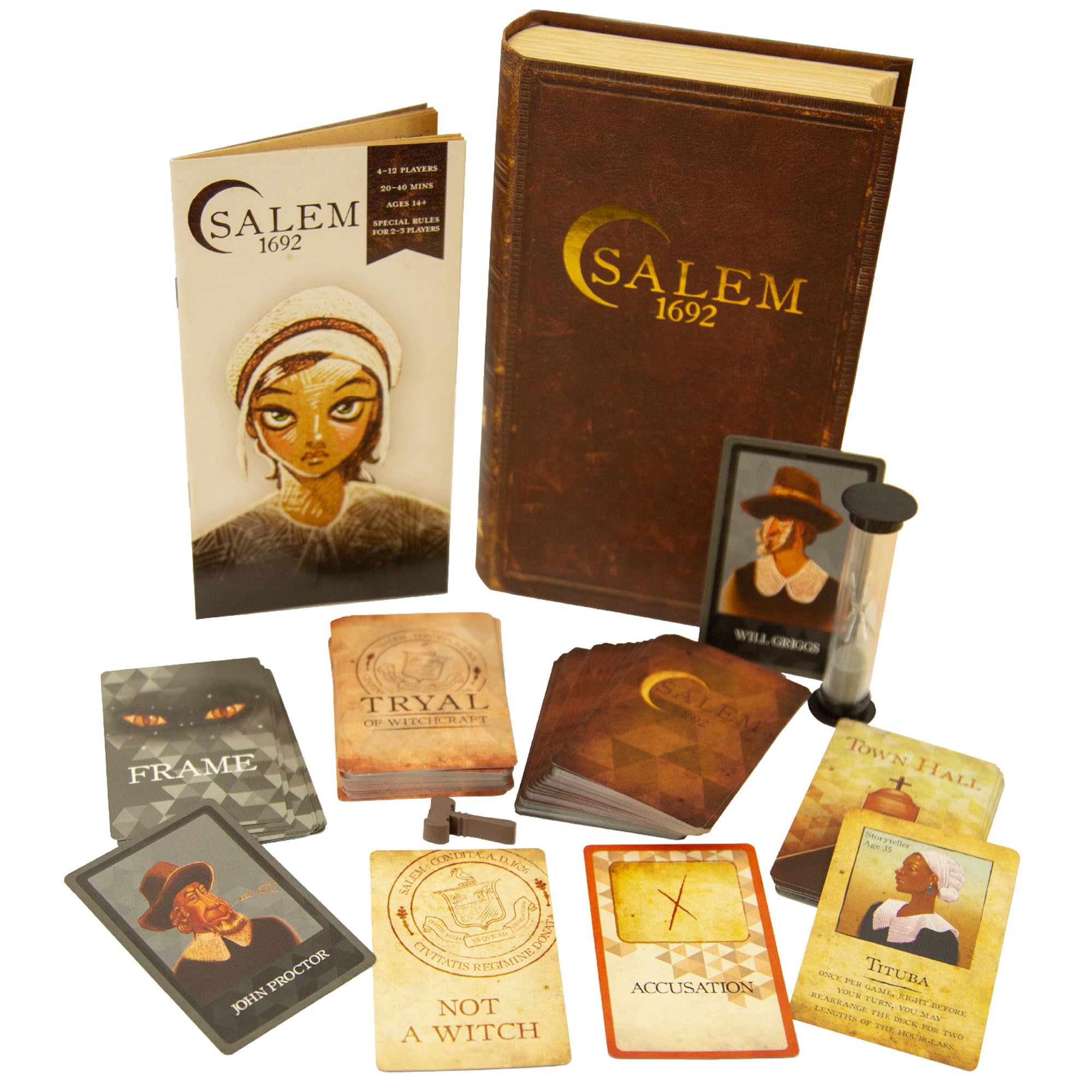
Salem is social deduction in the Mafia lineage. Everyone draws a villager, a witch, or a member of the Tryal family, and the accusations start immediately. Cards let you peek, block and accuse, while a thirty-second hourglass and a wooden gavel keep the arguing moving. Rounds run 20 to 40 minutes because a side completes its objective rather than because a timer runs out.

The presentation is what puts it on a Halloween table rather than a generic party table. It arrives in a magnetically closing faux-book box that looks like something pulled from a haunted library, and the 15 villager characters come with illustrations and short biographies. We liked that the history is treated as history instead of a spooky backdrop with names attached.

The learning curve is the honest caveat. The first round or two can be muddy while people work out what each card does, and the instructions are not the clearest we have read. Deal one practice round with the role cards face up — that costs five minutes and saves twenty.

Pros

  • Seats four to twelve players
  • Rounds run 20 to 40 minutes
  • Faux-book box and 15 illustrated characters

Cons

  • 14-and-up floor leaves younger kids out
Our verdict

Buy it for the head count: if you can fill a table with eight or more, Salem turns an ordinary game night into an argument everyone enjoys.

Check Latest Price
3

Best for Horror Fans

The Night Cage

92 /100
Lab Score Outstanding

Key details

Ages
14 and up
Modes
Basic and Advanced
Format
Cooperative tile-laying maze
Players
1 to 5
View on Amazon

Each player's candle lights only the tiles next to them, and the maze behind you goes dark as you move — the tiles you leave are pulled off the table and may resurface somewhere else entirely. There is no map to memorize because the map keeps dissolving.

That turns a cooperative game into a conversation about information. You collect keys, hunt for the gate, and try to keep everyone inside somebody's light while Wax Eaters move through the dark. Talking through the plan is the game, and when the plan collapses it is usually because one person wandered two tiles too far.

We were struck by how much the components do for the mood: the board is dark, the tiles are small, and the candlelight rule is enforced by the mechanics rather than merely suggested by the art. It is the only game here that made our table go quiet.

Two cautions. It is a 14-and-up game with real strategic weight, so it is not the one for a table that wants to chat and roll dice, and the Advanced mode layers new monsters and obstacles onto a game that is already tense. Teach it before people arrive — the light mechanic is simple once it clicks and muddy until it does.

Pros

  • Candlelight rule keeps deleting the map
  • Cooperative talk is the whole game
  • Advanced mode adds monsters and obstacles

Cons

  • Hard to win even before the Advanced mode
Our verdict

If your Halloween table is all adults and wants real dread rather than cartoon ghosts, this is the co-op we put in front of them.

Check Latest Price
4

Best Nostalgic Mystery

13 Dead End Drive

96 /100
Lab Score Outstanding

Key details

Ages
8 and up
Board
3-D mansion with traps
Players
2 to 4
Playing Pieces
13 cardboard heirs
View on Amazon

If you were playing board games in the 1990s, this box is a time machine: the mansion, the chandelier, the bookcase, the portrait with the moving eyes. Winning Moves has reproduced the original faithfully, down to the plastic clips and rubber band that arm each trap.

It is a bluffing game dressed as a murder mystery. Each player controls several heirs and only one of them is secretly yours, so you move everyone around the mansion, nudging your heir toward the will and steering the others under a falling chandelier. Last heir standing inherits, and dropping a trap on somebody else's character is the entertainment.

Setup is the tax. Assembling the mansion, the stairs, the fireplace and the statue takes a while the first time and wants adult hands, and it is not a job to hand a 5-year-old. That is the trade for a board that physically does something when you land on the wrong square.

With 8-to-12-year-olds and adults who remember the original, it is a genuinely fun session of not that room. The deduction is light, the traps do the work, and nobody takes a loss personally because the dice usually caused it. It is the least strategic game here, and the one we pull out when the table has mixed ages and a short attention span.

Pros

  • Traps actually fire when you land wrong
  • Hidden heir keeps everyone bluffing
  • Faithful reproduction of the 1990s original
  • Works for kids 8 and up with adults

Cons

  • Cardboard traps and pieces wear with repeated play
Our verdict

For families with grade-school kids and a taste for slapstick, this is the Halloween game we hand them: the traps are the whole show.

Check Latest Price
5

Best for Disney Fans

Haunted Mansion: Call of the Spirits

93 /100
Lab Score Outstanding

Key details

Ages
8 and up
Format
Set collection
Players
2 to 6
Play Time
30 minutes
View on Amazon

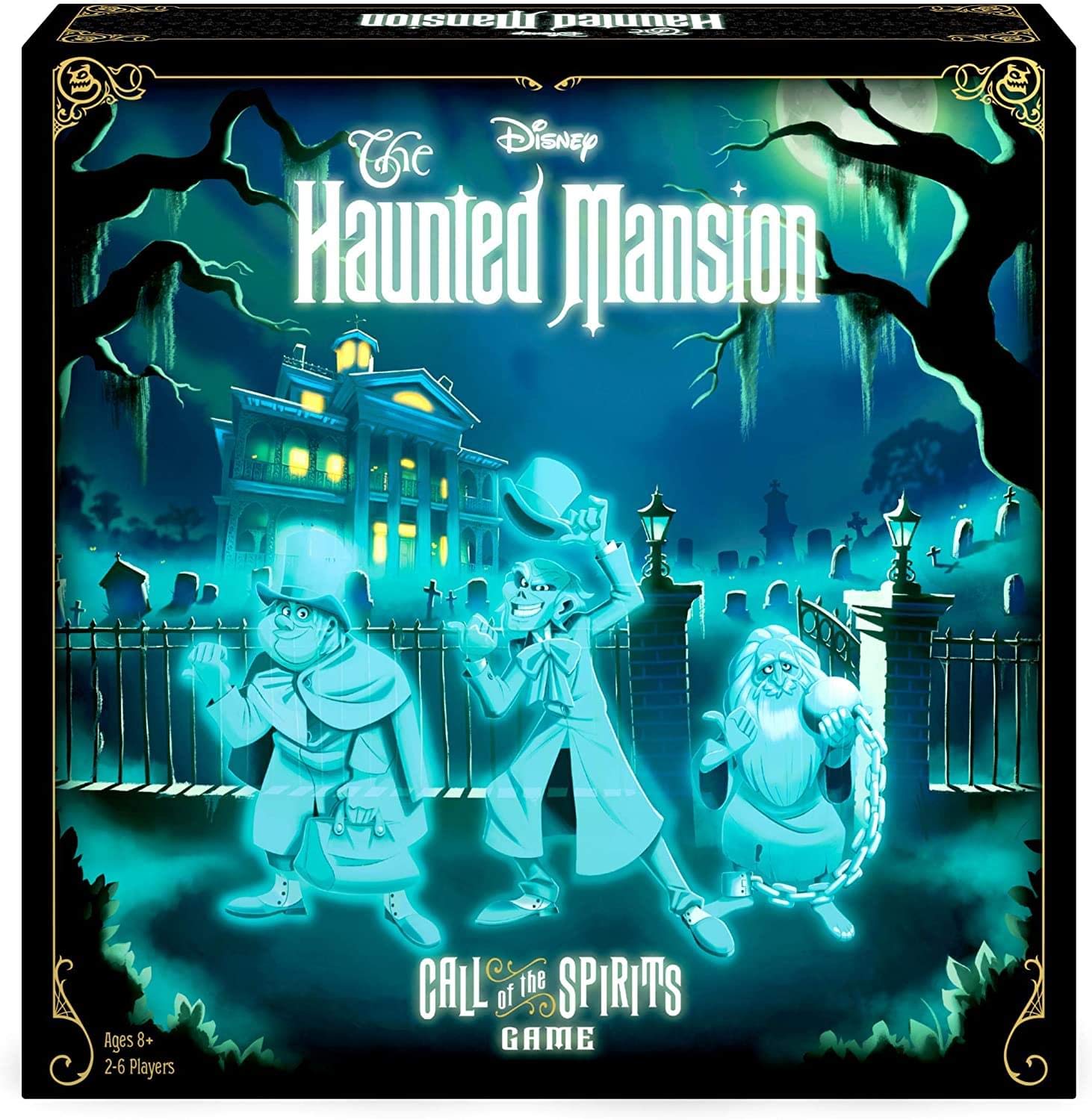
There is a rotating ring in the middle of the board: the Endless Hallway turns around Madame Leota's séance room, and where you can go changes with it. It is a small mechanical idea that makes a light set-collection game feel like the ride it came from.

For a Disney Parks household, the detail is the reason to buy. The 99 Happy Haunts are all here with art lifted from the attraction, you move between the Ballroom, the Attic and the Graveyard, and the Hitchhiking Ghosts can follow you home and cost you the game. We think the theming is affectionate rather than a label stuck on a generic board.

Underneath, it is set collection: gather matching ghost cards, because different sets score differently, and keep an eye on the Hitchhiking Ghosts while you do it. Two to six players, around half an hour, with the whole thing fitting on a small table.

It is at its best with people who know the ride. If nobody at your table recognizes the mansion, the references cannot carry the evening on their own, and the game underneath is pleasant but slight.

Pros

  • Rotating Endless Hallway changes your options
  • Ride artwork and all 99 Happy Haunts
  • Half an hour, two to six players

Cons

  • Rulebook needs a read-through before the first game
  • Light strategy next to the co-ops here
Our verdict

For a Disney Parks household, the ride references and the rotating hallway make this the obvious Halloween-night pick; the rules just need a rehearsal.

Check Latest Price
6

Best Family Co-Op

Ghost Fightin' Treasure Hunters

92 /100
Lab Score Outstanding

Key details

Ages
8 and up
Modes
Co-op and one-vs-all
Players
2 to 5
Components
24 ghost movers, 8 jewels
View on Amazon

One box, two games: everyone cooperates to carry eight jewels out before six rooms turn haunted, or one player runs the ghosts against up to four treasure hunters. That second mode is why the box stays near the top of our shelf — a family co-op that one person can make competitive when the table tires of winning together.

The co-op side has Basic and Advanced rules, which is how the same box has covered a 7-year-old and a table of adults on the same evening. Basic is short and forgiving. Advanced tightens the haunting and makes ghost placement matter. The components are the pleasant surprise: 24 ghost movers, six chunky haunting figures, sculpted treasure hunters.

What we did not expect was how much game sits inside a kids' box. Adults at our table had to think about where to move and when to fight, and the loss condition arrives faster than you expect when the dice run cold. It is kid-first without being kid-only.

For households with kids around 8 who want something they can win together on a school night, this is the family pick with the most inside it. It is also the one we hand adults who claim they do not like kids' games.

Pros

  • Two modes, co-op and one-versus-all
  • Basic and Advanced difficulty in one box
  • Chunky, well-made components

Cons

  • Two modes mean somebody keeps the rules
Our verdict

For families with kids around 8, this is the co-op we buy: it starts as a quick basic game and grows into a real one.

Check Latest Price
7

Best for Young Kids

Return of the Headless Horseman

93 /100
Lab Score Outstanding

Key details

Ages
6 and up
Format
Cooperative
Players
Up to 4
Play Time
15 minutes
View on Amazon

Fifteen minutes, up to four players, and a price that makes it an easy add-on: this is the Halloween game we buy for a young family that does not own a shelf of them yet. You are helping Ichabod reach the covered bridge before the Headless Horseman catches him, and the tree in the middle spins to spit out more cards.

The cooperative structure is the smart part. Nobody is eliminated, nobody loses to a sibling, and the tension comes from the deck thinning out rather than from a player getting knocked out. The rules also adjust, so you can dial the strategy down for a 6-year-old or tighten it for older kids, and the Ichabod and Horseman figures are posed mid-gallop instead of standing there like pawns.

Where it lands short is the ceiling: four players is a small table, and the decisions are light enough that adults will be playing for the kids rather than for themselves. We did not mind, because fifteen minutes is fifteen minutes. The artwork is the standout — board, box and cards all use the look of the Disney Sleepy Hollow short, so a family that watches it every October has a companion piece.

Pros

  • Nobody is eliminated, so no tears
  • Rules adjust down for a 6-year-old
  • Fifteen minutes and easy to teach
  • Artwork from the Disney short

Cons

  • Caps at four players
Our verdict

For a first Halloween game with young kids, this is the one we buy: quick, cooperative, and short enough to play twice before bed.

Check Latest Price
8

Beetlejuice Fans

Monopoly Beetlejuice

95 /100
Lab Score Outstanding

Key details

Ages
8 and up
Tokens
6 film-prop movers
Players
2 to 6
Play Time
60+ minutes
View on Amazon

The tokens tell you what kind of reskin this is: the Wedding Dress, the Handbook for the Recently Deceased, the Skeleton Key, the Beetlejuice Tombstone. Six film props rather than six generic hats.

Underneath it is Monopoly, with the same dice, the same rent and the same slow late game. What changed is the dressing — Chance and Community Chest become Haunting and Occurrence cards, houses become Haunted Houses, and the say-his-name-three-times gag is written into the rules as a way to collect before passing GO.

We think that is a fair trade if your group already likes Monopoly. The theming is specific and funny instead of a label on the lid, it seats two to six with an 8-and-up floor, and nobody needs a teach before the first roll. A licensed reskin is easy to get wrong; this is a good version of a game people already know how to play.

For a Halloween party where half the table does not want a rules lesson, that matters more than originality. It is the box we slide toward the relatives who ask what the rules are and then stop listening.

Pros

  • Six film-prop movers, not generic tokens
  • Haunting and Occurrence cards re-theme the deck
  • No teach needed for a Monopoly crowd

Cons

  • Same long Monopoly endgame
Our verdict

If your crowd already knows Monopoly and loves the film, this themed version earns its shelf space — the dressing is the entire reason.

Check Latest Price
9

Mystery Fans

Clue: Nightmare Before Christmas

91 /100
Lab Score Outstanding

Key details

Ages
8 and up
Players
2 to 6
Weapons
6 sculpted tokens
Play Time
60 minutes
View on Amazon

Standard Clue asks who did it in the billiard room. This one asks who kidnapped Sandy Claws, with which weapon, and where he is hidden — and the locations run from Oogie's Lair to Jack's House instead of the study and the conservatory.

The pieces are the reason to buy this over a plain Clue: six coffin-shaped movers, six sculpted weapons including Frog's Breath and a Bear Trap, and a board that covers Halloween Town and Christmas Town. We also liked the Intrigue cards, which the classic game does not have and which hand you small advantages instead of pure movement.

It plays like Clue, which is either the pitch or the warning. Two to six players, about an hour, 8 and up, and the deduction is the same deduction you did as a kid. A mystery-minded group settles in happily; a table that groans at roll-and-move will not be converted.

Against the Beetlejuice Monopoly, this is the one we choose for people who like a puzzle, and against a plain Clue it is the one we choose for anyone who wants the film on the table. The coffin movers get a reaction when the box opens, which counts for something in a gift.

Pros

  • Coffin-shaped movers and six custom weapons
  • Intrigue cards add a wrinkle classic Clue lacks
  • Film locations across both towns

Cons

  • An hour is long for younger players
Our verdict

For a Nightmare Before Christmas household that already likes Clue, the coffin movers and Halloween Town board make this the version to own.

Check Latest Price
10

Villainous Owners

Villainous: Filled with Fright

93 /100
Lab Score Outstanding

Key details

Ages
10 and up
Players
2 to 4
Requires
Villainous base game
Play Time
60 minutes
View on Amazon

Before anything else: this is an expansion, not a game, and that single fact should decide whether it belongs in your cart. On its own the box is a good-looking Oogie Boogie mover, a realm board and cards you cannot use without a Disney Villainous base set.

If Villainous already lives on your shelf, it is an easy yes. Oogie runs on dice manipulation rather than the usual deck optimization: you roll and re-roll to reach the numbers his objective needs, which gives him a rhythm no other villain has. The mover, the realm board and two Oogie dice are in the box, along with 130 villain cards and 15 Fate cards.

We liked that he plays differently rather than reskinning an existing villain's engine. The dice make every turn a small gamble, and the Fate deck stays busy because his board is exposed. At two to four players and about an hour, it slots into a normal Villainous night rather than replacing it.

If you are shopping for a standalone Halloween game, this is not it — start with Horrified or the Haunted Mansion. This one is for the shelf that already has Villainous on it, where a Nightmare Before Christmas villain is exactly the right addition.

Pros

  • Oogie's dice mechanic plays unlike other villains
  • Includes mover, realm board and two custom dice
  • Drops into an existing Villainous collection

Cons

  • Requires the Villainous base game
Our verdict

Worth it if Villainous is already on your shelf — Oogie's dice mechanics are a genuine change of pace, not a repaint.

Check Latest Price

How We Tested a Dozen Halloween Board Games

We started by pulling together a shortlist from publisher catalogs, hobby shop shelves, and the Halloween aisle of a few big-box stores—filtering out anything that was purely decorative or required an app to function. That left 12 games at different price points, from small card games to full board setups. Over eight weeks, we played each one at least three times with groups ranging from two to eight players, including family game nights, an adult friends' gathering, and a deliberately chaotic party where half the table had never played a modern board game.

For every title, we timed how long it took a first-time player to read the instructions and teach the game to the table. We noted whether the rulebook answered obvious questions or sent us to a phone for clarification, and we counted setup minutes from opening the box to the first turn—including sorting tokens, shuffling decks, and assembling any cardboard. Games that needed a practice round to make sense got marked down unless the practice round itself was fun.

During play, we watched for the things that make a game worth keeping: whether people leaned in, whether turns moved quickly, and whether the cooperative ones actually felt tense rather than solvable by one bossy player. We tracked how often a game hit the table again within the same week, and we paid attention to difficulty—not just age ratings, but whether a mixed-age group could play without one person running the whole show. After each session, we checked components for wear: card edges, token paint, cardboard chits that had been handled by sticky fingers. The games that survived eight weeks of shuffling and grabbing without fraying or denting earned extra credit.

By the end, the pattern was clear: the best Halloween games were the ones that got out of their own way. They set up fast, explained themselves without a lecture, and gave every player at the table something to do—whether they were cooperating to survive the night or competing to collect the most candy.

How to Choose a Halloween Board Game

Start With the Scare, Not the Shelf

Theme runs from cute-spooky to genuinely unsettling, and the gap between those two is wider than a box lid suggests. Haunted Mansion: Call of the Spirits and Return of the Headless Horseman sit at the gentle end: ghosts, jokes, nobody eliminated. The Night Cage and Horrified sit at the other end, where the tension is the point rather than the decoration.

Our rule is simple. If anyone at the table is under 10, make the main event a gentle one and save the darker game for after bedtime. The printed age floor is a decent proxy, but read the play style as well — a 14-and-up deduction game is a different kind of frightening from a 14-and-up horror co-op.

Decide Co-op or Competitive Before You Shop

Cooperative games solve the mixed-age problem, because everyone wins or loses together and a 9-year-old cannot be knocked out by an adult in round three. Horrified and Ghost Fightin' Treasure Hunters are the two we reach for. Competitive games are better when the table is evenly matched and enjoys a bit of theatre: Salem 1692 lives on accusations, and 13 Dead End Drive lives on springing a trap on a friend.

One-versus-all is the useful middle ground. Ghost Fightin' Treasure Hunters lets one player run the ghosts, which resets a family that has stopped losing gracefully.

Count the Chairs

Player count is where most Halloween purchases go wrong, because shoppers read the upper number and ignore the lower one. A two-to-four-player game on a six-person night leaves two people watching, and a four-to-twelve-player game with only four at the table is a thinner experience than it is with ten.

Write down your realistic headcount before you shop, then check the minimum as carefully as the maximum. If your guest list swings between four and twelve, Salem 1692 is the one box here that covers the whole range.

Budget for the Teach

Every game here is sold as easy to learn, and most of them are — after somebody has read the rulebook twice. The real question is who does that work. Icon-driven co-ops like Horrified teach themselves once the board is out; deduction games with text on every card need a reader who prepares.

Our habit is to open the box the afternoon before, play a hand alone, and keep the rulebook on the table. Five minutes of head start is the difference between a game and a lecture.

Look Under the Theme

Plenty of Halloween games are a familiar game with pumpkins on them, and that is fine as long as you know which one you are buying. Monopoly Beetlejuice and Clue: Nightmare Before Christmas keep the mechanics of their originals and change the dressing; The Night Cage and Horrified build the rules around the premise. Both approaches work, but only one feels like a discovery.

Also budget for setup. Trap games like 13 Dead End Drive need assembling before anyone can play, and that job wants adult hands the first time.

Frequently Asked Questions

Final Verdict

Horrified is the box we put in front of almost anyone: cooperative, quick to teach, adjustable when the threat track turns nasty, and built so a 10-year-old and an adult can win or lose together. It is the safest Halloween purchase on this page and the one most likely to still be played in March.

If your table is all adults and wants to be genuinely uneasy, take The Night Cage instead — it is the only game here that makes the dark a mechanic rather than a mood. And if the night means ten people in the kitchen, Salem 1692 is the one that seats them.