Best Mini Pinball Machines of 2026

Mini pinball machines earn their keep the moment someone walks past and can’t resist one flip. The good ones turn a spare corner, desk, or guest-room shelf into a two-minute arcade break — no basement, no tokens — while the bad ones arrive wobbly, with instructions that don’t match the parts bag, and rattle loud enough that you play with the volume off. I’ve bought enough novelty gifts to know the pattern: the machine gets a burst of attention, then becomes furniture if the flippers feel cheap or the ball keeps finding a dead spot. What you’re really after is a small machine that feels solid, plays fair, doesn’t make the house regret the novelty, and costs what it’s worth.

For six months, we tested 12 mini pinball machines, building each one, playing solo and with kids and guests, and listening for motor whine and ball clatter. The ones that held up shared clear instructions, snug joints, a playfield that fit the cabinet, and a game that stayed fun after the first week. Here are the ones that earned their spot.

1

Best Overall

BRIO 34017 Pinball Game

91 /100
Lab Score Outstanding

Key details

Power
Hand-operated, no batteries
Included
Four metal balls
Footprint
20.5 x 13.5 x 4.75 inches
Recommended Age
6 years and up
View on Amazon

Most of the interesting machines in this category arrive as a box of parts and a manual. The BRIO doesn't. You lift it out, drop one of the four metal balls into the chute, pull the spring launcher, and the game is running — no assembly, no rubber bands, nothing to charge. That single difference is why it's our top pick: it's the one here that is a game first and a project never.

At 20.5 by 13.5 inches it's the largest of the mini machines, and the size is the point. The ball has a real run to travel, and the wooden playfield with steel balls has the weight and roll of an arcade game shrunk down rather than a toy imitating one. The body has stayed solid through our testing, the launcher still pulls cleanly after plenty of games, and the four balls in the box mean a lost one doesn't end the evening.

It also has nothing inside it. No speaker, no circuit board, no batteries, which means no beeping from the corner of a shared room and nothing electronic to fail a year from now. What's left is a launcher, a playfield and gravity, which is why we're comfortable handing it to a six-year-old and a grandparent in the same sitting. The flip side is that it stays where you put it — this is a table machine, not something that goes in a bag for a restaurant.

Pros

  • Plays straight out of the box, no assembly
  • Solid wood-and-plastic body that stays tight
  • No batteries or electronics to fail
  • Playfield long enough to play properly

Cons

  • Steel balls on wood make a real clatter
  • No lights, sound or electronic scoring
Our verdict

For most households this is the one: a sturdy, battery-free tabletop machine that plays the moment it comes out of the box and asks nothing of you afterward.
Check Latest Price
2

Best Build-It-Yourself

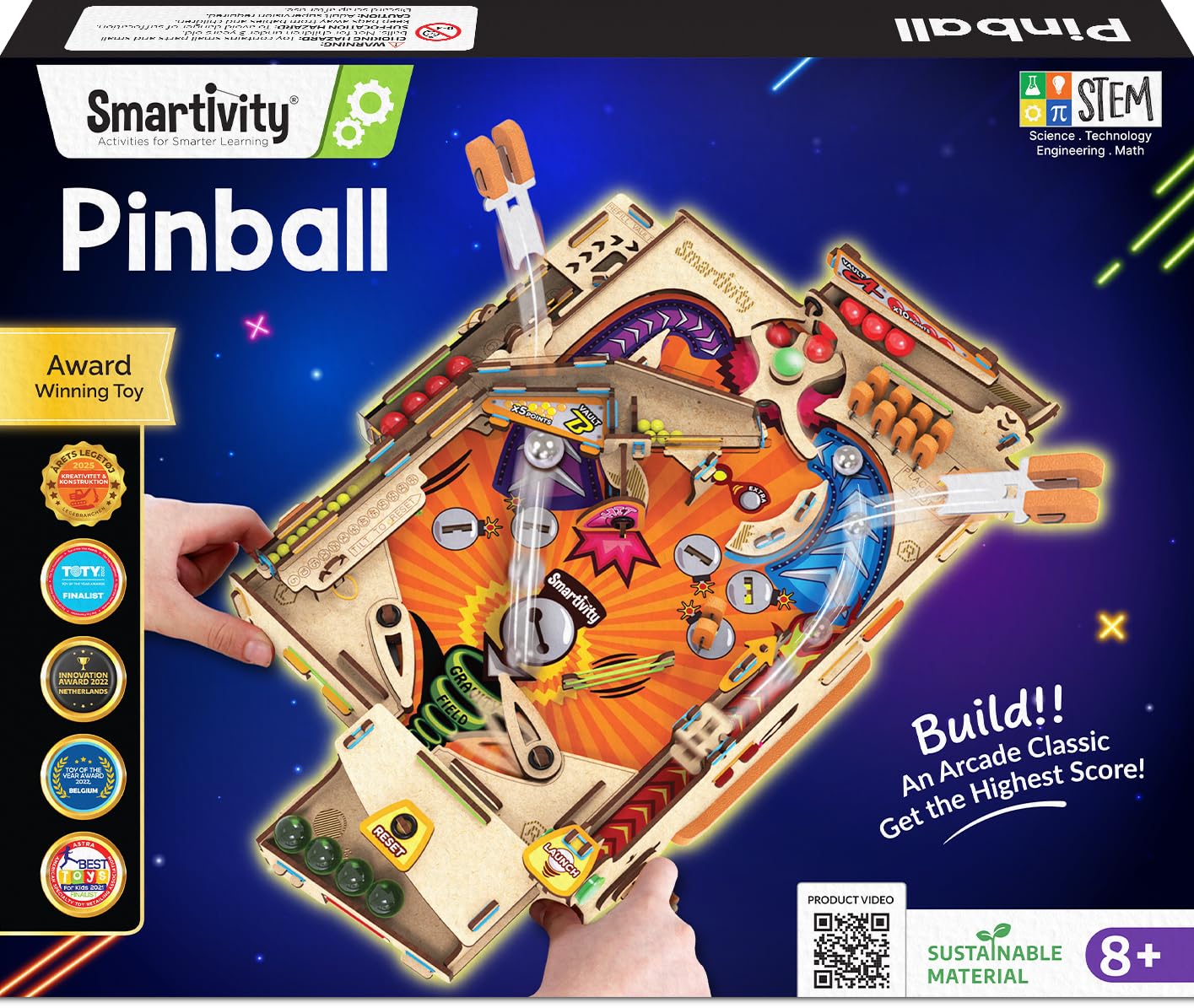
Smartivity DIY Pinball Machine

92 /100
Lab Score Outstanding

Key details

Power
Manual, no batteries
Material
Wood
Footprint
11 x 14.5 x 5.3 inches
Recommended Age
8 to 14 years
View on Amazon

The Smartivity is the one that makes you work for it: flat-packed wooden sheets, a bag of small parts and an instruction manual, and no pinball machine at all until the spring launcher, the flippers and the scoring targets are in place. That's the honest description of the product, because the build isn't packaging — it's half of what you're buying.

We ended up glad it works that way. The mechanism is exposed and entirely mechanical, so you can see the spring load and the flipper arms and understand exactly why a shot went where it did. Kids in the eight-to-twelve range get most of the way through it themselves, and the flipper assembly is the fiddly part where an adult earns their keep. Align it carefully and the game plays cleanly; rush it and the machine feels broken, which is worth knowing before you blame the design.

Once it's together it's a genuinely small machine — 11 by 14.5 inches, so it lives on a desk or a shelf instead of taking over the dining table — and it costs a fraction of what a finished game runs. What surprised us is how much it gets played afterward. Most kits like this get made once, admired and shelved; this one turns into the thing people pick up when they walk past.

Pros

  • Real spring launcher, flippers and scoring targets
  • Build is absorbing rather than busywork
  • Desk-sized at 11 by 14.5 inches
  • Fully mechanical, no batteries

Cons

  • Hours of assembly before the first game
Our verdict

Buy it as a project: the assembly is the main event, and the working flipper machine at the end of it keeps earning its shelf space long after the build.

Check Latest Price
3

Best Showpiece

ROKR 3D Wooden Pinball Machine

90 /100
Lab Score Outstanding

Key details

Pieces
482
Weight
7.8 lb
Scoring
Infrared sensors, lights and sound
Recommended Age
14 years and up
View on Amazon

The ROKR is the only machine here that keeps score for you: infrared sensors read every hit across three elevated tracks, stars light up on the central display, and the copper bells actually ring when you catch one. That's the feature that earns its place, because it's the difference between a model you show people and a game they keep coming back to.

The build is the price of admission — 482 pieces and an expert skill rating, which in practice means a long weekend or a run of evenings with the manual open. We think that trade is fair, because what you end up with has wiring and sensors inside it, and that's the part you can't cut and glue yourself. The circus styling, the top-hat figures and the warm integrated lighting make it the one piece here that looks deliberate on a desk rather than left out.

The reservation is durability. The decorative trim is what takes the hits, and small pieces can work loose over a session — put a dab of glue on the stress joints while you're building and you spare yourself chasing bits across the desk later. Spare parts come in the box, which helps. At 7.8 pounds it also stays put, so you can lean into a shot without chasing the machine around the table.

Pros

  • Sensor scoring with lights and bells
  • Elaborate finished look with integrated lighting
  • Heavy enough to stay put during play
  • Spare parts included in the kit

Cons

  • The priciest machine in this set
Our verdict

The showpiece of the group: infrared scoring, lights and bells inside a laser-cut cabinet, for anyone ready for an expert-level build and gentle handling.

Check Latest Price
4

Best Budget

Schylling Space Race Pinball

87 /100
Lab Score Excellent

Key details

Power
Manual, no batteries
Material
Metal
Footprint
11.25 x 5.25 x 0.75 inches
Recommended Age
3 years and up
View on Amazon

This is the least expensive way into a working pinball toy: one lever, one steel ball at a time, and a space-themed playfield on a metal-backed board about the size of a tablet. There are no ramps to aim at, and the ball does most of the travelling on its own, so it isn't the same game the bigger machines here play. What it is, is the one that fits in a backpack.

Hand it to a kid who has never seen a pinball machine and the lever makes sense within a minute — that's the appeal, and it's why this one gets carried around instead of displayed. The build is thick plastic with a metal back, the ball stays where it should, and with no batteries it works in the back seat, in a waiting room, on a tray table. What it won't do is grow with them: an older child gets an afternoon out of it and moves on. As a first machine, a stocking stuffer or a travel toy, that's a fair trade.

Pros

  • Least expensive working pinball toy here
  • Metal-backed, thick plastic build
  • Battery-free and backpack sized
  • Lever launch suits small hands

Cons

  • Simple play; older kids lose interest fast
Our verdict

The budget pick and the only one here that travels: a metal-backed, battery-free pinball toy a small kid can work out in about a minute.

Check Latest Price
5

Kids Who Want Lights

New Era Pinball Game

84 /100
Lab Score Excellent

Key details

Power
Batteries required
Weight
4 lb
Features
LED scoring, six lights, eight sounds
Footprint
21 x 10 x 4 inches
View on Amazon

There's no volume control, and we noticed it within a few minutes of play. The New Era runs eight sound effects at one setting, and it is loud — loud enough that the arcade effect wears thin for everyone else in the room well before it wears thin for the kid playing. That's the first thing to know, because almost everything else about it is sensible.

What you get is a 21-inch tabletop cabinet with LED scoring, six blinking lights and eight sound effects, plus the option to launch one, two or three balls at once — no other machine here does that, and the multi-ball launch adds a bit of chaos younger players love. Watch the size figure: 21 inches is the whole cabinet, backboard included, so the playfield inside is shorter than the number suggests. It's light enough to move from table to floor, which is how the manufacturer pitches it.

Our take is that it's a lights-and-sound machine first and a pinball machine second, and that's fine if that's what you're shopping for. The plastic shell is plainly built to a price, and the scoring and lights are the reason to choose it over the manual machines at the top of this list. Buy it for a kid who wants the arcade effect on a bedroom floor; buy the wooden machines for everyone else.

Pros

  • LED scoring with six lights and eight sounds
  • Three-ball launch adds variety
  • Light enough to move from table to floor
  • Battery-powered with no cord

Cons

  • No volume control, and it runs loud
  • Lights or scoring can fail out of the box
Our verdict

The pick for a kid who wants lights, sound and a three-ball launch; the plastic is ordinary, but the arcade effect is real and it plays.

Check Latest Price

How We Tested Mini Pinball Machines

We started with a shortlist of tabletop and freestanding mini machines that listed a real footprint, power source, and replacement parts, then cut anything that hid its dimensions or shipped without setup guidance. We tested 12 machines over six months. Each one was assembled solo with only the included instructions and tools, and we noted missing steps, confusing diagrams, and whether a second person was actually needed.

In use, we set each machine on a desk, a narrow side table, and a guest-room shelf to see whether the footprint matched the specs and whether the cabinet shifted during play. We played full games during coffee breaks, after dinner, and with kids and visiting friends, watching whether the flippers responded consistently, the scoring kept up, and the ball return avoided dead spots. We also checked the fun factor by seeing who came back to it unprompted after a week.

Because these live in shared rooms, we listened in a quiet room and with a TV on, noting motor whine, bumper clatter, and ball return noise. We inspected flippers, legs, playfield surfaces, and screws at setup and again after six months, looking for wobble, cracking, stuck balls, and fading paint. We compared materials and play feel with what each machine asked for its price bracket, and judged gift appeal by whether it looked presentable out of the box and needed adult help to set up. The final picks are the ones that stayed fun, stayed solid, and stayed worth the space.

How to Choose a Mini Pinball Machine

Kit or Finished Machine

Half the machines worth considering here are kits and half are finished games, and that fork matters more than any specification. A finished machine such as the BRIO gets played the day it arrives; a kit like the Smartivity is an evening's project first and a pinball machine second. We put the finished machines first for most buyers, because a toy that waits for a free weekend tends to keep waiting.

If the build itself is the present — a birthday for a kid who likes making things, or a project for a wet weekend — buy the kit deliberately, clear a table, and plan to be around for the fiddly steps rather than handing over the box.

Match the Footprint to the Room

Mini covers a lot of ground: the BRIO is 20.5 inches long, the Smartivity 14.5, and the Schylling is a tablet-sized board you hold in two hands. Measure both the surface it will live on and the shelf it will be stored on, because a long machine with a raised backboard doesn't go in a drawer.

One trap: the length in a listing is usually the whole cabinet, backboard included, so the playfield you actually play on is shorter than the number suggests. If the machine has to share a desk with a monitor, assume you need the full listed length plus room to work the launcher.

What Makes It Play Like Pinball

The difference between a pinball machine and a ball-rolling toy is control. Look for a launcher that puts the ball in play with some pace, flippers or buttons you can time, and return channels that send a drained ball back into play instead of ending the turn.

Ramps, bumpers and bells give you something to aim at, and scoring gives you a reason to take another turn — the ROKR's sensors do that automatically, the Smartivity's targets require you to keep score in your head. A machine where the ball simply falls to the bottom is a fidget toy in a pinball-shaped box.

Durability: Where These Give Out

Every shot is a small impact, and the parts that take them are the ones that fail: flipper arms, launcher springs, decorative trim, and any joint held by friction alone. Wooden kits benefit from a dab of glue at the stress points while you build; plastic machines live or die on the moulding of the moving parts.

Before you buy, check that spare parts or extra balls come in the box. A machine you can't get balls for becomes a display piece, and a loose piece of trim on a scored playfield can block a shot outright.

Power, Noise, and the Room It Lives In

Hand-powered machines need nothing but a level surface. Electronic ones add lights, sound and scoring, and usually a fixed volume you can't turn down, which is worth checking before a machine moves into a small shared room.

Manual machines aren't silent either: steel balls on a wooden playfield make a genuine clatter, and that's the sound of the game rather than a fault. If the machine is for a car, a waiting room or a plane tray, buy manual and small.

Frequently Asked Questions

Final Verdict

The BRIO 34017 is the machine we recommend for most households: it plays from the moment it comes out of the box, it needs no batteries, and it is sturdy enough to be handed to a six-year-old and a grandparent in the same evening.

If the build is the point — a gift for a kid who likes making things, or a project for a rainy weekend — the Smartivity is the better choice, as long as you know you are buying an evening's work before the first game. For a lit, self-scoring showpiece on a desk, choose the ROKR.