Best Retro Game Consoles of 2026

A retro console is supposed to be a shortcut back to the games you remember, not a weekend lost to emulator settings and controller mapping. The promise is simple: your old favorites on a modern TV, with a controller that feels right and none of the hassle of keeping aging hardware alive. The catch is that two consoles can claim the same library and feel completely different once you press start. The right one closes that gap; the wrong one turns nostalgia into a project.

Over the past six months, I've had 12 of these consoles hooked up in my living room, and the ones worth keeping got the small things right: games that load without drama, controls that respond when a jump gets tight, and sound and picture that don't make a classic feel like a knockoff. A spec sheet won't tell you whether the included library is worth playing or whether you'll need to buy extra controllers before friends come over. That's what this list is for.

1

Best Overall

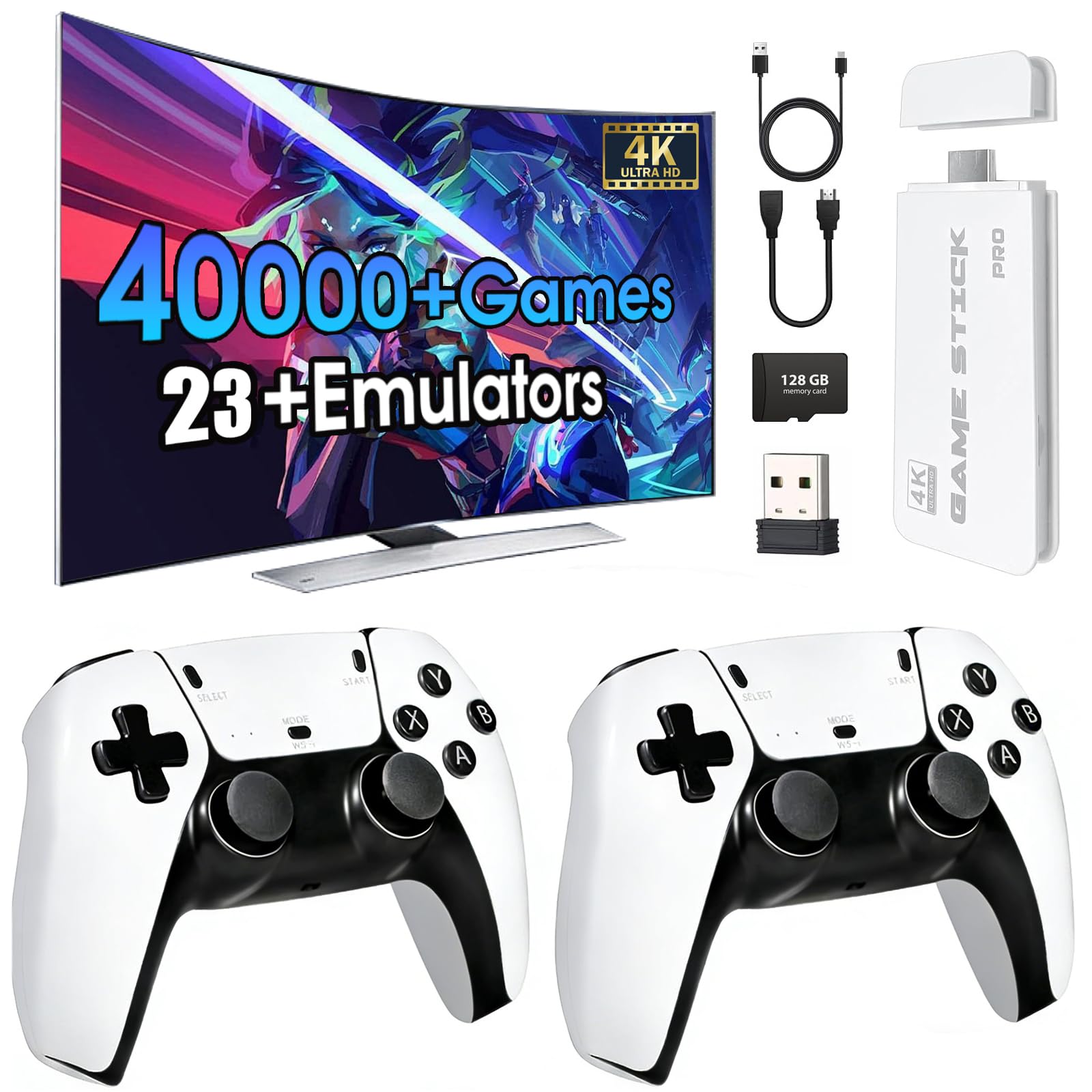
TEFELE M15 Game Stick

92 /100
Lab Score Outstanding

Key details

Storage
128 GB
Emulators
23
Controllers
Two 2.4 GHz wireless
Built-in Library
40,000+ games
View on Amazon

There is nothing to install. The stick goes into an HDMI port, the two 2.4 GHz controllers connect wirelessly, and 128 GB of games is already inside it. We had a picture on the TV before we had finished reading the quick-start card, and the whole thing is small enough to carry into another room in a coat pocket.

That is why it earns the top spot. Someone shopping for a retro console usually wants a Saturday afternoon, not a project, and this is the only pick here that asks nothing of you: no cartridges to dig out, no front end to configure, no microSD to write. It also carries the strongest buyer rating in this group, which fits how little there is to get wrong on the way in.

One thing worth knowing before you order: the 4K on the box describes the HDMI signal, not the games. Nothing from the 1990s outputs 4K, and what you'll see is a clean upscale of sprites that were drawn for a CRT. That is the right result — these games should look like these games — but the headline resolution isn't buying you detail.

Pros

  • Two wireless controllers in the box
  • Plug-and-play setup with no configuration
  • 128 GB of games built in
  • Small enough to move between TVs

Cons

  • No cartridge slot
  • Long game list includes duplicates and filler
Our verdict

For most people this is the retro console to buy: it plays on any TV in minutes and comes with two wireless controllers, though the library is fixed.

Check Latest Price
2

Best for Cartridge Collections

Retro-Bit Super Retro Trio HD Plus

84 /100
Lab Score Excellent

Key details

Video Output
720p over HDMI
Cartridge Slots
NES, SNES, Genesis
Original Controllers
Supported on all three
View on Amazon

The Super Retro Trio's best trick is that it doesn't ask you to rebuy anything. Three cartridge slots take original NES, SNES, and Sega Genesis games, and the console puts them on a modern TV at 720p over HDMI. Cartridges that had been in a shoebox for years worked the first time we tried them.

It is clone hardware, and it behaves like it. Most games look and sound right, though audio runs a touch thin on some titles and colors come out slightly warm next to a real console — the sort of difference you notice side by side and stop noticing after ten minutes. The controller ports accept original pads for all three systems, which is the strongest argument for this one over the Hyperkin below.

The controllers that come with it are fine rather than good, and anyone with original pads will use those instead. At about 2 pounds it sits happily under a TV, and the plastic is where the money went: it's light, and it isn't something to stack books on.

Pros

  • Plays NES, SNES, and Genesis cartridges
  • 720p HDMI output for modern TVs
  • Original controllers work on all three systems

Cons

  • Hinged front door is the fragile part
  • Some SNES cartridges won't run properly
Our verdict

If your closet already holds NES, SNES, and Genesis cartridges, we think this is the console that finally gets them back onto a modern TV.

Check Latest Price
3

Best Budget Cartridge Console

Hyperkin RetroN 2 HD

84 /100
Lab Score Excellent

Key details

Video Output
720p HD
Cartridge Slots
NES, SNES, Super Famicom
Included Controllers
Two classic-style
View on Amazon

Cheaper than the three-slot Retro-Bit, and it gives up only the Genesis slot. The RetroN 2 HD takes NES, SNES, and Japanese Super Famicom cartridges — NTSC and PAL — and sends them to a modern TV at 720p over HDMI. Two classic-style controllers come in the box.

We left the aspect switch on 4:3 the whole time. Stretching a game drawn for a tube across a widescreen makes everyone look like they've been hit by a cartoon anvil, and the black bars become part of the furniture. The picture is crisp on an LCD, the cartridge pins grip hard for the first few insertions, and original NES and SNES pads work in the ports.

Performance is the honest caveat. Most cartridges run smoothly, but a few heavier titles slow down and a small number crash, so test your favorites early. Retro-Bit's machine is the safer bet for a large collection; this one is the cheaper way in, and it comes with a one-year warranty.

Pros

  • Plays NES, SNES, and Super Famicom carts
  • Two controllers included
  • Switchable 4:3 and 16:9 output

Cons

  • No Genesis slot, unlike the Retro-Bit Trio
  • Colors can look off on some games
Our verdict

We recommend it to anyone who wants their NES and SNES carts on an HDTV for the least money, and can live without a Genesis slot.

Check Latest Price
4

Best Premium Handheld

Retroid Pocket Flip 2

87 /100
Lab Score Excellent

Key details

Screen
5.5 in. AMOLED, 1080p
Chipset
Snapdragon 865, 8 GB RAM
Storage
128 GB, microSD
Preloaded Games
None
View on Amazon

The Flip 2 is the only clamshell here, and the shape does real work: the lid closes over a 5.5-inch 1080p AMOLED panel that is the best screen in this group by a clear margin. Hall-effect sticks won't develop drift, the hinge has been reinforced, and we opened and closed it far more than necessary without any looseness.

Under the lid sits a Snapdragon 865 with 8 GB of RAM — the most capable hardware on this page, and not by a small margin. That chip is what you're paying for: the 16-bit systems the others handle are easy work for it, and the 3D-era systems that strain the cheaper handhelds here are the reason to spend the extra.

None of it is plug and play. It boots into Android 13 with an empty library, and the first evening disappears into emulator front ends, BIOS files, and box art. Buy it if that sounds like a hobby; skip it if you want to hand a controller to a guest and start playing.

Battery life is the other variable. The 5000 mAh cell goes a long way on 16-bit games and much less far once you're pushing 3D systems, which is normal for this class of device and worth planning around on a long flight.

Pros

  • Sharpest display here
  • Most powerful chipset in this set
  • Hall-effect sticks resist drift
  • microSD expansion for your own files

Cons

  • No games preloaded
  • No charger in the box
Our verdict

Buy it if you're happy to build your own library; we think it's the best hardware here and the wrong choice for a plug-and-play household.

Check Latest Price
5

Best Handheld With TV Output

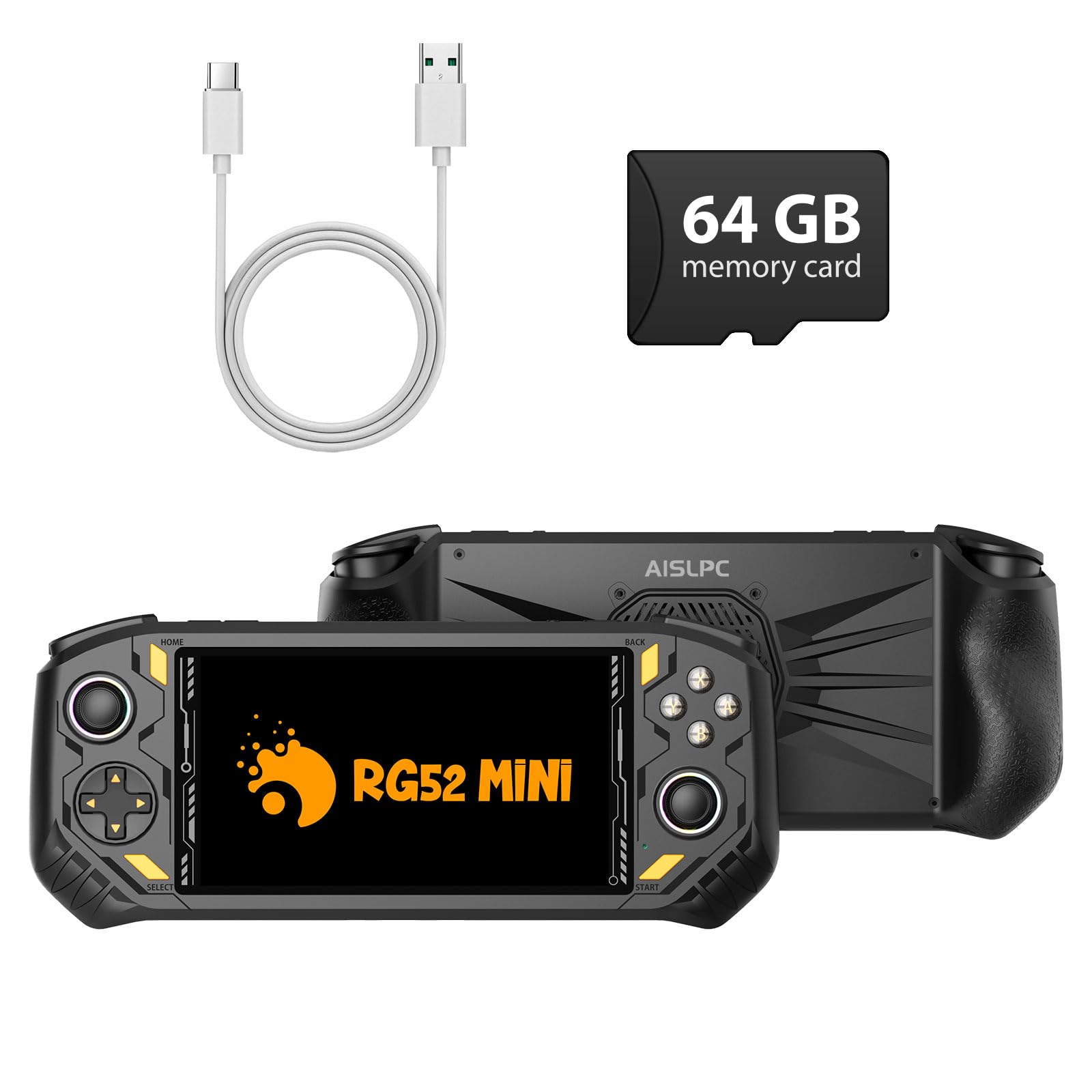
RG52MINI Handheld

82 /100
Lab Score Excellent

Key details

Screen
5.5 in. IPS, 720 x 1280
Battery
5000 mAh
Storage
64 GB
TV Output
Mini HDMI
View on Amazon

A 5.5-inch IPS panel at 720 by 1280 is a lot of screen for a handheld this size, and it's the first thing anyone picks up on. Text in the menus is legible without squinting, and the extra height suits vertical shooters and old handheld games that look cramped on a widescreen.

It runs two front ends, EmuELEC and RGBOX, on an RK3562 chip, with 64 GB of games on the card, WiFi for networked play, and a mini HDMI port for a TV. The dual 3D joysticks are the part we appreciate most: they make fighting games and 3D titles feel right instead of compromises.

This is the one we take on a trip. Two things to plan for: the menus are not intuitive without the booklet, and it wants a 2-amp USB adapter — with a weak charger it can sit there looking dead when it isn't.

Pros

  • 5.5-inch IPS screen
  • Mini HDMI output for a TV
  • Dual joysticks for fighting and 3D games

Cons

  • Menus need the booklet to learn
Our verdict

The handheld we reach for on a trip: a big, bright screen, a real HDMI port, and enough battery for a long flight.

Check Latest Price
6

Pocket Tinkering

RG35XX Pro Handheld

78 /100
Lab Score Very Good

Key details

Battery
3200 mAh
Storage
64 GB card
TV Output
HDMI
Resolution
640 x 480
View on Amazon

At 6.56 ounces it disappears into a jacket pocket, and the transparent teal shell is the most fun any console here has looked sitting on a desk. Two joysticks on a body this small is the surprise — they're usable, not decorative.

For the size it's well connected: HDMI out, WiFi for streaming and wireless controllers, vibration, and support for both 2.4 GHz and wired pads. The 64 GB card carries the preloaded set, and adding your own games is a copy-and-paste job onto a second microSD — an evening with a tutorial rather than a computer science degree.

The preloaded library is the weak part: it's missing headline titles, and loading your own is the fix, which is exactly the kind of project this handheld is built for. It's the least expensive handheld here, and the one we point people to when they want to learn how these devices work.

Pros

  • Weighs 6.56 ounces
  • HDMI out and WiFi on an inexpensive handheld
  • Easy to add your own games by microSD

Cons

  • Some units arrive that won't power on
Our verdict

Our pick for tinkerers on a budget: light, inexpensive, and easy to load with your own games.

Check Latest Price
7

Big Preloaded Library

RG56PRO Handheld

77 /100
Lab Score Very Good

Key details

Screen
5.5 in. IPS, 1280 x 720
Battery
5000 mAh
Storage
128 GB card
Controls
Hall-effect triggers
View on Amazon

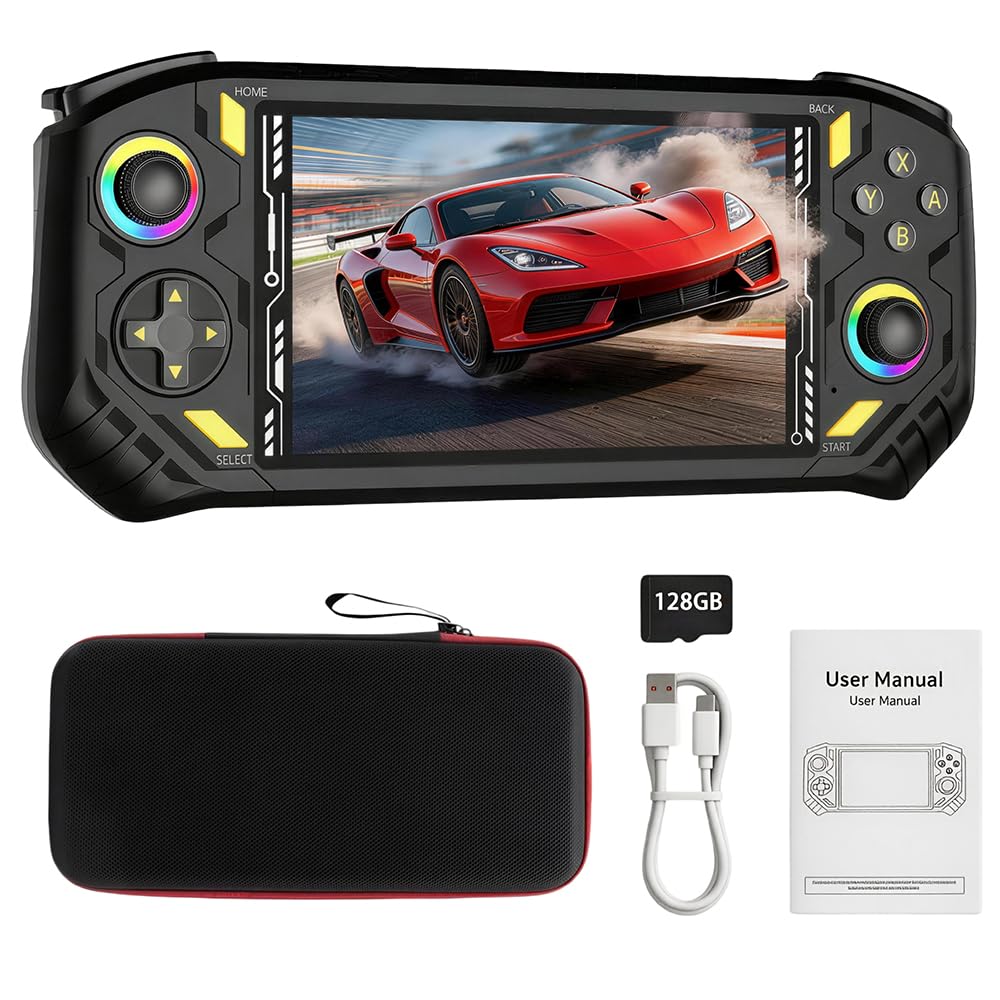
The 128 GB card is the headline: it carries the largest preloaded library of any handheld here, more than 31,000 titles by the listing's count, including the fifth-generation 3D games the smaller cards skip.

The hardware is more thoughtful than the price suggests: an RK3562 with active cooling, a fully laminated 1280 by 720 IPS panel with an anti-glare finish, Hall-effect L1 and R2 triggers, and a hard EVA case in the box. The Hall triggers are the detail we appreciated most, since they don't wear out the way potentiometer triggers do.

Where it runs out of road is the 3D era. Nintendo 64 and newer systems are beyond the chip, so judge it on the arcade and 16-bit games it handles well rather than on the modern-sounding titles the card advertises.

That makes this a specific recommendation rather than a general one: buy it for a big library, a bright anti-glare screen, and a case that survives a backpack, and keep your expectations in the 16-bit era.

Pros

  • 128 GB card with the largest library here
  • Laminated, anti-glare 5.5-inch screen
  • Hall-effect triggers and active cooling
  • Hard EVA case included

Cons

  • Preloaded card skips big DS and PlayStation titles
Our verdict

For a big preloaded library on a bright 5.5-inch screen, we like it — just don't expect it to run Nintendo 64 games well.

Check Latest Price

How We Chose and Tested These Consoles

We started by building a shortlist from the consoles that actually support the platforms people ask about—8-bit and 16-bit favorites, arcade ports, and the odd later system—then filtered out anything with unclear compatibility lists, missing controller ports, or a price that only made sense if you already owned the accessories. That left 12 units, which we ran for six months in a living room setup: weeknight sessions on a modern TV, weekend rounds with two or four players, and handheld units carried on commutes and played on the couch until the battery gave out.

Setup was timed from unboxing to first playable game, including how long it took to connect, pair controllers, and navigate the menu. I played a fixed list of timing-sensitive games—platformers where a missed jump is obvious, fighting games where input delay shows up in a blocked hit—and noted when a console felt a beat behind or smoothed over animation in a way that changed the feel. For compatibility, I loaded games from each supported system and checked whether saves held, whether region or format quirks surfaced, and whether the included library was mostly filler or genuinely replayable.

On picture and sound, I compared side-by-side with original hardware where I could, looking for stretched aspect ratios, blurry pixel scaling, and audio that turned a favorite soundtrack thin or harsh through TV speakers and headphones. Controllers got the most handling: d-pad accuracy, button travel, grip, cable length, and whether the build flexed or creaked during a long session. Handheld battery life was measured by continuous play at a normal volume until shutdown; for value, I counted what came in the box against what you'd need to buy to play with a friend.

How to Choose a Retro Game Console

Decide Where the Games Come From

There are three routes and they barely overlap. A plug-and-play console arrives with a library built in: you plug it into a TV and play, and you're limited to whatever shipped on it. A clone console like the Retro-Bit Trio or the Hyperkin RetroN 2 HD plays the cartridges you already own, which is unbeatable if you have a box of them and pointless if you don't. The third route is a device that ships empty and runs your own files — more work, and the only route where the library is exactly what you want.

Read the Game Count Skeptically

A number like 40,000 counts files, not classics. Regional duplicates, alternate versions, and filler are how these libraries get that large, and the titles you want to play first can still be missing — the RG35XX Pro is a good reminder that a big card doesn't guarantee a big-hitting selection. If the listing shows a game list, scan it before ordering. If it doesn't, expect surprises in both directions.

Match the Console to the Era You Want

Everything on this page handles 8- and 16-bit systems well, because that hardware has been solved for years. The cost jumps sharply when you want Nintendo 64, Dreamcast, GameCube, or PlayStation 2, which need a much faster chip — that gap is the whole reason the premium handheld here costs several times what a plug-and-play stick does. Decide which era you actually care about before you start comparing prices.

Handheld, TV Stick, or Cartridge Console

A handheld is the most flexible shape, especially with an HDMI port: you play on the train and plug into a hotel TV the same evening. A TV stick is the simplest thing to live with but is tethered to a screen. And ignore the 4K badge on any of them — no game from the 1990s is 4K, so that figure describes the output signal, not the picture you'll see.

Check the Controllers and the Plastic

Bundled controllers are usually where money is saved, so on cartridge consoles the ports matter more than the pads in the box: original NES and SNES controllers work on both clones here, and that's the upgrade most people end up wanting. Look at hinges and cartridge doors too, and treat quoted battery life on handhelds as the best case, measured on the lightest games anyone plays.

Frequently Asked Questions

Final Verdict

Buy the TEFELE stick if you want the shortest path from box to couch: two wireless controllers, 128 GB of games, no configuration, and the lowest price here. If you own cartridges, the Super Retro Trio HD Plus is the better spend, because three slots and original controller support get a real collection back onto a modern TV.

And if the library you want is your own, the Retroid Pocket Flip 2 is the hardware worth paying for — as long as you're willing to spend the first evening setting it up.