11 Best Single-Fan Graphics Card of 2026: 1080P Gaming Performance Under Control

Find the single-fan graphics card that matches your build's size and budget for solid 1080p gaming.

Single-fan graphics cards are the go-to for compact builds, but they come with trade-offs. Many listings boast 4K support while ignoring the fan noise that can ruin a quiet gaming session. The real challenge is finding a card that fits your case and delivers the frame rates you actually need without sounding like a hairdryer.

The most common mistake is picking based on price alone. A cheaper card with 4GB VRAM won't handle modern titles at 1080p, while an overpriced 'premium' model might not run any better than a mid-range option. The best choice depends on whether you value proven reliability, raw price-to-performance, or the smallest possible footprint.

This guide cuts through the hype to match you with a single-fan card that actually works for your specific use case – whether that's budget 1080p gaming, a media server, or an ultra-compact ITX rig.

1

Best Overall

ASUS GTX 1660 S

88 /100
Lab Score Excellent

Key details

VRAM
6GB GDDR6
Power
8-pin
Rating
4.5 ★
Cooling
Single fan (Phoenix)
View on Amazon

The GTX 1660 Super provides strong 1080p gaming performance for its price point. It runs most modern titles at medium to high settings with consistent frame rates, from esports shooters to open-world adventures. The 6GB GDDR6 memory is adequate for 1080p textures, and the overclocked boost clock adds headroom without requiring extra power. Compared to older cards like the GTX 1060, it delivers a tangible performance bump that justifies its budget cost.

During extended play, the card maintains stable temperatures and does not throttle under typical loads. The single-fan design is sufficient for its 130W power draw, making it a straightforward drop-in upgrade for existing systems. No special cooling arrangements are needed beyond standard case airflow. The card supports DirectX 12 and can handle modern APIs for smoother gameplay.

This GPU targets builders on a strict budget who want the most frames per dollar at 1080p. It is not for silence-sensitive users — the fan can become audible under load, especially in quiet rooms. It also omits RTX features like ray tracing and DLSS, so those are not considerations. If you prioritize price-to-performance over acoustics and advanced effects, this card fits well.

The compact Phoenix cooler measures only about 8 inches, fitting into most small form factor cases where dual-fan cards would not. It requires a single 8-pin power connector and works with standard ATX and SFX power supplies. The 192-bit bus and 6GB VRAM provide enough bandwidth for 1080p gaming without bottlenecks. For builders seeking a space-efficient single-fan GPU with solid performance, this is a strong candidate.

💡 Set a custom fan curve via software to reduce noise during lighter loads while maintaining safe temperatures.

Pros

  • Delivers smooth 1080p gaming on medium to high settings for a low cost.
  • Among the most cost-effective options per frame in the single-fan category.

Cons

No notable drawbacks to flag.

Our verdict

For budget 1080p gamers who need a single-fan card, this ASUS model delivers the highest performance per dollar, with the tradeoff being audible fan noise under load.

Check Latest Price
2

Best Proven Workhorse

EVGA GTX 1060 6GB

92 /100
Lab Score Outstanding

Key details

VRAM
6GB GDDR5
Power
8-pin (400W)
Rating
4.6 ★
Cooling
Single fan ACX 2.0
View on Amazon

The EVGA GTX 1060 6GB has accumulated the most extensive user feedback of any single-fan graphics card, with consistent reports of strong 1080p performance at high to ultra settings. It handles modern titles smoothly and installs without hassle, thanks to a driver CD and straightforward setup. The tradeoff is an older Pascal architecture that lacks DLSS and other modern enhancements, and the single fan can become audible under sustained gaming loads.

This GPU is a fit for builders assembling a compact single-fan system who value community-tested compatibility over raw specs. Years of user posts mean you can find solutions for almost any case clearance issue or driver quirk. The 6GB VRAM limits 1440p and VR use, and the lack of ray tracing support means newer graphical effects are off the table.

Thermal behavior depends heavily on case airflow — in a well-ventilated chassis the card runs within acceptable ranges, but restricted spaces can push temperatures higher and trigger more fan noise. The fan noise itself is noticeable in quiet rooms; it's less of a concern if your system sits under a desk or in a gaming room with ambient sound.

💡 In a compact case, ensure adequate airflow to keep fan noise in check.

Pros

  • Handles modern 1080p games at high to ultra settings with consistent frame rates.
  • Plug-and-play installation with included driver CD and broad OS support.
  • Massive community of users provides troubleshooting guides and build examples.

Cons

  • In quiet environments, the single fan can produce a whirring sound during gaming loads.
  • Temperatures may climb higher than expected in cases with restricted airflow, affecting fan speed and noise.
Our verdict

If you prioritize a single-fan card with a long history of user feedback and don't need ray tracing or DLSS, this remains a capable option for 1080p gaming.

Check Latest Price
3

Best for Tiny Cases

MSI AERO RTX 3060

89 /100
Lab Score Excellent

Key details

VRAM
12GB GDDR6
Power
8-pin
Rating
4.6 ★
Cooling
Single fan dual slot
View on Amazon

MSI's AERO ITX RTX 3060 measures just 6.77 inches long, making it the most compact single-fan 3060 on the market. Despite its size, it retains the full 12GB GDDR6 memory and a 1792 MHz boost clock, handling modern games at high settings in 1080p and even 1440p without issue.

This card is designed for ITX and SFF builders who need top-tier performance in the tightest spaces. The tradeoffs are clear: the premium price exceeds many dual-fan RTX 3060s, and the single fan can produce noticeable noise under load, especially in cases with limited airflow or in quiet rooms.

Thermal management relies on a dense fin stack and copper base plate to keep the GPU cool, though sustained heavy gaming will push fan speeds higher than larger designs. For those committed to an ultra-compact build, the performance-to-size ratio is unmatched.

Pros

  • Extremely compact
  • Strong gaming performance at 1080p and 1440p, including modern titles.
  • 12GB VRAM provides headroom for texture mods and future game requirements.

Cons

  • Premium price exceeds many dual-fan RTX 3060s, making it a niche choice for space-constrained builds.
  • Fan noise under load may be noticeable in quiet environments or tightly packed cases.
Our verdict

For builders who need the absolute smallest RTX 3060 for an ITX project, this card delivers — just factor in the higher price and potential fan noise.

Check Latest Price
4

Best Media Hub Card

ASRock A380 ITX

85 /100
Lab Score Excellent

Key details

VRAM
6GB GDDR6
Power
8-pin (500W)
Rating
4.4 ★
Cooling
0dB Silent single fan
View on Amazon

The ASRock A380 ITX trades gaming performance for unmatched media server capabilities in a single-fan design, delivering AV1 encoding and multi-stream transcoding that typically require more expensive hardware.

This card is built for home theater PC enthusiasts and Plex/Jellyfin users who need hardware-accelerated transcoding for multiple 4K streams, including the latest AV1 codec. It also handles light eSports gaming at 1080p, but AAA titles at higher resolutions are outside its scope. Note that an 8-pin power connector is required - not a dealbreaker but a planning point for compact builds.

The 0dB silent mode keeps the fan off during light media playback, making it nearly inaudible in a quiet living room. Under gaming load, the single fan becomes audible but remains manageable for a budget card. Its 6GB VRAM is generous for this class, supporting texture mods and higher resolutions in less demanding games.

💡 An 8-pin power connection is required - verify your power supply has an available cable before purchase.

Pros

  • Great price-to-performance ratio for media-centric builds and entry-level gaming.
  • Superb transcoding and media handling for Plex/Jellyfin setups.
  • Smooth light gaming and everyday creative tasks.

Cons

  • Requires an 8-pin power connector - some builds may need a PSU upgrade.
  • Gaming performance is limited to light eSports titles; not suitable for AAA gaming at 1440p or above.
Our verdict

For buyers building a media server or home theater PC, the ASRock A380 ITX offers unique AV1 encoding and multi-stream transcoding in a compact single-fan design at a budget-friendly price.

Check Latest Price
5

Best for 12GB VRAM Lovers

ASUS Phoenix RTX 3060

89 /100
Lab Score Excellent

Key details

VRAM
12GB GDDR6
Power
8-pin (650W)
Rating
4.6 ★
Cooling
Axial-tech single fan
View on Amazon

The 12GB VRAM sets this single-fan card apart from budget alternatives like the GTX 1660 Super Phoenix, which tops out at 6GB. For modding, VR, or games that push texture budgets, that extra headroom matters. The Phoenix runs cool and quiet during light use, and its compact length fits standard ITX cases without crowding.

This card targets builders who need RTX 3060 performance in a small form factor but also want the VRAM cushion for future game textures or VR titles. Be aware: thermal management can be inconsistent under sustained load, and the card requires an 8-pin power cable (not included). A well-ventilated case and a PSU with a spare 8-pin connector are prerequisites.

Under normal desktop use and moderate gaming, the single fan stays nearly inaudible. When pushed with long gaming sessions, some units run warmer than dual-fan alternatives – this is manageable with good airflow but worth checking before installing in a tightly packed chassis.

💡 Keep an 8-pin PCIe power cable from your PSU ready – the card does not include one.

Pros

  • Delivers smooth frame rates at 1080p and handles light 1440p gaming.
  • Remains nearly silent during daily use and light gaming.
  • 12GB GDDR6 VRAM enables VR, heavy modding, and future game textures without hitting memory limits.

Cons

  • Under prolonged gaming, some units may run hotter than expected
  • Requires an 8-pin power connector that is not included
Our verdict

For compact builds that demand the extra VRAM headroom of an RTX 3060, the Phoenix delivers where budget single-fan cards fall short – just ensure your PSU and case airflow are up to the task.

Check Latest Price
6

Also Great

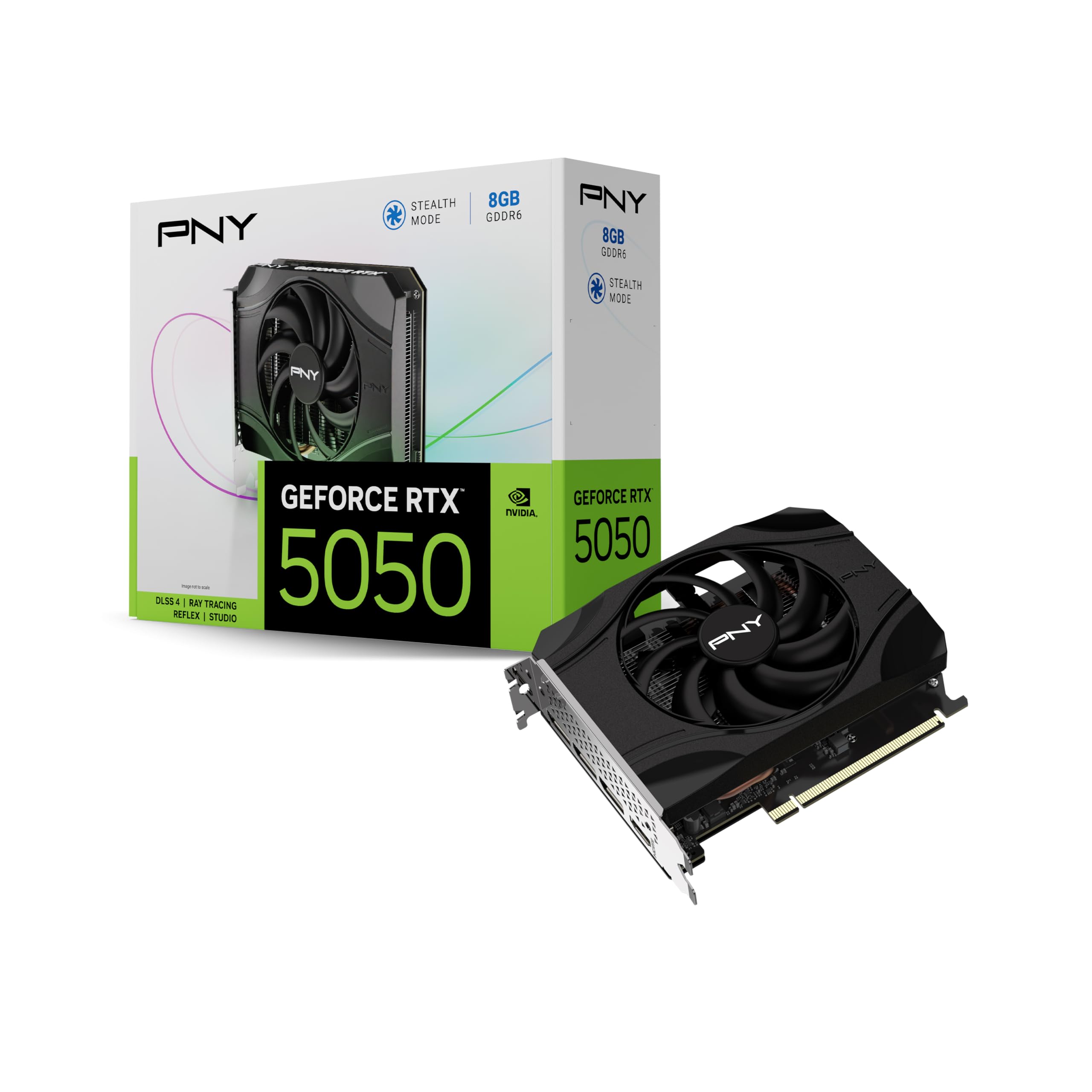
PNY RTX 5050 SF

85 /100
Lab Score Excellent

Key details

VRAM
8GB GDDR6
Power
Rating
4.5 ★
Cooling
Single fan
View on Amazon

The PNY RTX 5050 brings NVIDIA's Blackwell architecture and DLSS 4 to the smallest single-fan form factor available, with PCIe 5.0 support for forward-looking SFF builds. However, because the card has only recently hit the market, there isn't a body of long-term owner experience to confirm noise levels under sustained load or how the single-fan cooler handles extended gaming sessions. For early adopters prioritizing the latest features in a compact build, this risk may be acceptable, but buyers who want a well-documented track record should consider established alternatives like the ASUS GTX 1660 Super Phoenix.

Pros

  • Latest Blackwell architecture with DLSS 4 support in a single-fan form factor
  • PCIe 5.0 interface for future-proof connectivity in small builds

Cons

  • Priced higher than some established single-fan cards that offer comparable 1080p performance
Our verdict

Best for early adopters building a compact SFF system who want the newest GPU features and are willing to accept a less-proven track record.

Check Latest Price
7

Also Great

Zotac GTX 1650

88 /100
Lab Score Excellent

Key details

VRAM
4GB GDDR6
Power
None (PCIe bus)
Rating
4.5 ★
Cooling
90mm single fan
View on Amazon

This single-fan Zotac draws all power from the PCIe slot, making it a clean fit for budget builds focused on competitive shooters and older titles. The 4GB VRAM is a hard limit for modern AAA games — cranking textures above medium will cause stuttering. Performance claims rest on international reviews, with limited domestic user feedback to confirm long-term behavior.

💡 For modern games, lower texture quality to keep within the 4GB VRAM budget.

Pros

  • Runs entirely on PCIe power, no separate cable needed in small cases.
  • Delivers playable frame rates in Fortnite, CS:GO, and Valorant at 1080p.
  • Single 90mm fan keeps noise under control during light gaming sessions.

Cons

  • In modern AAA games, only low or medium settings are possible due to 4GB VRAM bottleneck.
  • No ray tracing or DLSS support limits visual features in newer titles.
Our verdict

Pick this card if your main games are eSports and you want a simple, cable-free install — but skip it for AAA titles at higher settings.

Check Latest Price
8

Also Great

MSI GT 1030 4GB

88 /100
Lab Score Excellent

Key details

VRAM
4GB DDR4
Power
None (PCIe)
Rating
4.5 ★
Cooling
Single fan
View on Amazon

This single-fan MSI GT 1030 is the lowest-cost way to add a dedicated GPU for multi-monitor office setups and 4K video playback. It outputs to DP and HDMI, handles two displays without issue, and the fan stays near-silent during desk work. However, the 'Gaming' label on the box is misleading: the 64-bit DDR4 memory and limited CUDA cores cannot run modern AAA games even at 720p low settings. This card is strictly for non-gaming builds - office tasks, media consumption, or as a display adapter for systems lacking integrated graphics.

Pros

  • Multi-monitor office support via DP and HDMI outputs.
  • Budget-friendly price for a dedicated GPU with basic display capabilities.
  • Single-fan design stays quiet during non-gaming workloads.

Cons

  • Cannot run modern AAA games even at 720p low settings due to 64-bit DDR4 memory and weak GPU core.
Our verdict

Pick this card only if you need a single-fan, low-cost GPU for office work or media playback and have zero gaming expectations.

Check Latest Price
9

Also Great

Maxsun GT 1030

86 /100
Lab Score Excellent

Key details

VRAM
4GB GDDR4
Power
None (PCIe)
Rating
4.4 ★
Cooling
Single fan
View on Amazon

This single-fan card adds display outputs to a PC lacking integrated graphics at the lowest price available. It handles office applications and 2D titles without issue. However, the DDR4 VRAM and narrow 64-bit bus restrict video playback to sub-4K resolutions, and some units produce visual artifacts or blurry output. For any gaming beyond very old titles, this card will disappoint — the GT 1030 class simply lacks the horsepower.

Pros

  • Stable output for office multitasking and multi-monitor setups.
  • Budget-friendly upgrade for old PCs that lack integrated graphics.

Cons

  • DDR4 memory and 64-bit bus can cause inconsistent video quality
  • Cannot handle modern games; even light titles struggle with poor frame rates.
Our verdict

A fit only for budget office builds where the absolute lowest cost is needed and video quality is not critical.

Check Latest Price
10

Also Great

PNY RTX 3060 XLR8

85 /100
Lab Score Excellent

Key details

VRAM
12GB GDDR6
Power
Rating
4.5 ★
Cooling
Single fan + RGB
View on Amazon

The PNY RTX 3060 XLR8 Gaming Epic-X RGB delivers the same Ampere architecture and 12GB GDDR6 VRAM as larger dual-fan models, but in a compact single-fan design with addressable RGB lighting across the shroud. For builders assembling a color-matched, visible-window system that demands a single-fan card, this is the only option that adds programmable lighting without moving to a larger cooler.

The catch is price: this card costs noticeably more than other single-fan RTX 3060s, and gaming performance is identical to those cheaper alternatives. The RGB is the sole differentiator. If your build doesn't require integrated lighting on a single-fan 3060, the extra spend offers no practical benefit. Consider this only when the aesthetic requirement overrules cost efficiency.

Pros

  • Only single-fan RTX 3060 with integrated RGB lighting out of the box.
  • Full 12GB GDDR6 VRAM supports texture-heavy mods and 1440p gaming.

Cons

  • Price is significantly higher than other single-fan 3060s with no performance gain.
Our verdict

Fits only if you need RGB lighting in a single-fan RTX 3060 and can accept the premium. Otherwise, a cheaper single-fan 3060 delivers the same frames.

Check Latest Price
11

Also Great

ASUS RTX 3050

84 /100
Lab Score Excellent

Key details

VRAM
8GB GDDR6
Power
Rating
4.4 ★
Cooling
Axial-tech single fan
View on Amazon

This single-fan card brings ray tracing and DLSS to compact builds, though the modest performance of the RTX 3050 means RT effects require low settings at 1080p. The Axial-tech fan with dual ball bearings fits easily in small cases, but fan noise under load may be noticeable in quiet rooms. Pricing is unknown, and with limited user feedback, long-term thermal behavior under sustained use is unverified. For gamers who prioritize RT features over raw rasterization, this card suits budget-minded ITX builds – but those expecting higher frame rates should consider a dual-fan GTX 1660 Super instead.

Pros

  • Ray tracing and DLSS support in a single-fan form factor
  • 8GB GDDR6 memory provides ample VRAM for modern titles
  • Dual ball bearings on the fan improve durability in compact cases

Cons

  • Ray tracing performance is entry-level
  • Fan noise under load may be noticeable in quiet environments; thermal behavior lacks long-term verification
Our verdict

This card fits compact builds where ray tracing and DLSS are desired on a tight budget, but only if the price lands near $250-$300 – otherwise, a dual-fan GTX 1660 Super offers more reliable performance.

Check Latest Price

How to Choose

VRAM: 6GB or More for Gaming

VRAM is the graphics card's working memory for textures and frame buffers. 4GB cards like the GT 1030 can't hold enough texture data for modern AAA games, causing constant swapping and stuttering.

For 1080p, 6GB is the baseline. 8GB or 12GB gives headroom for high-resolution texture packs and VR applications. If you only play eSports titles like Fortnite or CS:GO, 4GB may suffice, but you'll hit limits in newer releases.

GPU Architecture Generation

Architecture determines feature support and efficiency. Newer architectures like Ampere and Blackwell support ray tracing and DLSS, while older Pascal and Turing lack these features or offer limited performance.

The trade-off: older cards (Pascal) are cheap and proven, but you miss out on modern upscaling that can boost frame rates in demanding games. For pure 1080p horsepower without ray tracing, Turing cards like GTX 1660 Super provide excellent value.

Single Fan Cooling and Noise

A single fan has to move a lot of air over a small heatsink. At high loads, the fan spins faster to keep temperatures in check, which creates noise. Cards with larger fans or 0dB silent modes can reduce noise during idle or light use.

If you game in a quiet room, look for cards that allow fan stop at low temperatures. Some models also use dual ball bearings for longer life, though that doesn't reduce noise. The quietest single-fan cards balance a well-designed heatsink with intelligent fan curves.

Form Factor and Size

Length and slot thickness determine if the card fits your case. Most single-fan cards are under 7 inches and occupy 2 slots, but some 'mini ITX' models are even shorter for ultra-compact cases.

Always measure your case's GPU clearance, especially depth from the backplate to the nearest drive cage. Also check if the power connector (usually 8-pin) adds length – some cards place it at the end, requiring extra space for cable bending.

Power Connector Requirements

Some low-power cards draw all power from the PCIe slot (75W max), requiring no additional cables. Others need a 6-pin or 8-pin connector from the power supply. An 8-pin can deliver 150W, which is common for cards with 6GB VRAM or more.

The mistake is assuming a 'single-fan design' means low power draw. Cards like the RX 6400 are slot-powered, but many RTX 3060 single-fan models still need an 8-pin. Check your PSU has the required cable before buying.

Frequently Asked Questions