10 Best Single-Slot Graphics Card 2026: Find Your True Use Case

Which single-slot card actually fits your build: media server, silent HTPC, or budget gaming? Not all single-slot cards game alike.

Most single-slot graphics cards aren't designed for heavy gaming — they're built for specific jobs like powering multiple monitors, transcoding video, or fitting into compact cases. Many listings exaggerate gaming capability, leaving buyers with a card that underperforms in the one task they needed.

The real decision hinges on whether you need modern codec support (AV1) for a media server or raw 1080p gaming performance for esports. This guide helps you pick based on your actual workload, not marketing hype.

The result is a clear map of which card suits which build — from silent home theaters to compact gaming rigs.

1

Best Overall

Sparkle Arc A310 ECO

88 /100
Lab Score Excellent

Key details

VRAM
4GB GDDR6
Power
50W bus-powered
Outputs
HDMI, 2x Mini DP
Form Factor
Single-slot LP
View on Amazon

Intel's Arc A310 GPU brings hardware AV1 encoding to a 50W bus-powered package, making it the only single-slot card in this class that can transcode modern video formats without taxing the CPU. The low-profile design fits ITX cases and compact workstations, and the included short bracket covers most Dell Optiplex SFF chassis.

For light gaming at 1080p — titles like Rocket League, CS2, or older AAA games — the 4GB GDDR6 frame buffer handles medium settings at playable framerates. The card also supports ray tracing and DX12 Ultimate, though real-world gaming performance falls behind the maxsun RX 550 in raw rasterization. Where the A310 pulls ahead is media serving: Plex and Jellyfin users will see smooth 4K transcoding with very little power draw.

This card is best suited for a media server, HTPC, or secondary GPU in a workstation where quiet environments are not a priority. Users comfortable fine-tuning fan curves will get the most out of it — the stock behavior can be adjusted through Intel's Arc Control software. For a silent bedroom PC or a gaming rig that runs high settings, a larger card with passive cooling (like the ASUS GT 730) or a faster option would be a better fit.

At this price point, the A310 offers a modern feature set that older cards cannot match — AV1 encoding alone justifies the upgrade for anyone building a new media server. It competes directly with entry-level options like the RX 550 but brings substantially better video encoding and lower power consumption, making it the most versatile single-slot card available.

💡 Set a custom fan curve in the Intel Arc Control software to avoid the stock revving behavior in quiet rooms.

Pros

  • AV1 hardware encoding provides smooth, low-power transcoding for Plex and Jellyfin servers.
  • Draws only 50W, runs on PCIe slot power alone
  • Brings ray tracing and DX12 Ultimate to an entry-level single-slot card.
  • Single-slot, low-profile design with included short bracket fits tight ITX and SFF cases.

Cons

  • Fan noise can be noticeable in quiet rooms, with some units exhibiting a revving pattern.
  • Inconsistent fan control curve may cause cycling up and down, requiring manual adjustment in silent environments.
Our verdict

For a media server or SFF build that needs modern video encoding, this is the obvious pick — just plan for a fan curve tweak if silence matters.

Check Latest Price
2

Best Value for Budget Gaming

maxsun RX 550 STD

88 /100
Lab Score Excellent

Key details

VRAM
4GB GDDR5
Power
50W bus-powered
Outputs
DVI, HDMI, DP
Form Factor
Single-slot FH
View on Amazon

The maxsun RX 550 delivers the best rasterization performance in this compact form factor, easily handling titles like Minecraft, CS:GO, and Fortnite at 1080p. It outpaces the top pick in traditional gaming, though you miss out on AV1 encoding and ray tracing capabilities.

Installation is truly plug-and-play with automatic driver detection, and the card sips power at around 50W from the PCIe slot alone. Under typical use it stays quiet, but sustained gaming sessions cause the single fan to become audible — a tradeoff for the slim single-slot profile.

This card is aimed at budget-conscious builders who need a single-slot GPU for light 1080p gaming or entry-level video editing. Its single HDMI port means multi-monitor setups require adapters, and the fan noise under heavy load is noticeable in a quiet room — acceptable if you use headphones or keep sessions short.

💡 Keep gaming sessions moderate or use headphones — the fan is fine for short bursts but noticeable after extended play.

Pros

  • Exceptional value for budget single-slot builds
  • Handles esports and light 1080p gaming smoothly
  • Truly plug-and-play with automatic driver detection

Cons

  • Single fan can become audible during sustained gaming loads
Our verdict

If you need a single-slot card for light 1080p gaming and don't require AV1 support, this is the most cost-effective choice with proven performance.

Check Latest Price
3

Best for Silent HTPC

ASUS GT 1030 2GB

90 /100
Lab Score Outstanding

Key details

VRAM
2GB GDDR5
Power
30W passive
Outputs
HDMI, DVI
Form Factor
Single-slot LP
View on Amazon

This ASUS GT 1030 uses a large finned heatsink with no fan, so it runs completely silent. For a home theater PC or a budget office build where noise is the priority, that’s a decisive advantage. The GDDR5 memory here (not the slower DDR4 variant) gives it enough bandwidth for 1080p video playback and older or less demanding games like Fortnite or CS:GO at playable settings.

The card draws power directly from the PCIe slot and outputs up to 1080p60 on two displays via HDMI and DVI. It fits in low-profile cases, making it a natural for space-constrained builds. The catch: because it relies on passive cooling, it needs airflow around the heatsink. In a well-ventilated case the card stays cool, but inside a cramped HTPC enclosure with poor circulation, temperatures can climb under sustained load. That’s a design tradeoff, not a flaw – it’s what enables zero noise.

The 2GB VRAM and two-output limit mean you won’t drive a multi-monitor workstation or play modern AAA titles at high settings. For its intended use – silent media playback, light gaming, and general office work – these boundaries are acceptable. Compared to the 4GB DDR4 version of the same card, this one actually delivers usable gaming performance thanks to GDDR5 bandwidth.

💡 Ensure your case has airflow around the heatsink – a small case fan can help if the enclosure is tight.

Pros

  • Completely silent operation
  • Strong performance for HTPC and light 1080p gaming with GDDR5 memory.
  • Solid value as an entry-level card
  • Very low power consumption, drawing all power from the PCIe slot

Cons

  • Passive cooling means the card can run hot in cases with limited airflow
  • Only two outputs (HDMI and DVI) and 2GB VRAM limit multi-monitor setups and modern game texture demands.
Our verdict

For a silent HTPC build or a secondary gaming machine for older titles, this GT 1030 delivers on its promise with no fan noise and low power draw – just keep the case airflow adequate.

Check Latest Price
4

Best Low-Profile Gaming Card

maxsun RX 550 LP

83 /100
Lab Score Excellent

Key details

VRAM
4GB GDDR5
Power
50W bus-powered
Outputs
HDMI, DP
Form Factor
Single-slot LP
View on Amazon

This card slides into pre-built SFF desktops that other single-slot GPUs can't reach – a clean fit for Optiplex and similar cases. The smaller fan keeps the card short but does produce more audible noise under sustained load than the full-height version, which is a tradeoff to consider in quiet rooms.

Best for upgrading an office PC for light gaming and multi-monitor work, not for high-end titles or AV1 transcoding. The 4GB GDDR5 memory handles older games and esports at 1080p with consistent 60fps, while the ~50W bus-powered design keeps installation simple in cramped builds.

Performance is solid for the price tier: Counter-Strike 2, League of Legends, and Rocket League run smoothly, and the card idles at around 6W so system temps stay low. The single HDMI and DisplayPort outputs cover two monitors without adapters, though you'll need a DisplayPort adapter for a third display.

💡 Set a custom fan curve in Radeon Software to keep the fan near-silent at idle; the card's low heat output allows that.

Pros

  • Smooth 60fps in many esports and older titles at 1080p
  • Fits low-profile cases like Dell Optiplex SFF with no modification needed
  • Low power draw keeps system temps down, idle around 6W

Cons

  • Fan noise becomes noticeable under sustained gaming load in a quiet room
  • Lacks AV1 encoding support, limiting its use for modern media transcoding
Our verdict

For budget SFF builds focused on esports or office multi-monitor, this card delivers where it counts – just note the noise tradeoff if silence is critical.

Check Latest Price
5

Best for Professional Workstations

PNY Quadro P4000

81 /100
Lab Score Excellent

Key details

VRAM
8GB GDDR5
Power
105W bus-powered
Outputs
4x DP 1.4
Form Factor
Single-slot FH
View on Amazon

The PNY Quadro P4000 offers certified driver support for professional CAD and 3D applications like SolidWorks and Fusion 360, a feature set the top pick does not provide. While the Sparkle A310 focuses on AV1 encoding and light gaming, this card targets multi-5K display setups and reliability in workstation environments.

This card suits buyers building a space-constrained workstation for SolidWorks, AutoCAD, or similar ISV software, where the single-slot form factor and four DisplayPort 1.4 outputs are essential for multiple high-resolution monitors. However, its Pascal architecture and workstation drivers make it weaker than consumer cards at the same price for gaming, and it lacks modern encoders like AV1 for media transcoding.

Under sustained rendering loads the card runs cool and quiet — no throttling or instability noted. Installation is straightforward with bus-powered 105W draw, requiring no additional PCIe power connector in compact builds.

Pros

  • Certified driver support for SolidWorks, Fusion 360, and other ISV software
  • Single-slot design with four DisplayPort 1.4 outputs for up to four 5K displays
  • Bus-powered 105W draw
  • Rock-solid stability under sustained professional workloads

Cons

  • No AV1 hardware encoder for efficient media transcoding
  • Premium price compared to consumer GPUs that deliver stronger gaming performance
  • Gaming performance limited by workstation drivers and older Pascal architecture
Our verdict

For workstation use with multiple high-resolution displays, the Quadro P4000 is a focused tool — but for gaming or media encoding, a different card would serve better.

Check Latest Price
6

Silent Multi-Monitor

ASUS GT 730 2GB

87 /100
Lab Score Excellent

Key details

VRAM
2GB GDDR5
Power
25W passive
Outputs
4x HDMI
Form Factor
Single-slot LP
View on Amazon

The ASUS GT 730 delivers silent operation with a fanless heatsink and four native HDMI outputs, so you can connect multiple 1080p monitors without adapters or fan noise. The included low-profile bracket helps it fit compact cases and HTPC enclosures where space is tight.

The 2GB GDDR5 VRAM is adequate for office tasks and media playback at 1080p, but it can struggle with high-resolution multi-monitor setups that require more memory for windowing and scaling. Gaming performance is limited to 2D titles and older 3D games – modern titles will not run smoothly. This card is best suited for a quiet multi-monitor office or home theater PC, not for gaming or 4K productivity.

Pros

  • Completely silent passive cooling for noise-sensitive environments
  • Four HDMI ports enable simple multi-monitor setup without adapters
  • Single-slot design with low-profile bracket fits space-constrained builds

Cons

  • 2GB VRAM can limit multi-monitor resolution and high-density desktop workflows
  • Only handles 2D and older 3D games
Our verdict

Best suited for an office or HTPC where multiple 1080p displays are needed in complete silence – not for gaming or 4K multi-tasking.

Check Latest Price
7

Budget Multi-Monitor

QTHREE GT 730 4GB

81 /100
Lab Score Excellent

Key details

VRAM
4GB DDR3
Power
30W bus-powered
Outputs
2x HDMI, DP, VGA
Form Factor
Single-slot LP
View on Amazon

The QTHREE GT 730 is the most affordable card here that includes a VGA port, ideal for upgrading older office PCs with legacy displays. Installation is plug-and-play in most systems, and the low-profile bracket fits compact cases. Reliability can vary between units — some may experience boot issues or require replacement. For the buyer who prioritizes cost and VGA compatibility above all else, these risks are manageable, but consistent long-term operation is not guaranteed.

Pros

  • Supports dual monitors with HDMI, DP, and VGA outputs.
  • Installation is quick and requires no extra power cables.
  • Budget-friendly price makes it accessible for entry-level builds.

Cons

  • HDMI ports are placed close together, which may block larger cable connectors.
  • Driver installation requires manual download from NVIDIA's website, which can be confusing for non-technical users.
Our verdict

Best suited for the very tightest budgets where VGA output is needed and the buyer accepts potential hardware or driver variance.

Check Latest Price
8

Old PC Upgrade

EVGA GT 740 4GB

86 /100
Lab Score Excellent

Key details

VRAM
4GB DDR3
Power
60W bus-powered
Outputs
mini-HDMI, 2x DVI
Form Factor
Single-slot FH
View on Amazon

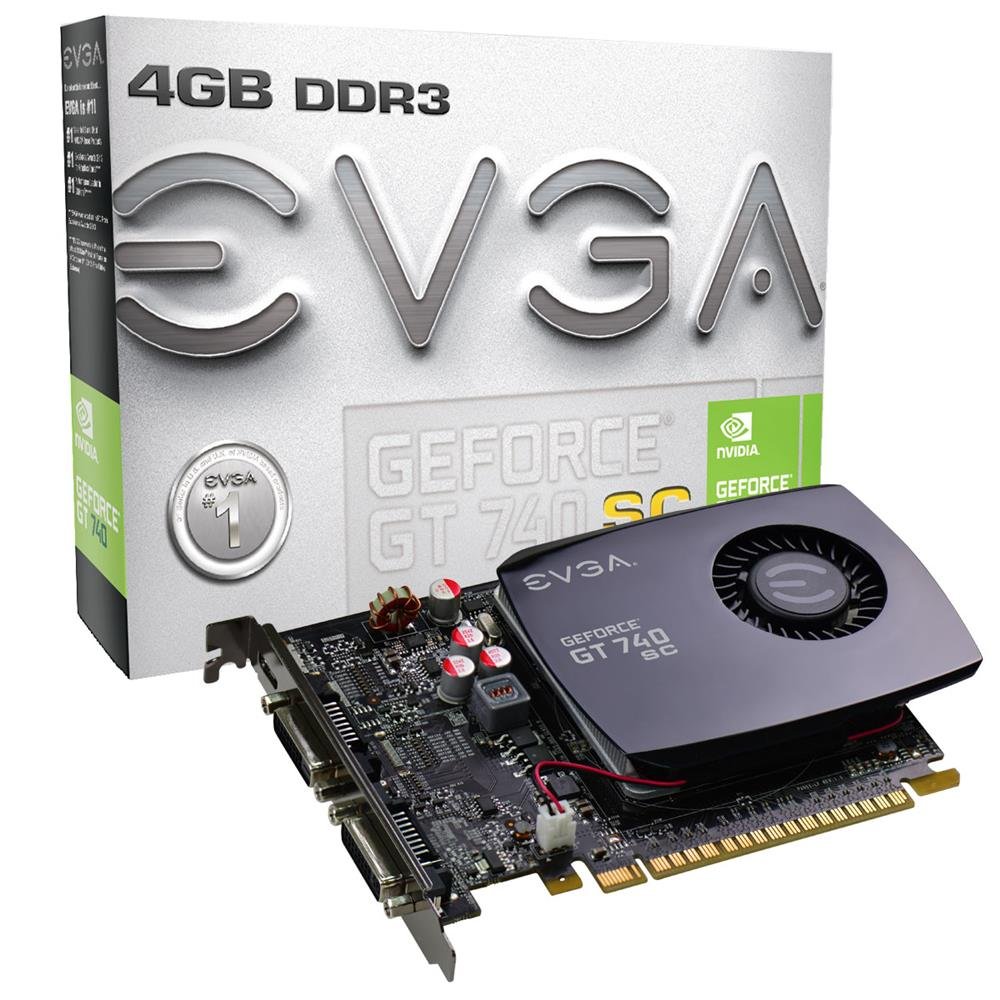
This single-slot GT 740 runs older titles like Skyrim and World of Warcraft at 1080p medium settings, drawing power directly from the motherboard — no extra cables needed. It boots in older systems that lack UEFI support, making it a drop-in upgrade for late-2000s office PCs. However, its Kepler architecture is outdated by current standards, and the mini-HDMI port requires an adapter for standard monitors (cable retention can be loose). Some HP and Dell BIOS revisions may need a firmware update to recognize the card. Given the 4GB DDR3 memory, this is a budget-friendly option only if you find it under $100 and have DVI displays already.

Pros

  • Runs many older games at 1080p with medium settings
  • Draws power from the PCIe slot, so no PSU upgrade needed in older builds.
  • Compatible with systems lacking UEFI

Cons

  • The mini-HDMI port’s cable retention can be weak
  • Compatibility with some HP and older Dell BIOS revisions may require a firmware update
Our verdict

This card only makes sense for breathing life into a pre-2010 desktop that already uses DVI monitors and has a strict budget under $100. For anything newer or HDMI-based, look elsewhere.

Check Latest Price
9

Office, Basic Use

MSI GT 1030 4GB DDR4

88 /100
Lab Score Excellent

Key details

VRAM
4GB DDR4
Power
30W bus-powered
Outputs
HDMI, DP
Form Factor
Single-slot LP
View on Amazon

The MSI GT 1030 provides 4GB of VRAM in a low-profile, single-slot design — useful for running two displays on a basic office PC with minimal power draw and a known brand. However, the DDR4 memory bandwidth is a fraction of what GDDR5 versions offer, which cripples any gaming ambition beyond 720p low settings. That same memory trade-off also makes it overpriced next to cards like the RX 550 or a GDDR5 GT 1030. Consider this only if you absolutely need 4GB in a compact form factor and cannot stretch your budget for a faster option.

Pros

  • 4GB VRAM aids basic multitasking and memory-light office workflows.
  • Low 30W TDP and bus-powered operation fit low-wattage PSUs and compact cases.
  • Low-profile, single-slot design with included bracket suits space-constrained builds.

Cons

  • DDR4 memory limits gaming to 720p low settings at best.
  • Priced at a premium compared to faster alternatives like the RX 550 or GDDR5 GT 1030.
Our verdict

Buy this only if you need 4GB VRAM in a single-slot low-profile card for office multi-monitor use and cannot afford a faster option like an RX 550.

Check Latest Price
10

Budget Multi-Monitor

Glorto GT 730 4GB

83 /100
Lab Score Excellent

Key details

VRAM
4GB DDR3
Power
30W bus-powered
Outputs
2x HDMI, DP, VGA
Form Factor
Single-slot LP
View on Amazon

This Glorto GT 730 offers four output ports (2xHDMI, DP, VGA) and 4GB DDR3 at the lowest price point for single-slot multi-monitor office builds. Installation is straightforward and the card runs bus-powered, making it a simple drop-in for legacy systems. The tradeoff: video output can be inconsistent — some units have been noted to produce black screens or garbage display, which makes it a gamble for buyers who cannot tolerate glitches. For similar money, the QTHREE or ASUS GT 730 are more dependable choices if video consistency matters.

Pros

  • Four output ports (2xHDMI, DP, VGA) for expanding multi-monitor office setups.
  • Budget-friendly price and simple plug-and-play installation for basic builds.

Cons

  • Not suited for gaming or video playback
  • Video output may be inconsistent; black screens or garbage display have been noted in some units.
Our verdict

Works for ultra-budget multi-monitor office upgrades where the lowest price outweighs the risk of video glitches — but consider alternatives if display reliability is critical.

Check Latest Price

How to Choose

GPU Architecture and Generation

GPU generation determines codec support and driver longevity. Cards with Kepler or Pascal architectures (GT 730, GT 1030) lack modern encoders like AV1 and HEVC 10-bit. The Intel Arc A310 uses a current-gen design with AV1, but requires Resizable BAR support in the motherboard BIOS to reach full performance.

If you plan to use the card for Plex transcoding or streaming, a newer architecture matters more than raw pixel count. For pure office use, older architectures work fine.

VRAM Size and Type

VRAM type affects performance more than capacity. A 4GB DDR3 card (like many GT 730s) can be slower than a 2GB GDDR5 GT 1030 because DDR3 memory bandwidth is a fraction of GDDR5. For multi-monitor setups at 4K, 2GB is the absolute minimum; 4GB GDDR5 or higher is better for smooth windowing.

Don't be fooled by higher VRAM count alone — always check whether it's GDDR5 or DDR3. GDDR5 is essential for any task beyond basic desktop output.

Power Consumption

Nearly all single-slot cards are bus-powered from the PCIe slot, drawing 30–75W. This makes them compatible with older power supplies. However, passive cards (no fan) rely on case airflow to stay cool. In a cramped HTPC, a fan-cooled card can actually be quieter because the fan runs at low RPM rather than relying on turbulent airflow.

Check that your motherboard's PCIe slot delivers at least 75W. Most do, but some proprietary systems (e.g., older Dell Optiplex) may limit power delivery.

Output Ports

Port type and count determine multi-monitor flexibility. Cards with 4x HDMI (ASUS GT 730, VisionTek RX 550) avoid adapters but often lack DisplayPort for high refresh rates. HDMI 2.0 supports 4K@60Hz, while DisplayPort 1.4 can drive 5K. For financial trading or digital signage, native HDMI is convenient.

Watch for port spacing: some budget cards (QTHREE GT 730) have HDMI ports too close together for thick cable heads. Physical interference is a real annoyance in practice.

Form Factor

Form factor is critical for space-constrained builds. Low-profile cards come with a short bracket that fits Dell Optiplex SFF and similar cases. Full-height cards need a standard ATX slot. Single-slot thickness (approx. 20mm) is the defining feature — double-check that a low-profile bracket is included in the box.

The maxsun RX 550 LP is a rare low-profile gaming card. Most single-slot gaming-capable cards are full-height, so if you need both performance and small size, that variant is your only option.

Frequently Asked Questions