11 Best 1440P OLED Gaming Monitor of 2026: Speed, Gloss, and Budget That Align

Which 1440p OLED monitor gives the best motion clarity for your games and room lighting? This guide covers the top picks from budget to esports.

OLED gaming monitors have dropped in price, making 1440p options accessible. But the trade-off between brightness, refresh rate, and panel finish means the best pick depends on your room and playstyle.

Many buyers discover after purchase that a glossy OLED in a bright room creates reflections, or that a budget model's lower brightness impacts HDR. This guide breaks down the key specs and real-world trade-offs so you can match a monitor to your specific lighting and gaming needs.

Whether you prioritize motion clarity for competitive titles or color pop for single-player immersion, the decision comes down to three factors: refresh rate, panel type, and ambient light control. No single monitor does everything, but the right one will transform your gaming experience.

1

Best Overall

MSI MAG 271QPX

85 /100
Lab Score Excellent

Key details

Brightness
857 lm peak
Panel Type
QD-OLED
Refresh Rate
360 Hz
Screen Finish
Glossy
View on Amazon

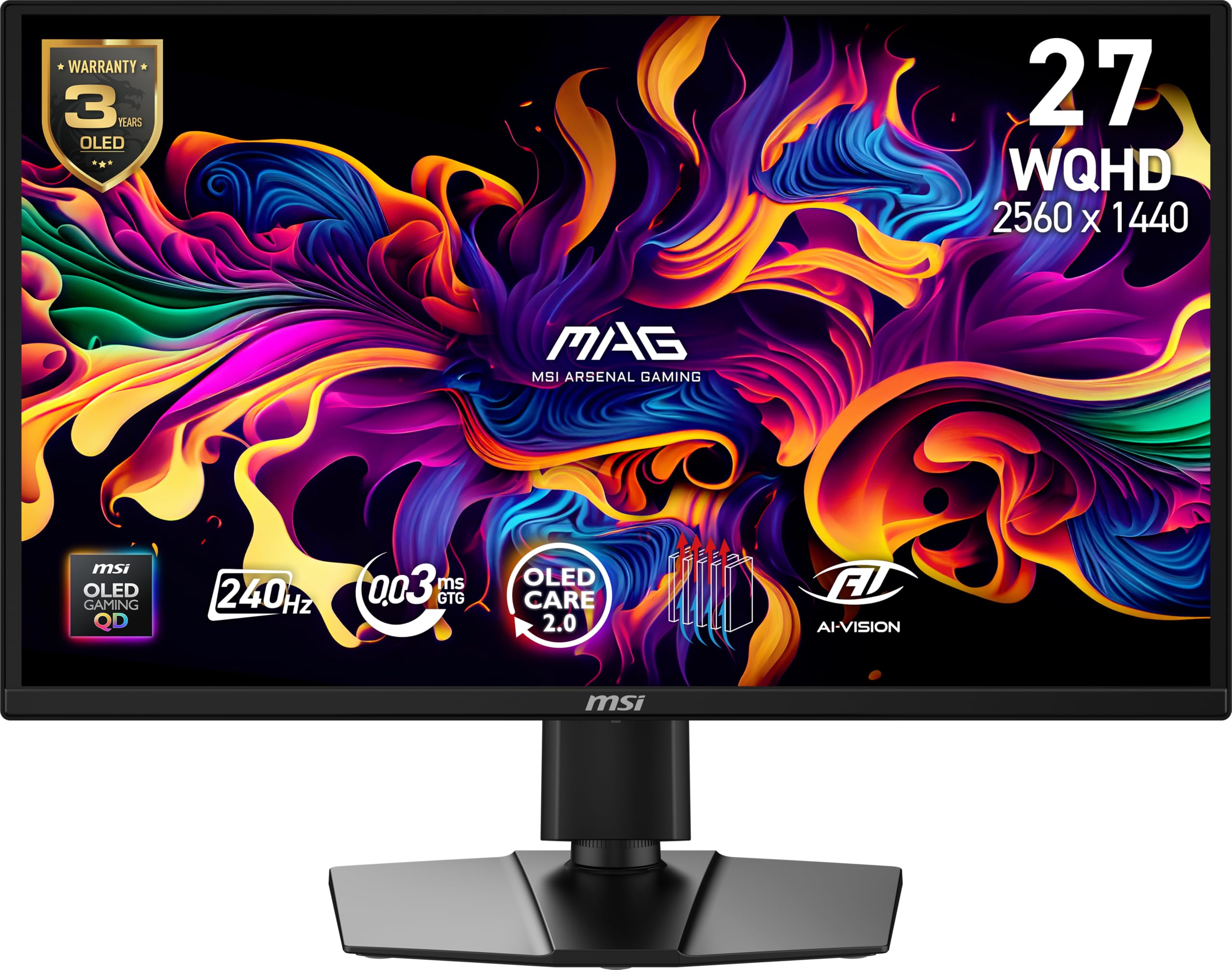
The MSI MAG 271QPX delivers vibrant, true-to-life colors with the deep blacks that make QD-OLED panels stand out. Motion clarity at 360 Hz eliminates blur and tearing, giving competitive gamers a clear advantage in fast-paced titles. The glossy finish enhances perceived contrast in controlled lighting, and the 0.03 ms response time keeps everything razor-sharp during rapid scene changes.

When alt-tabbing out of fullscreen games, a brief black screen may appear while the monitor switches modes. This is a quirk of the panel’s signal handling, not a defect, and it passes in a few seconds. The mandatory pixel refresh can also interrupt longer sessions, though it runs quickly and helps maintain long-term panel health. Users who frequently switch windows may find the blackout an occasional annoyance.

This monitor suits enthusiast gamers who prioritize motion clarity and color fidelity over raw brightness or ultrawide immersion. It is not for budget buyers or those who alt-tab frequently and find brief blackouts disruptive. The combination of 360 Hz refresh, QD-OLED contrast, and a large, satisfied user base makes it a strong contender for a primary gaming display at a premium-but-reasonable price.

Build quality is clean and modern, with minimal bezels that keep the focus on the screen. The stand offers tilt and height adjustment, though a VESA mount provides more flexibility for multi-monitor setups. Connectivity includes HDMI, DisplayPort, and USB-C, covering most modern GPU and console inputs without adapters.

💡 Plan for short breaks during long sessions to allow pixel refresh cycles to complete without interrupting gameplay.

Pros

  • Stunning color accuracy and deep blacks across a wide range of content.
  • Excellent motion clarity at 360 Hz eliminates blur for competitive play.
  • Great overall gaming performance and value for a high-refresh QD-OLED.
  • Sleek, modern design with minimal bezels looks premium on any desk.

Cons

  • The mandatory pixel refresh can interrupt longer gaming sessions.
  • A brief black screen may appear when alt-tabbing out of fullscreen games.
Our verdict

For gamers who demand top-tier motion clarity and color accuracy at a competitive price, the MAG 271QPX delivers. The alt-tab blackout is a minor tradeoff in an otherwise capable monitor.

Check Latest Price
2

Best Budget OLED

Samsung Odyssey G5 27"

86 /100
Lab Score Excellent

Key details

Brightness
280 cd/m²
Panel Type
QD-OLED
Refresh Rate
180 Hz
Screen Finish
Matte
View on Amazon

Samsung's Odyssey G5 delivers genuine QD-OLED image quality at a budget-friendly price, undercutting many 240 Hz OLEDs. The 180 Hz refresh rate (via DisplayPort) and HDMI 2.0 cap at 144 Hz mean it falls short of the 360 Hz top pick, but for single-player titles the motion clarity is already excellent.

This monitor suits gamers who prioritize picture quality over maximum refresh rates and are willing to use DisplayPort for the full 180 Hz. It represents a low-risk entry into OLED for those who play in dim rooms and don't need high brightness for HDR. Console users or those relying on HDMI should be aware of the 144 Hz cap.

The QD-OLED panel produces deep blacks and vibrant colors that make OLED beloved, and build consistency is reassuring for the price. The occasional dead pixel has been noted, so checking the unit early is a sensible precaution.

💡 Connect via DisplayPort to achieve the full 180 Hz refresh rate; HDMI is limited to 144 Hz.

Pros

  • Genuine QD-OLED image quality at an entry-level price
  • Vivid colors and true blacks that surpass IPS/VA panels
  • Sturdy build with minimal QC complaints overall

Cons

  • Using HDMI limits refresh to 144 Hz
  • Screen may appear dim in bright rooms, especially in HDR mode
  • A small number of units arrive with a dead pixel
Our verdict

If your budget is tight and you can use DisplayPort for the full refresh rate, this is the most affordable route to OLED gaming without compromising on panel quality.

Check Latest Price
3

Best for Esports

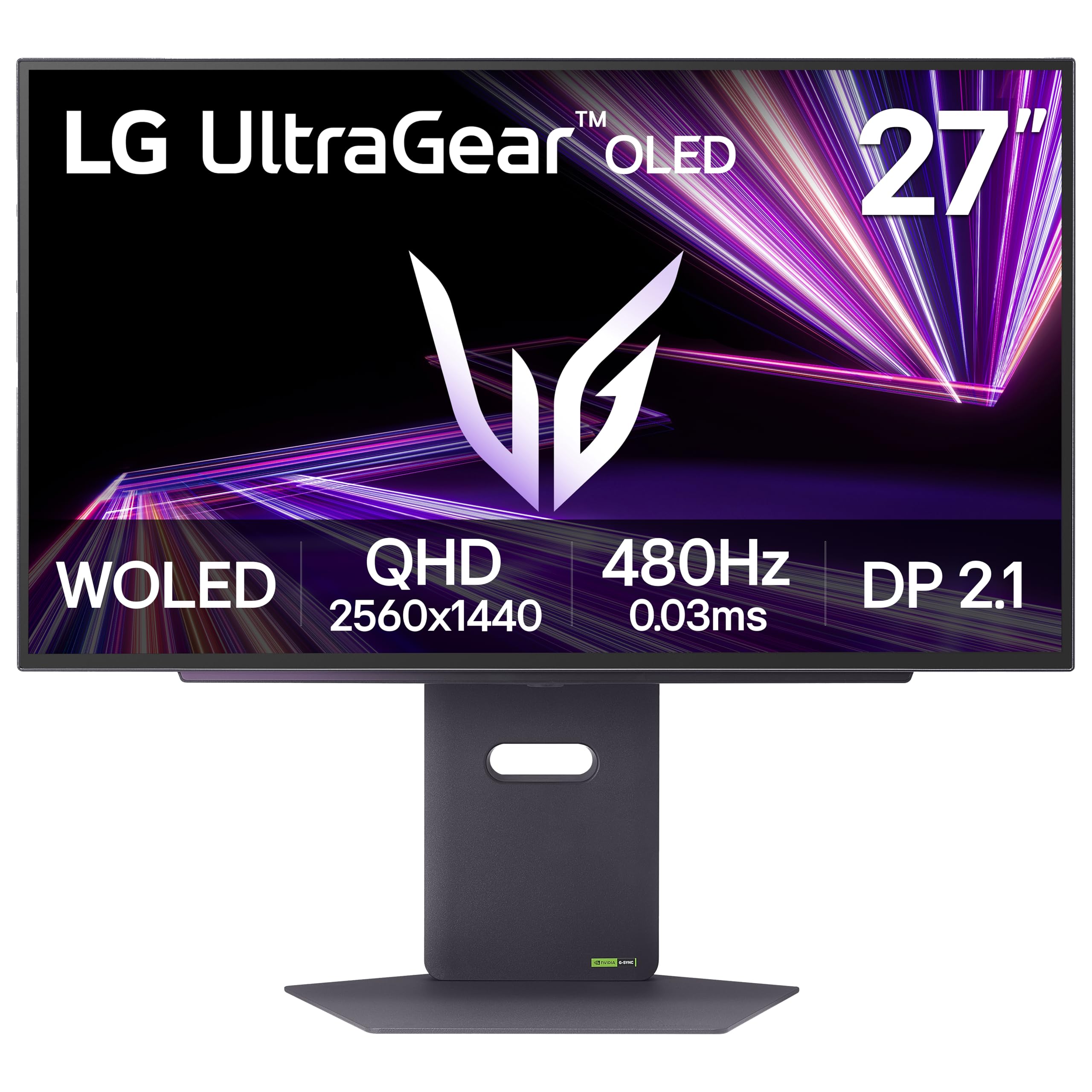
LG 27GX790A-B

83 /100
Lab Score Excellent

Key details

Brightness
275 cd/m²
Panel Type
WOLED
Refresh Rate
480 Hz
Screen Finish
Matte
View on Amazon

The LG 27GX790A-B pushes refresh rates beyond what most gamers can use: 480 Hz at 1440p with a WOLED panel that delivers deep blacks and vivid color. This is a genuine step up from the 360 Hz top pick if you compete at a level where every millisecond matters and your rig (think RTX 5090) can sustain those frame rates consistently.

Motion clarity at this refresh rate is exceptional — players report it feels like a whole new tier of responsiveness. But that performance comes with tradeoffs. HDR brightness measures low at 275 cd/m² typical, which can make some darker games feel washed out or unplayable in bright rooms. More critically, a subset of units may not power on after a few weeks of use, a pattern worth verifying with your seller’s return policy before committing.

This monitor suits competitive esports players who already own or plan to buy a GPU powerful enough to hit 480 fps in titles like Valorant, Overwatch, or CS2. It’s less appropriate for general gaming or single-player HDR experiences where brightness and long-term consistency carry more weight. Budget-conscious buyers will also find better value in lower-refresh OLEDs with more reliable user feedback.

💡 For HDR content, use a dark room or lower ambient lighting to improve perceived brightness.

Pros

  • 480 Hz refresh rate provides unmatched motion clarity in 1440p OLED monitors.
  • Deep blacks and vibrant colors from the WOLED panel deliver immersive visuals.
  • Low input lag makes every action feel instant in fast-paced games.
  • DisplayPort 2.1 support matches future GPU bandwidth requirements.

Cons

  • HDR brightness is low enough that dark-scene games may look dim in well-lit rooms.
  • Some units may stop powering on after a few weeks, so a solid return policy is advisable.
  • Premium price that carries more early-adopter risk compared to alternative OLEDs.
Our verdict

If you compete at the highest esports level and have the hardware to drive 480 fps, this monitor offers an experience no other OLED can match — just plan for the possibility of an early replacement.

Check Latest Price
4

Premium 360 Hz with Great Warranty

ASUS ROG Strix XG27ACDNG

87 /100
Lab Score Excellent

Key details

Brightness
3426 lm peak
Panel Type
QD-OLED
Refresh Rate
360 Hz
Screen Finish
Matte
View on Amazon

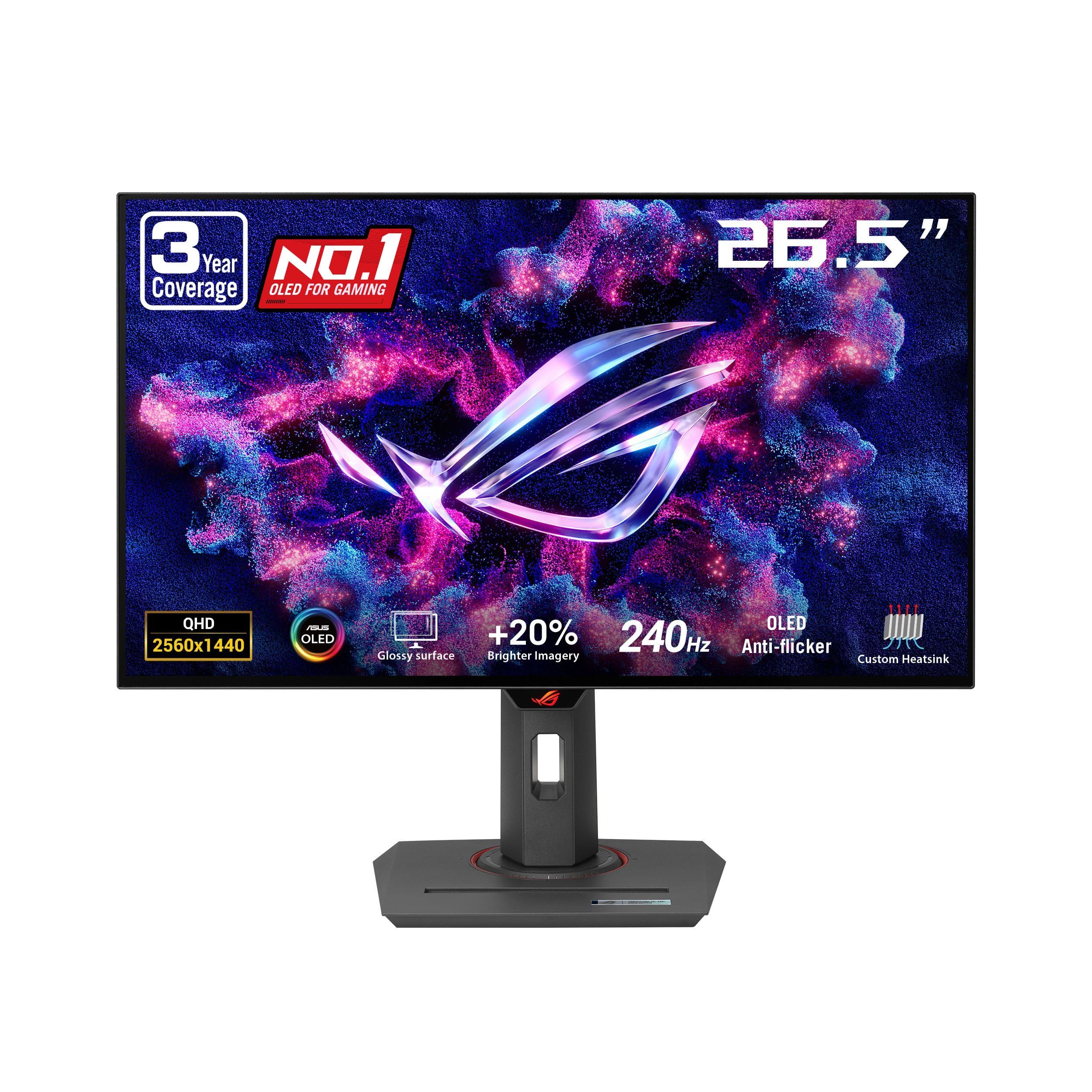
The XG27ACDNG pairs a custom heatsink with a comprehensive 3-year burn-in warranty, a combination that directly addresses the biggest concern for OLED owners. This makes it a distinct option among 360 Hz QD-OLEDs, where long-term panel degradation is a known vulnerability.

The QD-OLED panel delivers vibrant colors and deep blacks, with the 360 Hz refresh rate and 0.03 ms response time eliminating motion blur in fast-paced titles. For esports players with a high-end GPU, the responsiveness is near instant — no perceptible lag or ghosting.

This monitor suits competitive gamers who want a high refresh rate and are willing to accept some tradeoffs. VRR flicker has been noticed in some units during variable refresh rate use, and the ELMB feature may stop working after firmware updates. These are boundary conditions worth verifying before purchase, but the warranty offers a safety net that few competitors match.

💡 If you rely on ELMB, consider holding off on firmware updates until community feedback confirms compatibility.

Pros

  • Custom heatsink and 3-year burn-in warranty address OLED longevity concerns
  • QD-OLED delivers vivid colors, deep blacks, and excellent HDR performance
  • 360 Hz refresh rate with 0.03 ms response time eliminates motion blur

Cons

  • In variable refresh rate use, some units may exhibit noticeable flicker
  • ELMB feature may stop working after firmware updates, reducing motion blur reduction
Our verdict

For gamers who value burn-in protection over perfect VRR stability, the XG27ACDNG delivers high-speed OLED performance with a safety net.

Check Latest Price
5

Best Glossy 240 Hz

ASUS ROG Strix XG27AQDMG

88 /100
Lab Score Excellent

Key details

Brightness
4454 lm peak
Panel Type
WOLED
Refresh Rate
240 Hz
Screen Finish
Glossy
View on Amazon

The ASUS ROG Strix XG27AQDMG sets itself apart with a glossy WOLED panel that produces deep blacks and rich, vibrant colors — ideal for single-player games played in a low-light room. Its 240 Hz refresh rate and 0.03 ms response time keep motion smooth and input lag low, though it does not match the 360 Hz top pick for competitive edge.

In darker environments, the glossy finish enhances perceived contrast and eliminates the hazy look common on matte OLEDs. The custom heatsink helps manage brightness uniformity, and G-SYNC compatibility ensures tear-free gameplay without VRR flicker — an advantage over some QD-OLED rivals. Peak brightness of 445 cd/m² suits dim rooms but falls short in brightly lit spaces.

The main tradeoff is the aggressive auto-dimming behavior, which can darken the screen during static content or slower-paced scenes. This is adjustable via the on-screen menu, but may still intrude in certain games. A subset of units also show scan line artifacts at specific refresh rates or develop dead pixels shortly after purchase — worth factoring into any buying decision.

This monitor is best for gamers who play primarily in a dark or controlled-light environment, value contrast and color saturation over raw refresh rate, and are comfortable with the potential need to exchange a unit for quality control issues. It is less suited for bright rooms or users who cannot tolerate auto-dimming.

💡 Disable Uniform Brightness or adjust dimming settings in the OSD to reduce aggressive auto-dimming.

Pros

  • Glossy WOLED delivers vivid colors and true black levels for immersive single-player games.
  • Very responsive with low input lag and smooth motion at 240 Hz.
  • Competitive price for a glossy 240 Hz OLED with a large owner community.

Cons

  • Scan line artifacts may appear on some units at certain refresh rates.
  • Auto-dimming can be aggressive, dimming the screen during static content or slower scenes.
  • Quality control varies: some units develop dead pixels or fail within weeks of use.
Our verdict

For gamers who play in a dark room and prioritize contrast over motion clarity above 240 Hz, this ASUS offers a vivid panel with manageable compromises — just be prepared to inspect the unit early.

Check Latest Price
6

Value 240 Hz QD-OLED

AOC Q27GAZDV

87 /100
Lab Score Excellent

Key details

Brightness
200 cd/m²
Panel Type
QD-OLED
Refresh Rate
240 Hz
Screen Finish
Glossy
View on Amazon

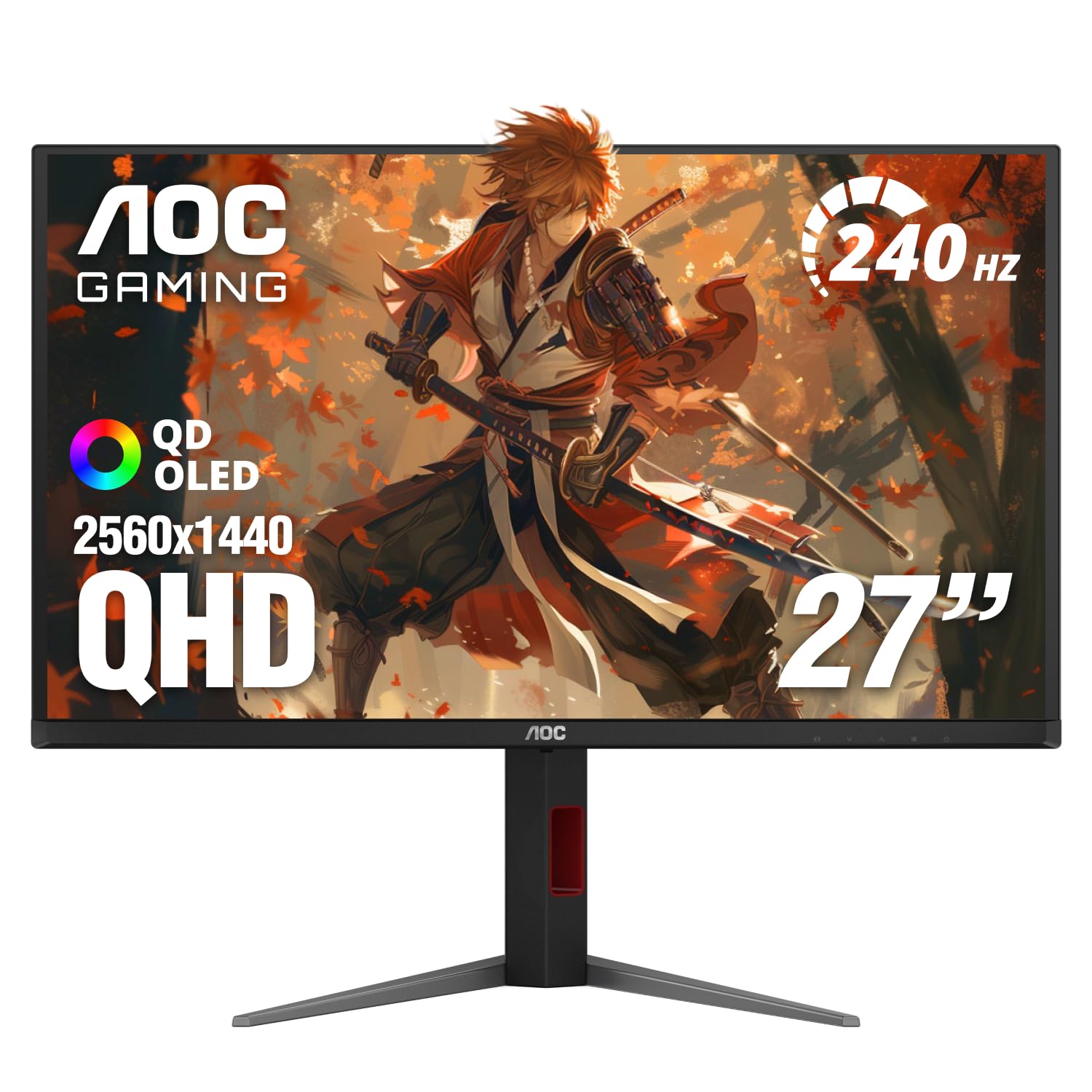
The AOC Q27GAZDV delivers QD-OLED picture quality and a 240 Hz refresh rate at a price that undercuts every other 27-inch 1440p OLED monitor. While the slower 180 Hz QD-OLED model is even cheaper, this AOC matches the higher refresh rate of premium options for less.

This monitor fits budget-focused gamers who play in dimmer rooms and aren't concerned about long-term reliability data. The low typical brightness (200 cd/m²) means it struggles in bright ambient light, and durability under heavy daily use is a known vulnerability – ideal for early adopters who value price above all else.

Colors and blacks are impressive for the money – deep, inky blacks with no ghosting in fast motion. The glossy panel enhances perceived contrast in darker environments, and build quality feels solid for its price tier.

💡 Keep ambient lighting low to get the most out of the panel's contrast and color.

Pros

  • Incredible value
  • Great colors and deep blacks with no ghosting
  • Solid overall quality for the money

Cons

  • HDR colors can appear flat on some units
  • Peak brightness of 200 cd/m² is low
Our verdict

If your gaming space is dark and your budget is tight, this is the most OLED performance per dollar available today.

Check Latest Price
7

Mid-Range Gamers

LG 27GS93QE

89 /100
Lab Score Excellent

Key details

Brightness
400 nits peak
Panel Type
WOLED
Refresh Rate
240 Hz
Screen Finish
Matte
View on Amazon

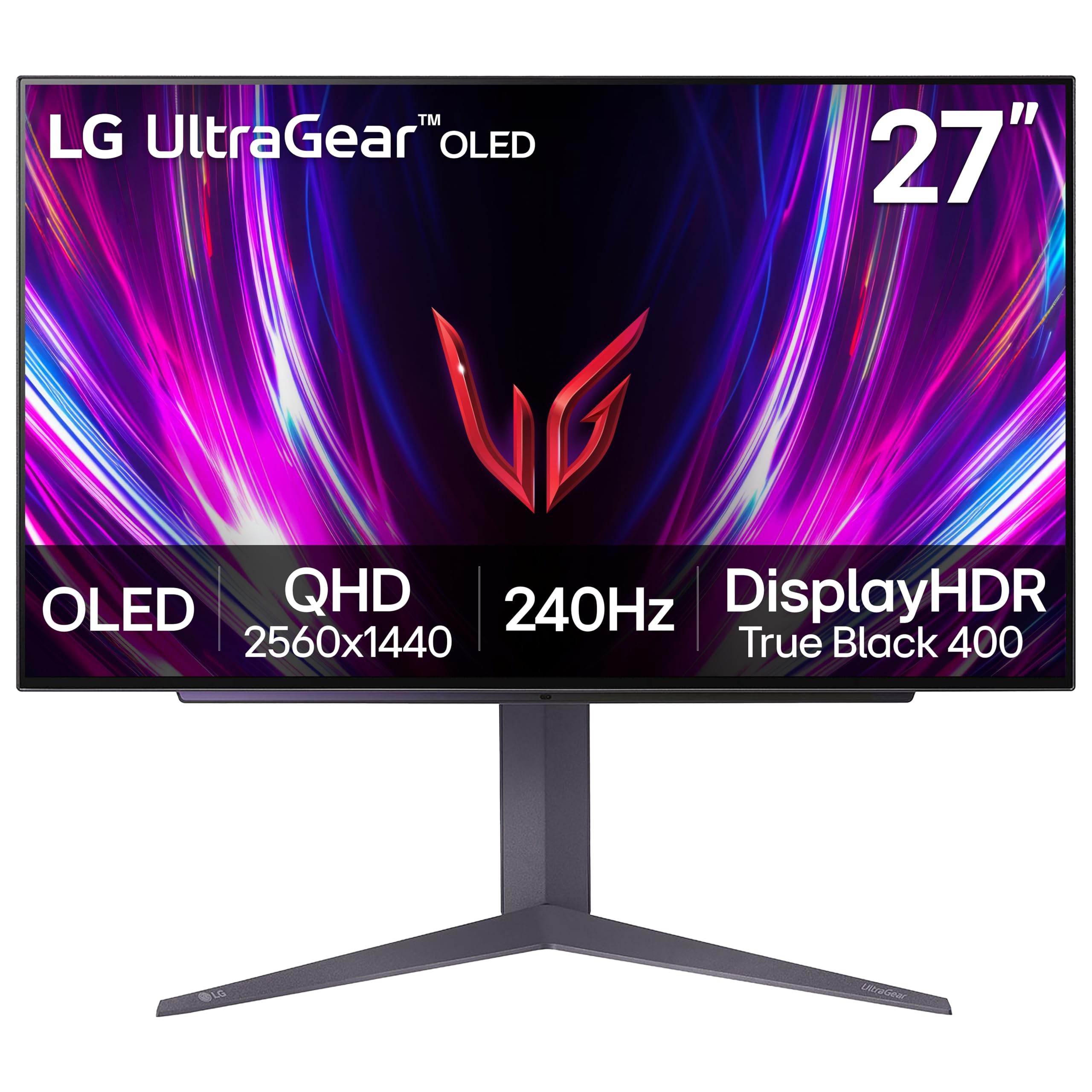
The LG 27GS93QE provides crisp 1440p detail and deep blacks typical of WOLED, with a fast 240 Hz refresh rate that suits competitive gaming. Color accuracy and peak brightness vary between units — some owners note dim HDR performance and occasional monitor shutdowns within days of use. This makes it a fitting choice for moderately lit rooms and gamers who prioritize motion clarity over HDR punch, but those expecting a flawless experience or consistent color out of the box may want to look elsewhere.

Pros

  • Sharp, vivid OLED image with excellent contrast
  • Deep blacks and accurate colors for immersive gaming

Cons

  • HDR brightness can be lower than expected in bright scenes
  • Color accuracy may require calibration due to unit-to-unit variation
Our verdict

A good value 1440p OLED for gamers who play in controlled lighting and don't need top-tier HDR brightness or flawless consistency.

Check Latest Price
8

Value Seekers

MSI MAG 272QP

84 /100
Lab Score Excellent

Key details

Brightness
1370 cd/m² peak
Panel Type
QD-OLED
Refresh Rate
240 Hz
Screen Finish
Glossy
View on Amazon

The MSI MAG 272QP offers sharp QD-OLED picture quality and 240 Hz motion at a price that makes it an attractive alternative to higher-end models. Brightness is less than ideal for HDR gaming in well-lit rooms, and a small number of units may fail to power on. It lacks the 360 Hz refresh rate and higher peak brightness of the top pick. This monitor suits gamers who prioritize color and contrast over raw speed and who play in dimmer environments.

Pros

  • Sharp picture with true black and vibrant colors typical of QD-OLED
  • Great value

Cons

  • In bright scenes or HDR, the display may appear dim to those used to high-nit LCDs
  • Some units have experienced power-on issues shortly after purchase
Our verdict

For budget-conscious gamers who play in a dim room and don't need 360 Hz, this QD-OLED delivers strong value.

Check Latest Price
9

Samsung Loyalists

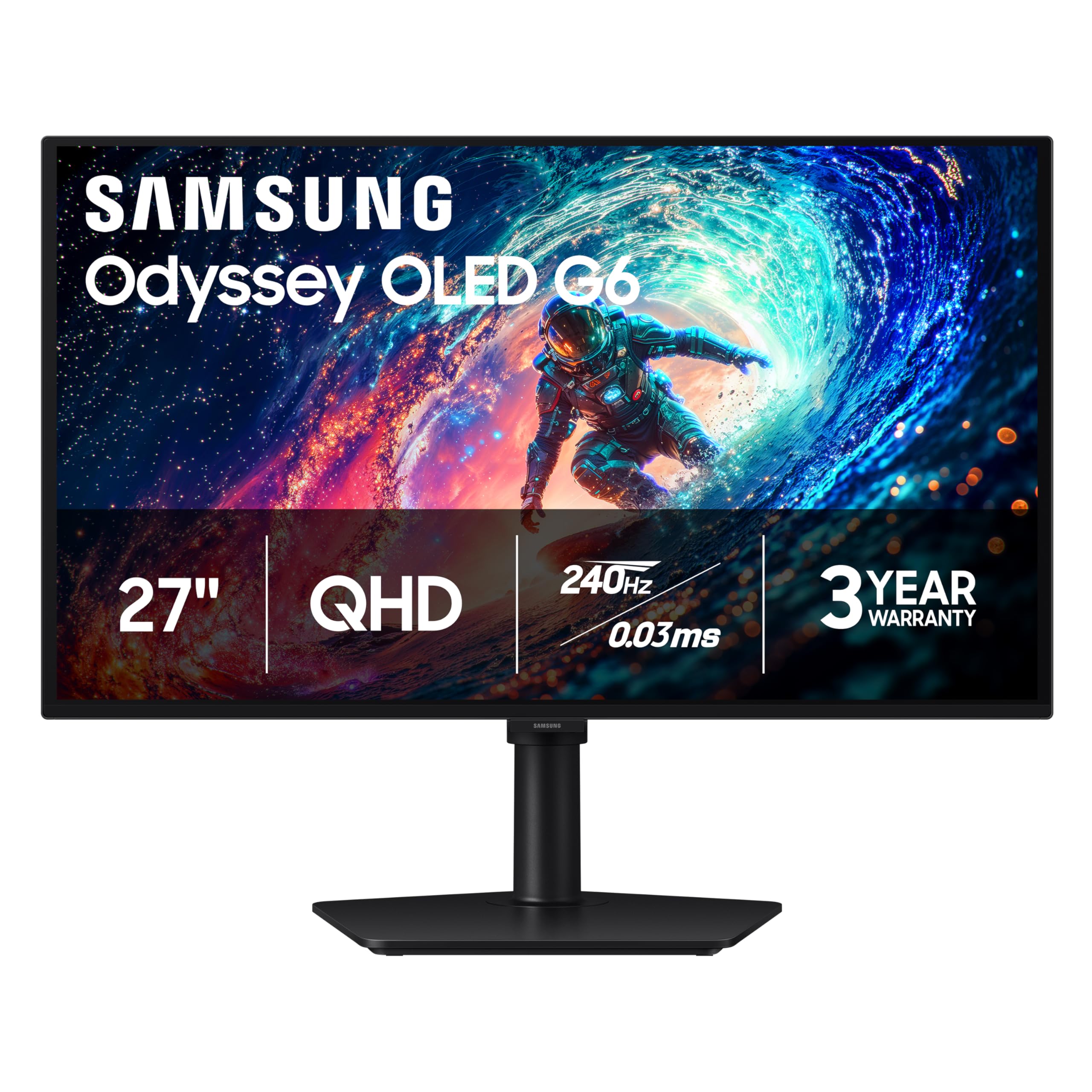
Samsung Odyssey G6 27"

87 /100
Lab Score Excellent

Key details

Brightness
400 cd/m²
Panel Type
QD-OLED
Refresh Rate
240 Hz
Screen Finish
Matte
View on Amazon

The Odyssey G6 brings a vibrant QD-OLED panel with Pantone validation and a height-adjustable stand that makes desk setup simple. Colors pop and motion stays crisp at 240 Hz. But this model costs more than Samsung's own G5 without a clear performance jump, and the limited user feedback means long-term consistency isn't certain. Some units may deliver lower brightness or less accurate colors than expected, so unit variance is worth checking.

💡 Pantone validation suggests good color out of the box, but if you rely on precise accuracy, consider calibrating or verifying the unit you receive.

Pros

  • Vibrant QD-OLED with rich, eye-popping color reproduction
  • Price competitive for a 240 Hz QD-OLED that includes a height-adjustable stand

Cons

  • Costs more than the G5 without offering a significant performance advantage
  • Some units may show lower-than-expected brightness or less accurate colors out of the box
Our verdict

Best for Samsung loyalists who need a built-in height-adjustable stand and are willing to pay a premium over the G5, but only if unit variance with brightness and color is acceptable.

Check Latest Price
10

Brightness Enthusiasts

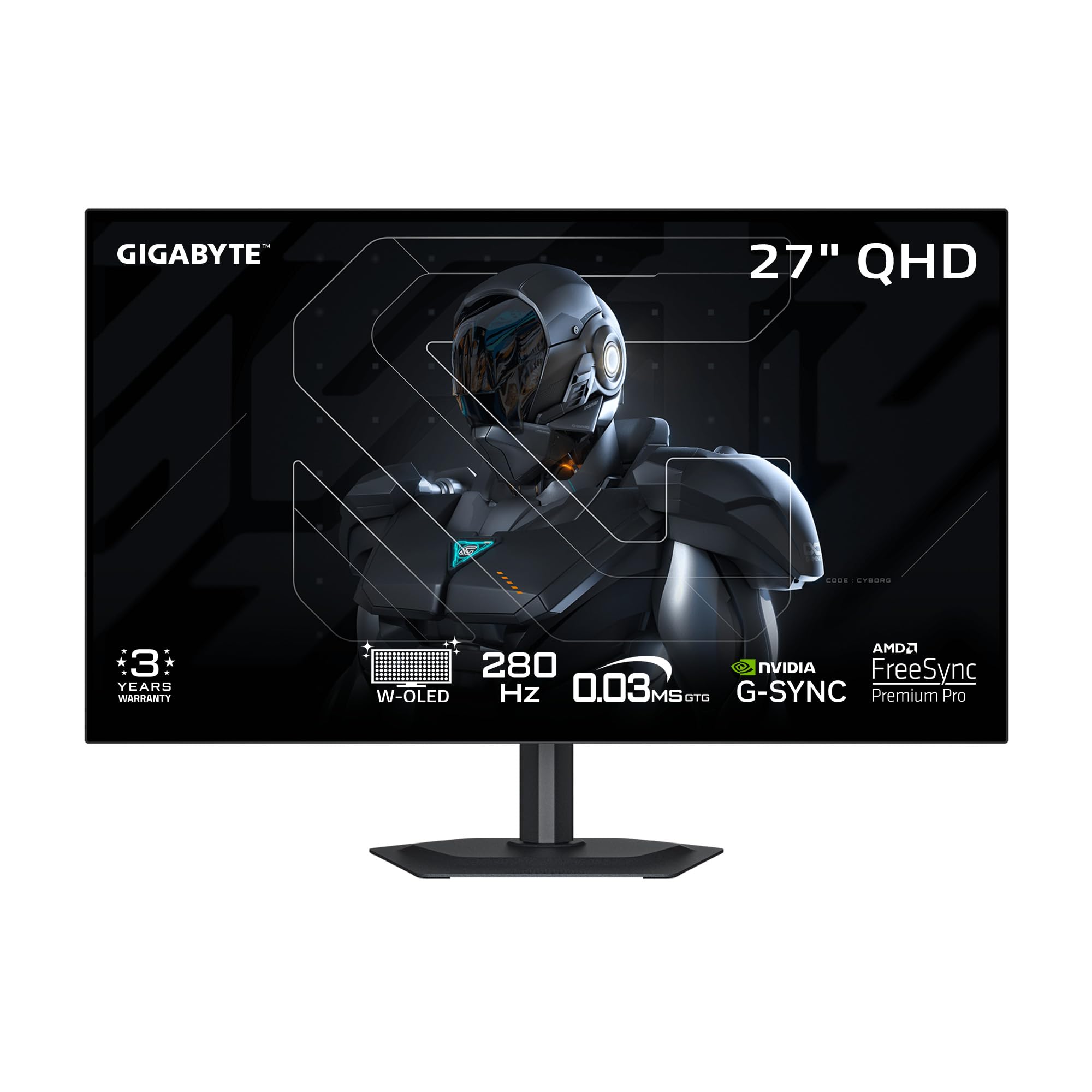
GIGABYTE MO27Q28GR

82 /100
Lab Score Excellent

Key details

Brightness
1500 cd/m² peak
Panel Type
WOLED
Refresh Rate
280 Hz
Screen Finish
Glossy
View on Amazon

The GIGABYTE MO27Q28GR delivers impressive peak brightness of 1500 cd/m² with deep blacks typical of WOLED panels, paired with a 280 Hz refresh rate that provides fluid motion in fast-paced games. Its sleek design and solid build quality add to the premium feel at a mid-range price point.

The main drawback is grey uniformity: vertical banding and dirty screen effect can be noticeable on solid grey backgrounds, and unit-to-unit variation means some displays show more artifacts than others. This keeps it from reaching the top tier for buyers who expect consistent panel quality across the entire screen.

💡 Using a dynamic background or dimming ambient lighting can help reduce the visibility of grey banding.

Pros

  • Bright and punchy HDR with deep blacks
  • Sleek, minimal design with good build quality
  • Good value for a 280 Hz Tandem OLED

Cons

  • On grey backgrounds, vertical banding and dirty screen effect can be visible.
  • Unit-to-unit variation in grey uniformity may result in visual artifacts.
Our verdict

If you prioritize peak brightness and smooth 280 Hz motion over perfect grey uniformity, this monitor offers strong value at its price point.

Check Latest Price
11

MSI Loyalists

MSI MPG 271QRX

83 /100
Lab Score Excellent

Key details

Brightness
250 nits typical
Panel Type
QD-OLED
Refresh Rate
360 Hz
Screen Finish
Glossy
View on Amazon

This 27-inch QD-OLED monitor matches the top pick's 2560x1440 resolution, 360 Hz, and 0.03 ms response time, with HDR400 support and a glossy finish for vibrant colors. However, without customer feedback to verify real-world performance, its motion clarity, color accuracy, and longevity remain uncertain — a notable caveat at a premium price. Buyers willing to rely on MSI's reputation may find it appealing, but for most the better-documented top pick is a safer investment.

Pros

  • Blazing 360 Hz refresh rate delivers fluid motion in fast-paced esports and competitive shooters.
  • QD-OLED panel provides deep blacks and rich color saturation for immersive single-player gaming.

Cons

  • Glossy screen finish can produce distracting reflections under bright overhead lighting or near windows.
  • Typical brightness of 250 nits is modest for HDR highlights in well-lit rooms, limiting daytime use.
Our verdict

A suitable pick if you want the 360 Hz QD-OLED spec and are comfortable with unconfirmed real-world performance — otherwise, the better-documented top pick is less risky.

Check Latest Price

How to Choose

Refresh Rate

Higher refresh rates (240 Hz, 360 Hz, 480 Hz) reduce motion blur and improve responsiveness in fast-paced games. But the benefit depends on your GPU's ability to consistently output those frame rates.

A 240 Hz monitor is sufficient for most gamers and pairs well with mid-range GPUs. 360 Hz and above require a high-end card like an RTX 4080 or better to be worthwhile, otherwise you're paying for headroom you can't use.

Panel Type

QD-OLED panels use quantum dots to achieve wider color gamut and higher brightness than standard WOLED panels, especially in bright scenes. WOLED panels often have better near-black uniformity and lower power consumption.

In practice, QD-OLED delivers more vibrant HDR and less color shift at off-angles, but can suffer from magenta tint in bright reflections. WOLED is more forgiving in mixed lighting but typically peaks lower in brightness.

Screen Finish

Glossy screens reflect ambient light like a mirror, producing the highest contrast and color saturation in a dark room. Matte screens diffuse reflections and work better in well-lit rooms or with windows behind the user.

The trade-off: glossy panels look flat when light hits them, while matte panels scatter a slight haze that reduces perceived depth. Choose based on whether you play in a controlled dark environment or a bright living space.

Brightness

OLED peak brightness typically ranges from 200 to 1500 cd/m², but sustained brightness is lower than high-end IPS. High peak brightness is needed for impactful HDR highlights, but many OLEDs dim significantly in full-screen white scenes.

For HDR gaming, look for a monitor with DisplayHDR True Black 400 or higher. In a bright room, aim for at least 400 cd/m² peak; for dark rooms, even 250 cd/m² can look excellent due to infinite contrast.

Burn-in Warranty

OLED burn-in is permanent image retention caused by static elements like HUDs. A warranty covering burn-in (typically 2-3 years) is essential for peace of mind, especially if you use the monitor for work with fixed UI elements.

Not all brands offer explicit burn-in coverage. ASUS includes a 3-year warranty on some models, while others rely on pixel refresh routines. Without a warranty, the risk of long-term image retention falls entirely on you.

Frequently Asked Questions