8 Best Audiophile Computer Speakers 2026: LDAC, USB DAC & Sub-Out

Which best audiophile computer speakers deliver high-res wireless and the connectivity you'll actually need? This guide balances LDAC, USB DAC, and sub-out for a flexible desktop setup.

The chase for audiophile-grade desktop sound often fixates on Bluetooth codecs like LDAC or aptX HD, but the features that truly shape daily use — a noise-free USB connection and a subwoofer output — frequently get overlooked. Without a USB DAC, your PC's onboard audio can introduce hiss and interference that no wireless codec can fix. And without a sub-out, you're stuck with the low end that small drivers can manage, which rarely satisfies for games or movies.

This guide shifts focus to the connectivity that keeps a desktop setup flexible over time, while still demanding the hi-res streaming that modern phones and tablets offer. It also navigates a tension in this category: several newer models pack impressive specs but have so few real-world reviews that long-term reliability is a genuine unknown. The picks below prioritize proven performance, with clear call-outs when a high-potential newcomer might tempt the adventurous.

1

Best Overall

Edifier M60

90 /100
Lab Score Outstanding

Key details

USB DAC
USB-C
Desktop Footprint
3.9x6.6x5.8 in
View on Amazon

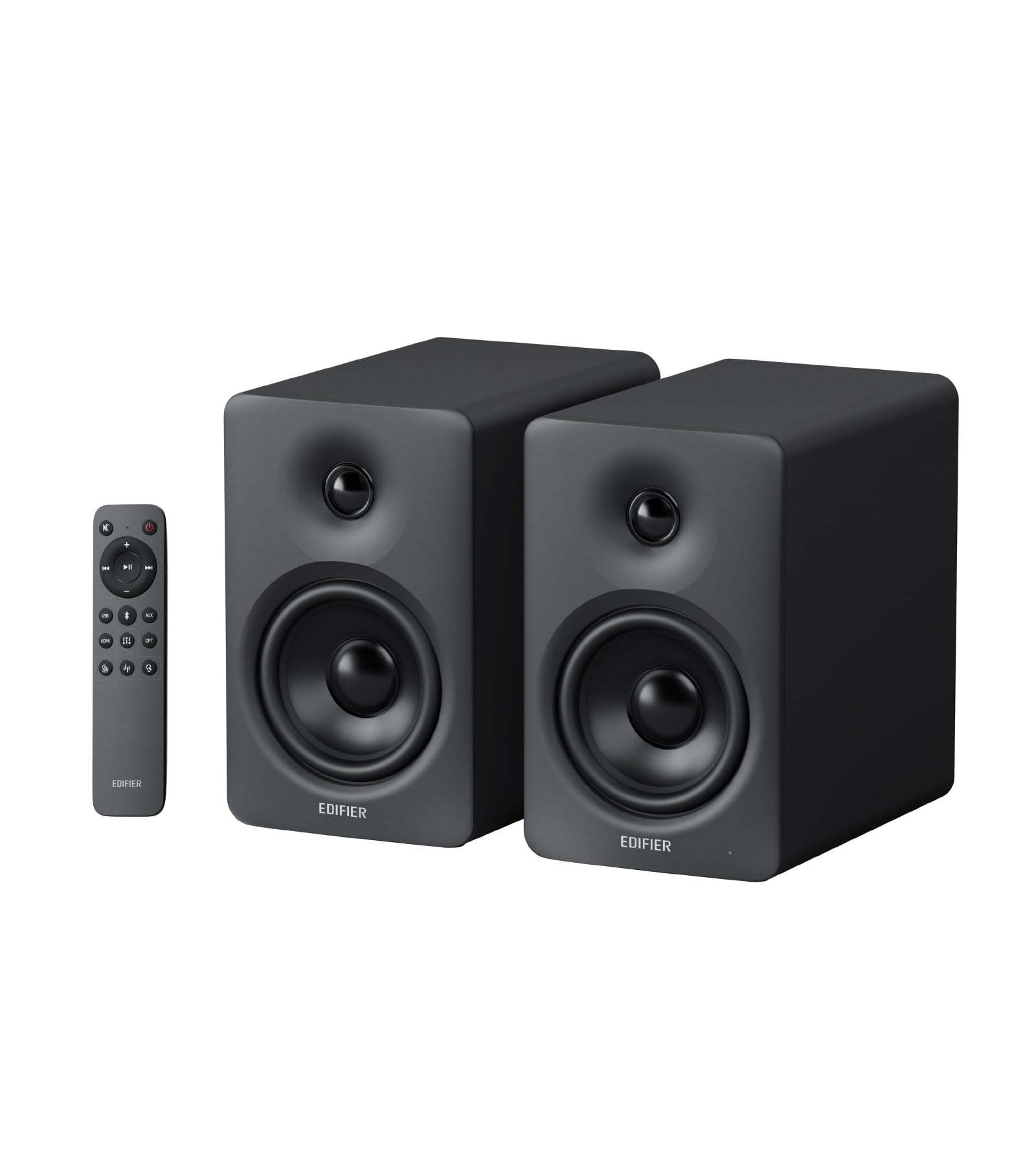
The M60's 3-inch aluminum mid-bass driver and 1-inch silk dome tweeter put clarity and detail ahead of thumping bass. Vocals cut through with texture, and acoustic instruments sound natural, making these speakers feel like a near-field monitor shrunk down to desk size. Despite the compact cabinet, the 66W RMS total output fills a small room without strain, and the sound signature prioritizes midrange transparency over exaggerated low end.

LDAC over Bluetooth 5.3 preserves far more musical information than standard codecs, and the USB-C audio input provides a clean, direct path from a computer without any extra DAC. The included 15-degree aluminum stands lift the drivers toward ear level and decouple the cabinets from the desk surface, improving stereo imaging noticeably for desktop listening.

Bluetooth stability can vary. In a room with many wireless devices, pairing may stutter or drop occasionally; the wired USB-C or 3.5mm AUX inputs eliminate this entirely and unlock the system's full clarity. The capacitive touch panel on the speaker top is responsive, though it lacks the tactile feedback of a physical knob.

This system targets the desk listener who wants high-resolution sound in the smallest possible package and has no plans to add a subwoofer — there's no sub-out, and you'll need a different setup if deep bass is a priority. It also omits HDMI eARC and optical, so it's not meant for TV integration. For near-field music, voice, and acoustic content, the M60 delivers an audiophile experience without crowding your desk.

💡 Use the included USB-C cable for zero-interference wired audio; when streaming over LDAC, keep your phone or transmitter within a few feet for the most stable connection.

Pros

  • Crisp, detailed mids and highs that bring vocals and acoustic instruments to life.
  • Exceptional value for a compact LDAC speaker system.
  • Tiny footprint with integrated angled stands saves desk space and targets sound accurately.
  • Solid MDF cabinets and metal stands give a premium feel for this size class.

Cons

  • Bluetooth pairing may introduce occasional dropouts or stutter in busy wireless environments; a wired connection resolves it.
Our verdict

For the desk listener who prioritizes vocal clarity, wireless LDAC streaming, and an ultra-compact form over subwoofer expansion, the M60 delivers an unusually refined sound without eating up real estate.
Check Latest Price
2

Best Full‑Featured Hub

Edifier M90

86 /100
Lab Score Excellent

Key details

USB DAC
USB-C
Desktop Footprint
View on Amazon

Where the top pick focuses on ultra-compact desktop purity, the Edifier M90 stretches out to become a full entertainment hub. Its 100W RMS output, HDMI eARC input, optical, USB-C, and subwoofer output let it anchor a multi-device setup — PC, television, and a powered sub can all connect to one set of speakers. LDAC support delivers high-resolution wireless streaming, and the included 2.4 GHz remote and ConneX app provide control from the couch. The sound signature is clean and tight, with the 4-inch woofer and 1-inch silk dome tweeter producing clear highs and a low-end punch that belies its size in a 2.0 configuration.

This speaker set suits desktops that pull double duty as a small TV sound system — the HDMI eARC connection integrates TV volume and power via a single cable, and the sub-out port opens the door to deeper bass with an external powered subwoofer. You trade the smaller footprint and simplicity of the top pick for that flexibility. Bluetooth stability with TV sources can be temperamental, sometimes requiring manual re-pairing, and the speaker’s EQ adjustments are only accessible through the Bluetooth-connected app — not via the wired inputs. This means if you rely on USB-C or optical for wired music, you won’t be able to tweak the tone profile without switching to Bluetooth.

💡 Set your preferred EQ once via the Bluetooth app — the speaker keeps the profile for all wired inputs.

Pros

  • Clean, tight sound with crisp highs and punchy bass for its size.
  • HDMI eARC input connects to a TV with a single cable and responds to the TV remote.
  • Powered subwoofer output expands low-frequency headroom for movies and bass-heavy music.

Cons

  • Bluetooth connection to a TV may require manual re-pairing after input changes.
  • EQ adjustments are only available through the Bluetooth app, not for wired optical or USB-C connections.
Our verdict

The M90 suits desks that serve double duty as a media center and benefit from adding a subwoofer. Expect to manage the EQ exclusively through Bluetooth and handle occasional reconnection steps with TV sources.

Check Latest Price
3

Best for Pro Mixing & Critical Listening

KRK RP5G5

90 /100
Lab Score Outstanding

Key details

USB DAC
Desktop Footprint
9.5x7.1x10.4 in
View on Amazon

The KRK RP5G5 exists for one reason: to give you an uncolored window into your audio. Its 5-inch Kevlar woofer and silk dome tweeter, powered by 82 watts of Class D amplification, produce a ruler-flat frequency response that doesn’t flatter or hide flaws. The companion KRK Audio Tools app unlocks a graphic EQ and advanced room correction, letting you compensate for desk reflections and wall proximity in seconds — something no Bluetooth or USB speaker in this roundup can do.

Where the top pick includes LDAC, USB-C, and angled stands for an instant desktop setup, the RP5G5 strips all of that away. It’s an analog-only monitor with a single XLR/TRS combo input. You must supply your own audio interface or DAC and run balanced cables. That extra hardware cost and clutter isn’t a flaw; it’s the price of admission for reference-grade monitoring. For critical listening at a desk, that tradeoff translates directly to cleaner signal paths and zero digital noise contamination.

Room correction is where the RP5G5 pulls ahead of all other powered near-field options here. The DSP analyzes your space through the app and adjusts bass buildup and upper-mid anomalies with surgical precision. Spatial imaging tightens noticeably, and the soundstage becomes more coherent even in awkward corners. Switch off the correction, and the raw monitor reveals an admirably linear presentation — bass extends with control, never muddy, and the high end stays smooth without the fatiguing edge some studio monitors impose.

This monitor makes sense for producers, mix engineers, and audiophiles who already own a quality DAC or recording interface and want a neutral canvas. It completely ignores Bluetooth, USB, and optical connections. If your desktop workflow revolves around a DAW and you need to hear what’s truly in your tracks, the RP5G5 delivers the most accurate picture below far pricier reference monitors. For casual streaming or direct phone playback, look to the wood-veneered aptX HD model or the ultra-compact top pick instead.

💡 Use the KRK Audio Tools app to run the room correction before critical listening — the improvement in imaging and bass tightness is noticeable in most untreated rooms.

Pros

  • Uncolored, reference-grade frequency response reveals every detail in a mix.
  • App-controlled graphic EQ and room correction adjust output to any desk environment.
  • 82 watts of total power drives the 5-inch Kevlar woofer and silk dome tweeter with authority.
  • Balanced XLR/TRS combo inputs ensure a noise-free connection to audio interfaces.

Cons

  • No built-in Bluetooth, USB, or optical inputs
Our verdict

A monitoring tool built for sonic truth, not everyday convenience — the RP5G5 is the right choice if your desk already has a good interface and you value accuracy above all else.

Check Latest Price
4

Best Design Statement

Audioengine A2+ Wireless

89 /100
Lab Score Excellent

Key details

USB DAC
USB-C 24-bit
Desktop Footprint
6x6x7 in
View on Amazon

The Audioengine A2+ Wireless pairs genuine wood veneer cabinets with aptX HD Bluetooth and a built-in 24-bit USB DAC, delivering a desktop speaker that looks more like fine furniture than audio gear. Unlike flat-response studio monitors in this set, this model emphasizes tactile materials and graceful proportions over analytical sound reproduction.

At low to moderate volumes, the A2+ projects a warm, full-bodied presentation that fills a small room without strain. The compact enclosure and silk-dome tweeter contribute to an easygoing character, but the tuning can cause vocals to sound slightly veiled and bass to lose definition on denser tracks. This character suits casual listening and background music rather than dissecting mixes.

The A2+ fits buyers who value desktop aesthetics and simple wired or wireless connection over strict sonic neutrality. The USB DAC provides a clean signal path for computer audio, and aptX HD offers high-quality streaming from phones. If you demand precise imaging and flat frequency response, a dedicated monitor is a better match.

💡 If wireless dropouts become frustrating, the USB DAC connection provides flawless wired playback.

Pros

  • Luxurious real wood veneer cabinets with premium matte or gloss finish
  • Compact size that fills a small room with big, room-filling sound
  • Built-in 24-bit USB DAC for clean wired computer audio

Cons

  • Bluetooth connection to PCs can be choppy, with occasional dropouts
  • Value for money questioned, with some feeling performance doesn't match the price
  • Sound character can feel muddy in the bass and muffled in the treble, lacking hi-fi clarity
Our verdict

The Audioengine A2+ Wireless suits style-conscious desktop setups where appearance and compactness matter more than analytical sound accuracy. Buyers seeking neutral monitoring will find better value elsewhere.

Check Latest Price
5

Best Minimalist Wired DAC Speaker

Kanto YU2

91 /100
Lab Score Outstanding

Key details

USB DAC
USB 24-bit
Desktop Footprint
5.3x3.9x5.9 in
View on Amazon

The Kanto YU2 carves out a niche for those who consider speakers as furniture: genuine walnut veneer cabinets in a compact, no-frills wired design. A single USB cable carries both audio and power, making it disappear on a desk in a way that bulkier monitors or plastic shells cannot. While the top pick covers every wireless codec, the YU2 sticks to a stripped-down approach — 24-bit USB DAC input plus a 3.5mm AUX — for buyers who prioritize a clean analog-free signal chain.

The built-in DAC extracts noticeably more detail than a typical laptop headphone jack, delivering a quiet background and precise stereo imaging. The silk dome tweeter stays smooth and fatigue-free, and the 3-inch woofer projects clear mids that flatter vocals and acoustic tracks. Bass rolls off naturally, so genres with deep sub-bass will feel lightweight; a powered subwoofer fills that gap if needed.

This speaker fits the computer user who values handcrafted looks and a minimalist footprint over streaming flexibility. It works best as a dedicated near-field pair for a Mac or PC, where the wired connection never drops or compresses. Some units may develop operational issues after months — something to consider if uninterrupted uptime is critical. For listeners who must have Bluetooth, the similarly wood-clad Monoprice option in this roundup adds aptX HD but trades the YU2's precise imaging for a more colored sound.

💡 To add a subwoofer, use a sub with high-level inputs or an inline speaker-to-line converter — the YU2 has no dedicated sub-out.

Pros

  • Genuine walnut or bamboo veneer cabinets offer a handcrafted, furniture-grade appearance.
  • Clean, detailed sound with precise imaging from the built-in 24-bit USB DAC.
  • Extremely compact footprint (5.3 x 3.9 x 5.9 inches) saves desk space.
  • 50W RMS provides ample volume for near-field listening without distortion.

Cons

  • No Bluetooth or wireless connectivity
Our verdict

The YU2 is a purist's wired choice — its real wood cabinet and clean USB DAC output suit a clutter-free computer desk, but the lack of Bluetooth and sub-out confines it to a specific, minimalist setup.

Check Latest Price
6

Budget Versatile

Ortizan C7

90 /100
Lab Score Outstanding

Key details

USB DAC
USB-C
Desktop Footprint
5.1x5.9x7.7 in
View on Amazon

The Ortizan C7 pulls off a rare trick: it loads a USB-C DAC, balanced 6.35mm TRS input, and Bluetooth 5.3 into a compact powered monitor that costs a fraction of what those features usually demand. The 3.5-inch carbon fiber woofer and silk dome tweeter produce a crisp, articulate soundstage, and the front headphone jack keeps late-night sessions from disturbing others.

Wireless streaming tops out at SBC and AAC, so buyers chasing LDAC or aptX HD will find the C7 a mismatch. Tone controls offer limited range, and the voice prompt on mode change can grate — small reminders this is a budget product. That leaves the C7 as a wired-first desktop companion where balanced TRS and USB audio take priority over Bluetooth extravagance.

Pros

  • Crisp, well-balanced mids and highs that sound far better than the price suggests.
  • Outstanding value with features usually found at double the cost.
  • Bluetooth connects effortlessly and remains stable.

Cons

  • No LDAC or aptX HD support
  • No dedicated subwoofer output to extend low-end depth.
Our verdict

If your priority is a wired desktop setup with balanced TRS and USB-C DAC at a remarkably low price, and you can accept standard Bluetooth codecs and no subwoofer expansion, the C7 delivers crisp, detailed audio that outperforms its cost.

Check Latest Price
7

Gaming Bass

Klipsch ProMedia 2.1

91 /100
Lab Score Outstanding

Key details

USB DAC
Desktop Footprint
View on Amazon

The Klipsch ProMedia 2.1 delivers explosive bass and a wide soundstage that gaming and action movies demand, courtesy of its dedicated subwoofer and THX tuning. Its analog-only 3.5mm input and lack of digital connectivity — no USB, optical, or Bluetooth — place it firmly outside the audiophile near-field category. Long-term amplifier durability has also been a consideration, and there is no onboard power switch. This system suits those who prize room-shaking bass and THX certification over reference accuracy and modern inputs.

Pros

  • Powerful, room-filling sound that excels at gaming and movies
  • Very good value for a THX-certified setup
  • Dedicated subwoofer gain knob allows quick bass level tweaks for different content

Cons

  • Analog-only 3.5mm input and absence of a power switch limit desk integration
  • Long-term durability of the amplifier can be inconsistent, with possible repair needs over time
Our verdict

For desktop gamers or movie watchers who value chest-thumping bass above accurate frequency response or digital connectivity, this system offers an engaging experience — provided the lack of a power switch and potential long-term durability concerns are acceptable.

Check Latest Price
8

Casual Coaxial

JBL 104-BT

85 /100
Lab Score Excellent

Key details

USB DAC
Desktop Footprint
4.9x6x9.7 in
View on Amazon

The coaxial point-source driver creates an even tone whether you sit dead center or off to the side, a real advantage on a desk where you shift positions. Bluetooth 5.0 keeps the cable clutter down, and the compact footprint per speaker slides into tight spaces without crowding. A front headphone jack and dual wired inputs add flexibility for juggling different sources.

The treble-forward voicing and lack of deep bass become fatiguing quickly, and the loud startup chime is impossible to disable or adjust. For someone chasing the neutral, accurate presentation that near-field monitors with USB DACs and LDAC deliver, this speaker’s bright character and limited low-end are a mismatch. The auto-off behavior after inactivity can also disrupt a casual listening flow.

💡 Lower the volume control before powering on — the startup chime always plays at full level and cannot be disabled.

Pros

  • Coaxial driver delivers a broad listening position that stays consistent as you move around the desk.
  • Front headphone output and multiple wired inputs (RCA, 3.5mm) add desktop connectivity without extra gear.
  • Compact 4.9 x 6 x 9.7-inch per-speaker footprint fits tight workspaces while delivering 60W total power.

Cons

  • The bright treble and limited bass depth can cause listener fatigue, and the startup chime plays at full volume with no adjustment.
  • Bluetooth pairing can drop intermittently, and the speaker automatically shuts down after a period of inactivity.
Our verdict

Consider the 104-BT if you want a compact set with Bluetooth for background listening on a desk where you move frequently and can accept a bright, bass-light signature; for fatigue-free sessions or critical work, a neutral monitor with a DAC is the better path.

Check Latest Price

How to Choose

Hi-Res Wireless Codecs

LDAC and aptX HD support higher bitrates for Bluetooth streaming, but only if your source device supports them. iPhones don't use LDAC, so iPhone users gain nothing by choosing a speaker with LDAC over standard AAC. If you primarily stream from a PC, a direct USB connection usually delivers lower noise than any wireless codec.

USB DAC for Wired Audio

A built-in USB DAC bypasses your computer's noisy headphone jack, delivering a clean digital signal straight to the speakers. This wired path avoids the compression and latency of Bluetooth, making it essential for critical listening or gaming where timing matters.

Subwoofer Output for Future Bass

Adding a powered subwoofer later can transform your near-field setup by filling in the low end that small desktop speakers can't reach. A dedicated sub-out connection simplifies integration; without one you'll need either speaker-level inputs on the sub or a separate crossover.

Desktop Footprint and Positioning

Compact speakers with smaller drivers may lack deep bass but excel at near-field accuracy when placed on a desk. Larger bookshelf models can deliver fuller sound but often overwhelm a desktop and require careful positioning to avoid bass buildup. Included angled stands or DSP tuning can improve imaging at close range.

Digital Inputs Beyond USB

Having an optical or HDMI eARC input lets you connect a TV, console, or streamer directly, turning your desktop speakers into a multimedia hub. Without these, you're limited to the analog or USB path from your PC, which may require extra adapters for non-PC sources.

Frequently Asked Questions