Best Board Games for Adults of 2026

Every game shelf has one: the box that got opened once, got a big laugh, and never came out again. Usually the game isn't the problem — the mismatch is. A box built for six loud people on a Saturday is a slog for two on a Tuesday, and the deepest, cleverest game is usually the one nobody volunteers to teach. What you want is something everyone is playing within ten minutes, with enough left to think about on the fifth play.

I've been my friend group's default rules-explainer for years, so I've watched a lot of decent games die during the teach. Over the past eight months, my team and I played through 14 games at tables from two people at a kitchen counter to eight around a dining room table. The lesson I keep relearning is to ignore the player count on the box and ask what the game looks like at three or four, which is where most groups actually land. The picks below sort themselves by which table they belong on.

1

Best Overall

Splendor

98 /100
Lab Score Outstanding

Key details

Players
2-4
Contents
90 development cards, 40 tokens, 10 noble tiles
Age Range
10 years and up
Play Time
30 minutes
View on Amazon

A turn in Splendor comes down to three choices: take gem tokens, buy a development card, or reserve one for later. That's close to the entire rulebook, and it's why we can put this box in front of a table of mixed experience without a practice round. You spend the game building an engine — cheap cards make the expensive ones cheaper — and the first player to 15 prestige points ends it.

What surprised us is how much timing lives inside those three choices. Reserving the card your neighbor is two tokens short of buying is a real move, and it costs you a whole turn to make it. We've played it at two and at four, and four is where the denial gets sharp, because you can watch somebody's plan die on turn order alone.

The tokens are plastic but weighted, and the card costs are printed large enough to read from across the table. Thirty minutes a round means an evening holds three of them, which is the practical argument for this box over the heavier games here: it gets played, and then it gets played again.

One habit from our table: play the first round with the development cards face up and narrate your own turn out loud. Everyone absorbs the engine idea before a score is counted, and the second game is a real game.

Pros

  • Teaches in a single round to any table
  • Thirty-minute rounds you can repeat all night
  • Genuine depth in a very small rule set
  • Weighted tokens and readable card values

Cons

  • Seats only four players
Our verdict

We recommend Splendor as the default for adult game night: three actions, 30 minutes, and enough depth that the same table plays it three times in a row.

Check Latest Price
2

Best for Two Players

Azul

96 /100
Lab Score Outstanding

Key details

Players
2-4
Includes
4 player boards, linen bag, 9 factory displays
Age Range
8 years and up
Components
100 resin tiles
View on Amazon

The tiles are the reason Azul gets played. There are 100 resin pieces across five colors, heavy enough to click when they land and thick enough that the wall you build by the end looks like something you'd frame. We watched a table of people who don't call themselves gamers lean in to pick through a factory display, which is not a reaction a cardboard token usually earns.

The rules take about a page: pull tiles of one color from a shared display, lay them into a row, and take the penalty for whatever you can't place. The bite is in the taking, because what you leave behind is exactly what the next player needs. At two players you can see the whole board and still get punished for reaching one turn too far, which is why this is the one we play head-to-head.

Setup is a bag, nine factory discs, and four boards, and cleanup takes about thirty seconds because everything goes back in the linen bag instead of a plastic tray. It's the best-looking box in this guide and the one we're happiest to leave out on a coffee table between rounds.

Pros

  • Resin tiles that feel and look expensive
  • The sharpest two-player game in this set
  • Fast setup and a linen bag for cleanup

Cons

  • Scoring rules need a careful first read
Our verdict

Azul is the one we take when it's just two of us — drafting against a single opponent is where the tile denial bites hardest, and the board looks good enough to leave out.

Check Latest Price
3

Best for Large Groups

Secret Hitler

98 /100
Lab Score Outstanding

Key details

Players
5-10
Material
Wood
Age Range
17 years and up
Components
Foil-inlay boards, secret envelopes
View on Amazon

The argument starts early, when someone insists that the person who just helped pass a fascist policy is obviously a fascist. Everyone at the table has a hidden role, the liberals are trying to keep the government clean, and the fascists are lying to your face about it for the entire game.

What makes it work at a big table is the physical kit. The boards are solid with foil inlay, the pieces are wood, and each player gets a little envelope for their identity, so nothing about the evening feels improvised. It's the most handsome box here, and at a table of eight or nine that matters more than it should.

We found the round length is the design win. One game is short enough that a bad one costs you minutes rather than an evening, and the roles reshuffle, so the person who was Hitler before the snack break is a liberal now. That's what keeps a full room arguing instead of drifting toward their phones.

Run a practice round before the real thing. The mechanics land in one game, but the accusation logic takes a full round to click, and nobody minds losing a rehearsal. Check the room, too — the 17-and-up rating is there for the theme.

Pros

  • Fills a table the strategy games can't
  • Short rounds mean several games a night
  • Wooden boards and foil-inlay components

Cons

  • Needs five or more players
Our verdict

For a table of five or more, Secret Hitler is the one we pull out: short rounds, real bluffing, and wooden pieces that make it feel like a keeper.

Check Latest Price
4

Best Deep Strategy Game

Wingspan

96 /100
Lab Score Outstanding

Key details

Players
1-5
Age Range
14 years and up
Solo Play
16 Automa cards included
Components
170 bird cards, birdfeeder dice tower, egg miniatures
View on Amazon

Wingspan has the roughest first hour of anything in this guide. Three rulebooks come in the box, the iconography takes a round to read, and our first game had a rulebook open on the table from setup to final score.

What sits underneath is the best engine in this set. You play bird cards into three habitat rows, and each row is a machine: the more birds in a row, the more food, eggs, or new cards that action hands you. The birdfeeder dice tower is a genuine toy, and 170 unique bird cards mean the combination you build on Tuesday doesn't exist on Thursday.

It's also the only game here that plays solo, with a full Automa deck included. That matters more than it sounds, because the people who take to Wingspan tend to take to it hard enough to play alone when the table doesn't fill.

We came back to this box more than any other in the guide, and that's with a setup involving five player mats, a tower you assemble once, and a lot of small eggs. What earns the shelf space is the scoring: an engine that looked weak in round one quietly pays out in the last, and you don't see it coming until the pads are added up.

Pros

  • Deepest engine building in this set
  • 170 unique bird cards and huge replayability
  • Plays solo as well as with five
  • Artwork people stop to look at

Cons

  • A whole-evening game, not a filler
Our verdict

Wingspan is the one we keep for a group that meets every week — the deepest game here, and the only box that still surprised us on a tenth play.

Check Latest Price
5

Best Game to Teach Newcomers

Carcassonne

96 /100
Lab Score Outstanding

Key details

Players
2-5
Includes
The River and The Abbot mini-expansions
Age Range
7 years and up
Components
Landscape tiles and meeples
View on Amazon

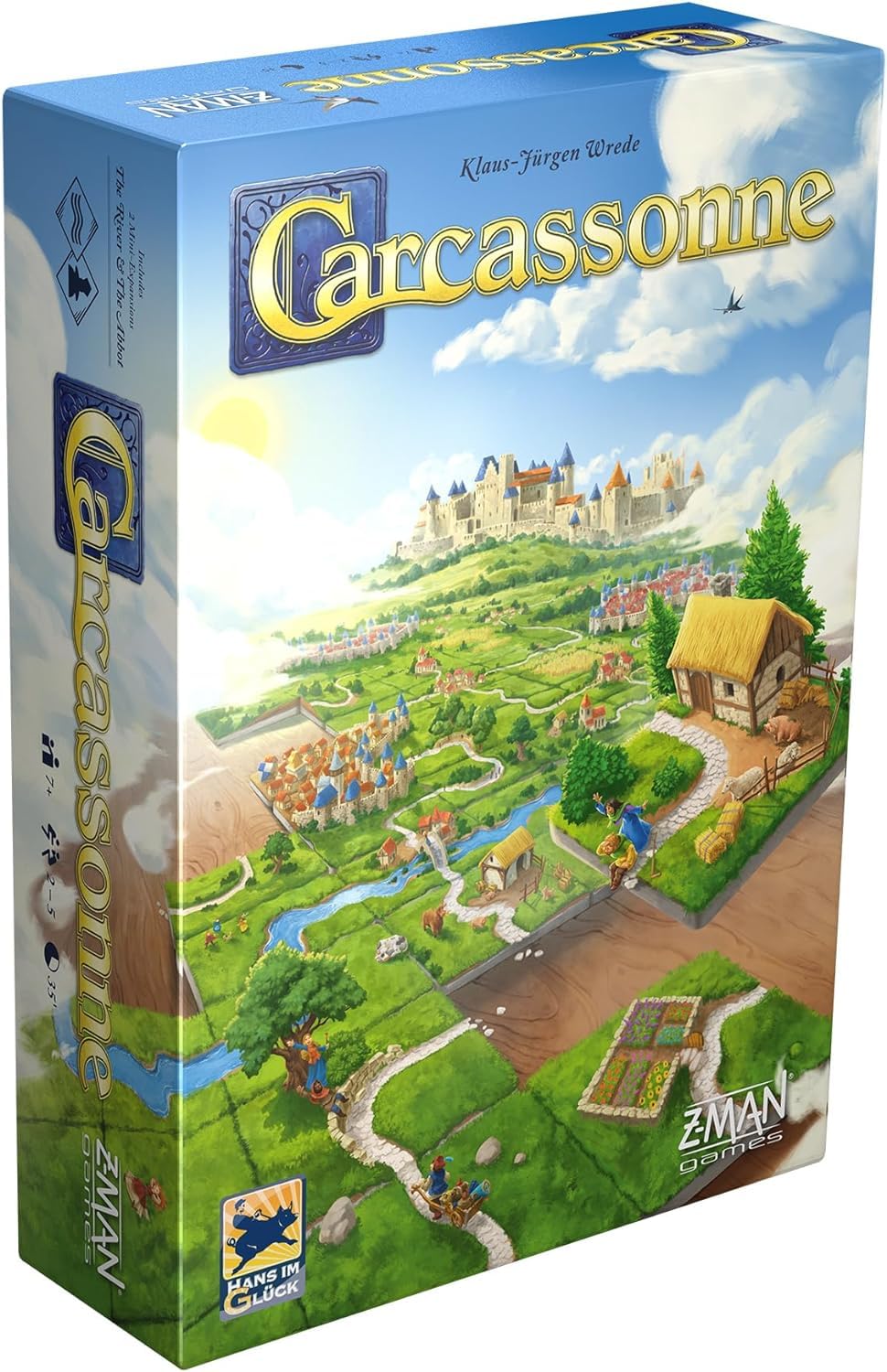
Where Azul gives you a private board and a shared pool, Carcassonne puts one map in the middle of the table and lets everyone build it together before fighting over it. You draw a tile, match it to an open edge, and decide whether to claim the road, city, or field you just created.

That single decision carries the whole game, and it's why this is our first choice for a mixed table. No hand of cards, no reading during play, no hidden information — you can explain it in three minutes and the first game still works.

The base box now includes two mini-expansions, The River and The Abbot, which is more variety than most groups will exhaust. The tiles are thick enough to survive a picnic table, and a game runs comfortably inside an hour, so it fills the slot before the main event.

One warning from our table: farmers score at the end and confuse everyone the first time out. Leave fields out of the teaching game and add them on the second night — the game is complete without them, and nobody spends round one lost.

Pros

  • Three-minute teach with no reading
  • A different map every single game
  • Two mini-expansions already in the box

Cons

  • Lighter strategy than Splendor or Wingspan
Our verdict

Carcassonne is the easiest game here to teach — three minutes of rules, no reading, and a fresh map every time you open the box.

Check Latest Price
6

Best Adult Party Game

Cards Against Humanity

96 /100
Lab Score Outstanding

Key details

Cards
500 white, 100 black
Edition
Version 2.0
Players
4-20+
Age Range
17 years and up
View on Amazon

Cards Against Humanity is the only game in this guide with a hard content warning, and that warning is the whole buying decision. The cards are crude and deliberately offensive, and the 17-and-up rating on the box is not decoration. If the room signs off on that, nothing else here gets people laughing as fast.

The rules take about a minute: one player reads a black card with a blank in it, everybody else submits a white card, and the reader picks a winner. Version 2.0 carries 500 white cards and 100 black ones, more than a single night can burn through, and the booklet includes alternate rules for when the standard round starts to sag.

We've seen it take off with eight and fall flat with four, which says more about the format than the cards — it wants a crowd willing to read aloud and be judged by the table. It's also the widest box here by a mile, since 4 to 20-plus means it absorbs whoever shows up after dinner.

Keep the expansions in your back pocket. The base set is the one that has to land, and it either does or it doesn't on the first black card.

Pros

  • Seats 4 to 20-plus players
  • Six hundred cards before a repeat
  • Fastest laughs of any game here

Cons

  • 17-and-up content limits the guest list
Our verdict

If your table can handle the content, Cards Against Humanity is the fastest laugh in this guide and the only box here that seats twenty people.

Check Latest Price
7

Best Quick Party Game

The Chameleon

96 /100
Lab Score Outstanding

Key details

Topics
800
Players
3-8
Age Range
12 years and up
Play Time
15 minutes
View on Amazon

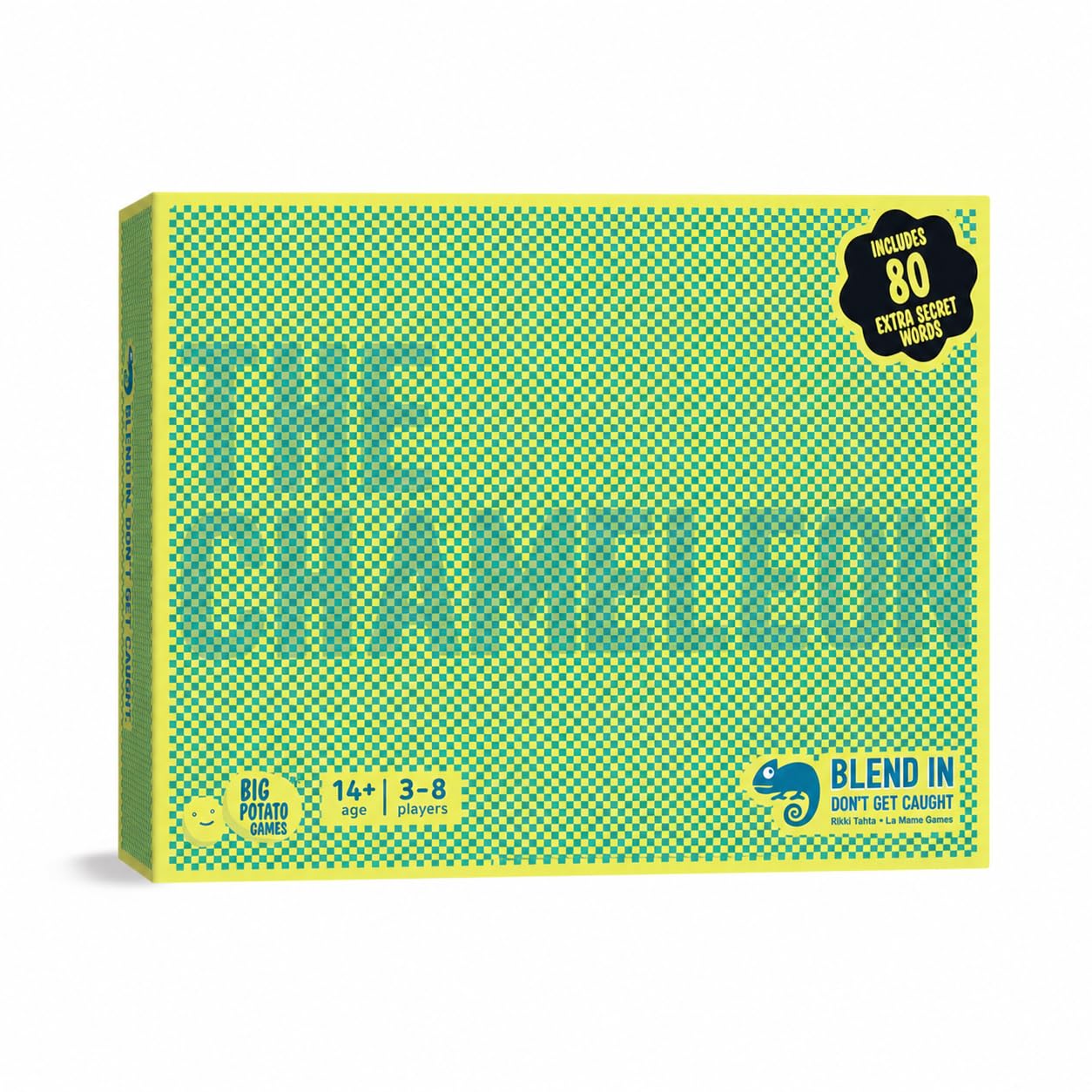
One person at the table doesn't know the secret word, and everyone else has to describe it with a single word each. Say something too obvious and the Chameleon works out the word and escapes; say something too vague and the table decides you're the Chameleon.

That's the whole game, and it costs one card and about fifteen minutes. The box carries 800 topics, enough that we haven't hit a repeat across a dozen sessions, and there is nothing to write, deal, or tidy up afterward.

What we didn't expect is how different it feels from the other party game here. Cards Against Humanity is about the funniest card in your hand; this one is about reading a room, and the tell usually lands in the half-second before somebody speaks.

It's the box that lives in a bag rather than on a shelf, and it plays on a restaurant table with no more room than a dinner plate.

Pros

  • Rounds in about fifteen minutes
  • 800 topics before a repeat
  • Nothing to write or clean up

Cons

  • Thin with only three players
Our verdict

The Chameleon is our pick when the night is short: one-word clues, one hidden player, and rounds that fit between dinner and dessert.

Check Latest Price
8

Mixed-Age Tables

Blank Slate

96 /100
Lab Score Outstanding

Key details

Players
3-8
Includes
8 dry-erase slates, 250 double-sided cards
Age Range
8 years and up
Play Time
30 minutes
View on Amazon

Someone writes "surprise" on a slate, someone else writes "birthday," and the table finds out who thinks alike. Blank Slate is a stack of cue cards and eight dry-erase slates, and the whole game is that reveal.

You score for matching another player and for matching nobody at all, which is the design detail that keeps it from turning into a test of who knows whom best. The scoring takes a round to click — the first game usually ends with somebody asking how the points worked — and then it runs itself.

It's the most accessible box in this guide: no reading beyond the cue card, no strategy to learn, and the 8-and-up rating holds up when a nine-year-old is playing. Wiping the slates between rounds is the only upkeep.

The thing we didn't expect to like so much is what it does to a table of near-strangers. Matching answers is an instant, low-stakes icebreaker, and the misses usually land funnier than the matches.

Pros

  • The easiest box here to get started
  • Eight slates keep big tables writing
  • Works with kids and grandparents at once

Cons

  • Plays best with four or more
Our verdict

We keep Blank Slate for mixed-age tables — everyone writes, everyone compares, and the scoring rewards thinking alike and differently at once.

Check Latest Price

What Eight Months of Game Nights Taught Us

The shortlist started at roughly 40 titles pulled from award lists, bestseller charts, and the games that still turn up on other people's shelves a decade after release. We cut it by player count, listed playtime, and price until 14 were left, aiming for a spread: heavy strategy, light tile-laying, and party games that live or die on the group. Each one got played at least three times — once with the wrap just off the box, once with people who already knew the rules, and once in the setting it's actually sold for, whether that was a weeknight dinner for two, a six-to-eight-person party, or a holiday afternoon with teenagers and grandparents at the same table.

The clock started before the box was open. We timed how long the teach took from cracking the rulebook to the first legal turn, and kept a tally of every ruling we had to look up mid-game. We also watched whether the person in last place was still making real decisions by the final round, since complexity that only pays off for the player with twenty games under their belt is a different product than complexity that keeps the whole table leaning in. A game that taught in five minutes and still had us second-guessing a move an hour later beat one that needed a twenty-minute explanation and then played itself.

Party games got their own pass, because humor has a short shelf life. We ran them with a full table of eight, then again with a mixed group that included a middle-schooler and a grandparent, and noted the exact moments attention slid to phones. Components got handled hard: cards shuffled until they softened, tokens spilled and re-sorted, boxes packed into a tote bag for a weekend trip and unpacked on a rental kitchen table.

Set-up and teardown went on the same sheet, along with how much table space a game claimed once it was fully laid out. We also kept a running note of which boxes came back out on nights when nobody was testing anything — the truest measure of whether a game has legs once the novelty wears off.

How to Choose a Board Game for Adult Game Night

Count the table before you shop

Every box prints a player range, and the top of it is usually optimistic. The number that matters is the count you actually host. Four adults is the most common game night, and it's why Splendor and Azul are our defaults; a recurring table of six or more needs a different shelf entirely, since the strategy games here stop at four or five.

Fluid groups are best served by buying for the number you hit most often, then adding one party game that swallows whoever arrives late. The trap is a box that claims 2 to 12 and plays well at neither end.

Pick a format for each part of the night

Three formats cover almost every adult game night: a strategy game people lean over, a party game people shout over, and a short filler between the two. The usual mistake is buying three strategy games, because the group that wants a 45-minute efficiency puzzle at eight o'clock is not the group that wants one at eleven.

One from each column covers an evening better than three variations on the same mood. Check the footprint too: Wingspan spreads across a dining table, while The Chameleon fits on a side table at a bar.

Weigh the teach, not just the playtime

The teach is the part that goes wrong, and it never appears on the box. Two things predict an easy one: no reading during play, and no hidden information. Carcassonne and Blank Slate clear both, which is why they work with a table that includes someone who hasn't played a game since college.

Wingspan clears neither, and it's still worth the effort. Learn it alone first, then run a practice game nobody is trying to win.

Depth comes from decisions, not rulebooks

The thickest rulebook here is not the deepest game. Splendor has three actions and rewards planning several turns ahead; Wingspan has three booklets and rewards the same instinct with more machinery. Both hold up, which tells you length of rules is the wrong thing to shop by.

What separates a game you play twice from one you play all winter is whether the choices stay close. If the best move is obvious every turn, the table solves it and stops talking. Look for a decision your neighbor can ruin.

Match the rating to the guest list

Two boxes here carry a 17-and-up rating, and the rating is about content rather than difficulty. Cards Against Humanity and Secret Hitler are the two best big-table games in this guide and the two you cannot put in front of a thirteen-year-old, so settle who is coming before you settle what to buy.

Mixed-age tables do better with Blank Slate, The Chameleon, and Carcassonne, all of which play well below the adult range.

Frequently Asked Questions

Final Verdict

Start with Splendor. Three actions a turn, 30 minutes a round, and a table that starts arguing about timing by the second game — it's the one that converts the skeptics, and it's the box we reach for first when a game night is still finding its feet.

If your nights are usually two people, buy Azul instead; the duel is sharper and the tiles look better on a coffee table. If you routinely fill a room, open with Secret Hitler and save the strategy games for the smaller nights.