Best Dice Games of 2026

The best dice games earn their place in the odd pockets of the day—the 20 minutes before dinner, the rainy afternoon at a rental cabin, the lunch break when everyone needs to stop staring at a screen. What separates a keeper from a dust collector usually isn't the theme or the box art. It's how quickly a new player can join, and whether the decisions stay interesting once the novelty wears off. Over the past three months, my team and I have played 14 dice games to find the ones that hold up.

Rules matter more than anything. I've watched a table full of adults lose interest during a 12-minute explanation, and I've watched kids half that age teach themselves a game in two. The games that survived our testing were easy to teach, portable enough to toss in a tote, and quick enough that nobody checked the clock. They also had to survive real family play—sticky fingers, dropped dice, and the occasional missing component. The picks below are the ones we kept coming back to.

1

Best Overall

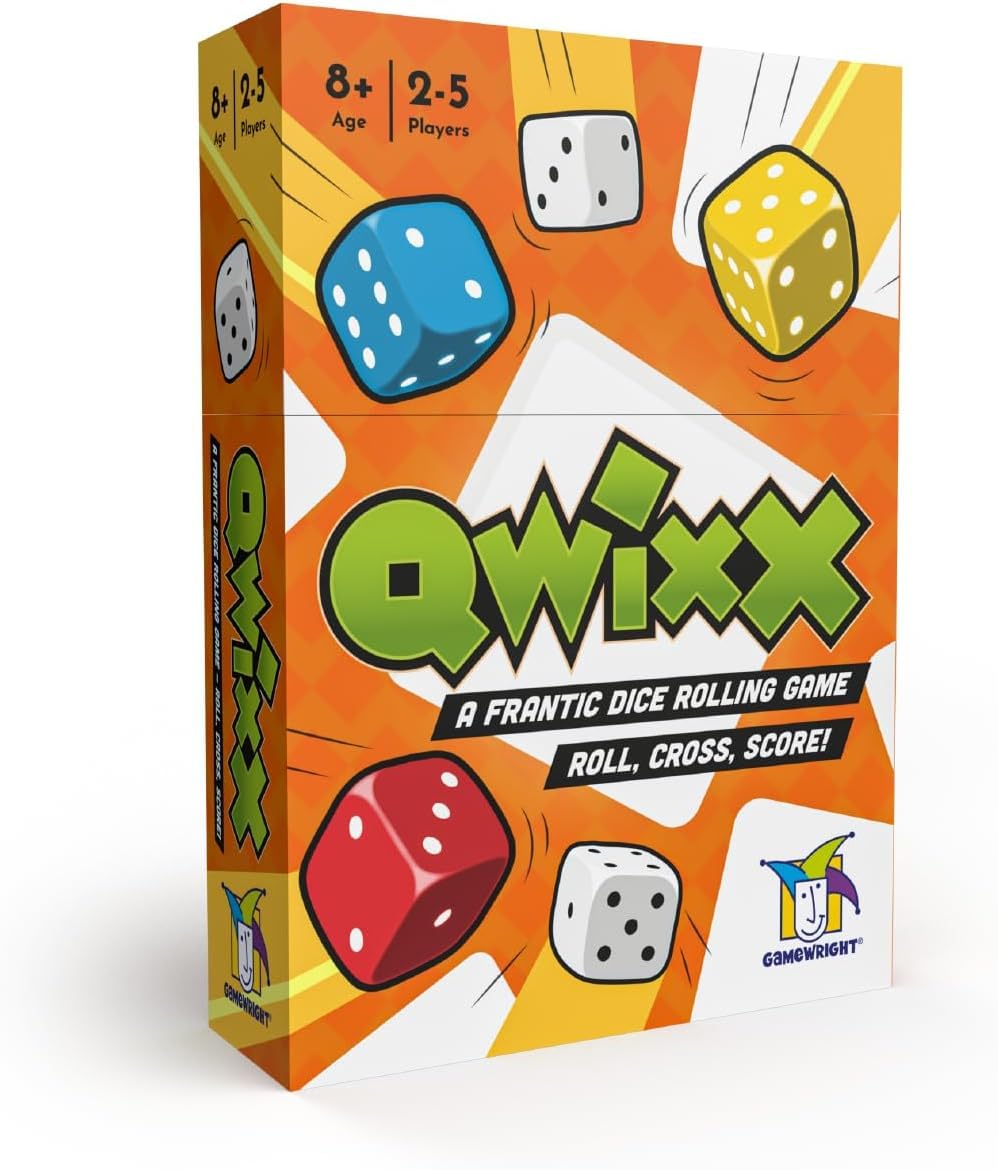
Qwixx

96 /100
Lab Score Outstanding

Key details

Players
2 to 5
Age Range
8 years and up
In The Box
Score pad, dice, rules
Playing Time
15 minutes
View on Amazon

The rule that sells Qwixx is the white-dice total. Whoever throws, everybody at the table gets to cross that number off their own sheet, so a turn never belongs to just one person. We've sat through plenty of dice games where three people watch and one person rolls; this is the one that fixes that, which is why it's our pick for a mixed-age family table.

Fifteen minutes is the honest length, and it's fifteen minutes of decisions rather than bookkeeping. Every number you cross off scores, so you're always weighing a mark now against saving a spot for a better number later, and a roll that helps your neighbor is still a roll you can use. The arithmetic is light but real — adding two dice is the whole of it — which is why an eight-year-old can play an adult even.

The box is about five inches by four and light enough to vanish into a tote bag. Ours lives in the car rather than on a shelf, and it has come out on more restaurant tables than anything else we own.

Teaching takes one round. Roll, add the white dice, cross the number. We've had a table playing properly by the second turn without anyone reading the rules aloud, and that's rarer than it sounds in a hobby full of three-page rulebooks.

Pros

  • Every player marks a score on every roll
  • Real decisions inside a 15-minute round
  • Small, light box that travels easily

Cons

  • Caps out at five players
  • Score sheets are a recurring purchase
Our verdict

Our overall pick: everyone scores on every roll, so a five-player family table stays in the game from the first throw to the last.

Check Latest Price
2

Best for Big Groups

LCR Dice Game

96 /100
Lab Score Outstanding

Key details

Weight
3.2 oz
Players
3 or more
Age Range
5 years and up
Container
Tin
View on Amazon

Three dice and a tin the size of a deck of cards, and it needs at least three people at the table. That mismatch is the whole story with LCR: it's the most portable game here and also the one that's worst with two players. The dice are stamped left, right, center and a dot, so you roll, you pass pieces, and they migrate around the table until one person has collected them all.

We think the lack of strategy is the point. There's nothing to learn and no way for an adult to hold an edge over a five-year-old, so grandparents, teenagers and small kids all have the same chance on every throw — and the game gets better as the table gets bigger. Six to ten people is where it sings.

Two practical notes from playing it. The tin has no molded insert, so dice and pieces rattle around loose; a small bag inside keeps them together. And plenty of tables play with quarters or candy instead of the pieces in the box, which changes the feel of a round more than the pieces do.

Pros

  • Plays a crowd; six to ten is the sweet spot
  • No rules to teach, ages 5 and up
  • Tin fits a purse at 5 by 4 inches

Cons

  • Needs at least three players
Our verdict

Buy it for a loud table of six or more: three dice, no rules to teach, and a five-year-old with the same odds as grandpa.

Check Latest Price
3

Best Classic

Yahtzee Classic

96 /100
Lab Score Outstanding

Key details

Players
2 or more
Age Range
8 years and up
In The Box
Shaker and 5 dice
View on Amazon

Yahtzee is the game most people already know how to play, and that's a real feature at a table with mixed ages. Five dice, a shaker and a scorecard with fixed categories: you roll, keep what you like, re-roll the rest, then commit the result to a box you haven't filled yet.

The scoring is arithmetic homework in disguise. Adding three of a kind, totaling a straight, deciding whether to take a zero in a category you're saving — a kid practices addition here without noticing, and the printed categories give a younger player a structure to think inside. Turn-taking is the cost: with four at the table, three people are watching most of the time, the opposite of how Qwixx and Tenzi work.

We keep it for the nights when somebody wants to keep score and nobody wants to learn anything new. The shaker is shaped so it won't stand upright between turns, a small annoyance you stop noticing after a round or two. Count the dice as you unpack — a set short one die changes the game, and it's easier to sort out before the box goes on the shelf.

Pros

  • Nobody has to learn the rules
  • Scorecard turns rolls into addition practice
  • Two players or a full table

Cons

  • Shaker won't stand upright between turns
Our verdict

The safest choice for a table that already knows the rules, and still the best game here for quietly drilling addition.

Check Latest Price
4

Best Push-Your-Luck Party Game

Zombie Dice

96 /100
Lab Score Outstanding

Key details

Players
2 or more
Age Range
10 years and up
Playing Time
10 to 20 minutes
View on Amazon

Brains, shotgun blasts and a decision on every roll. Zombie Dice is the purest push-your-luck game here, and the theme does a lot of the work: you keep rolling while the dice are kind, and the moment you push one roll too far you lose everything you banked that turn. We've watched a table go silent over a third roll, which is a lot of tension for a cup of dice.

It plays in ten to twenty minutes with two or more people, and the rules take about a minute to explain. Against Yahtzee it's lighter and faster, with no scorecard to fill, just a running total and a decision about whether to stop. The ten-and-up age grade is about the pictures rather than the rules.

Those pictures are the one thing that won't suit every family: a cartoon zombie set with shotguns on the dice, which you'll end up explaining to a five-year-old. For a table of teenagers and adults it's the fastest route to a loud argument, and the box is small enough to keep in a bag for exactly that.

Pros

  • Tension on every single roll
  • Ten to twenty minutes with 2 or more players
  • Taught in about a minute

Cons

  • Most expensive pick here for a small set
Our verdict

Our pick for a themed party round: ten tense minutes, a rule sheet you can teach in a minute, and a gamble on every throw.

Check Latest Price
5

Best for Young Kids

Tenzi

96 /100
Lab Score Outstanding

Key details

Players
2 to 4
Age Range
7 years and up
Ways To Play
9
Dice Included
4 sets of 10
View on Amazon

Forty dice hit the table at once, and that sound is the game. Tenzi gives each player their own set of ten colored dice and everyone rolls and re-rolls at the same time, setting aside the ones that match the target, until one player's set is finished. No turns, no waiting, no scorecard.

That structure makes it the best of these for the youngest players. A six- or seven-year-old who can't add yet can still roll, spot a matching number and set it aside, and the frantic pace leaves nobody time to get bored or to notice they're behind. The age grade is seven and up, and we've watched younger siblings roll along happily at the edge of the table.

The variations matter more than they sound. Nine different ways to play are included, from team versions to a stacking race, so a set that could have been a five-minute novelty keeps coming back out. The tube is the other quiet win: forty dice in one place, which is more than most of the games here can say about their pieces.

Whether it's worth the outlay depends on the group. It's one of the pricier games here and you're paying for dice rather than a board, but forty dice in one tube that play in five minutes earn their shelf space. We keep ours for the after-school window, when dinner is nearly ready and nobody has the patience for a score pad.

Pros

  • Everyone rolls at once, so there's no downtime
  • Nine ways to play in one tube
  • Simple enough for pre-readers

Cons

  • Colors vary, and a set can repeat shades
Our verdict

The pick for a house full of young, loud players: forty dice, no turns, and a round over before anyone loses interest.

Check Latest Price
6

Best Budget Pick

Farkle

96 /100
Lab Score Outstanding

Key details

Players
2 or more
Age Range
8 years and up
In The Box
Cup, 6 dice, score pad
View on Amazon

The whole game is one decision, repeated: bank what you've scored, or pick the dice back up and risk the lot. Six dice, a cup, a score pad. You set aside scoring dice, total them, roll the rest — until a throw produces nothing that scores, which is a Farkle, and the turn is gone.

It's the best value in this guide. No board, no tray, no expansion, and a box small enough for a kitchen drawer; what you get is a complete game that plays with two people or six and lasts as long as the table wants. The scoring is also the most arithmetic-forward of anything here: counting ones and fives in a hurry is a genuine skill, and kids get faster at it without being taught.

Two things we noticed in play. The cup isn't a luxury — six dice rolled loose on a table end up under the sofa, and the cup is what keeps a round moving. And six is exactly the right number of dice, so losing one changes the game, which is why ours live in the cup between rounds rather than loose in the box.

Pros

  • Complete game at the lowest price tier
  • Scales from two players to a full table
  • Scoring drills quick addition

Cons

  • Turn-based, so a big table waits
Our verdict

The budget pick: six dice, a cup and a score pad that turn a family night into a running argument about risk.

Check Latest Price
7

Silly Party Laughs

Pass the Pigs

96 /100
Lab Score Outstanding

Key details

Players
2 or more
Age Range
7 years and up
In The Box
Case, 2 pigs, pad, pencil
Target Score
100 points
View on Amazon

Two small rubber pigs instead of dice, and a scoring table that depends entirely on how they land: a Sider, a Trotter, a Razorback, a Snouter. Throw them, take the points, and decide whether to throw again — an Oinker or a Pig Out and the turn is gone. First to 100 wins.

The pigs are small. They fit in a palm, the score pad is smaller still, and the pencil is short — fine for a travel case, slightly fiddly for an adult hand. The case is molded as a pig sty with a lid, so the whole thing goes into a bag without a bag of its own, and nothing has gone missing from ours yet.

We reach for it when the table needs to laugh rather than compete. It's the silliest game here by a distance, and it doubles as a neat probability lesson: the scoring table is a distribution, and older kids work that out fast. Paint wear on the pigs is the one thing to expect over time, which nobody at the table has ever minded.

Pros

  • Silly enough to win over a mixed table
  • Scoring doubles as a probability lesson
  • Pig sty case keeps everything together

Cons

  • Pigs and score pad are small in the hand
Our verdict

Buy it for the laughter: two rubber pigs, a silly scoring table and a push-your-luck round that fits any number of players.

Check Latest Price
8

Math Practice at Home

Shut the Box

95 /100
Lab Score Outstanding

Key details

Tiles
12 spots
Players
2 or more
Material
Wood with felt
In The Box
Board and 2 dice
View on Amazon

A wooden box with twelve numbered tiles, two dice and green felt: Shut the Box is the most furniture-like game here and the least like a boxed set. Roll the dice, flip the tiles that add up to your roll, and try to shut the box; whatever is still standing when you can't move counts against you.

It's the pick for a child learning to add. The arithmetic sits right there on the board — roll an eight and find two tiles that make eight — and because everyone takes the same simple turn, a seven-year-old can beat an adult honestly. Twelve spots leave plenty of combinations, which starts to matter once a child plans instead of counting.

It also plays solo, which almost nothing else here does, and the wooden box doubles as the dice tray, so a roll stays on the felt rather than the floor. There's no lid, though: carry it in a bag and the dice will find their way out, so a rubber band or a small pouch is worth adding.

For a family that wants a game sitting out on the coffee table rather than filed in a cupboard, this is the one we point to. Guests pick it up and ask about it, which is not something we can say for a cardboard box.

Pros

  • Addition is the whole game, in a good way
  • Works solo or with a group
  • Solid wood, felt-lined, doubles as a dice tray

Cons

  • Heaviest and bulkiest game in this set
Our verdict

The pick for a young mathematician: addition is the game, and it's the only one here you can play on your own.

Check Latest Price

How We Played Our Way Through 14 Dice Games

We started with a shortlist of 30 games pulled from hobby shops, big-box shelves, and the deep corners of board-game forums. We filtered that list by player count, age range, listed playtime, and price, looking for variety rather than a pile of near-identical party games. That left 14 games—party fillers, push-your-luck rounds, and a handful of family-weight strategy titles. Every one had to be teachable without a video.

Testing happened where dice games actually get played: kitchen tables after dinner, a picnic blanket in the park, a campsite table, and a coffee shop during a lunch break. We played with mixed-age groups, including kids and grandparents, and timed how long the rules explanation took before anyone touched a die. We also timed full rounds to see whether a quick game stayed quick after the third or fourth play. Before the first roll, we counted every component against the list and checked the colors, sizes, and materials against the product photos; after each session, we counted again to see what had gone missing.

During play, we watched for meaningful choices—whether a turn involved a real decision or just a roll and a shrug—and noted when players checked their phones. We packed each game back into its box and asked whether it would fit in a tote bag without spilling. We also watched for wear: chipped dice, frayed cards, and boxes that split at the corners. The games that came back to the table without anyone suggesting them are the ones that earned a spot below.

How to Choose a Dice Game

Count your regular table before you count dice

Start with how many people actually sit down on a normal night, not the maximum the box claims. LCR needs three players and gets better at eight or ten. Qwixx is at its best with three or four and caps at five. Tenzi ships four sets of ten dice, so a fifth player needs another set of dice, not another chair.

The phrase to watch is 2 or more players. It usually means two is the floor rather than the sweet spot, and a game that drags with six will end up in the cupboard. If your group varies wildly, buy for the small table and add a party game for the big one.

Decide whether anyone should be waiting

Turn-based games concentrate attention on one player at a time. That suits adults who enjoy watching a good roll and it is hard on a six-year-old who has to sit through three other turns first. Qwixx and Tenzi both put every player in action on every roll, one by scoring off the shared dice and the other by rolling at the same time.

At a family table that difference is bigger than any component upgrade. If your game nights involve small children or a hard stop at bedtime, buy the simultaneous game first and save the turn-based classics for the adults-only evenings.

Match the arithmetic to the youngest player

Every game here asks something different of a child. LCR asks only that you match a symbol to a direction. Tenzi asks a player to spot a number and set it aside. Yahtzee, Farkle and Qwixx all ask for addition, and they are better games for it, but a child still counting on fingers will be slow, and being slow in a fast game is the quickest way to lose interest.

Read the rules for two things: whether scoring needs mental addition, and whether a bad roll only costs you or wrecks everyone else's turn. Games where the damage stays local are kinder to a mixed-age table.

Check what's in the box and what you'll rebuy

Two contents questions separate a good purchase from a frustrating one. First, does the box include the thing that keeps dice on the table, whether that is a cup, a tray or a felt-lined box? Loose dice rolled across a carpet is how small pieces disappear for good.

Second, is part of the game consumable? Score pads are the hidden running cost. Qwixx and Farkle both play off paper, and a pad that empties mid-evening ends the night. Buy a spare pad with the game, or laminate a sheet and keep dry-erase markers in the box.

Frequently Asked Questions

Final Verdict

Qwixx is the one we recommend first. It's the only game here where a five-person table is playing on every throw, a round fits into fifteen minutes, and the arithmetic is light enough that an eight-year-old isn't a handicap at the table.

If your game nights run to eight or ten people, LCR is the better buy: smaller, cheaper, nothing to teach, and it gets louder as the table grows.