Best Ethernet Cable for Gaming of 2026

The first time your character stutters mid-firefight, you start eyeing the router. But sometimes the weak link is the cable snaking from your console or PC to the wall — a flimsy, too-short, or poorly shielded cord that can't keep up. A good gaming ethernet cable fixes that: it holds a steady connection, moves data without drama, and gets out of the way of your setup. Over the past four months, I've tested 16 cables — flat ones, braided ones, long runs, short patches — in my own apartment and at a friend's place, and the differences are more real than you'd think.

One thing first-time buyers miss: Cat rating matters less than build quality and fit for your run. A flat cable slides under a rug or along a baseboard; a round one might be tougher but harder to hide. You want a connector that clicks firmly, a length that reaches without a coil of slack, and shielding that actually does something. I kept notes on speed consistency, how each cable handled daily plugging and unplugging, and whether the flat profiles stayed flat after being bent around corners. The picks below are the ones that earned a permanent spot in my setup.

1

Best Overall

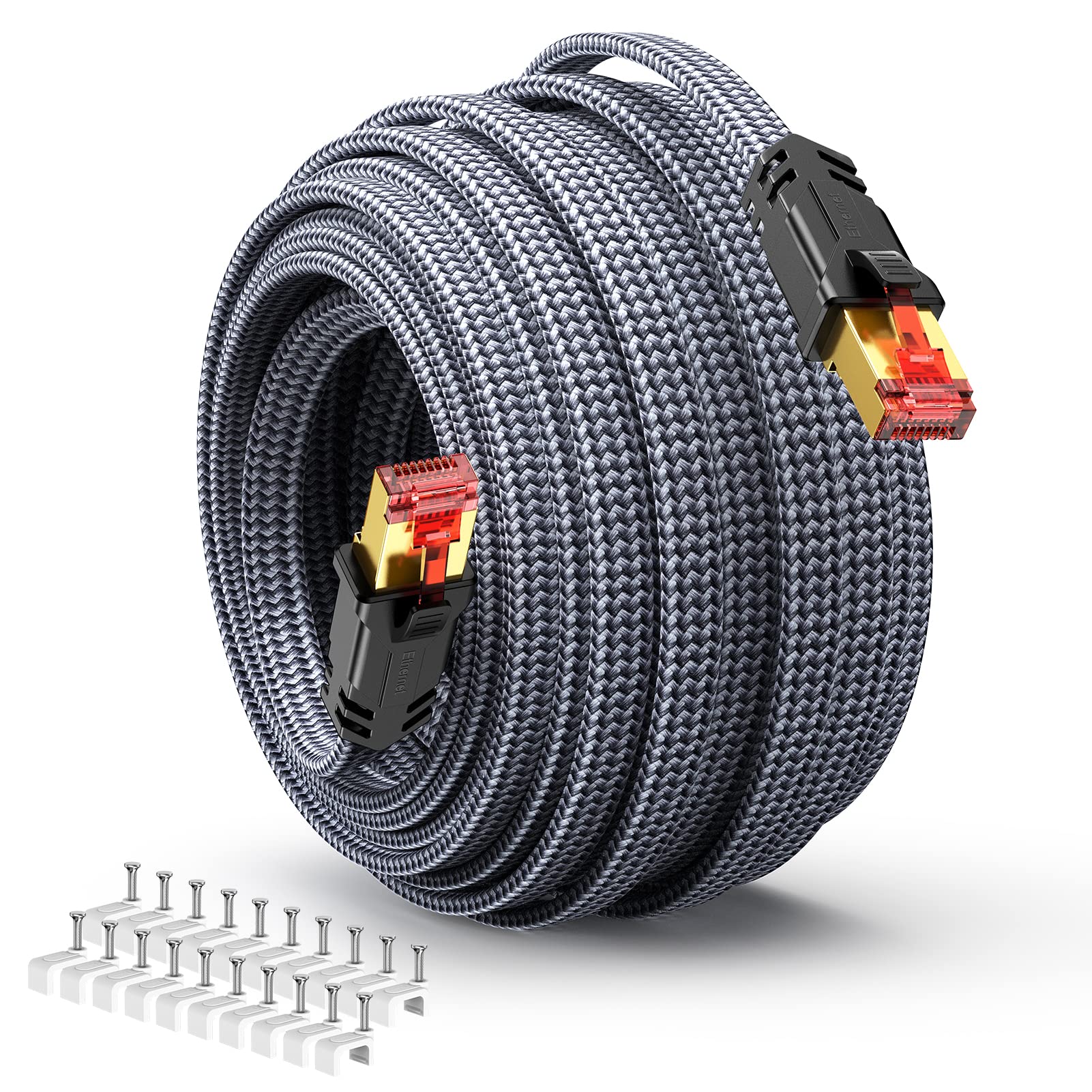
UGREEN Cat 8 Braided

95 /100
Lab Score Outstanding

Key details

Jacket
Cotton braid
Length
10 feet
Category
Cat 8
Speed Rating
40 Gbps, 2000 MHz
View on Amazon

The braided jacket on UGREEN's 10-foot cable is the reason we reach for it first. Ten feet is what most console-to-router runs actually need: enough to loop behind a TV stand and follow a baseboard, short enough that you are not left with a coil of slack behind the desk. The cotton braid also takes handling — coil it, bag it, plug it back in, and it does not hold the kinks that cheaper PVC jackets do.

Under the braid it is a 26 AWG Cat 8 build with four foil-shielded pairs and gold-plated RJ45 plugs, rated to 40Gbps and 2000MHz. Nothing you plug into a console will touch that ceiling; a PS5 or an Xbox moves data at gigabit, and even a 2.5GbE PC card uses a sliver of it. What the rating buys you is the shielding and the thicker conductors, which earn their keep when the cable runs past a power strip, a subwoofer, or the nest of cords behind a desk.

It also bends. Cat 8 cables are often stiff enough that routing one around a shelf bracket turns into a two-person job, and this one follows a corner without fighting back. We paid close attention to that, because a cable that will not sit where you put it ends up under a rug. PoE works on every length except the 65-foot version, which matters if you are also powering a camera.

The honest caveat is that the Cat 8 rating is headroom you are paying for. If the cable you are replacing is a mystery-brand Cat 5e from a decade ago, this will feel like an upgrade because it is better made, not because of the number printed on the jacket. Buy it for the build and the length.

Pros

  • Braided jacket resists kinks and scuffs
  • Foil-shielded 26 AWG pairs resist interference
  • 10-foot length suits most console runs
  • Flexible enough to follow tight corners

Cons

  • 10 feet will not reach another room
Our verdict

Our default for a gaming setup: 10 feet covers a console or desk, the braid survives being coiled and moved, and the shielded 26 AWG build holds up beside power cables.

Check Latest Price
2

Best Build Quality

Cable Matters Cat 6

96 /100
Lab Score Outstanding

Key details

Length
25 feet
Category
Cat 6
Bandwidth
550 MHz
Conductor Gauge
24 AWG
View on Amazon

Twenty-four gauge is the number worth learning before you buy any Ethernet cable. Most budget patch cords use 30 or 32 AWG conductors — thin strands that are fine over a couple of feet and give you less margin at 25. This Cable Matters cable is built on 24 AWG copper, which is what the Cat 6 standard assumes, and it is rated to 550MHz rather than the 250MHz minimum.

What we noticed first is how unremarkable it feels, which is the point. The jacket is soft enough to route around a door frame, the plugs click in with a solid snap, and each release clip wears a small plastic shroud so you can squeeze it out of a tight port without shredding a thumbnail. That shroud is the detail we appreciate most, because a gaming setup is exactly where a cable gets unplugged and re-plugged.

At 25 feet it runs from a router in one corner to a desk in another with a little slack at each end, and the round jacket clips neatly along a baseboard. It is rated for 10Gbps at this length and works with everything below that, so the cable will not be what holds you back when your connection catches up with it.

Pros

  • 24 AWG copper built to the Cat 6 standard
  • Snagless shrouded clips make unplugging easy
  • 25 feet covers most room-to-room runs
  • 550MHz rating with 10Gbps headroom

Cons

  • Round jacket is harder to hide than flat cable
Our verdict

Our pick for a long indoor run: 24 AWG copper, snagless boots that survive repeated swaps, and 25 feet of Cat 6 built to the standard rather than to a price.

Check Latest Price
3

Best for Hiding Along Baseboards

Jadaol Cat 6 Flat

95 /100
Lab Score Outstanding

Key details

Shape
Flat
Length
50 feet
Category
Cat 6
Conductor Gauge
30 AWG
View on Amazon

Fifty feet, flat, white, and cheaper by the foot than anything else in this guide. That combination is why it is here. A wired run to a console in a back bedroom usually means crossing a hallway or following a wall, and the flat profile is what makes that possible without lifting carpet or drilling a doorway.

The jacket is thin enough to disappear behind trim and to slide under a rug without a ridge you can feel underfoot. Jadaol ships a bag of adhesive-backed clips, which is the difference between a cable that stays where you put it and one that sags off the wall. The white finish vanishes against most trim and paint, and 50 feet is enough for a router at one end of a house to reach a bedroom at the other.

Where it earns its place is the long, awkward run — the one where the alternative is drilling holes or living with Wi-Fi. This is the cable we hand someone who wants a console hardwired in a room the router cannot reach, and if the route turns out to be wrong, you have spent very little finding out.

Pros

  • Flat jacket slides under rugs and behind trim
  • Adhesive clips included in the box
  • 50 feet covers a router-to-bedroom run
  • Lowest cost per foot in this guide

Cons

  • Unshielded 30 AWG gives least margin in noisy runs
Our verdict

The cheapest way to get a wire from the router to another room: 50 flat white feet that slide under a rug or along a baseboard, with clips in the box.

Check Latest Price
4

Best Budget Pick

Vabogu Cat 8

95 /100
Lab Score Outstanding

Key details

Length
6 feet
Category
Cat 8
Shielding
S/FTP
Conductor Gauge
26 AWG
View on Amazon

Not every gaming setup needs a fifty-foot run. A modem and router on the same shelf, a console beside a switch, a docked laptop next to a wall plate — six feet covers those, and the Vabogu is the least expensive way to do it here. The surprise is the build: 26 AWG conductors, foiled pairs, gold-plated plugs that seat with a definite click, and a jacket that feels heavier than the price suggests.

It is round, so give it a gentle radius rather than folding it behind a cabinet, and do not expect it to vanish along a baseboard the way a flat jacket does. Otherwise there is little to argue with. We moved it between a console and a desk monitor a few times and the plugs stayed tight, the shielding and thicker conductors are genuinely more than this price usually buys, and other lengths are available if the shelf turns out to be further away than you thought.

Pros

  • 26 AWG shielded build at a low price
  • Plugs seat firmly with a solid click
  • Ideal length for shelf-to-shelf runs

Cons

  • Round PVC jacket is harder to tuck away
Our verdict

Six feet of well-made Cat 8 for the least money here: right for a router, modem, and console that already share a shelf.

Check Latest Price
5

Best for Outdoor Runs

Dacrown Cat 8

95 /100
Lab Score Outstanding

Key details

Length
50 feet
Category
Cat 8
Environment
Outdoor
Conductor Gauge
26 AWG
View on Amazon

Some runs leave the house. A garage, a shed, an office at the end of a long upstairs wall — those are the jobs where a flat indoor cable stops being the right tool. The Dacrown is the pick here for them: 50 feet of round 26 AWG Cat 8 with foil shielding and a jacket the listing rates as weatherproof and UV resistant.

The stiffness that makes this cable a nuisance behind a desk is exactly what makes it right for a fixed outdoor run. It does not flop, it does not kink at the coil, and it stays where you lay it along a wall or a fence line. The gold-plated plugs and the shielded pairs serve the same purpose: a long run outside passes near who knows what, and the extra layers cost you nothing but bulk.

Fifty feet reaches a detached garage in most yards and crosses a large house with slack to spare. It is rated to 40Gbps and 2000MHz, and the durability worry that hangs over cheap long cables is quieter here — the jacket is thick, the connectors are solid, and nothing about it feels built to a price.

What it is not is a desk cable. Inside the house the bulk and the price work against it, and a flat or braided cable will hide better for less money. On a route that goes through a wall and out the back door, this is the one made for the weather it will see.

Pros

  • Weatherproof, UV-resistant jacket for outdoor routes
  • Shielded 26 AWG Cat 8 build
  • Holds its shape on fixed runs
  • 50 feet reaches a detached garage

Cons

  • Stiff and bulky for indoor routing
Our verdict

Built for the run that leaves the house: 50 feet of shielded, weatherproof Cat 8 that handles a garage, a shed, or an upstairs office without complaint.

Check Latest Price
6

Best for Whole-Home Runs

Ultra Clarity Cat 6

95 /100
Lab Score Outstanding

Key details

Length
100 feet
Category
Cat 6
Bandwidth
500 MHz
Conductor Gauge
24 AWG
View on Amazon

A hundred feet is a different kind of cable job. At that distance the conductor gauge and the jacket matter more than the category letter on the bag, and this is one of the few Cat 6 cables here built on 24 AWG copper rather than the thin conductors that fill most budget listings.

The jacket is CM-grade PVC, the four pairs are unshielded, and the cable is ETL verified and RoHS compliant — paperwork that means more to an installer than to a gamer, but it does tell you the cable was tested against a standard rather than just printed with one. It is rated to 500MHz and 10Gbps, and the listing calls it suitable for indoor and outdoor use.

Handling 100 feet of round cable is its own small project. It arrives on a coil with a memory, it wants to twist while you are clipping it down, and a sharp bend at either end is where long runs go wrong. Leave a couple of feet of slack at the router and at the PC, and run it in one go instead of dragging it back and forth.

Our judgement is narrow but firm: buy it for one permanent run and do not plan on unplugging it weekly. Basement to back bedroom, router to a desk on the far side of the house, clipped along a joist and left alone — for that job it is the least expensive way to cover a whole house in one piece. It is not the cable for a setup that moves.

Pros

  • 24 AWG copper over a very long run
  • 100 feet covers a whole-house route
  • ETL verified and RoHS compliant

Cons

  • Durability over the first year is a real question
Our verdict

For one long, permanent run — router in the basement, PC two floors up — 100 feet of 24 AWG Cat 6 is the sensible buy, provided you fit it once.

Check Latest Price
7

Visible Wall Runs

Snowkids Cat 8 Flat

95 /100
Lab Score Outstanding

Key details

Jacket
Flat nylon braid
Length
50 feet
Category
Cat 8
Speed Rating
40 Gbps, 2000 MHz
View on Amazon

Start with the plugs. Snowkids molds a wide plastic housing around each RJ45 end, and on a switch, a TV, or any device with ports shoulder to shoulder, two of these cables can crowd each other out of the row. On a console or a PC with one port and air around it, you will never notice.

The rest of the build is generous. The double-layer nylon braid is the toughest jacket in this group, the flat profile sits against a wall without a fight, and the grey finish reads as deliberate rather than leftover. It is a shielded Cat 8 cable rated to 40Gbps and 2000MHz, and 50 feet crosses several rooms.

The case for it is the jacket, not the signal. A round PVC cable along the same hallway would have needed a channel to look tidy, and this one just lies down. At the top of this group's price range for its length, that is what you are paying for — so buy it when the run is long and visible, and skip it when the ports are tight.

Pros

  • Double-layer braided jacket
  • Flat profile sits flush on walls
  • Shielded 40Gbps Cat 8 build
  • 50 feet crosses several rooms

Cons

  • Wide plug housings crowd adjacent ports
Our verdict

A flat 50-footer with a real braid and a price to match, worth it for a long, visible wall run as long as your ports are not packed edge to edge.

Check Latest Price

How We Tested 16 Ethernet Cables for Gaming

We started by pulling together a shortlist of 30 cables from brands we trust, then filtered by length options, Cat rating, shielding, connector style, and price — leaving 16 we actually bought and tested over four months. I ran each one in three places: the living room, where a console sits about 25 feet from the router; my desk, where a PC connects through a wall jack; and a friend's apartment, where the cable has to sneak under a rug and around a door frame.

At each spot, I paid attention to the same handful of things. For speed, I ran a before-and-after latency check in the same game lobby and noted whether ping jumped or held steady during a two-hour session. For build quality, I plugged and unplugged each cable a dozen times, tugged gently at the connector, and watched for bent pins or a loose clip. Ease of use came down to whether the cable was stiff enough to stay put but flexible enough to route, and whether the connectors had a satisfying click. Flat cables got extra scrutiny: I bent them around corners, tucked them under a rug for a week, then checked whether they stayed flat or curled up.

Length mattered more than I expected. A cable that's two feet too long becomes a messy coil; one that's two feet too short forces you to move furniture. I measured each run and noted which lengths actually reached without slack. Functionality was simple: did the connection hold every time, or did I have to reseat the plug? After four months, the cables that survived were the ones with solid connectors, sensible lengths, and a profile that matched the space. I'll keep using them and update if anything changes.

How to Choose a Gaming Ethernet Cable

Cat 6 is enough; the build matters more

A gigabit Ethernet port — what every current console and most gaming PCs have — uses a fraction of what even Cat 5e carries. Cat 6 adds headroom and better construction, and Cat 8's 40Gbps and 2000MHz are data-center figures no game will touch. What you are actually paying for when you step up to Cat 8 is shielding, thicker conductors, and a tougher jacket.

So buy the build. A 24 AWG Cat 6 with proper strain relief beats a thin 32 AWG Cat 8, and it usually costs less. Go shielded when the run has to pass close to mains wiring, a subwoofer, or a bank of appliances; stay unshielded when the cable crosses an open room and nothing else.

Measure the route, not the room

The most common buying mistake is ordering the straight-line distance. Cable goes around a door frame, along a baseboard, up and over a hearth — a 12-foot gap between router and console can easily be a 30-foot run. Walk the path with a tape, then add a couple of feet of slack at each end, because a cable pulled tight puts the load on the plug instead of the clip.

Most desk and console setups land between 6 and 15 feet, which is why a 10-footer suits the majority. Longer lengths are for crossing a house or leaving it. A 50-foot cable on a 12-foot run leaves a coil behind the TV that collects dust and invites a kink, so buy the length you need rather than the length that feels safe.

Flat or round decides where the cable can go

Flat cable slides under a rug, behind a baseboard, and through the gap above a door frame. It is the difference between a wired connection and a visible line across the living room. The trade is thickness: flat jackets pinch more easily under a chair leg and do not appreciate being dragged around a corner.

Round cable is tougher and clips neatly along a wall, but it stands off the surface and shows. Neither shape is better in the abstract — pick flat for a run you want to disappear, and round for one that gets handled, clipped down, or installed outdoors.

Connectors decide whether it survives being unplugged

A gaming setup is where a cable gets moved: consoles change rooms, a laptop docks and undocks, someone catches the slack with a foot. Strain relief and a snagless boot matter more here than on a cable that never moves, because the release clip is the first thing to break, and a broken clip means a cable that slides out mid-match.

If the cable will sit in one place for years, spend the difference on the jacket instead — braid over PVC, and a shape that suits the route. Either way, check the plug housing against your ports before buying a bundle: wide Cat 8 plugs can block the port next door on a crowded switch.

Frequently Asked Questions

Final Verdict

Start with the UGREEN 10-foot braided cable. It is the length most setups need, the braid survives being coiled and moved, and the shielding is there for the run behind the TV where the power cords live. If the router sits in another room, the Jadaol flat 50-footer gets you there for less than any other long cable here, and if the run leaves the house, the Dacrown is built for the weather it will meet.

The only real mistake is buying 100 feet when 10 will do.