Best GPU Thermal Putty for VRAM and VRM Repads of 2026

Thermal putty sits in the awkward space between paste and pads: it has to squish into the uneven gaps around VRAM and VRMs, stay put under compression, and still move heat like it means it. I've repasted enough cards to know the wrong putty can turn a straightforward cooler swap into a cleanup job, and that a good one makes the whole process feel almost boring. What it fixes is the gap problem—literally—on cards where pads are too thick, too thin, or simply don't make clean contact.

Over the past six months, my team and I worked through 14 thermal putties on real cards, not just a test bench. We cared about cooling and thermal performance under sustained load, but also how each one applied, spread, compressed, and cleaned up—because a putty that's miserable to work with rarely earns a place in my drawer. Value mattered too: some tubes cover one card generously, while others disappear after a single GPU. The picks below are the ones that made the job easier and the temperatures better.

1

Best Overall

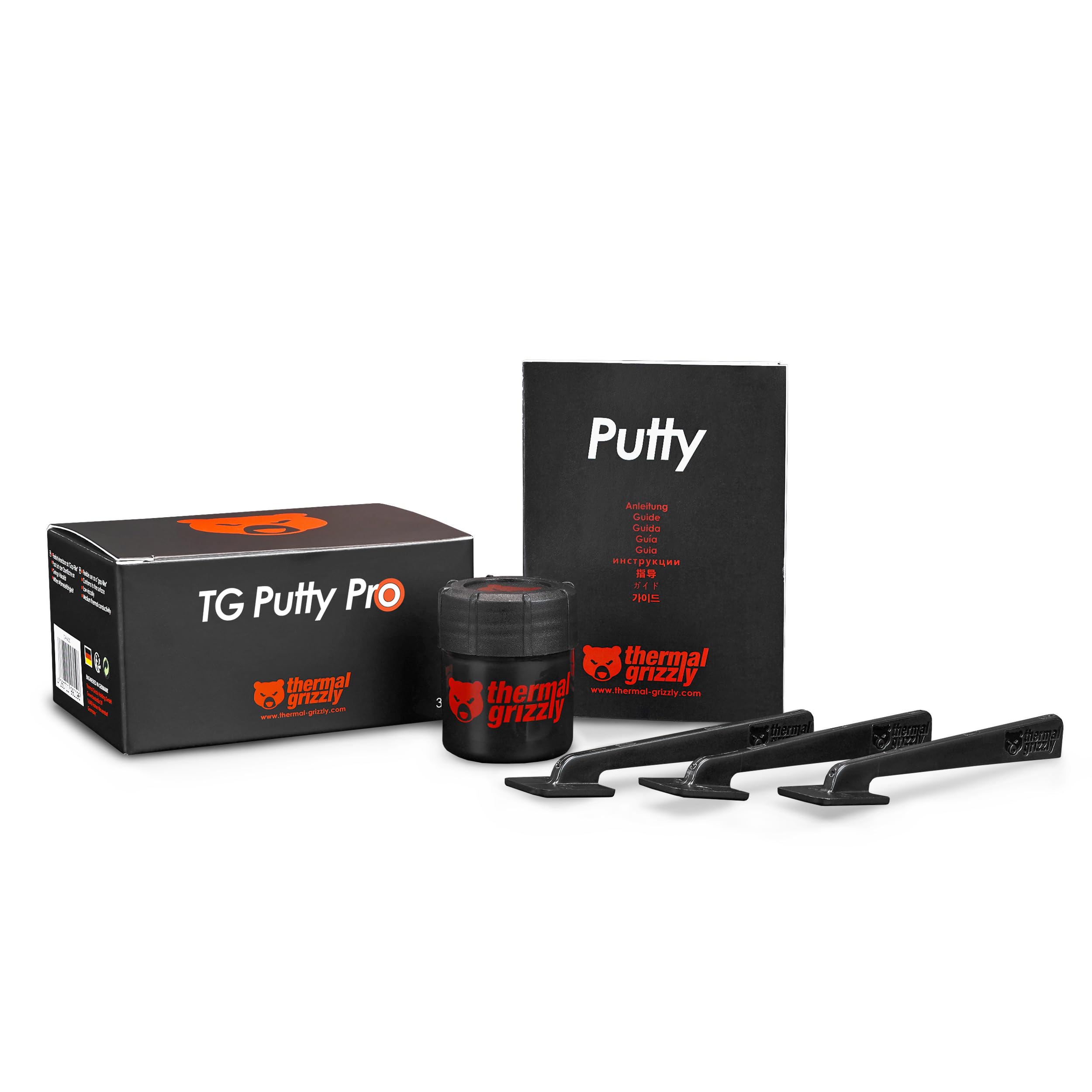
Thermal Grizzly TG Putty Pro

91 /100
Lab Score Outstanding

Key details

Gap Fill
0.2 to 3.0 mm
Quantity
1.06 oz
Electrical
Non-conductive
Conductivity Grade
High-end
View on Amazon

Two tenths of a millimeter to three millimeters is the whole pitch, and it's the most useful number on the jar. A graphics card rarely uses one pad thickness — memory sits at one height, the VRMs at another, the chokes lower still — so a fixed pad is a compromise everywhere except the one spot it was sized for. Putty compresses to whatever the real clearance turns out to be. Halfway through our first card, we stopped measuring individual pad thicknesses and started laying beads instead.

Cooling is where the Pro earns the top spot in this group. The strongest cooling results here land on memory and hotspot readings, the numbers that actually throttle a card, rather than the core temperature you watch in an overlay. Some of that is the compound and some of it is the format: a putty that wets both surfaces gives the cooler a shorter path than a pad that's a fraction of a millimeter off. We paid close attention to how evenly it squashed out across a row of memory chips, and it behaved like a material designed for this rather than adapted to it.

Is the top grade worth it over the Basic in the same line? On a card you plan to keep, we think so. Both fill the same 0.2 to 3.0 mm range and both are electrically non-conductive; what changes is the conductivity grade and what sits behind it. If the card is a spare or a flip, the Basic does the job. If it's the one in your main machine and you don't want to open it twice, this is the jar we put in.

One detail we appreciated more than we expected: non-conductive material forgives a small mistake. A bead that creeps toward a capacitor leg is a wipe-and-retry rather than a dead card, which takes some of the tension out of working around a densely packed VRM section.

Pros

  • 0.2 to 3.0 mm fill covers most pad sizes
  • Top conductivity grade in its own line
  • Strongest cooling results in this set
  • Electrically non-conductive around VRM and memory

Cons

  • Premium price for a 30 g jar
Our verdict

Our pick for most repads and for a card you intend to keep: 0.2 to 3.0 mm of gap fill, the strongest cooling results here, and the top conductivity grade in its line.

Check Latest Price
2

Best for Multiple Repads

UPSIREN UTP-6

92 /100
Lab Score Outstanding

Key details

Cure
Fully cured
Quantity
3.53 oz
Compliance
RoHS, halogen-free
Consistency
Low viscosity
View on Amazon

Three times the material in our top pick's jar, and a formulation stated to be fully cured and not to dry out over time. That combination is why this is the tub we reach for when the job isn't a single card. Repadding a card and a laptop in the same month, or keeping a couple of machines alive, changes the arithmetic completely.

Low viscosity is the design decision everything else follows from. It's built to move — through a dispenser, through a stencil, or under a spatula — and it flows into uneven gaps instead of being forced into them. Working by hand, we laid narrow beads and let the cooler spread them, which is faster and neater than pre-shaping the material. The flip side of something this mobile is that it rewards a light touch; pile it on and you'll spend more time cleaning squeeze-out at the edges than you spent applying it.

What the jar does state is RoHS and halogen-free compliance, which matters for equipment that has to stay inside those rules, plus that fully cured formulation that won't go off between jobs. Those are the practical arguments, and for a maintenance drawer they're most of the case: a tub you can open, use, and shelve without wondering what it'll be like next year.

Pros

  • 100 g covers several cards
  • Fully cured and stated not to dry out
  • Low viscosity suits spatula, stencil, or dispensing work
  • RoHS compliant and halogen-free

Cons

  • No stated W/mK figure to compare
  • 100 g is more than a single card needs
Our verdict

The tub we reach for when the job is bigger than one card: 100 grams of fully cured putty that won't dry out between repads, at a cost per job nothing else here matches.

Check Latest Price
3

Best Budget

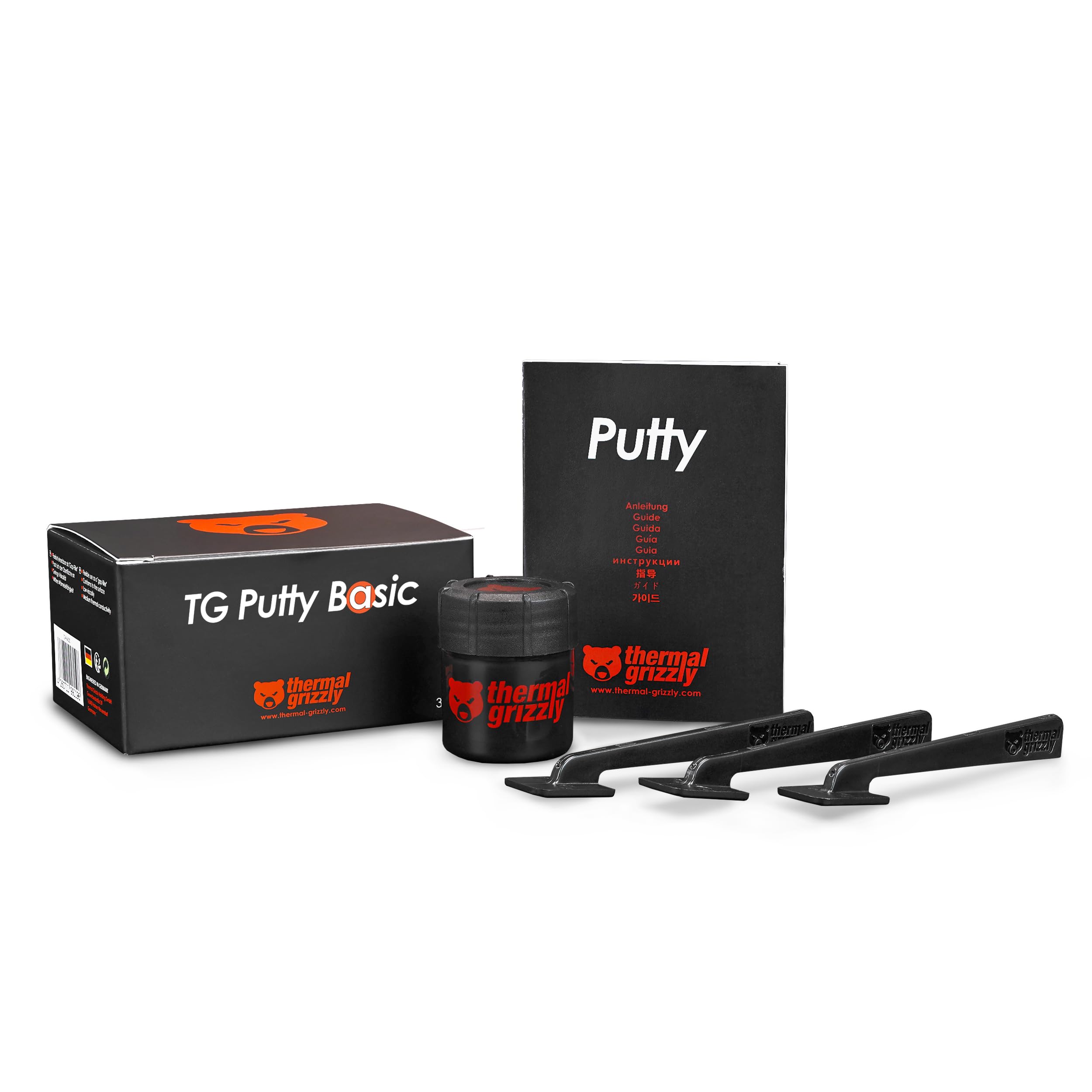
Thermal Grizzly TG Putty Basic

91 /100
Lab Score Outstanding

Key details

Gap Fill
0.2 to 3.0 mm
Quantity
1.06 oz
Electrical
Non-conductive
Conductivity Grade
Very good
View on Amazon

Basic is the entry point of Thermal Grizzly's putty line, and it keeps the two things that decide whether a repad works: the same 0.2 to 3.0 mm fill range as the Pro, and the same electrically non-conductive formulation. What changes is the conductivity grade. For a first repad, or a card you're fixing up to sell on, that's exactly the right place to come in.

Spreading is where it asks for patience. The material is stiffer than the rest of this group and takes more working to level across a row of memory chips, so a plastic spreader and a little warmth from your fingers do more for it than a quick pass will. Give yourself a few extra minutes and it behaves.

Cooling is better than the grade suggests. On the memory and VRM areas where putty does its work, temperatures came down and stayed there through our runs, and the kneaded material held its position under the cooler instead of creeping toward the edges. It's not the jar to buy if you want the best number on the box; it's the jar to buy if you want the job done properly without paying for a grade your card will never notice.

Pros

  • Same 0.2 to 3.0 mm fill as the Pro
  • Electrically non-conductive formulation
  • Cooling holds up for the grade

Cons

  • Lower conductivity grade than the Pro jars
Our verdict

The budget way into the Thermal Grizzly line: the same 0.2 to 3.0 mm fill and the same non-conductive formulation as our top pick, with a lower grade and a bit more elbow grease.

Check Latest Price
4

Best for Smaller Jobs

UPSIREN UTP-8

89 /100
Lab Score Excellent

Key details

Quantity
1.76 oz
Electrical
Non-conductive
Consistency
Tacky, moldable
Conductivity
14.8 W/mK
View on Amazon

Roll it into a thin cylinder for a run of chokes, press a small ball onto a single memory chip, and it stays where you put it. Tack is the whole point of this one. Where a low-viscosity putty wants to be dispensed and spread, this one is meant to be placed by hand, and it holds its shape long enough for you to get the cooler down on top without anything sliding out of position.

The stated 14.8 W/mK is the highest conductivity figure attached to any jar here, and it sits alongside an electrically non-conductive, halogen-free formulation that's stated not to dry out. We found it the easiest of the group to position accurately around a row of components, because it doesn't slump or wander while you're working across the board.

Against the UTP-6, the choice comes down to application style rather than performance. The 100 g tub is a dispensing material: mobile, low viscosity, happy under a stencil. This jar is the hand-application version of the same job — tackier, moldable, and easier to keep off the parts you aren't covering. If you're working with a spatula and your fingers rather than a dispenser, this is the one that suits the method.

Pros

  • Highest stated conductivity figure here
  • Tacky and moldable for precise hand placement
  • Non-conductive, halogen-free, and stated not to dry out

Cons

  • 50 g covers a single card or one laptop
Our verdict

The hand-application pick: tacky enough to shape onto individual memory chips, with the highest stated conductivity figure here and a jar sized for one careful job.

Check Latest Price

How We Tested GPU Thermal Putty

We started by gathering putties that show up in GPU repair threads and from brands known for thermal interface materials, then filtered out anything with vague consistency claims, poor reported coverage, or a tube size that made a single-card job wasteful. That left 14 products, which we tested over six months on a mix of air-cooled and water-cooled cards, including older cards pulled from storage and current GPUs in gaming builds. Each putty went onto the same set of VRAM and VRM contact points, applied by hand with a spatula and then compressed by the cooler.

On the bench, we ran sustained load loops and logged GPU hotspot, VRAM, and VRM temperatures before and after a 30-minute warm-up, then repeated the runs after a week of thermal cycling. In real use, we paid attention during game sessions and overnight renders: did temperatures creep, did the putty pump out at the edges, and did it stay where we placed it? We also noted how it spread, whether it clung to the cooler or the board, and how much work it took to clean off a card for a second application.

Application and value got the same scrutiny. We weighed each tube, tracked how far it stretched across a card, and judged whether a putty needed warming, thick spreading, or a delicate touch to avoid air pockets. Quality showed up in consistency—smooth versus grainy, stable versus oily—and in whether the putty survived compression without crumbling. The best ones kept temperatures in check, applied without a fight, and left enough in the tube for another card.

How to Choose Thermal Putty for a Gpu Repad

Start With the Gap, Not the Conductivity Figure

Thermal putty exists because a graphics card isn't flat. Memory, VRMs, and chokes sit at different heights relative to the cooler, and pre-cut pads come in fixed thicknesses, so most cards mix two or three of them and every pad is a compromise except where it was sized exactly right. Putty compresses to the real clearance, which is why the fill range matters more than anything printed in large type.

The Thermal Grizzly jars here cover 0.2 to 3.0 mm and the UPSIREN putties state fill up to 3 mm. Check the thickest gap on your card and make sure the putty reaches it. What you don't need to do is measure every individual pad to a hundredth of a millimeter, which is the job putty is meant to delete.

Consistency Decides How the Job Goes

Two putties with the same fill range can feel nothing alike. A tacky, moldable material such as the UTP-8 can be rolled and pressed into place, which suits hand application around a row of components. A low-viscosity material such as the UTP-6 is built to be dispensed or stenciled and flows into gaps rather than being pressed into them.

The trap is buying for the wrong method: a mobile putty under a finger goes everywhere you don't want it, and a stiff one fights a spatula and wastes material. Buy for how you'll apply it, and keep gloves and a plastic spreader on the bench, because putty sticks to itself and to anything it touches.

Buy for the Number of Jobs, Not the Price per Gram

Thirty grams is about one card. Fifty grams covers a card with margin, or one laptop. A hundred grams is three or four cards, or a couple of machines plus a retry after a mistake. The trap is buying on unit cost: the biggest tub looks like the better deal until it sits in a drawer, and the smallest jar runs dry halfway through a second card. Count the jobs you actually have, add one for error, and buy to that.

Non-Conductive Still Means Careful

Electrically non-conductive is the phrase to look for, and the Thermal Grizzly jars and the UPSIREN UTP-8 state it outright. It means a stray smear near an exposed contact isn't automatically a dead card, not that you can be casual. Apply enough to fill the gap and let mounting pressure do the spreading, keep the material off the die itself, and check that the cooler sits flush before you tighten it down.

Frequently Asked Questions

Final Verdict

Our recommendation for a GPU repad is the Thermal Grizzly TG Putty Pro. The deciding advantage isn't a headline number: it's that 0.2 to 3.0 mm of fill covers whatever your card actually measures, so the job stops being an exercise in pad-thickness arithmetic, and the cooling results behind it are the strongest in this group.

If you maintain more than one machine, buy the UPSIREN UTP-6 instead and get 100 grams of fully cured, dispensing-friendly material that costs less per repad. For a first attempt on a card you're learning on, the TG Putty Basic fills the same range and asks for a little more patience rather than a bigger commitment.