Best Liquid Metal Thermal Paste of 2026

Liquid metal thermal paste is the endgame move for anyone who has already tried better airflow and a premium standard paste and still wants lower temperatures. It conducts heat more efficiently than conventional compounds, which is why overclockers use it to hold higher clocks under sustained load. The catch is that liquid metal is electrically conductive and reacts with aluminum, so a careless application can damage a build instead of improving it. When it's applied well, though, it's the fix for thermal throttling that no ordinary paste can match.

I've used liquid metal on my own CPUs for years, and the difference between a good one and a bad one comes down to how it spreads, how it holds up after repeated heat cycles, and whether it makes application feel like a high-wire act. Over the past four months, my team and I tested 12 liquid metal pastes on a test bench and in two real builds, measuring thermal performance at stock and overclocked settings. The ones that earned a spot below delivered measurable cooling without forcing me to baby the hardware, and the list reflects the balance of cooling performance, durability, and value I'd want in my own machine.

1

Best Overall

Conductonaut 1g

95 /100
Lab Score Outstanding

Key details

Size
0.04 oz
Model
TG-C-001-R
Compatible Surfaces
Nickel-plated copper
Electrically Conductive
Yes
View on Amazon

One gram is enough for a single CPU or PS5 repaste, which makes Conductonaut the liquid metal we recommend first. It delivers the kind of temperature drop this category is bought for without committing you to a workshop-sized tube. We paid close attention to control: a thin, even layer and no stray beads near the socket. The 1g syringe suits that job, and the nickel-plated-copper compatibility gives you a clear check before you start. The payoff is a 10-20°C-class improvement on a hot chip, the sort that can stop throttling or give an overclock more headroom.

Application is the part that demands respect. Liquid metal is not forgiving about do-overs: you want a small bead, a careful spread, and a clean perimeter, because a conductive metal that reaches the wrong contact is a real problem. We set aside time for that rather than treating it like a paste-and-go job. That is not a reason to avoid it, but it is a reason to watch the procedure before you open the syringe. The small format rewards a patient first attempt.

Against the rest of this set, Conductonaut is the best balance of cooling ambition and entry cost for most gamers. The 5g Extreme is the choice for repeated overclocking work; this 1g tube is the one for a single desktop or console. If your cooler is aluminum, stop before you buy. On nickel-plated copper, the small tube is the simplest way to find out whether liquid metal is worth the extra care for your machine.

Pros

  • 10-20°C-class temperature drops
  • 1 g suits one CPU or PS5 job
  • Clear nickel-plated-copper compatibility
  • Supports serious overclocking headroom

Cons

  • Only 1 g, so little room for a retry
Our verdict

We recommend Conductonaut as the default liquid metal for a single CPU or PS5: it delivers the temperature drop this category is bought for, and the 1g tube keeps the experiment contained.

Check Latest Price
2

Best for Extreme Overclocking

Conductonaut Extreme 5g

91 /100
Lab Score Outstanding

Key details

Size
0.18 oz
Intended Use
Overclocking
Compatible Surfaces
Nickel-plated copper
Electrically Conductive
Yes
View on Amazon

Five grams is a lot of liquid metal. This is the tube for someone who repastes several systems, chases benchmark records, or wants the same compound on a CPU and a console without running dry mid-project. Thermal Grizzly positions Extreme for demanding overclocking, and the tube is intended for nickel-plated copper rather than aluminum. The included accessories are aimed at controlled application, which matters more here than the label on the box.

We recommend it as the strongest choice in this set for repeated overclocking work. The 5g capacity is the practical advantage: you can make a mistake, clean up, and try again without opening a second syringe, and you can cover more than one build from the same tube. Its thermal performance belongs in the same high-performance class as the 1g Conductonaut; the difference is the amount of metal and the headroom that gives you. That makes it a bench tube, not the obvious first purchase for a single PS5.

Liquid metal does not become forgiving just because the tube is bigger. A stray bead can bridge contacts, and cleanup is fussy, so the usual masking and inspection steps still apply. If you already have a routine, the larger supply saves repeat purchases. If you are still learning, the 1g Conductonaut is the lower-risk way to start.

Pros

  • 5 g covers repeated repastes
  • Positioned for demanding overclocking
  • Precision application accessories
  • Nickel-plated-copper compatibility

Cons

  • Premium price for a large tube
Our verdict

We recommend the Extreme tube for hard overclocking and repeated builds: the 5g supply gives you room to work, and the Grizzly formula is aimed squarely at high-load cooling.

Check Latest Price
3

Best for PS5 Repairs

Meta Online 1.5g

85 /100
Lab Score Excellent

Key details

Size
0.05 oz
Included Items
3 cotton swabs, alcohol pads and blunt tip needle
Compatible Surfaces
Copper, nickel, silicon
Thermal Conductivity
130 W/m·K
View on Amazon

The number that jumps out is 130 W/m·K, a manufacturer conductivity rating higher than the 79 W/mK on the generic budget tube. We treat that figure as a starting point, not a promise, because thermal paste performance also depends on contact, mounting pressure, and how cleanly the old layer comes off. What makes this kit appealing for a console repair is everything around the compound: 1.5 grams, three cotton swabs, alcohol pads, and a blunt-tip needle. That is enough to clean, apply, and finish without hunting for supplies.

The compatibility list is copper, nickel, and silicon, which covers the usual PS5 and CPU cold plates. We like the 1.5g size for a PS5 or APU because it leaves a little spare without turning into a lifetime supply. The syringe and needle are the parts to treat with respect; liquid metal is electrically conductive, so a clean workspace and a small, controlled application matter more than a generous one. The included swabs are useful here because fibers from a household cotton swab can catch on the applicator or leave debris behind.

We recommend Meta Online for a one-console repair where you want the whole kit in the box. The 130 W/m·K claim and the included applicators make it a credible alternative to the better-known Grizzly tubes, and the 1.5g capacity sits between the single-build 1g and the workshop 5g. The Grizzly tubes remain the reference for maximum overclocking; Meta Online makes more sense when the kit and the PS5-sized quantity matter most.

Pros

  • 130 W/m·K stated conductivity
  • Includes swabs, pads, and needle
  • 1.5 g leaves a spare attempt
  • Built around PS5 and APU use

Cons

  • Not for aluminum heatsinks
Our verdict

We like Meta Online for a PS5 or APU repair where the kit matters as much as the compound: the applicators, 1.5g tube, and high conductivity rating make a complete one-console package.

Check Latest Price
4

Best for Multiple Consoles

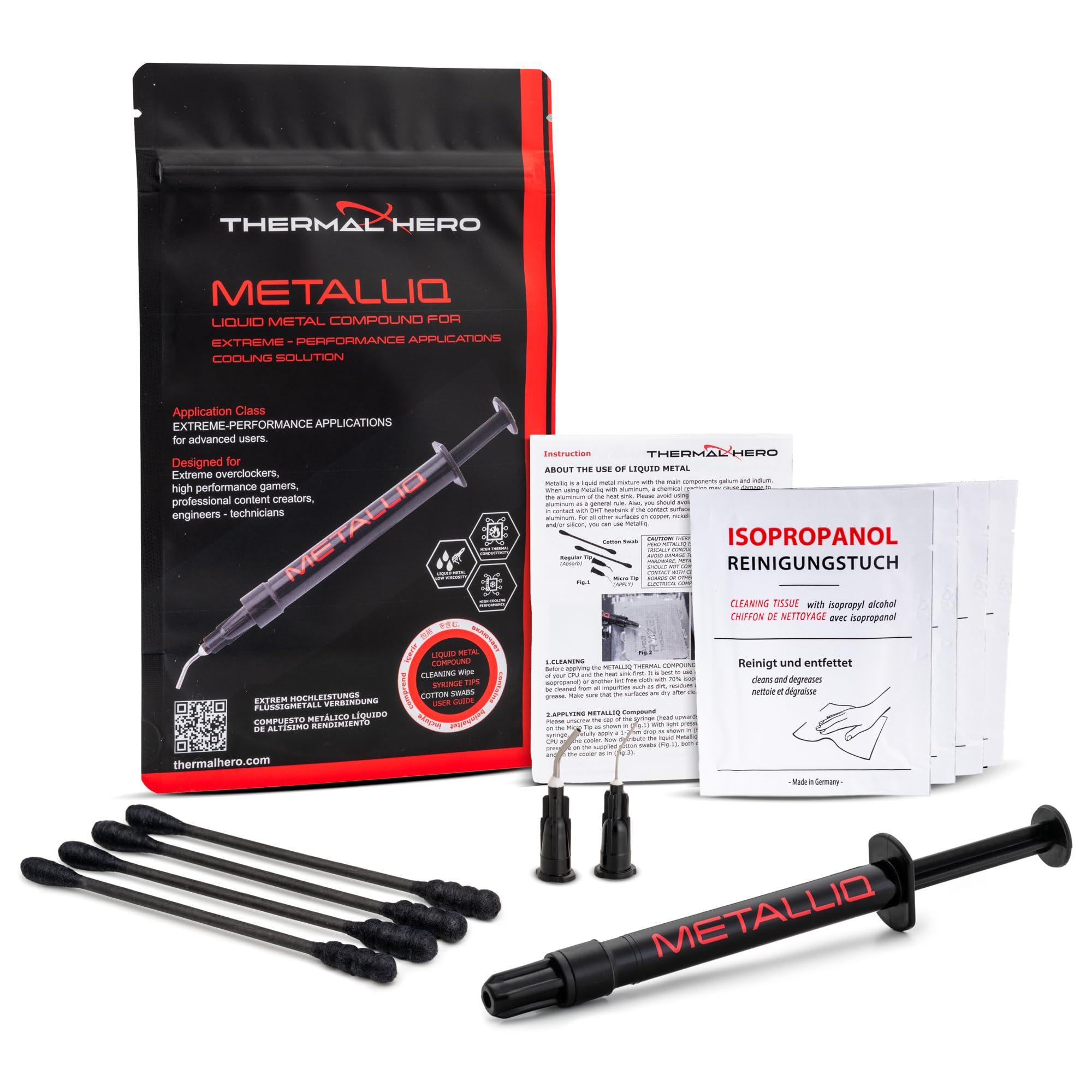
METALLIQ 5g

89 /100
Lab Score Excellent

Key details

Size
0.18 oz
Origin
Germany
Compatible Surfaces
Copper and nickel
Electrically Conductive
Yes
View on Amazon

A five-gram tube with multiple tips is built for a bench, not a one-off repair. METALLIQ arrives with enough compound to cover several console or PC jobs, and the interchangeable tips let you choose a finer or broader bead depending on the contact area. It is made in Germany and listed for copper and nickel contact surfaces. For PS5 work in particular, that combination of capacity and control is why it belongs in this roundup.

We recommend it for anyone who repairs more than one machine. The large tube is the practical advantage, and the multiple tips make it easier to keep application consistent from job to job. On thermal performance it sits in the same high-performance liquid-metal class as the Grizzly tubes; for most buyers the difference will be quantity and application kit rather than a dramatic cooling gap. The five grams are the reason to choose it.

The caution is the same one that applies to every metal here: it is conductive, so a neat bead and a clean surrounding area are non-negotiable. For a one-time PS5 repair, the smaller Meta Online kit is the more sensible spend. If you service several consoles, the capacity and tips earn their keep.

Pros

  • 5 g supports several repastes
  • Multiple application tips included
  • Made in Germany
  • PS5 and high-performance PC use

Cons

  • Not for aluminum or brass
  • Premium price for a large tube
Our verdict

We recommend METALLIQ for multi-console work: five grams and multiple tips make several repastes easier to manage, though its premium price suits a workshop more than a one-off.

Check Latest Price
5

Best Budget

PolorTronix 1g

89 /100
Lab Score Excellent

Key details

Size
0.04 oz
Origin
Made in USA
Included
Cleaning wipe
Aluminum Compatibility
Not recommended
View on Amazon

The PolorTronix tube is the budget route into liquid metal, and we recommend it for one careful CPU or PS5 repaste when you want the lowest-cost way to try the category. The 1g syringe is paired with a cleaning wipe, which sounds minor until you are trying to remove old paste without lint or residue. The surface list is broader than the Grizzly tubes: copper, nickel-plated copper, stainless steel, and silver. For the right heatsink, that is a usefully broad compatibility list.

The case for it is format rather than a headline number. A single small syringe is easier to justify for one build than a five-gram workshop tube, and the included wipe supports a clean first attempt. You get one application's worth, so measure twice and keep the bead small. On an unusual cooler, that broader compatibility is the real reason to consider it over a better-known brand.

The missing piece is a published thermal conductivity figure. We judge this one on its role and its surface compatibility, not on a number it does not provide, and that is fine for a budget single-job tube. For a compatible cooler and a first liquid-metal attempt, PolorTronix is the one we point to.

Pros

  • Low-cost single-build entry
  • Broad listed surface compatibility
  • Cleaning wipe included
  • Made in USA

Cons

  • No published thermal conductivity figure
  • Not for aluminum heatsinks
Our verdict

PolorTronix is the budget pick we point to for one careful repaste: it costs little, includes a cleaning wipe, and still targets the same PS5 and CPU cooling job.

Check Latest Price
6

Single Delid

79 W/mK Liquid Metal 1g

81 /100
Lab Score Excellent

Key details

Size
0.04 oz
Included
Cleanser and spreader
Thermal Conductivity
79 W/mK
Aluminum Compatibility
Not for use
View on Amazon

The 79 W/mK figure is the first clue that this is a value-first kit rather than a flagship compound. It comes with a cleanser and a spreader, which is more than some single-build tubes provide, and the 1g size keeps the experiment cheap. The listing is clear that this is for experienced users, with beginners pointed to video guidance and warned away from aluminum. We appreciate that honesty more than a vague easy-to-use claim.

For a single delid, the spreader is the useful part. Liquid metal needs a thin, controlled layer, and a tool designed for that job is easier to manage than improvising with a swab or a finger. The 79 W/mK rating is lower than the 130 W/mK Meta Online claim, but that gap does not tell you everything about real cooling; mounting pressure and surface prep still decide the result. What matters is that you are buying a basic kit for one controlled application, not a premium compound for a high-load overclock.

We see this as a specialist budget pick for a delid or a single experimental build, not the first tube we hand to a PS5 owner. The spreader and cleanser earn their place if you already have a procedure, and the low cost makes it easier to write off if the attempt does not go well. If you have not worked with conductive metal before, choose a kit with clearer support. If you know the steps, it covers a narrow job without extra fuss.

Pros

  • 79 W/mK stated rating
  • Spreader and cleanser included
  • Suited to delidding and PS5 work
  • Low-cost 1 g kit

Cons

  • Only 1 g, so no margin for a retry
Our verdict

We see the 79 W/mK tube as a one-job kit for a delid: the spreader and cleanser help, but the 1g fill and thin guidance make it a specialist choice.

Check Latest Price

How We Tested Liquid Metal Thermal Paste

We started by building a shortlist from every liquid metal compound sold by established thermal-paste makers, then narrowed it by material data sheets, syringe size, and whether the kit included applicators and barrier strips. That left us with 12 pastes, which we tested over four months on an open bench and in two closed-loop builds. I cleaned each CPU and cooler with isopropyl alcohol, applied the recommended amount, and spread it with the supplied tool, noting whether it beaded up, dragged, or spread thin.

Once the cooler was mounted, I ran a 30-minute stress test at stock settings and then a manual overclock, logging package temperatures and clock speeds to see which pastes held higher frequencies without throttling. After the first round, each build went through two weeks of daily use, including long gaming sessions and a 24-hour encode, before I disassembled to check for pump-out, staining, or corrosion on the copper cold plate. I re-ran the thermal tests after that break-in period to see whether the numbers drifted.

I also paid attention to the small stuff: whether the syringe dispensed cleanly, how many applications I could get from each tube, and whether the kit included everything needed to apply it safely. The best pastes were the ones that kept their cooling performance after repeated heat cycles, felt predictable under the applicator, and didn't make me nervous about the hardware underneath. We'll keep using these in our own builds and update this list if anything changes.

How to Choose Liquid Metal Thermal Paste

Check the Contact Surface First

Liquid metal is not a universal paste. Gallium alloys can react with aluminum, and every pick here warns against aluminum heatsinks; some also rule out brass. Nickel-plated copper is the safest common target, while bare copper is listed by several makers but can alloy over time and may need a later reapplication. Before you buy, identify the cold plate and heatsink material, not just the CPU socket.

If the cooler is aluminum, stop and use a standard thermal paste. If the surface is nickel-plated copper, the Grizzly tubes and Meta Online kit are straightforward fits; PolorTronix also lists stainless steel and silver. We prefer a confirmed compatible surface over a broad marketing claim.

Choose Tube Size by Job Count

A 1g syringe is a single-build purchase, while 1.5g leaves a little room for a console repair, and 5g is a bench supply. More metal is not better for cooling; a thin layer is what matters, and excess is waste you have to clean up. Buy the larger tube only if you service several machines or expect to redo an application.

Our picks line up that way: Conductonaut 1g for one CPU or PS5, Meta Online 1.5g for a console with a spare attempt, and the Extreme or METALLIQ 5g tubes for repeated work. If you are trying liquid metal for the first time, the smaller tube keeps the experiment contained.
Treat Conductivity Ratings as a Starting Point

The 79 W/mK and 130 W/m·K figures in this set are manufacturer conductivity ratings, not a guarantee of a specific temperature drop. Contact pressure, surface flatness, how cleanly you remove old paste, and how evenly the metal spreads all affect the result. A higher number can signal a more ambitious formulation, but it does not erase a poor mount.

We look for a kit that helps you apply a thin, even layer. Meta Online includes swabs, pads, and a blunt needle; the generic tube includes a spreader and cleanser; PolorTronix adds a cleaning wipe. Those extras matter because liquid metal is harder to tidy than paste, and a controlled bead is safer than a generous one.

Plan for the Electrical Risk

Liquid metal is electrically conductive, and that is the difference that matters most in a build. A stray bead can bridge contacts around a CPU socket, GPU die, or console APU. Work with the board powered down, mask or protect nearby components, keep the bead small, and inspect the perimeter before you mount the cooler.

This is not a compound to learn on an expensive board. If you are not comfortable lifting a console's heatsink or cleaning around exposed components, a high-quality standard paste is the more sensible choice. For an experienced builder chasing a thermal limit, the risk is manageable with the right preparation.

Frequently Asked Questions

Final Verdict

We recommend Thermal Grizzly Conductonaut in the 1g tube as the default liquid metal for a gaming CPU or PS5. It delivers the temperature drop people buy liquid metal for, and the small tube keeps a first attempt contained. The 5g Conductonaut Extreme is the better buy if you overclock several machines or expect to repaste more than once; for a one-console repair, Meta Online's 1.5g kit is the tidier package. Match the metal first, then choose the tube size.