Best PS5 FPS Controllers of 2026

The worst thing a controller can do is start drifting mid-firefight. You feel it before you see it—your reticle creeps left while your thumb is still. A good PS5 controller for FPS games should keep that from happening as long as possible, while also giving you back paddles, shorter trigger pulls, and a grip that doesn't turn slippery after an hour. It should feel like an extension of your hands, not a piece of plastic you're fighting.

I've been through controllers that felt great in the first week and developed a wobble by month three. Over the past eight months, my team and I have put a dozen PS5 controllers through ranked matches, sprint-and-slide drills, and long weekend sessions. The ones that hold up share a few things: solid stick tension, responsive face buttons, and software that lets you remap without a headache. Battery life and build quality separate the rest. Below are the ones worth your money, whether you care most about ergonomics, durability, or sheer enjoyment.

1

Best Overall

DualSense Edge

93 /100
Lab Score Outstanding

Key details

Profiles
Saved and swapped on the pad
Thumbsticks
Swappable modules, 3 cap types
Back Buttons
Two swappable sets
Trigger Travel
Adjustable length
View on Amazon

Three additions separate the Edge from the controller that came in the box: two back buttons, an adjustable trigger stop on each side, and stick modules you can pull out and replace. For a shooter, that's the whole list. Set the triggers to the short pull and your shots break at a click instead of a squeeze; map the back buttons to jump and crouch and your right thumb stays on the stick where it belongs.

What makes it the pick rather than a clever idea is that Sony built it inside its own controller. Haptics, adaptive triggers, the touchpad, the mic, the headset jack: all of it still works, the PS5 treats it as a DualSense, and there is no dongle to lose behind the console. We also appreciate that the profiles live on the pad, so moving from a shooter layout to a racing one is two button presses instead of a trip through a menu.

The swappable modules matter most over time. Stick drift is what ends the life of a DualSense, and here it becomes a parts swap rather than a new controller: Sony sells the modules on their own, so a worn stick costs you a module instead of a whole pad.

The battery is the compromise. The Edge drains faster than the stock pad, so a charging cable within reach of your seat is part of the setup rather than an occasional errand. That's a small tax on the best hardware in this set, and nothing else here adds trigger stops and back buttons without stepping outside Sony's own design.

Pros

  • Trigger stops shorten the pull to a click
  • Swappable stick modules turn drift into a repair
  • Two back buttons map to any input
  • Keeps Sony's haptics and adaptive triggers

Cons

  • Only two back buttons, where rivals here give four
  • Sits near the top of this set on price
Our verdict

For shooters, this is the PS5 pad we point most people to: trigger stops, back buttons and swappable stick modules, with Sony's own haptics still intact.
Check Latest Price
2

Best for Maximum Inputs

SCUF OMEGA

87 /100
Lab Score Excellent

Key details

Weight
8.82 oz
Switches
Omron mechanical
Thumbsticks
Endurance TMR
Extra Inputs
4 rear paddles, 2 side buttons, G-Keys
View on Amazon

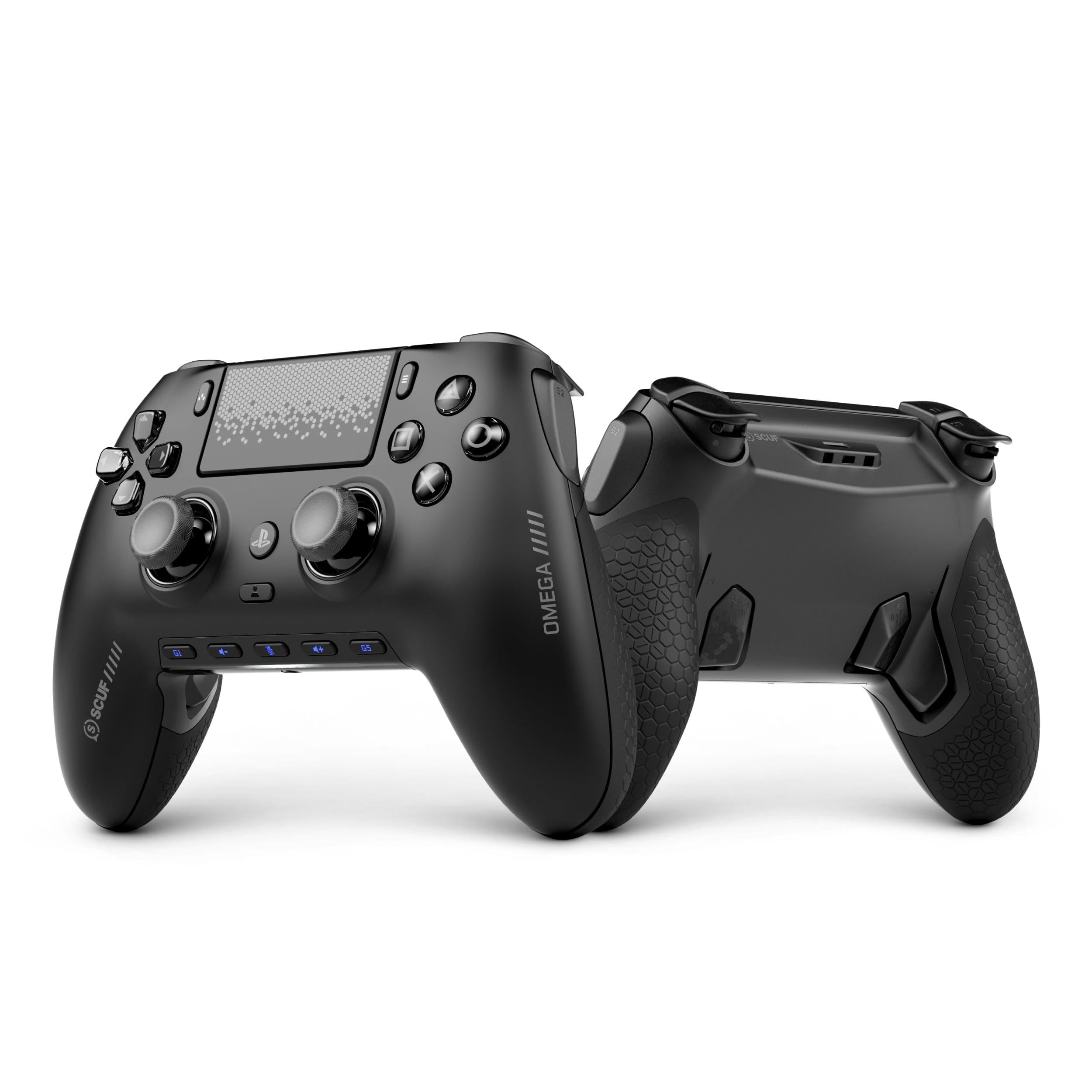
Count the extra inputs on the OMEGA: four rear paddles, two side action buttons, and the G-Keys, which is how SCUF arrives at eleven additions to a standard layout. In a shooter that matters for one reason — every one of them can carry something you currently reach for, so reload, ping, crouch and slide stop costing you a thumb on a stick.

The switches are the other half of the pitch. Omron mechanical switches sit under the triggers, the D-pad and the action buttons, and they click like a mouse rather than mushing like a membrane pad. Instant Triggers cut the pull to almost nothing, and the Endurance TMR sticks are built to hold their accuracy as they wear instead of developing the jitter that starts a drift problem.

We were pleasantly surprised by how much the app handles: response curves for triggers and sticks, action remapping, and three profiles to load before a match. It's the most tunable controller in this set, and the textured shell stays put in your hands through a long session.

The mechanical buttons are the adjustment. A few of them want a firmer press than a DualSense's, and it took us an evening to stop noticing. If you want the most bindings available and don't mind tuning, this is the most capable pad here; if you want the controller to disappear in your hands, the Edge is the easier one to live with.

Pros

  • Eleven extra inputs including four paddles
  • Omron mouse-click switches and instant triggers
  • App curves for triggers and sticks
  • Endurance TMR sticks resist wear

Cons

  • Dongle dropouts; wired is the steadier mode
  • Tuning runs through a phone app
Our verdict

The pick for players who want every bind under a finger: eleven extra inputs, mouse-click switches and app tuning in the most capable pad here.

Check Latest Price
3

Best Modular Design

Victrix Pro BFG Reloaded

79 /100
Lab Score Very Good

Key details

Weight
9.28 oz
Modules
3 customizable, hall-effect
Triggers
5-stop clutch, hair-trigger mode
Back Buttons
4 mappable quick-action
View on Amazon

Five trigger stops, a hair-trigger mode, and a set of modules you can physically swap: the Pro BFG Reloaded is the most configurable controller here, and for a shooter that flexibility is the whole argument. Click the triggers down for a ranked match, then put the long pull back for anything with a car in it.

The modular system is where we think the design earns its keep. Three modules carry hall-effect sticks, so the sensing is magnetic and there's no wearing contact surface inside the stick, and the fightpad module trades the right stick for six Kailh-microswitched buttons — a fighting-game layout rather than a shooter one, and the reason this pad turns up in more than one genre. Eleven components come in the box, and four quick-action buttons sit on the back.

In the hand it's lighter than a stock DualSense at 9.28 ounces, and the back buttons fall where your middle fingers already rest. The five trigger stops give you the widest spread of pull length here, from a full analog squeeze down to a hair trigger.

More moving parts means more setup, and the companion app is the fussy part; expect to spend a session on the first configuration. That's the trade for a pad that changes shape between genres. If you only play shooters, the Edge asks nothing of you and gives you the two controls that matter. If your library is wider than that, this is the one that keeps up.

Pros

  • Five trigger stops with hair-trigger mode
  • Three swappable hall-effect modules
  • Six-button fightpad module included
  • Four mappable rear buttons

Cons

  • Extra buttons can be pressed by accident
Our verdict

Choose this if your library isn't all shooters: three swappable hall-effect modules, five trigger stops and a fightpad option in one controller.

Check Latest Price
4

Best Value Pro Controller

HEXGAMING Rival Pro

81 /100
Lab Score Excellent

Key details

Triggers
Mouse-click triggers and bumpers
In The Box
Controller, 8 thumbsticks, manual
Thumbsticks
Hall effect, 8 swappable, 2 heights, 3 styles
Back Buttons
4 remappable
View on Amazon

Hall-effect sticks, four rear buttons, mouse-click triggers and bumpers: the RIVAL PRO's feature list reads like the flagship pads and its price doesn't. It's also the plainest-looking controller in this set, which for a controller is not a criticism.

We think it's the smart buy for a shooter on a midrange budget. Hall-effect sensors read the stick magnetically, so there's no wiper inside to wear through, and the four rear keys can borrow any of 15 inputs — jump, crouch, slide and reload all at once without a thumb leaving the right stick.

The details are sensible. Eight stick caps across two heights and three shapes let you find a grip, the mouse-click triggers give you the short travel a shooter wants without adding a separate stop, and the whole layout stays where a PlayStation player expects to find it.

Add it up and this is the pad that makes flagship money feel optional: short-travel triggers, hall-effect sticks and four rear buttons are the three things that matter in a shooter, and it has all of them.

Pros

  • Hall-effect sticks at a midrange price
  • Four remappable rear buttons
  • Mouse-click triggers and bumpers
  • Eight swappable caps in two heights

Cons

  • No dock support, and no cable in the box
  • Heavier than a stock DualSense at 330 g
Our verdict

For a midrange budget, this is our shooter pick: hall-effect sticks, four rear buttons and mouse-click triggers for less than the flagships.

Check Latest Price
5

Best Budget

DualSense Wireless Controller

95 /100
Lab Score Outstanding

Key details

Weight
9.88 oz
Feedback
Haptic feedback
Triggers
Adaptive triggers
Connectivity
USB-C or Bluetooth
View on Amazon

The controller already in the box is still the cheapest good answer to this question, and that's worth saying before anyone spends flagship money on hardware they might not use.

What it has is everything Sony built the PS5 around: haptic feedback that changes the texture of what you're touching, adaptive triggers that stiffen under a bowstring or a scope, a built-in mic, a headset jack, and USB-C or Bluetooth for a PC. The textured grip is comfortable over a long session, and there's nothing to configure before you play.

We keep one on the shelf for a reason. It's the pad a friend picks up, it never needs an app or a profile, and it goes in a bag without a case. Nothing about it will make you better at a shooter, and nothing about it will get in your way either.

So it's the honest starting point if you're curious whether paddles change your game: play a month, then decide. Plenty of players never need more than this, and the ones who do will know precisely what they're after.

Pros

  • Adaptive triggers and haptic feedback
  • Comfortable textured grip
  • USB-C or Bluetooth, plus mic and headset jack

Cons

  • Stick drift develops over months of play
  • No back buttons or trigger stops
Our verdict

The right buy if you're not ready to spend on paddles: Sony's haptics, a comfortable grip, and nothing to configure before you play.

Check Latest Price
6

Second Controller

LENISUOLE Wireless Controller

78 /100
Lab Score Very Good

Key details

Audio
3.5mm jack, no built-in mic
Battery
1000 mAh
Connection
Bluetooth 5.3 or USB-C
Back Buttons
Two programmable (P1, P2)
View on Amazon

The cheapest controller here is also the easiest to justify, because it isn't pretending to be a competitive pad: it's a second controller for couch co-op, a spare for a kid's setup, or the one that lives in a bag. Two programmable back buttons and Bluetooth 5.3 are more than that job needs.

The feature list runs further than the price suggests. Turbo fires at ten shots a second, macro recording captures up to 24 inputs, the 1000 mAh cell is generous for a pad this cheap, and the purple shell with lit sticks is genuinely nice to look at, which is more than most budget pads manage.

It isn't the pad for ranked play. The gains a competitive shooter chases — trigger travel you can set, sticks you can tune or replace — come from hardware that lives on the flagship pads, not on this one. As a second controller that's fine; as your only one, the ceiling arrives quickly.

What it does well is the boring stuff, and we'll take boring in a spare: it pairs over Bluetooth without ceremony, plays wired over USB-C when the cell runs down, and the two rear buttons are worth mapping to something simple like sprint or melee. Set the expectation at spare and it earns its place in the drawer.

Pros

  • Two programmable back buttons
  • Bluetooth 5.3 or USB-C wired
  • 1000 mAh battery, turbo and macro

Cons

  • No built-in microphone
  • Lighter, more plasticky build than a DualSense
Our verdict

Buy it as a spare, not as a main: two back buttons, Bluetooth and a big battery for the least money in this set.

Check Latest Price

How We Tested a Dozen PS5 Controllers for FPS Play

We started by pulling together every PS5 controller we could find that was marketed for competitive play or had back paddles, trigger stops, or swappable sticks. From that list, we filtered by price tier, availability, and whether the manufacturer offered a companion app for remapping and sensitivity adjustments. That left us with 12 controllers, which we used as our daily drivers for eight months.

Testing happened where people actually play: living room couches, a desk setup with a monitor, and a couple of long weekend sessions that stretched past midnight. We played ranked matches in shooters, ran movement drills to check stick precision, and tracked how each controller felt after two hours. We noted stick drift by loading a game with a deadzone test and watching whether the reticle moved on its own. Battery life got timed from a full charge to the low-battery warning, and we checked button responsiveness by rapid-firing and holding inputs to see if anything stuck or double-registered.

We also dropped each controller onto a carpeted floor, shoved them into backpacks, and watched the grips and color finishes for wear. Software compatibility got checked on both PS5 and PC, including whether button remapping, profile switching, and stick sensitivity curves actually saved. Value came down to what each controller added—paddles, trigger stops, carrying cases—against what it cost, and we compared that to how it held up over the full eight months. The ones that made the list are the ones we kept reaching for even after the testing period ended.

How to Choose a Ps5 Fps Controller

Back buttons before anything else

Rear buttons are the single biggest change you can buy, because they let you jump, crouch or slide without lifting your right thumb off the stick. Two covers the essentials; four lets you add reload and slide. Reach matters as much as count, since a paddle that sits where your palm rests gets pressed by accident and one you have to stretch for never becomes habit. The DualSense Edge gives two, while the SCUF OMEGA, Victrix Reloaded and RIVAL PRO give four.

Trigger stops and the trade they make

Short trigger travel is the oldest trick in competitive shooters: less distance between your finger and the input means the shot leaves sooner. Mouse-click triggers, hair-trigger modes and adjustable stops all chase the same result, and every performance pad here approaches it differently. The trap is a pad that only does short. A hair trigger is miserable in a racing game, so if your library is mixed, buy adjustable travel rather than a fixed short pull.

Sticks: buy against drift

Drift is what ends a controller's life, and two designs push back. Hall-effect sensors read the stick magnetically and remove the contact surfaces that wear, which is what the Victrix Reloaded, RIVAL PRO and OMEGA use in their own forms. Replaceable modules take the other route, letting you swap the whole stick unit, as on the DualSense Edge. If you keep a pad for years, choose one of those two. Hall effect does not make a stick indestructible; it removes the wear surface.

Wireless is the weakest part of the package

Sony's own wireless link is the one thing third-party makers cannot copy, and the dongles they use instead are where most trouble starts: dropouts and pairing failures are the recurring story on dongle-based pads. That does not rule them out, it just means the serious setup is a USB-C cable at your seat with the dongle reserved for convenience. If you play at a desk, buy assuming wired is your default.

Weight, grip, and where the settings live

The pads here run from about 250 grams to 330, and the difference shows up late in a session: lighter is easier on the wrists, heavier steadies small aim corrections. Grip texture matters more than either. Just as important is where the tuning lives, because a profile you can switch on the controller gets used between matches and a deep app menu does not. Check that before a feature list wins you over.

Frequently Asked Questions

Final Verdict

The DualSense Edge is the controller we recommend for shooters on PS5: two back buttons, adjustable trigger travel and replaceable stick modules, with Sony's haptics and adaptive triggers left intact.

If you want every bind under your fingers and don't mind tuning in an app, the SCUF OMEGA is the more capable machine. And if you're not yet sure paddles will change your game, the standard DualSense is the cheapest way to find out — and the honest answer for a lot of players.