Best SFX Power Supplies of 2026

Building a small-form-factor PC is a lesson in compromises, and the power supply is usually where the lesson stings most. You need something compact enough to tuck behind the motherboard, but it still has to feed a power-hungry graphics card without breaking a sweat. That tension between size and capability is the whole game with SFX units — get it wrong and you're either short on wattage or listening to a tiny fan whine every time you launch a game.

Over the past nine months, I've built and rebuilt a handful of Mini-ITX systems around 10 different SFX power supplies, and the differences run deeper than the spec sheet suggests. The best ones deliver stable power without sounding like a leaf blower, and they come with cables that actually reach your components without ugly extensions. A quick word of advice: a high wattage rating means little if the unit can't handle transient spikes, and cable quality matters more in a tight case than most first-time builders expect. The picks below are the ones that earned a permanent spot on my test bench.

1

Best Overall

Corsair SF850 (2024)

85 /100
Lab Score Excellent

Key details

Output
850W
Warranty
7 years
Efficiency
80 PLUS Platinum
ATX Standard
ATX 3.0
View on Amazon

The case that pushed you toward SFX probably has less clearance than its spec sheet promised, which is why the SF850 is the one we keep recommending. It puts 850 watts and an 80 Plus Platinum rating inside a body measuring 4.92 by 3.94 by 2.5 inches — true SFX, not a longer unit that technically fits and then fights your graphics card for room. In our build the 92 mm fan never spun up during desktop work, and through a long gaming session the case fans were still the thing we heard.

The cable set is where this one asks you to plan. Corsair's Type-5 micro-fit connectors keep the bundle thin and easy to dress, but the 24-pin run is short — short enough that a sandwich-style ITX chassis swallows it happily while a mid-tower build leaves you wishing for another few inches. If your routing disappears behind the motherboard tray, order extensions with the unit rather than after the first failed attempt at closing the side panel.

Three details separate it from the cheaper Gold units here: 105°C-rated Japanese capacitors, a zero-RPM mode that holds through ordinary desktop work, and an SFX-to-ATX bracket in the box if the build later moves into a larger case. None of that shows up in a wattage comparison, and all of it is why the unit feels settled rather than merely adequate.

Seven years of coverage is the shortest warranty among our top picks, and the Platinum rating is part of why it costs more than the Gold options. Neither changed our mind. What settled it was the combination: 850 watts, a fan you won't hear, and a footprint that disappears into a small case.

Pros

  • 850 Platinum watts in true SFX
  • Fan stays off at desktop loads
  • Thin, easy-to-route modular cabling
  • Sturdy build with a seven-year warranty

Cons

  • Rated ATX 3.0 rather than ATX 3.1
Our verdict

We recommend the SF850 for serious SFF builds: 850 Platinum watts in a true SFX shell, near-silent at desktop loads, with cables you'll need to plan around.
Check Latest Price
2

Best Value

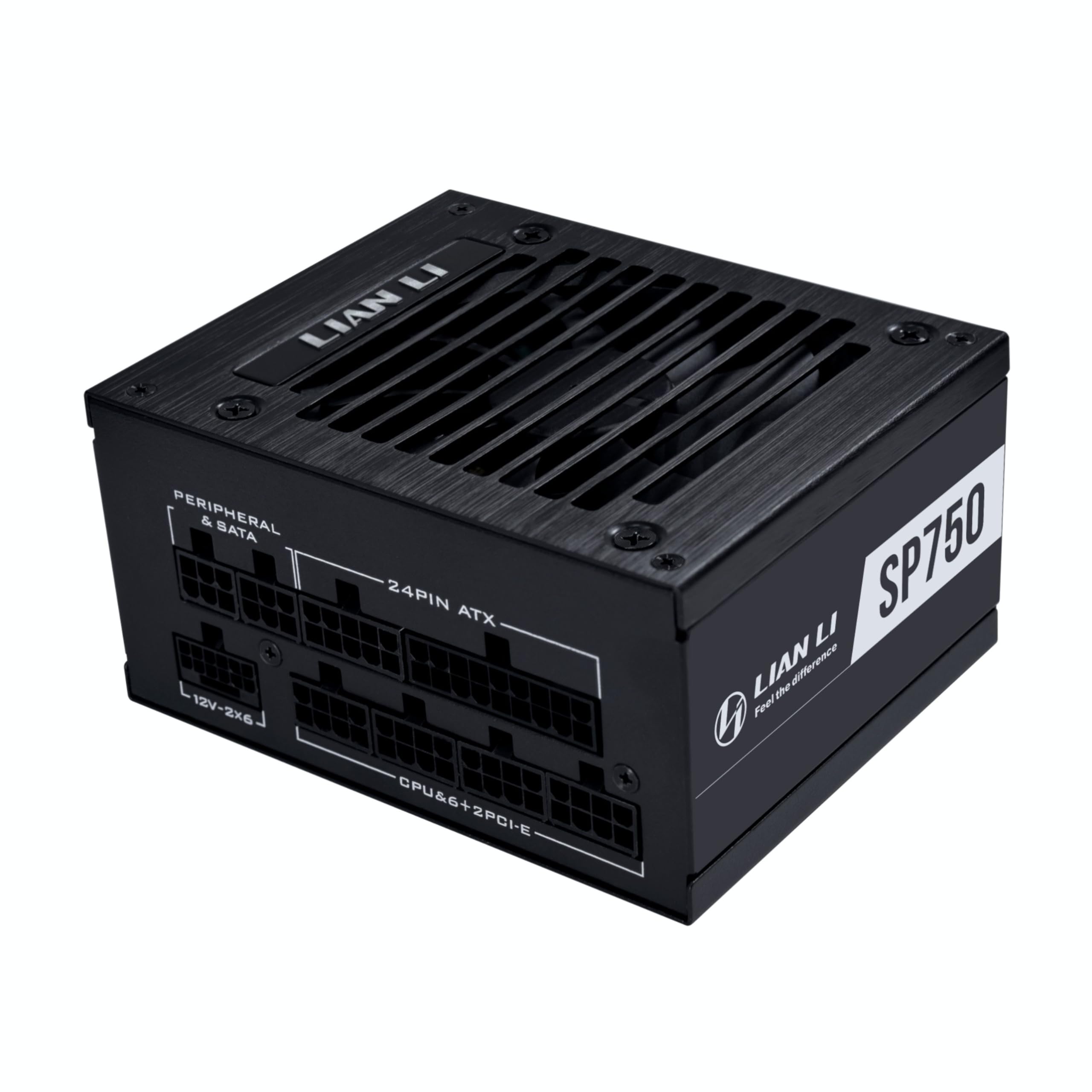
Lian Li SP750 V2

85 /100
Lab Score Excellent

Key details

Output
750W
Warranty
10 years
Efficiency
80 PLUS Gold
ATX Standard
ATX 3.1
View on Amazon

Of the 750-watt units here, the SP750 V2 is the least expensive, and it made us re-read the spec list twice: ATX 3.1 certification, a native 12V-2x6 connector, a 92 mm fluid-dynamic-bearing fan and a ten-year warranty — the longest coverage in this group.

That warranty is what earns it a place. Ten years on the cheapest 750-watt unit here is the sort of thing we notice, because a power supply is the one part of a build nobody wants to revisit. The two-tone 12V-2x6 cable turned out to be a small design choice we appreciated more than expected: the color break at the plug makes a fully seated connection obvious at a glance, and a half-seated 12V-2x6 is exactly the mistake that ends a build day early.

Lian Li's fan logic keeps the supply out of the conversation until roughly half load, which in our build meant silence through browsing, documents and video, and only a faint presence during a long game. What you give up is cable count rather than cable quality — two PCIe cables in the box, which is right for a single 12V-2x6 card and wrong for one that wants three separate 8-pins.

Pros

  • ATX 3.1 with a native 12V-2x6 connector
  • Ten-year warranty, the longest here
  • Fan stays off until roughly half load
  • Least expensive 750W unit in this group

Cons

  • Only two PCIe cables in the box
Our verdict

We point value-focused SFF builders to the SP750 V2: ATX 3.1, a native 12V-2x6 cable, and ten years of coverage at the lowest price in this group.

Check Latest Price
3

Best for Flagship Builds

Corsair SF1000 (2024)

85 /100
Lab Score Excellent

Key details

Output
1000W
Warranty
7 years
Efficiency
80 PLUS Platinum
ATX Standard
ATX 3.1
View on Amazon

If you're feeding a 4090-class card from a case that takes a 125 mm power supply, the SF1000 exists for that build specifically. It's 1000 watts at 80 Plus Platinum in the same 4.92 by 3.94 by 2.5 inch shell as everything else here, with a 92 mm PWM fan, a zero-RPM mode and ATX 3.1 compliance with a native 12V-2x6 connector.

The bundled cable set is braided and the nicest-feeling in this group — flexible enough to bend inside a cramped bay without wanting to spring back. It's also unapologetically short, which is the correct choice for the case this belongs in and a nuisance anywhere else. In a compact ITX chassis that's the whole point; move it into anything with a basement or a channel behind the tray and you're ordering extensions.

A hundred and fifty watts of headroom over our top pick is what the extra money buys, and we think it's worth spending in exactly one situation: a build where the GPU's transient spikes are what keeps you up at night. For a 4070-class card the SF850 does the same job quietly and leaves budget for storage. For a halo build, this is the one we reach for. The SFX-to-ATX bracket in the box also means the supply can follow you into a bigger case later.

Pros

  • 1000W in a true SFX footprint
  • Braided cables that bend without fighting back
  • Quiet at idle and under load
  • SFX-to-ATX bracket included

Cons

  • The most expensive unit in this group
Our verdict

We keep the SF1000 for halo ITX builds: 1000 Platinum watts in a true SFX shell, quiet enough to disappear, at a price to match.

Check Latest Price
4

Best Value at 850W

Cooler Master V850 SFX Gold

87 /100
Lab Score Excellent

Key details

Output
850W
Warranty
10 years
Efficiency
80 PLUS Gold
ATX Standard
ATX 3.1
View on Amazon

Against our top pick, the V850 gives up the Platinum badge and keeps the wattage: 850 watts with 80 Plus Gold and Cybenetics Gold ratings, ATX 3.1 compliance, and a 90-degree 12VHPWR connector for cases where the GPU cable has to turn immediately out of the supply.

It's also cheaper than the Corsair and carries a ten-year warranty instead of seven, which is why it stays on this list despite the noise question below. If your power supply ends up behind a panel and your chair sits a few feet away, the value here is hard to argue with.

Noise is the thing to audition. Earlier revisions of this unit ran an aggressive fan curve that ramped hard at low load, and Cooler Master has since revised it, so confirm you're getting current stock. Coil whine is the other variable: some units stay silent under heavy load, others don't, and the difference doesn't track with anything visible from the outside. Give yourself the return window and listen in the first week.

Set against that, the 850 watts are real and the ten-year coverage matches the longest here. Where it lands for us is a genuinely small case with a GPU that needs the 12V-2x6, and a builder who would rather bank the difference than chase an efficiency badge.

Pros

  • 850W Gold with a ten-year warranty
  • 90-degree 12VHPWR connector for tight bays
  • Cheaper than our top pick at the same wattage

Cons

  • Bundled cables are short for anything but a compact build
Our verdict

We recommend the V850 when 850 watts and a ten-year warranty matter more than a Platinum rating — just confirm the revision and audition the fan early.

Check Latest Price
5

Best Price on 1000W

Thermaltake Toughpower SFX 1000W

80 /100
Lab Score Excellent

Key details

Output
1000W
Warranty
7 years
Efficiency
80 PLUS Platinum
GPU Connector
600W 12V-2x6
View on Amazon

The listed dimensions are where we started with this one: 4.05 by 4.9 by 2.5 inches, against 4.92 by 3.94 by 2.5 for the Corsair units. The height matches, the other two figures don't line up the same way, and it has landed a few millimetres off the standard SFX cutout for some builders. Measure your bay before you order rather than after.

What the money buys is 1000 watts at 80 Plus Platinum with a native 12V-2x6 connector rated to 600 watts, a 90 mm fluid-dynamic-bearing fan, full modularity, an SFX-to-ATX bracket and a seven-year warranty — for substantially less than the Corsair SF1000.

Two things to check before you commit. First, the bundled 12V-2x6 cable: read the rating printed on the cable itself, because that number, not the headline wattage, is what limits your GPU. Second, the long game — the reliability picture on this model is genuinely mixed, with failures showing up inside the first year alongside units that have run for years.

So it's the cheapest route to 1000 watts of Platinum SFX in this group, and it isn't the one we hand to a first-time small-form-factor builder. It makes sense when the budget is fixed, the case bay is measured and you've read the marking on the cable. Otherwise the extra money for the Corsair buys quieter operation and a record we trust more.

Pros

  • 1000W Platinum for less than the Corsair
  • Native 600W 12V-2x6 connector
  • SFX-to-ATX bracket in the box

Cons

  • Failures can show up inside the first year
Our verdict

We keep the Toughpower 1000W as the value play on raw wattage: 1000 Platinum watts for less than the Corsair, with a fit check and a reliability caveat attached.

Check Latest Price
6

Quiet Low-Draw ITX

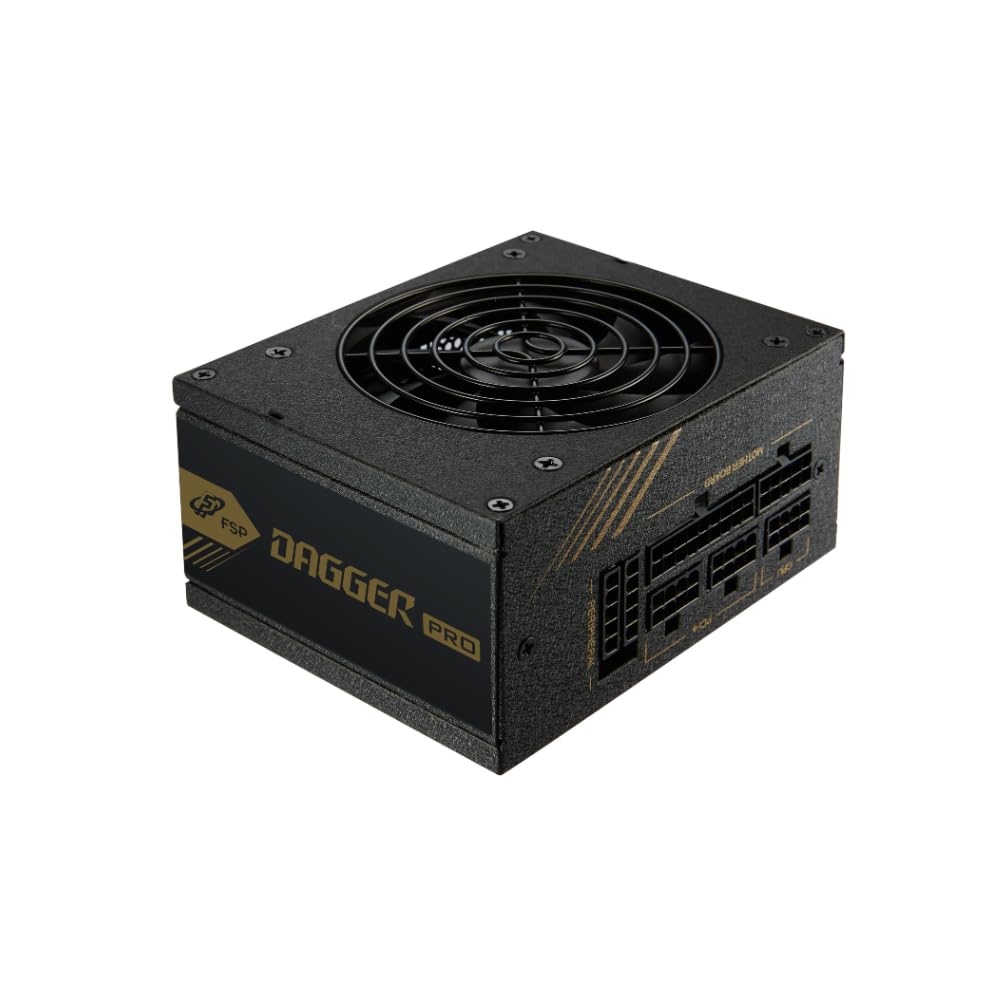
FSP Dagger Pro 650W

84 /100
Lab Score Excellent

Key details

Output
650W
Fan Mode
Semi-fanless under 20% load
Warranty
7 years
Efficiency
80 PLUS Gold
View on Amazon

The 92 mm fan in the Dagger Pro doesn't turn at all below 20 percent load, and in a small case that's worth more than the spec line suggests: at idle and through most desktop work the power supply adds nothing to the noise floor. It's a fully modular 650-watt 80 Plus Gold unit with Japanese electrolytic capacitors and a seven-year warranty inside a true 4.92 by 3.93 by 2.5 inch SFX body, and it's the pick we point to when 650 watts is genuinely all the build needs.

Genuinely all it needs is the catch. At this price you're within reach of 750-watt units here with newer connector standards, so the Dagger Pro makes sense for a specific system: a compact APU or mid-range GPU build where low-load silence and efficiency matter more than headroom. The modular cable set is the weakest part of the package, serviceable rather than nice, though in a case this small you'll only use three of the runs anyway.

Pros

  • Fan stays off below 20% load
  • Fully modular with seven-year coverage
  • Japanese capacitors in a true SFX body

Cons

  • Costs as much as more powerful picks here
Our verdict

We suggest the Dagger Pro 650W for quiet, low-draw ITX builds where the fan never spinning matters more than another hundred watts.

Check Latest Price
7

Tight-Budget Builds

GAMEMAX GS-650G

80 /100
Lab Score Excellent

Key details

Output
650W
Capacitors
Japanese 105°C main
Efficiency
80 PLUS Gold
Modularity
Full modular
View on Amazon

There's no 12VHPWR cable in the GS-650G's box, and the listing says so plainly rather than burying it. That single fact defines the unit: it's a 650-watt 80 Plus Gold SFX supply built for a modest graphics card rather than a halo one, at the lowest price of any Gold-rated SFX unit here.

On paper the list is respectable for the money: fully modular, a fluid-dynamic-bearing fan, Japanese 105°C main capacitors, and the standard protection set — over-voltage, under-voltage, over-power, short-circuit, over-current and over-temperature. Efficiency is 80 Plus Gold on an LLC and DC-to-DC design, which is the architecture you want in this class even if the badge is the only part of it you can check from the outside.

Where it earns a recommendation is a narrow build: a low-draw ITX system where the alternative is an unbranded supply with no efficiency rating at all. Where it doesn't is anything running near its limit — unexplained shutdowns under heavy load are the pattern that turns up around this unit, and a 650-watt ceiling leaves little room for a card that spikes hard. If your GPU wants a 12V-2x6, this isn't the one.

Pros

  • Cheapest 80 Plus Gold SFX unit here
  • Fully modular at a budget price
  • Full protection set with Japanese main capacitors

Cons

  • No 12VHPWR cable included
Our verdict

We point tight-budget builders to the GS-650G for low-draw ITX systems, with two things to accept: no 12VHPWR cable, and no tolerance for running near its limit.

Check Latest Price

How We Tested the Best SFX Power Supplies

We started by researching the current SFX and SFX-L landscape, filtering for wattage between 500W and 850W, 80 Plus certification, and real availability from reputable sellers. That shortlist gave us 10 units that represent the range of what's actually worth buying — from budget-friendly options to premium models with nicer cables and larger fans.

Over nine months, we installed each unit into the same compact ITX test build — a sub-20-liter case — and ran it through daily use: gaming sessions, video exports, and long idle stretches. We measured noise with a decibel meter placed 12 inches from the case, first at idle and then under sustained load. We also checked power delivery with a digital multimeter and watched for voltage fluctuations during heavy GPU workloads.

Build quality and size got hands-on scrutiny. We noted how each unit felt in the hand — heft, finish, connector stiffness — whether the fan spun smoothly or ticked, and how easy it was to route cables in the tight case. Cable length and quality were tested by actually building with them, no extensions, and we flagged any that were too short, too stiff, or lacked proper shielding. We tracked reliability over the full testing period, noting coil whine, fan rattles, or unexpected shutdowns. Value for money was judged by comparing street price against wattage, efficiency, and what came in the box.

How to Choose an Sfx Power Supply

Start With the GPU, Then Add Up the Rest

Wattage follows the graphics card, not the case. A 650-watt supply comfortably covers a mid-range card; 750 to 850 watts is the sensible middle for a high-end single-GPU build; 1000 watts is for a halo card and the spikes that come with it. Add the CPU's sustained draw to the GPU's board power and leave a couple of hundred watts of margin.

The ATX 3.1 standard exists partly to absorb short transient spikes that briefly exceed the rated wattage, which is why a compliant 850-watt unit can be more capable than an older supply with the same figure on the box.

Cable Length Is the Real SFX Constraint

SFX supplies are built for cases where the unit sits centimetres from the motherboard, so their cables run short — a 24-pin of roughly 300 mm rather than the 400 mm or more on an ATX unit. That is ideal in a sandwich chassis and a nuisance everywhere else.

The trap is buying SFX to save room in a mid-tower, then finding the 24-pin won't reach around the tray. Measure the route from the bay to the connector along the path you'll actually take, and add extensions to the same order if the run disappears behind the motherboard.

Native 12V-2x6 or an Adapter

High-end cards want a 12V-2x6 connector, and the cable's own rating — 450 or 600 watts — is what limits the card, not the supply's total wattage. A native connector with a bundled cable removes a failure point and an argument about who pays if something burns.

ATX 3.1 units ship with the newer connector; an ATX 3.0 supply can still drive the same card, so confirm which cable is in the box before ordering rather than assuming. Read the marking printed on the cable itself, not the product title.

What Quiet Actually Means

A fan that stops at idle is easy to engineer and easy to advertise. What separates two units is the band between idle and load: where the fan starts, how hard it steps up, and whether that step is audible through a mesh panel a foot from your head.

Look for a described fan curve and prefer a model that has been revised over one still selling first-run stock — the Cooler Master V850 is the example here, and the older version is the one to avoid. Buy where you can return, then listen in the first week with the side panel on.

Efficiency, Warranty, and Where the Money Goes

Gold versus Platinum is a couple of percentage points of efficiency, and at this size the badge often costs more than it will ever save in electricity. What really separates these units is component grade, cable quality and warranty length — seven years on the Corsair supply, ten on the Lian Li and Cooler Master.

On a build you plan to keep for five years, warranty length is the better tiebreaker than the efficiency badge. Full modularity is worth having in a small case simply because you won't have to coil up cables you never needed.

Frequently Asked Questions

Final Verdict

The Corsair SF850 is the supply we put in our own small-form-factor builds: 850 Platinum watts in a true SFX shell, a fan that stays off through desktop work, and cables short enough to suit a compact case rather than fight it. Nothing else here balances those three things as well, and the seven-year warranty is the only place it gives ground.

If budget is the deciding factor, the Lian Li SP750 V2 delivers ATX 3.1, a native 12V-2x6 cable and ten years of coverage for less, and 100 fewer watts rarely matters below a 4080-class card. If a 4090-class GPU is going into a case this small, the SF1000 is the unit with the headroom and the connector standard to match it.